July 15, 2026
Strategic Capital Deployment Framework in South American Mining
Global copper markets stand at a critical juncture as traditional supply centres face mounting operational challenges and regulatory uncertainties. The dynamics driving large-scale capital allocation decisions in mining have fundamentally shifted, with companies now prioritising long-term supply security over short-term cost optimisation. This transformation reflects broader structural changes in how the industry evaluates project economics, geopolitical risk, and technological integration. The First Quantum Minerals Argentina copper mine development exemplifies this strategic evolution in large-scale mining investment.
Within this evolving landscape, project selection criteria have expanded beyond conventional metrics to encompass factors such as renewable energy access, regulatory stability, and alignment with global decarbonisation trends. Furthermore, copper‑uranium investment opportunities are increasingly viewed through a portfolio risk management lens. Mining companies are seeking geographic diversification and operational resilience rather than purely maximising individual project returns.
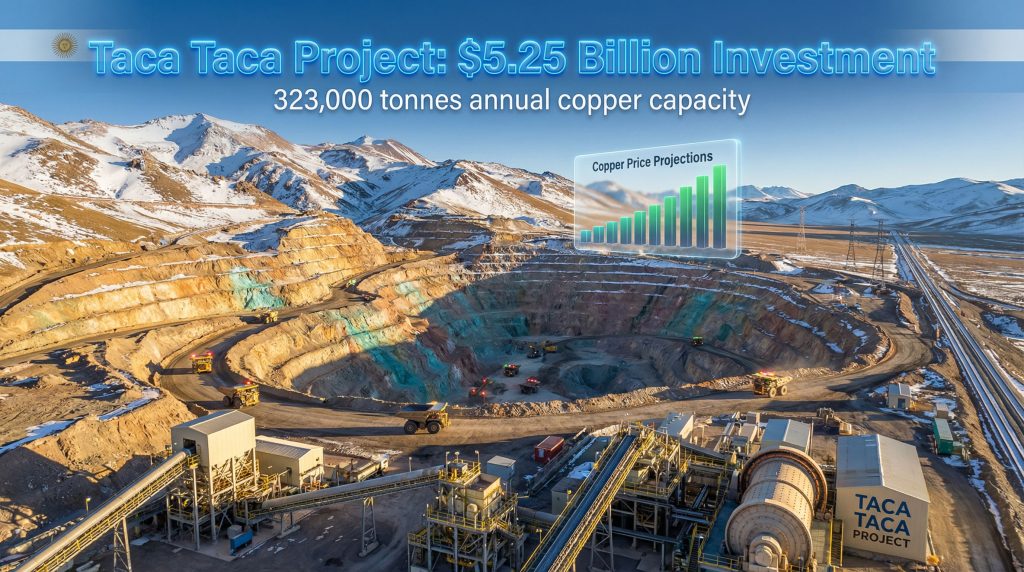
First Quantum Minerals' $5.25 billion commitment to the Taca Taca project represents this strategic evolution in action. The investment comprises an initial $4.23 billion for base-case development and an additional $1.02 billion for expansion capacity, positioning the project among the most substantial copper development commitments in recent mining history.
When big ASX news breaks, our subscribers know first
Production Scale Analysis and Global Market Positioning
The Taca Taca development employs a phased production approach designed to optimise capital efficiency while maximising long-term output potential. Initial processing capacity targets 40 million tonnes annually, expanding to 60 million tonnes by the fifth operational year. This staged methodology allows for operational refinement and market timing flexibility.
Production Profile Overview:
| Metric | First Decade | Peak Production | Life-of-Mine Average |
|---|---|---|---|
| Copper Output | 291,000 t/y | 323,000 t/y | 209,000 t/y |
| Gold Production | 133,000 oz/y | 171,000 oz/y | 96,000 oz/y |
| Molybdenum Output | ~3,000 t/y | Not specified | ~3,000 t/y |
The deposit's 1.99 billion tonnes of proven and probable reserves at 0.42% copper grade and 0.09 g/t gold grade support a 35-year mine life. According to updated technical reports, these reserves represent a 13% increase in combined proven and probable categories compared to previous assessments, alongside a 9% increase in contained copper and gold content.
Processing technology replicates First Quantum's established semi-autogenous grinding mill systems, successfully deployed at Sentinel and Kansanshi operations in Zambia. Consequently, this technological consistency reduces execution risk while enabling knowledge transfer and operational best practices implementation across the company's global portfolio.
The project's annual copper output of over 200,000 tonnes would position the First Quantum Minerals Argentina copper mine among the world's top 50 copper mines by production volume. Peak production capacity exceeding 320,000 tonnes annually places it in the top quartile of global copper producers, with meaningful impact on regional and international supply dynamics.
Multi-Commodity Revenue Streams and Portfolio Optimization
Beyond primary copper production, Taca Taca incorporates substantial precious metals and specialty metals output that enhances project economics and reduces commodity price volatility exposure. In addition, gold market resurgence trends support the project's multi-metal approach. Gold production averaging 133,000 ounces annually during the first decade provides significant revenue diversification, particularly valuable during copper price downturns.
Revenue Diversification Strategy:
- Primary Revenue Stream: Copper production representing approximately 70-75% of total revenue at base case commodity prices
- Secondary Stream: Gold contributing 20-25% of revenue, providing price volatility hedge
- Specialty Metals: Molybdenum output adding 3-5% revenue contribution with industrial demand exposure
The molybdenum component, estimated at 3,000 tonnes annually over the mine life, aligns with global steel industry demand trends and renewable energy infrastructure requirements. Molybdenum's role in high-strength steel alloys and wind turbine components positions this revenue stream favourably within the global energy transition framework.
Gold production peaking at 171,000 ounces annually during optimal mining phases provides substantial cash flow generation capability. At current gold price levels, this output represents approximately $500 million annually in gross revenue at peak production, demonstrating the project's multi-metal value proposition.
Argentina's RIGI Framework and Investment Incentive Structure
Argentina's Incentive Regime for Large Investments (RIGI) creates a transformative regulatory environment for major mining developments, addressing historical concerns about fiscal stability and operational predictability. The framework targets projects exceeding specific investment thresholds with comprehensive incentive packages designed to attract long-term foreign direct investment.
RIGI Framework Benefits Analysis:
- Fiscal Stability: Long-term tax rate guarantees protecting against adverse legislative changes
- Foreign Exchange Access: Preferential currency conversion and repatriation provisions
- Import Duty Relief: Equipment and machinery import exemptions reducing capital costs
- Accelerated Depreciation: Enhanced tax depreciation schedules improving cash flow timing
- Regulatory Certainty: Streamlined permitting processes with defined timelines
The RIGI application deadline of July 2027 creates urgency around project advancement and regulatory compliance. First Quantum's Environmental and Social Impact Assessment (ESIA) completion target of first half 2026 aligns with this timeline, enabling RIGI application submission within the required window.
Historical precedent suggests RIGI-qualified projects benefit from enhanced political and institutional support, reducing regulatory risk and improving operational predictability. However, the framework's relatively recent implementation means limited operational track record exists for large-scale mining applications.
Project Timeline Critical Path:
- ESIA Completion: First half 2026
- RIGI Application Submission: Before July 2027 deadline
- Material Spending Commencement: 2028 earliest
- First Production Target: Early 2030s
Financial Engineering and Return Profile Analysis
At base case commodity assumptions of $4.50/lb copper, $3,000/oz gold, and $18/lb molybdenum, the First Quantum Minerals Argentina copper mine delivers compelling financial returns that justify the substantial capital commitment. The project's after-tax net present value of $5.92 billion at an 8% discount rate significantly exceeds the $5.25 billion total development cost.
Base Case Financial Metrics:
| Metric | Value | Significance |
|---|---|---|
| After-tax NPV (8%) | $5.92 billion | 1.13x capital multiple |
| Internal Rate of Return | 19.3% | Premium to mining industry average |
| Payback Period | 9 years | Reasonable for large-scale mining |
| Capital Intensity | $13,545/t annual Cu equivalent | Competitive with peer projects |
The project demonstrates significant leverage to copper price movements, with every 10% copper price change translating to $1.47 billion or 25% NPV swing. This sensitivity profile reflects the project's substantial production scale and cost structure positioning.
Operating cost projections position Taca Taca favourably within the global copper cost curve. First decade C1 cash costs of $0.97/lb and life-of-mine average costs of $1.26/lb place the project in the lower quartile of global production costs. All-in sustaining costs estimated at $1.60/lb remain competitive with established operations while incorporating modern environmental and social standards.
Geographic and Infrastructure Strategic Positioning
Taca Taca's location in Salta province, Argentina, approximately 55 kilometres from the Chilean border at 3,500 metres elevation, provides strategic advantages for regional market access and operational logistics. The proximity to Chilean infrastructure enables integration with established Pacific shipping routes and electrical grid systems.
Infrastructure Development Framework:
- Power Connection: 122.5-kilometre transmission line to 345kV Argentina-Chile electrical system
- Renewable Energy Access: 100% renewable energy supply potential through grid integration
- Transport Infrastructure: 5-kilometre railway spur connection enabling Pacific shipping access
- Cross-Border Integration: Leveraging Salta-Mejillones railway corridor for export logistics
The high-altitude operational environment presents both challenges and opportunities. While elevation increases infrastructure costs and operational complexity, the location provides access to substantial renewable energy resources, particularly solar and wind power generation. This renewable energy access supports the project's commitment to delivering lower carbon intensity operations compared to existing mining standards.
Regional employment generation includes 4,000 direct positions during construction and 2,000 permanent operational roles. Economic multiplier effects extend throughout Salta province, supporting local service industries and infrastructure development initiatives. Moreover, evolution trends in mining emphasise the importance of local economic development in project sustainability.
The next major ASX story will hit our subscribers first
Technology Integration and Operational Excellence Replication
The processing design mirrors First Quantum's proven large-scale semi-autogenous grinding mill model successfully deployed at Sentinel and Kansanshi mines in Zambia. This technology replication reduces execution risk while enabling operational knowledge transfer across the company's global mining portfolio.
Technological Framework Implementation:
- Processing Architecture: Conventional open-pit mining with SAG mill systems
- Staged Expansion Capability: Infrastructure designed for 40-60 million tonne capacity scaling
- Automation Integration: Advanced process control systems and predictive maintenance frameworks
- Environmental Technology: Electric haulage systems and emissions reduction initiatives
The staged expansion methodology allows operational optimisation during initial phases, incorporating lessons learned and technological improvements before capacity expansion. Furthermore, data‑driven operations are becoming increasingly important for modern mining projects. This approach has proven successful at other First Quantum operations, reducing capital risk while maximising long-term production potential.
Innovation opportunities include implementation of next-generation mining technologies such as autonomous haulage systems, real-time ore grade monitoring, and integrated mine planning optimisation. The project's substantial scale justifies advanced technology investment that may not be economically viable at smaller operations.
Risk Assessment and Strategic Portfolio Integration
Following the November 2023 closure of Cobre Panama operations, the First Quantum Minerals Argentina copper mine represents First Quantum's primary growth platform for replacing lost production capacity and achieving long-term strategic objectives. The project's 35-year mine life provides substantial operational visibility and cash flow generation potential.
Strategic Risk Mitigation Elements:
- Geographic Diversification: Reducing exposure to Central American political and regulatory risks
- Production Scale: Large-scale operations providing operational leverage and cost advantages
- Technology Proven: Replicating successful processing systems reducing execution risk
- Multi-Metal Revenue: Diversified commodity exposure reducing price volatility impact
Geological risk assessment indicates mineralisation remains open at depth and along southern and eastern deposit margins, suggesting potential for future resource expansion beyond current reserve estimates. This exploration upside provides additional long-term value creation opportunities.
Operational risk management incorporates lessons learned from global mining operations, including comprehensive community engagement programmes, environmental monitoring systems, and integrated safety management frameworks. However, mining industry consolidation trends may influence the competitive landscape. The company's track record in challenging operating environments supports successful project execution capabilities.
Global Copper Market Impact and Supply Chain Integration
The First Quantum Minerals Argentina copper mine's annual production of over 200,000 tonnes of copper represents approximately 1% of current global copper production, with meaningful impact on supply-demand dynamics as the project reaches full production in the early 2030s. This timing aligns with projected copper demand growth driven by global electrification and renewable energy infrastructure development.
The project's integration with trans-Andean infrastructure systems enables efficient access to Asian markets through Chilean Pacific ports, positioning output strategically within global copper trade flows. Regional supply chain integration opportunities include processing optimisation and logistics coordination with other South American copper producers.
Market Positioning Analysis:
- Supply Security: Long-term production visibility supporting strategic customer relationships
- Cost Competitiveness: Lower quartile operating costs enhancing market share sustainability
- Quality Standards: High-grade concentrate production meeting premium market specifications
- ESG Compliance: Environmental and social standards alignment with modern procurement requirements
The project's substantial molybdenum and gold by-product streams provide additional market diversification benefits, reducing dependence on copper price cycles while capturing value from specialty metals demand growth.
Investment Consideration: This analysis is based on publicly available information and company projections. Commodity markets involve significant price volatility and operational risks that may materially impact project economics. Investors should conduct independent due diligence and consider professional advice before making investment decisions.
Ready to Capitalise on Major Mineral Discoveries?
Discovery Alert instantly alerts investors to significant ASX mineral discoveries using its proprietary Discovery IQ model, turning complex mineral data into actionable insights. Begin your 14-day free trial today to position yourself ahead of the market and gain the competitive edge needed in today's dynamic mining investment landscape.