July 13, 2026
Strategic chokepoint vulnerabilities represent one of the most underappreciated risks in global commodity markets. While analysts focus on supply fundamentals and demand projections, the maritime corridors that facilitate trillion-dollar energy flows operate on razor-thin margins of safety. When these critical passages face disruption, the cascading effects reveal the fragile interdependencies that underpin modern industrial civilization. Furthermore, recent incidents where two oil product tankers turn away from hormuz strait demonstrate how quickly normal commercial operations can collapse under geopolitical pressure.
Understanding Maritime Chokepoint Economics
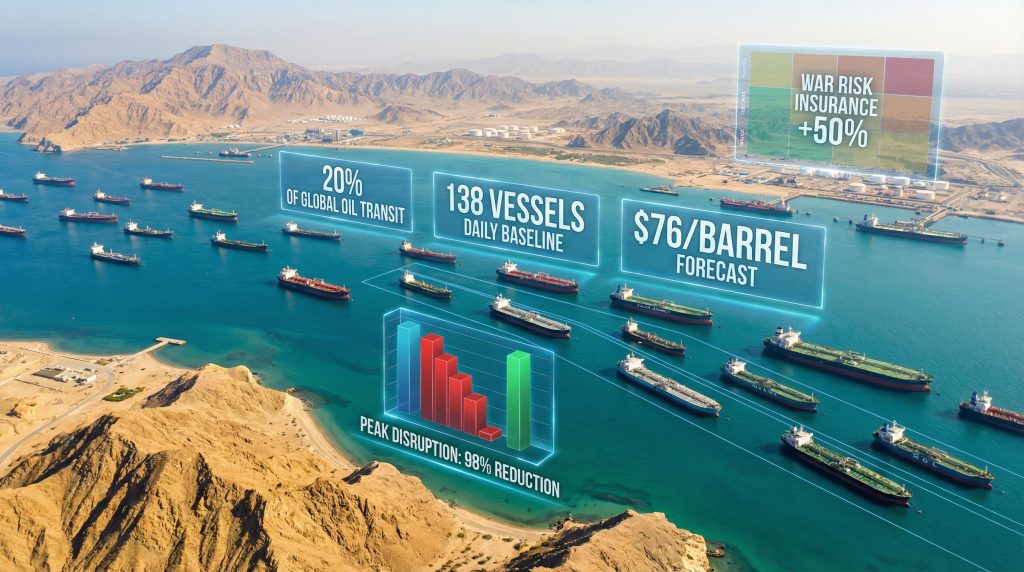
Critical shipping lanes function as bottlenecks in the global energy supply chain, with the Strait of Hormuz representing the most strategically significant passage. This narrow waterway facilitates approximately 20-21% of globally traded petroleum, according to the U.S. Energy Information Administration's analysis of world oil transit chokepoints. The economic multiplier effects extend far beyond crude oil, encompassing refined products that feed directly into industrial supply chains.
The Anatomy of Disruption Cascades
When maritime chokepoints face operational constraints, the impact ripples through multiple market layers simultaneously. Recent operational data demonstrates how quickly normal commerce can collapse under geopolitical pressure. Moreover, the oil price rally that typically follows such disruptions reflects both physical supply constraints and market psychology.
- Day 1 disruption: 50 tankers successfully transit
- Day 3 disruption: 3 tankers manage passage
- Day 5 disruption: Zero tanker transits recorded
- Overall vessel traffic: 98% reduction from baseline 138 daily vessels
This progression illustrates how shipping companies implement increasingly conservative risk management protocols as threats escalate. The decision-making framework involves complex calculations weighing operational costs against potential vessel losses, crew safety, and insurance coverage availability.
Product-Specific Vulnerability Mapping
Different refined products exhibit varying degrees of supply chain resilience during chokepoint disruptions. Jet fuel markets demonstrate particular fragility, with Europe depending on Middle East Gulf exports for approximately 50% of jet fuel imports, representing 15-20% of total European demand. When transit routes face closure, replacement sourcing from Asia-Pacific regions encounters the dual challenge of elevated regional prices and increased freight costs.
The vulnerability hierarchy follows this pattern:
- Jet fuel: Highest premium volatility, limited alternative sourcing
- Diesel: Moderate disruption impact, multiple supply alternatives exist
- Naphtha: Petrochemical feedstock constraints emerge rapidly
- LPG: Storage limitations amplify short-term supply pressures
When big ASX news breaks, our subscribers know first
Modern Tanker Fleet Operations Under Stress
Long Range (LR) tankers represent the workhorses of refined product transportation, with cargo capacities ranging from 75,000 to 85,000 deadweight tonnage. During crisis periods, these vessels become strategic assets subject to complex operational decisions that extend beyond normal commercial considerations.
Decision Matrix Implementation
Recent operational patterns reveal how shipping companies deploy decision matrices when facing elevated risk scenarios. Two oil product tankers have turned away from the Strait of Hormuz as shipping companies implement crisis response protocols. Clear Stars and DF Montmartre demonstrated typical crisis response by maintaining positions outside the strait for approximately four days before implementing diversion procedures. The vessels had been anchored off Fujairah since March 1st, awaiting loading slots for European-destined cargoes.
The decision to abandon European routes while maintaining Pakistan-destined operations suggests sophisticated risk assessment frameworks that consider:
- Geographic proximity calculations: Shorter routes present reduced exposure windows
- Destination market analysis: Regional risk variations influence route selection
- Contract penalty structures: Financial implications of cargo abandonment
- Alternative sourcing availability: Backup supply options for specific markets
Insurance Market Dynamics
War risk insurance represents the critical enabler for high-risk maritime operations. However, during acute crisis periods, insurance markets can experience complete functionality breakdown rather than simple premium escalation. Recent experience demonstrates how insurers cancelled war risk coverage entirely due to concerns about reinsurer withdrawal, effectively paralyzing commercial shipping operations regardless of operator risk tolerance.
This insurance market failure creates operational gridlock because:
- Vessel financing requirements mandate continuous insurance coverage
- Port authorities refuse entry to uninsured vessels
- Charter party contracts include insurance coverage clauses
- Cargo owners require vessel insurance for shipment acceptance
Risk Assessment Frameworks for Maritime Operations
Maritime security intelligence has evolved into a sophisticated ecosystem combining multiple data streams and analytical frameworks. The Joint Maritime Information Center (JMIC) represents the operational nerve center for threat assessment, providing real-time guidance that shapes commercial shipping decisions across global trade routes.
Intelligence Integration Systems
Modern maritime risk assessment relies on layered intelligence gathering that combines:
Vessel Tracking Technologies:
- Vortexa tracking systems for cargo flow analysis
- Kpler positioning data for fleet management
- Automatic Identification System monitoring
- Satellite imagery surveillance capabilities
Threat Assessment Metrics:
- Attack incident documentation and pattern analysis
- Navigation system integrity monitoring
- Port operational status verification
- Insurance market availability tracking
Navigation System Vulnerabilities
Recent developments highlight emerging technological threats to maritime operations. Significant Global Navigation Satellite System jamming throughout the Strait of Hormuz, Gulf of Oman, and Arabian Gulf creates additional operational hazards beyond direct physical threats.
The observed impacts include:
- Positional offset errors affecting navigation accuracy
- Automatic Identification System anomalies disrupting traffic management
- Intermittent signal degradation compromising backup navigation systems
- Communication system interference limiting coordination capabilities
These technological disruptions force vessels to rely on traditional navigation methods while operating in high-threat environments, significantly increasing operational complexity and risk exposure.
Energy Market Price Transmission Mechanisms
Geopolitical tensions translate into market volatility through well-established price transmission channels that operate across multiple timeframes and geographic regions. The speed and magnitude of price adjustments reflect both physical supply constraints and psychological market responses to uncertainty. Consequently, OPEC market influence becomes particularly significant during such disruptions.
Immediate Market Response Patterns
Jet fuel markets demonstrated extreme volatility during recent disruptions, with premium calculations reaching unprecedented levels:
| Market Metric | Normal Operations | Peak Disruption | Percentage Change |
|---|---|---|---|
| Jet fuel premium to crude | $20-30/barrel | $70-100/barrel | 250-400% increase |
| Daily tanker transits | 138 vessels | 0-3 vessels | 98% reduction |
| War risk insurance availability | Standard coverage | Market cancellation | Complete unavailability |
| Alternative route economics | Viable arbitrage | Cost-prohibitive | Negative arbitrage |
Regional Price Differential Analysis
Supply disruptions create immediate arbitrage opportunities that quickly self-correct as market participants compete for limited alternative supplies. European markets, facing reduced Middle Eastern imports, attempted to source replacements from Asian suppliers, only to discover that regional prices had increased simultaneously alongside freight cost escalation. Additionally, trade war effects on oil markets compound these challenges by creating additional uncertainty layers.
This dynamic illustrates how global commodity markets have evolved beyond simple regional supply-demand balances. Modern pricing mechanisms incorporate:
- Cross-regional demand competition for alternative supplies
- Freight rate volatility affecting delivered cost calculations
- Storage capacity constraints limiting inventory building strategies
- Forward contract obligations creating inflexible demand requirements
Strategic Response Patterns in Crisis Management
Corporate and government crisis response follows predictable patterns that reflect institutional risk management frameworks and policy coordination mechanisms. The speed and effectiveness of these responses often determine whether temporary disruptions evolve into sustained market dislocations. Furthermore, US-China trade impacts on global energy markets add complexity to crisis response planning.
Corporate Fleet Management Strategies
Shipping companies implement graduated response protocols that escalate alongside threat levels. Initial responses focus on operational adjustments within existing frameworks, while sustained disruptions trigger more fundamental strategic repositioning.
Phase 1 Response (Days 1-3):
- Vessel positioning outside high-risk zones
- Loading schedule delays and cargo prioritization
- Enhanced communication with port authorities
- Insurance coverage verification procedures
Phase 2 Response (Days 4-7):
- Route diversification to alternative destinations
- Contract renegotiation with cargo owners
- Alternative supply arrangement activation
- Fleet reallocation to lower-risk trade routes
Port Authority Coordination Mechanisms
Regional port networks demonstrate varying degrees of operational resilience during crisis periods. Recent events revealed how coordinated responses can maintain partial functionality even under direct threat. For instance, Iran has largely halted oil and gas exports through the Strait of Hormuz, forcing ports to adapt quickly to changing circumstances.
- Abu Dhabi AD Ports Group: Maintained normal operations across 10 facilities
- Fujairah port operators: Implemented temporary activity suspensions with limited staff access
- Kuwait's Shuaiba port: Gradual resumption following precautionary shutdowns
- Oman's Salalah port: Quick operational recovery after incident resolution
This varied response pattern suggests that port-specific risk assessment capabilities and emergency protocols significantly influence regional supply chain resilience.
Alternative Route Economics and Operational Constraints
When primary shipping routes become unavailable, alternative passages face immediate capacity and economic challenges that can amplify rather than mitigate supply disruptions. The Cape of Good Hope routing represents the primary alternative for Hormuz-dependent traffic, but operational limitations constrain its effectiveness as a replacement corridor.
Transit Time and Cost Analysis
Cape routing adds approximately 14 days to typical Middle East-Europe transit times, creating multiple cascading economic impacts:
Direct Cost Increases:
- Additional fuel consumption (approximately 40-50% increase per voyage)
- Extended crew costs and vessel time charter expenses
- Higher insurance premiums for longer voyage exposure
- Increased working capital requirements for delayed delivery
Indirect Market Effects:
- Reduced effective fleet capacity due to longer voyage cycles
- Port congestion at alternative destinations lacking surge capacity
- Storage facility strain in receiving markets
- Contract delivery deadline complications requiring renegotiation
Port Capacity Limitations
Alternative routing success depends critically on receiving port infrastructure capacity, which often lacks the surge capability needed during crisis-driven traffic diversions. European ports designed for steady-state Middle Eastern imports face immediate bottlenecks when Cape-routed vessels arrive simultaneously with normal Atlantic Basin supplies.
The next major ASX story will hit our subscribers first
Technology Solutions for Crisis Navigation
Maritime technology development increasingly focuses on crisis resilience capabilities that maintain operational effectiveness under adverse conditions. These solutions address both immediate operational challenges and longer-term strategic vulnerabilities, particularly as energy security challenges become more complex.
Navigation System Redundancy
Global Navigation Satellite System jamming threats have accelerated development of backup navigation technologies:
- Inertial navigation systems providing GPS-independent positioning
- Celestial navigation integration combining traditional methods with digital processing
- Dead reckoning enhancement using advanced sensor fusion techniques
- Quantum positioning systems offering jam-resistant alternatives
Real-Time Intelligence Platforms
Commercial intelligence platforms have become essential tools for fleet management during crisis periods:
Vessel Tracking Capabilities:
- Real-time position monitoring with predictive routing analysis
- Cargo flow pattern recognition for supply chain optimization
- Port congestion forecasting and alternative facility identification
- Weather routing integration with security threat assessment
Market Intelligence Integration:
- Price differential analysis across regional markets
- Freight rate forecasting incorporating risk premiums
- Insurance availability monitoring and cost projection
- Contract opportunity identification for displaced cargoes
Long-Term Strategic Implications for Energy Infrastructure
Repeated chokepoint disruptions drive fundamental changes in energy infrastructure development priorities and investment allocation patterns. These strategic responses often outlast the immediate crises that trigger them, reshaping global energy trade flows permanently.
Pipeline Development Acceleration
Alternative transportation infrastructure gains strategic priority during maritime chokepoint crises. Pipeline projects that might otherwise face extended development timelines receive expedited consideration when positioned as chokepoint vulnerability mitigation measures.
Recent infrastructure acceleration patterns include:
- Cross-border pipeline capacity expansion reducing maritime dependency
- Strategic storage facility development near alternative transportation hubs
- Multi-modal transportation networks combining pipeline, rail, and maritime options
- Renewable energy transition acceleration reducing imported fossil fuel dependency
Investment Pattern Evolution
Energy security considerations increasingly influence infrastructure investment decision-making, with chokepoint resilience becoming a standard evaluation criterion for major projects. This shift reflects growing recognition that supply chain reliability often outweighs marginal cost optimization in strategic resource allocation.
Risk Management Evolution in Global Shipping
The maritime shipping industry continuously adapts risk management frameworks to address evolving threat environments and operational challenges. Recent developments demonstrate how quickly established practices must evolve to maintain operational effectiveness under changing conditions.
Insurance Market Structural Changes
War risk insurance markets face fundamental structural challenges that extend beyond simple pricing adjustments. The complete withdrawal of coverage availability represents market failure rather than market correction, requiring alternative risk transfer mechanisms:
- Self-insurance consortiums among major shipping companies
- Government-backed insurance programs for strategic cargo movements
- Captive insurance company development by large fleet operators
- Risk pooling arrangements across industry participants
Technology Integration for Risk Mitigation
Advanced technologies increasingly support maritime risk management through enhanced situational awareness and automated response capabilities:
Automated Threat Detection:
- Machine learning algorithms for pattern recognition in vessel tracking data
- Satellite imagery analysis for early warning systems
- Communication interception and analysis for threat intelligence
- Weather and oceanographic data integration for route optimization
Crisis Response Automation:
- Pre-programmed route diversions triggered by threat level escalation
- Automated cargo prioritization systems for essential supply protection
- Real-time contract renegotiation platforms for disruption management
- Integrated communication systems for stakeholder coordination
Regional Market Adaptation and Supply Chain Resilience
Different regional markets demonstrate varying degrees of adaptability to supply chain disruptions, with adaptation capacity often determining long-term competitive positioning in global energy trade. These regional differences reflect both infrastructure capabilities and policy framework effectiveness.
European Market Response Mechanisms
European energy markets face particular vulnerability to Middle Eastern supply disruptions due to geographic distance from alternative suppliers and limited domestic production capacity. Response mechanisms focus on diversification strategies and strategic reserve utilisation:
- North American supply relationship strengthening through long-term contract arrangements
- Strategic petroleum reserve coordination among EU member states
- Renewable energy transition acceleration reducing import dependency
- Regional cooperation framework enhancement for crisis response coordination
Asian Market Supply Chain Flexibility
Asian markets generally demonstrate greater supply chain flexibility due to geographic proximity to multiple producing regions and more diverse import infrastructure. However, this flexibility faces testing during simultaneous disruptions across multiple supply corridors.
Adaptive Capacity Factors:
- Multiple supplier relationship maintenance across different geographic regions
- Flexible contract structures allowing source substitution during disruptions
- Advanced storage infrastructure supporting longer inventory cycles
- Integrated refining capacity reducing dependence on refined product imports
Building Resilient Energy Supply Chains
Future energy security depends on systematic resilience building that addresses both immediate operational challenges and longer-term strategic vulnerabilities. This requires coordinated efforts across multiple stakeholders and integrated solutions that enhance system-wide robustness.
Multi-Modal Transportation Network Development
Resilient energy supply chains require transportation diversity that reduces single-point-of-failure risks. This involves strategic infrastructure development that creates viable alternatives during primary route disruptions:
- Pipeline network expansion providing maritime route alternatives
- Rail transportation enhancement for emergency supply chain activation
- Strategic storage positioning near transportation hubs and consumption centres
- Port infrastructure diversification reducing bottleneck vulnerabilities
Technology Resilience Enhancement
Advanced technologies offer significant potential for supply chain resilience improvement, but implementation requires careful attention to system integration and failure mode analysis:
Priority Technology Areas:
- Quantum-resistant communication systems for secure coordination
- Artificial intelligence applications for predictive disruption analysis
- Blockchain-based supply chain tracking for enhanced transparency
- Autonomous vessel technology for high-risk environment operations
International Coordination Mechanism Development
Global energy supply chain resilience requires enhanced international coordination mechanisms that facilitate rapid response during crisis periods. These frameworks must balance national interests with collective security objectives.
Effective coordination requires:
- Information sharing protocols for early warning systems
- Strategic reserve coordination for crisis response effectiveness
- Alternative routing agreements providing backup transportation options
- Investment cooperation frameworks for infrastructure development financing
The complexity of modern energy supply chains demands sophisticated approach to resilience building that extends beyond traditional risk management. As geopolitical tensions continue evolving, the maritime corridors that facilitate global energy trade will require enhanced protection and alternative pathway development to maintain the stability that underpins industrial civilisation. Recent instances where two oil product tankers turn away from hormuz strait serve as stark reminders of these vulnerabilities.
This analysis incorporates market intelligence from multiple sources and represents current understanding of maritime chokepoint vulnerabilities. Energy market participants should consult current market data and professional advisors for investment and operational decision-making.
Looking for Alternative Opportunities During Energy Market Volatility?
Discovery Alert's proprietary Discovery IQ model delivers real-time notifications on significant ASX mineral discoveries, helping investors identify opportunities that could benefit from energy sector disruptions and commodity price movements. Whether these maritime chokepoint vulnerabilities drive demand for alternative energy sources or create supply chain advantages for domestic resource companies, subscribers receive actionable insights to position themselves ahead of market movements. Begin your 14-day free trial today to gain immediate access to Discovery Alert's comprehensive analysis of emerging opportunities in the resources sector.