July 13, 2026
When Physical Markets Diverge From Financial Signals: Reading the LME Aluminium Inventory Cycle
One of the most misunderstood dynamics in commodity markets is the frequent disconnect between physical supply conditions and short-term price behaviour. In base metals, this gap can persist for weeks or even months before fundamentals reassert themselves. The LME aluminium opening stocks decline observed in mid-2026 presents a textbook case of this divergence, with LME warehouse inventories falling sharply across the first half of the year while daily price sessions continue to respond more to macro risk sentiment than to the underlying tightness building in the physical market. For anyone seeking to understand what is actually happening in global aluminium supply and demand, the inventory data tells a far more significant story than the daily price moves alone.
When big ASX news breaks, our subscribers know first
What LME Aluminium Opening Stocks Actually Measure
Before interpreting movements in LME aluminium opening stocks, it is worth understanding precisely what these figures represent and why they carry such weight in global price discovery.
LME opening stocks refer to the total volume of aluminium held in LME-registered warehouses at the start of each trading session. These figures are distinct from broader estimates of global aluminium inventory, which include off-warrant metal, producer stockpiles, and unreported holdings. The LME warehouse system functions as the physical settlement backbone of the exchange, meaning that movements in registered inventory have direct implications for spot market liquidity and near-term price formation.
Within this system, the distinction between live warrants and cancelled warrants is fundamental to interpreting what inventory data is actually signalling:
- Live warrants represent aluminium held in LME warehouses that remains actively available for trading on the exchange.
- Cancelled warrants represent metal that has been formally earmarked for physical delivery and is in the process of being withdrawn from the warehouse system.
- Total opening stocks combine both categories to present the full registered inventory figure.
| Warrant Type | July 10, 2026 Level | Function |
|---|---|---|
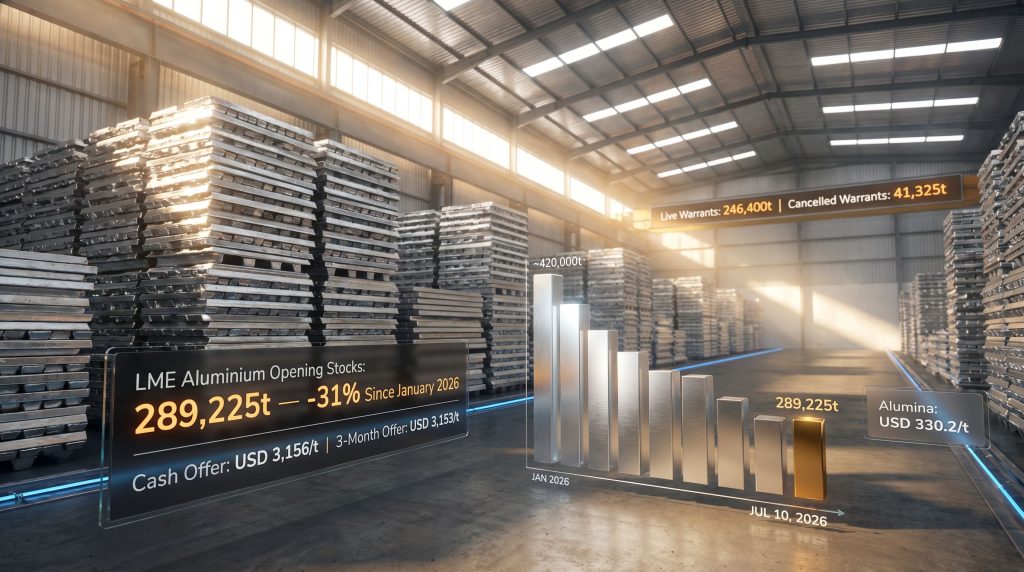
| Live Warrants | 246,400 tonnes | Metal available for trading |
| Cancelled Warrants | 41,325 tonnes | Metal earmarked for physical delivery |
| Total Opening Stocks | 289,225 tonnes | Combined warehouse inventory |
A decline in cancelled warrants signals accelerating physical withdrawal from the system. On July 10, 2026, cancelled warrants fell by 1,500 tonnes, representing a 3.50% single-session reduction. This kind of movement reflects genuine end-use demand pressure, not speculative repositioning.
This distinction is critical. Rising cancellations followed by stock drawdowns are the sequential signature of physical buyers pulling metal out of the system because they need it for actual production, not because they are making a financial bet on price direction. Understanding these mechanics is also relevant for those monitoring the broader aluminum and alumina markets, where similar structural dynamics are at play.
The Scale and Pace of the 2026 LME Aluminium Inventory Drawdown
The LME aluminium opening stocks decline observed throughout 2026 is not a minor fluctuation. From an approximate baseline of 420,000 tonnes in January 2026, registered warehouse inventory fell to 289,225 tonnes by July 10, representing a cumulative reduction of roughly 31% across six months. To place that in context, a drawdown of this scale over such a compressed timeframe is uncommon even by historical standards.
Timeline of Key Inventory Milestones in 2026
| Date | Opening Stocks (Tonnes) | Notable Development |
|---|---|---|
| January 2026 | ~420,000 | Baseline inventory level |
| April 2026 | 341,775 | 4-month low; physical withdrawal accelerates |
| June 16, 2026 | 298,775 | First sub-300,000t reading since March 2026 |
| July 9, 2026 | 290,825 | Continued drawdown trend |
| July 10, 2026 | 289,225 | 0.55% single-session decline |
The breach of the 300,000-tonne threshold in mid-June 2026 was a psychologically significant development for market participants. Round-number inventory levels act as informal reference points for traders and analysts, and falling below that level for the first time since March amplified the sense of accelerating tightness. Furthermore, a reduction of approximately 19,225 tonnes in just five weeks between mid-May and mid-June further illustrated the pace at which physical buyers were drawing down registered supply.
Current inventory trajectories are placing LME aluminium prices near 20-year lows by some historical comparisons, a threshold that has historically preceded extended periods of elevated spot pricing and increased competition for physical availability.
What Is Pulling Metal Out of LME Warehouses
Understanding who is withdrawing metal, and why, is as important as tracking the raw numbers. The composition of warrant cancellations and the sectors driving physical demand provide crucial context that pure price data cannot offer.
The Physical Demand Drivers
The drawdown in LME aluminium opening stocks is being driven primarily by physical buyers, not financial market participants. This distinction matters enormously for price outlook. Speculative repositioning creates temporary inventory distortions that self-correct relatively quickly. Genuine end-use demand, however, creates sustained drawdowns that eventually force prices higher or trigger supply-side responses.
Key consuming sectors contributing to accelerating metal withdrawal include:
- Automotive lightweighting: Ongoing structural shift toward aluminium-intensive vehicle platforms, particularly in electric vehicles where battery enclosures, structural frames, and heat management systems all require significant aluminium content.
- Aerospace components: Post-pandemic aviation recovery has sustained strong demand for aerospace-grade aluminium sheet and plate, with backlogs at major aircraft manufacturers providing multi-year demand visibility.
- Grid-scale energy infrastructure: Overhead transmission lines, transformer windings, and substation components use aluminium extensively. The global push to expand and modernise electricity grids is creating sustained, long-duration demand that is not sensitive to short-term price movements.
- Industrial packaging: Aluminium's recyclability credentials continue to drive can sheet and foil demand as brands pursue sustainability commitments.
The Russian Aluminium Sanctions Effect
A structural dimension of the current inventory tightness that receives insufficient attention is the impact of sanctions on Russian-origin aluminium. Russia is one of the world's largest primary aluminium producers, with Rusal historically accounting for a significant share of global smelter output. Restrictions on Russian metal's eligibility for delivery into LME-registered warehouses reduce the total pool of warrantable inventory available to the market.
This matters because LME warehouse stocks are not simply a reflection of how much aluminium exists globally. They represent a specific subset of metal that meets LME brand and origin specifications. When a major producing nation's metal becomes ineligible or restricted, the effective supply of LME-deliverable aluminium contracts independently of overall global production figures. This structural constraint can sustain inventory tightness even if global smelter output is technically sufficient to meet demand.
Supply-Side Constraints Limiting Fresh Warrant Creation
Beyond demand pressure and sanctions-related restrictions, the supply side is facing its own headwinds. Smelter output in several key producing regions remains constrained by energy costs, water availability for hydropower-dependent operations, and ongoing permitting challenges for capacity expansions. These factors limit the rate at which fresh aluminium can be produced, warranted, and delivered into LME-registered locations. For instance, Rio Tinto's Gladstone aluminium operations highlight how major producers are navigating exactly these kinds of energy-related constraints.
The LME alumina Platts assessed price of USD 330.2 per tonne on July 10 provides an important input cost reference. Alumina, the refined intermediate product derived from bauxite that is used to produce primary aluminium through electrolytic reduction, typically represents between 30% and 40% of total primary aluminium production costs at most smelters. At current alumina pricing levels, smelter margins remain positive given spot aluminium prices above USD 3,150 per tonne, but they provide limited buffer against energy cost spikes or unexpected operational disruptions.
In regions where power costs are elevated, some smelter operations remain marginal, limiting their capacity to meaningfully accelerate output in response to higher aluminium prices. Consequently, the Alcoa market downgrade has added further uncertainty to producer sentiment across the sector.
LME Aluminium Price Performance: Reading the Signals Correctly
Cross-Contract Price Performance on July 10, 2026
| Contract | July 9 Price (USD/t) | July 10 Price (USD/t) | Change | % Movement |
|---|---|---|---|---|
| Cash Bid | 3,163.00 | 3,155.50 | -7.50 | -0.24% |
| Cash Offer | 3,164.00 | 3,156.00 | -8.00 | -0.25% |
| 3-Month Bid | 3,168.50 | 3,152.50 | -16.00 | -0.50% |
| 3-Month Offer | 3,169.00 | 3,153.00 | -16.00 | -0.50% |
| Dec 2027 Bid | 3,085.00 | 3,075.00 | -10.00 | -0.32% |
| Dec 2027 Offer | 3,090.00 | 3,080.00 | -10.00 | -0.32% |
The sharpest single-session decline on July 10 occurred in the three-month contract, which fell 0.50% despite the ongoing LME aluminium opening stocks decline. This appears counterintuitive on the surface. Tightening inventories should be bullish for prices. However, the three-month contract is the LME's primary benchmark instrument and its most heavily traded segment, making it the first point of impact for macro-driven selling pressure and risk-off sentiment.
The paradox of falling prices alongside falling inventories is not a market malfunction. It is a timing asymmetry. Physical fundamentals build gradually and resolve slowly, while macro sentiment can shift within minutes on a single data release or geopolitical development.
The LME aluminium three-month Asian Reference Price stood at USD 3,139.5 per tonne on July 10, sitting below the global three-month offer of USD 3,153 per tonne. This spread reflects regional demand conditions, logistical premiums, and the relative tightness of aluminium availability in Asian markets compared to global exchange pricing. Indeed, the China metals demand outlook remains a key variable shaping how these regional price differentials evolve.
What the Forward Curve Structure Reveals
Backwardation as a Physical Tightness Signal
The relationship between the December 2027 offer price of USD 3,080 per tonne and the current cash offer of USD 3,156 per tonne is telling. When the spot price exceeds the forward price, this condition is known as backwardation. In base metals, backwardation is one of the clearest price signals that the physical market is tight in the near term.
Backwardation incentivises holders of physical metal to sell now rather than hold for future delivery, theoretically encouraging restocking of exchange inventories. It also signals to producers that near-term hedging opportunities are available at premiums to forward pricing. For consumers, a backwardated curve creates urgency around forward procurement decisions, as waiting is essentially penalised by the market structure.
The current near-backwardation structure in LME aluminium, combined with the persistent inventory drawdown, suggests the market is pricing meaningful near-term physical risk while remaining less concerned about supply adequacy in 2027 and beyond. According to LME Insight, this kind of curve positioning has historically aligned with periods of genuine physical scarcity rather than speculative activity.
The next major ASX story will hit our subscribers first
Scenario Analysis: Where Do LME Aluminium Stocks Go From Here?
Three Plausible Pathways for Inventory Trajectory
Scenario A: Continued Drawdown
- Sanctions on Russian-origin aluminium remain in place, keeping the pool of LME-eligible metal structurally constrained.
- Physical demand from energy transition infrastructure, EV production, and aerospace sustains withdrawal pace.
- Stocks approach or breach 20-year lows, creating acute spot price pressure and potentially triggering supply allocation difficulties for physical buyers.
Scenario B: Partial Restock
- Elevated spot prices incentivise producers to deliver metal into LME-registered warehouses to capture available premiums.
- A macro-driven demand slowdown reduces the pace of physical withdrawal, allowing some inventory accumulation.
- Cancelled warrant volumes stabilise or partially reverse, easing near-term tightness without resolving the underlying structural deficit.
Scenario C: Structural Deficit Entrenchment
- Energy cost constraints, sanctions-related restrictions, and permitting delays prevent meaningful production capacity additions.
- Long-duration demand from EV manufacturing, grid expansion, and aerospace sustains elevated consumption rates.
- LME stocks remain structurally depressed over a multi-year horizon, supporting a sustained price floor above USD 3,000 per tonne.
It is also worth noting that the introduction of aluminium and steel tariffs in key markets adds another layer of complexity to how trade flows and warrant creation patterns may shift across these scenarios. As Reuters notes, inventory cycles in the LME system have historically been influenced as much by policy shifts as by pure demand fundamentals.
Strategic Implications Across Market Participant Types
| Participant | Key Consideration |
|---|---|
| Physical Buyers | Tightening spot availability may require earlier forward procurement to avoid supply disruption |
| Smelters and Producers | Elevated prices and near-backwardation create favourable conditions for hedging near-term output |
| Traders | Backwardation-adjacent curve structure favours long spot and short forward positioning strategies |
| Investors | Near 20-year low inventories have historically preceded sustained aluminium price rallies |
| Downstream Manufacturers | Input cost management and strategic stockpiling become increasingly critical as spot premiums rise |
Key Data Summary: LME Aluminium on July 10, 2026
- 289,225 tonnes: LME aluminium opening stocks
- -1,600 tonnes (-0.55%): Single-session inventory decline
- -31%: Cumulative drawdown since January 2026
- USD 3,156 per tonne: Cash offer price
- USD 3,153 per tonne: Three-month offer price, down 0.50% in one session
- USD 3,139.5 per tonne: LME aluminium three-month Asian Reference Price
- USD 330.2 per tonne: LME alumina Platts assessed price
- 246,400 tonnes: Live warrants (unchanged on the session)
- 41,325 tonnes: Cancelled warrants, down 3.50% or 1,500 tonnes
The broader lesson embedded in the mid-2026 LME aluminium inventory data is one that applies across commodity cycles. Physical market signals, particularly sustained drawdowns in exchange-registered inventories, rarely resolve quietly. When genuine demand meets structurally constrained supply in a market as strategically important as aluminium, the eventual price response tends to be more pronounced than the gradual accumulation of inventory data might initially suggest. The LME aluminium opening stocks decline underway in 2026 is creating exactly that kind of setup, and the market participants who understand the mechanics behind the numbers will be best positioned to respond when the divergence between physical fundamentals and short-term price action finally closes.
This article is intended for informational purposes only and does not constitute financial advice. Commodity markets involve significant risk, and price forecasts, scenario analyses, and market projections referenced herein are speculative in nature. Readers should conduct their own due diligence before making any investment or procurement decisions.
Want to Capitalise on the Next Major Mineral Discovery Before the Broader Market Catches On?
When physical fundamentals diverge from short-term price signals — as the 2026 LME aluminium inventory cycle clearly illustrates — being first to act on structural shifts is what separates informed investors from the rest. Discovery Alert's proprietary Discovery IQ model delivers real-time alerts on significant ASX mineral discoveries, transforming complex market data into actionable insights for both short-term traders and long-term investors — explore historic discoveries and their returns to understand the potential, then start your 14-day free trial to position yourself ahead of the market.