May 21, 2026
Strategic Competition Through Technological Demonstration
Global aerospace development increasingly functions as a theater where nations project technological capability, strategic intent, and industrial capacity to international audiences. This dynamic transcends traditional military procurement, creating complex interactions between actual engineering progress, strategic messaging, and geopolitical positioning. Modern aerospace programs serve dual purposes: developing functional military capabilities while simultaneously influencing competitor behavior and domestic political narratives.
The intersection of materials science, aerospace engineering, and strategic competition reveals how nations can leverage supply chain advantages to support broader technological ambitions. Advanced aerospace systems require sophisticated materials with unique properties that often depend on specialised industrial processes and rare mineral inputs, creating vulnerabilities and opportunities for nations with different resource profiles.
When big ASX news breaks, our subscribers know first
China's South Heavenly Gate Project: Vision and Reality
China's South Heavenly Gate Project represents one of the most ambitious conceptual aerospace programs publicly discussed in recent years, featuring designs that push the boundaries of current engineering capabilities. The project encompasses multiple theoretical platforms designed to operate across atmospheric and near-space environments.
The Luan Bird Strategic Platform
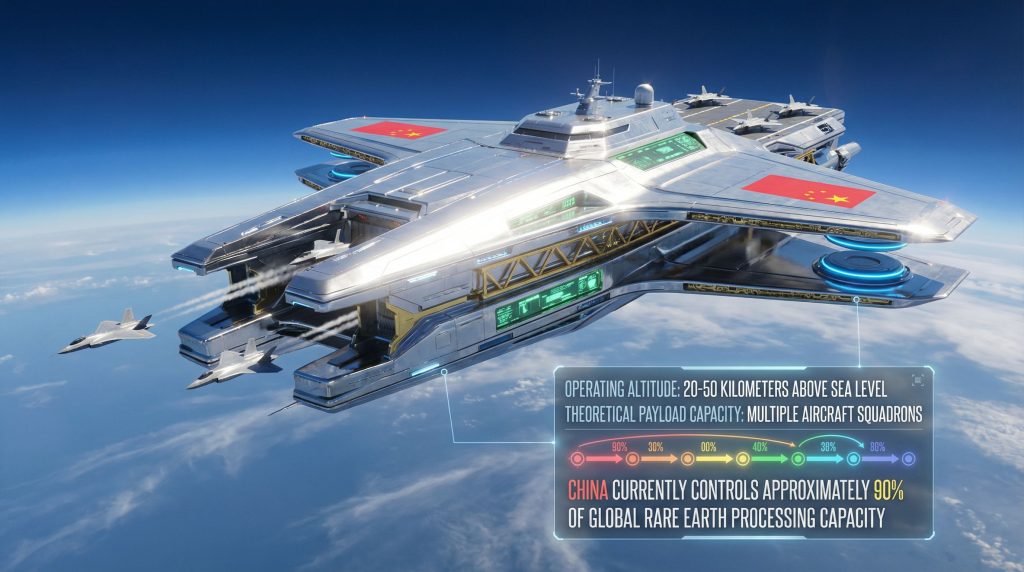
The centrepiece of this conceptual framework involves a massive 100,000-ton stratospheric carrier designed to operate in the 20-50 kilometre altitude range. This theoretical platform would function as a mobile command centre with persistent surveillance capabilities extending far beyond traditional aircraft limitations.
To understand the engineering magnitude, this proposed platform would be approximately 10 times larger than the Airbus A380 (575 metric tons) and 2.5 times larger than the Antonov An-225 (40,000 metric tons maximum takeoff weight). The scale represents a fundamental departure from existing aerospace engineering paradigms.
Technical Specifications:
- Operating altitude: 20-50 kilometres above sea level
- Theoretical payload capacity: Multiple aircraft squadrons
- Power requirements: Advanced nuclear or hybrid propulsion systems
- Materials demand: Extensive rare earth element integration
The 20-50 kilometre operating band presents unique challenges. At 40 kilometres altitude, atmospheric density drops to approximately 3% of sea-level density, requiring revolutionary propulsion and lift generation systems. Temperature extremes range from -60°C to -80°C, demanding materials capable of maintaining structural integrity under these conditions.
Advanced Fighter Integration Systems
The project envisions integration with sixth-generation fighter concepts, including the White Emperor variable-geometry spaceplane and unmanned Mysterious Maiden fighter swarms. These platforms would theoretically operate across atmospheric and near-space environments.
However, Western aerospace engineers emphasise critical distinctions between concept demonstration and operational capability. The White Emperor design revealed at China's 2024 Zhuhai Airshow represented a full-scale mockup linked to AVIC-supported science-fiction concepts, not a flyable prototype. As detailed in recent military analysis, these conceptual aircraft carriers push the boundaries between realistic military development and ambitious technological vision.
This distinction matters significantly in strategic assessment. Mockups demonstrate design intent and aesthetic vision, while prototypes demonstrate functional component integration and engineering maturity. The progression from concept to operational system typically requires 15-25 years for complex aerospace platforms.
Strategic Integration and Military Doctrine
Multi-Domain Operations Framework
The South Heavenly Gate concept aligns with China's military modernisation goals outlined in defence white papers from 2015-2019, which target 2035 as a benchmark year for achieving comprehensive strategic military modernisation. This timeline reflects systematic approach to capability development rather than immediate deployment expectations.
China's defence doctrine emphasises integrated multi-domain operations combining air, space, cyber, and maritime capabilities. This represents fundamental shift from traditional platform-centric warfare toward networked systems approach. The strategic implications include:
- Enhanced power projection capabilities across Pacific distances
- Reduced dependence on fixed ground installations vulnerable to attack
- Improved survivability against conventional missile strikes
- Extended operational reach supporting regional influence objectives
Comparative Strategic Approaches
Defence analysts distinguish between China's approach and traditional Western military development patterns. Rather than direct platform-for-platform competition, Chinese strategy emphasises asymmetric capabilities that exploit potential vulnerabilities while requiring lower investment than direct technological matching.
| Strategic Element | Chinese Approach | Western Approach |
|---|---|---|
| Development Timeline | 10-15 years through parallel development | 15-20 years traditional sequential |
| Risk Tolerance | High concept risk, incremental deployment | Lower concept risk, higher technology risk |
| Integration Focus | Multi-domain systems emphasis | Platform superiority emphasis |
| Resource Allocation | Cost-effectiveness priority | Technological superiority priority |
Technology Demonstration and Signalling
Strategic signalling through aerospace programs serves multiple functions beyond immediate military capability. These include demonstrating technological ambition to domestic audiences, influencing competitor threat assessments, and establishing narrative leadership in emerging technological domains.
The psychological impact of announced capabilities often proves as strategically valuable as deployed hardware. Programs like China's South Heavenly Gate Project can catalyse competitor responses, potentially forcing resource allocation decisions and accelerating development timelines across multiple nations.
Critical Materials and Supply Chain Dependencies
Rare Earth Element Requirements
Advanced aerospace systems require sophisticated materials with properties that depend heavily on rare earth elements, particularly heavy rare earths like dysprosium and terbium for thermal stability and magnetic performance under extreme conditions. Moreover, these critical minerals energy security considerations extend beyond aerospace applications into broader strategic sectors.
China currently controls approximately 90% of global rare earth processing capacity and maintains even stronger dominance in heavy rare earth refining. This supply chain control provides significant leverage in developing advanced military systems while potentially constraining competitor capabilities. Furthermore, China's export controls strategy demonstrates how supply chain dominance can serve broader geopolitical objectives.
Critical Material Applications:
| Component Type | Key Elements | Strategic Application |
|---|---|---|
| High-Performance Magnets | Neodymium, Dysprosium | Electric motors, generators for propulsion |
| Specialty Alloys | Yttrium, Scandium | Structural components for extreme environments |
| Electronic Systems | Europium, Terbium | Sensors, displays for command systems |
| Power Electronics | Lanthanum, Cerium | Energy storage, power conversion |
Materials Science Challenges
Creating functional stratospheric platforms requires materials science breakthroughs not currently available in operational systems. Key technical barriers include:
-
Structural Integrity: Maintaining mechanical properties of 100,000-ton structures at extreme altitudes requires revolutionary composite materials
-
Thermal Management: Managing temperature extremes from -80°C operational environment to heat generated by propulsion systems
-
Power Generation: Developing energy systems capable of sustaining massive platforms for weeks or months without refuelling
-
Manufacturing Scale: Producing materials and components at unprecedented scale while maintaining precision tolerances
Supply Chain Strategic Implications
China's "Two Rare Earth Base" strategy consolidates upstream supply control while expanding downstream research, development, and manufacturing capabilities. This approach aims to control not just raw materials but the entire value chain from mining through advanced component assembly.
For Western nations, this creates potential vulnerabilities in developing competing aerospace systems. Alternative supply chains require significant investment and time to establish, particularly for heavy rare earth processing capabilities essential to high-performance military systems.
Economic and Industrial Competition Dynamics
Global Aerospace Market Context
The global aerospace and defence market reached approximately $840 billion in 2023, with projected compound annual growth rate of 3.5-4.2% through 2030. Competition for market leadership drives continued innovation investment across major powers.
China's defence budget reached approximately $225-250 billion USD in 2024 according to official reporting, with actual spending estimated significantly higher when including related research and development programs. This level of investment enables sustained development of conceptual programs like the South Heavenly Gate Project. Consequently, the defence critical materials strategy becomes increasingly important for allied nations seeking to maintain competitive capabilities.
Technology Race Acceleration
Announced capabilities, even conceptual ones, can accelerate competitive technology development across multiple nations. The South Heavenly Gate Project potentially influences:
- U.S. Response: Accelerated funding for next-generation aerospace programs and space-domain defence systems
- Allied Coordination: Enhanced technology sharing among democratic partners to maintain competitive position
- Supply Chain Diversification: Increased investment in alternative rare earth processing capabilities outside China
- Industrial Base Mobilisation: Expanded aerospace manufacturing capacity to support competing development programs
Market Psychology and Investment Flows
Strategic aerospace announcements influence investor behaviour and resource allocation decisions across defence and technology sectors. Even conceptual programs can drive:
- Increased venture capital investment in related technologies
- Higher valuation multiples for aerospace and defence companies
- Government funding prioritisation for competing research programs
- Supply chain speculation in critical materials markets
Technical Feasibility Assessment
Engineering Reality Checks
Creating operational stratospheric aircraft carriers presents enormous technical challenges that current technology cannot fully address. Primary barriers include:
Power Systems: A 100,000-ton vehicle operating at 40 kilometres altitude would require propulsive force equivalent to overcoming atmospheric drag plus maintaining altitude. Current largest aircraft engines (General Electric GE9X) produce approximately 110,000 pounds of thrust maximum. The proposed platform would require propulsion systems significantly beyond current capabilities.
Structural Engineering: Maintaining integrity of massive structures at extreme altitudes requires materials and design approaches not yet demonstrated at operational scale. Historical comparison with the U.S. X-20 Dyna-Soar programme, cancelled after $300 million investment due to technical complexity, illustrates development challenges.
Environmental Systems: Operating in the -60°C to -80°C temperature range for extended periods requires life support and mechanical systems beyond current aerospace standards. Commercial aircraft systems are not designed for sustained operation in these conditions.
Development Timeline Reality
Realistic assessment suggests that even with aggressive development timelines, functional systems matching China's South Heavenly Gate Project specifications would require 15-25 years of development and testing before operational deployment, assuming significant technological breakthroughs in multiple areas.
Historical aerospace development provides context. Asteroid mining advances demonstrate similar long development timelines for revolutionary space technologies:
- Skylon (UK): Hypersonic spaceplane concept in development over 20 years with continued technical challenges
- F-35 Fighter: Conventional fighter aircraft required 20+ years from concept to initial operational capability
- International Space Station: Multi-national cooperation required 15+ years for operational deployment
The next major ASX story will hit our subscribers first
International Security Implications
Strategic Stability Considerations
The South Heavenly Gate Project contributes to concerns about militarisation of near-space environments and potential conflicts extending beyond traditional atmospheric boundaries. Operating platforms at 20-50 kilometre altitudes occupies transitional zone between air and space domains, potentially complicating existing treaty frameworks. According to recent analysis of China's aerospace ambitions, these developments blur the lines between scientific advancement and military capability.
Arms Race Risk Assessment
Strategic aerospace competition may accelerate competitive military technology development among major powers. Key risk factors include:
- Escalation Dynamics: Announced capabilities driving competitor overreaction and resource misallocation
- Alliance Strain: Pressure on allied nations to contribute to expensive competing development programmes
- Economic Disruption: Diversion of resources from civilian applications to military aerospace competition
- Technical Accident Risk: Rushed development programmes increasing potential for catastrophic system failures
Diplomatic and Strategic Communication
Managing international responses to announced aerospace capabilities requires careful balance between maintaining credible deterrence and avoiding unnecessary escalation. Western policymakers face complex decisions about appropriate response levels to conceptual Chinese programmes.
Policy Response Frameworks
Strategic Assessment Methodology
Intelligence communities emphasise distinguishing between China's aspirational messaging and current operational capabilities. Assessment frameworks include:
Technological Feasibility Analysis: Current engineering limitations and required breakthrough technologies
Resource Allocation Tracking: Actual funding levels and development timeline indicators
Strategic Signalling Assessment: Psychological and diplomatic impact evaluation
Supply Chain Monitoring: Materials availability and industrial capacity analysis
Response Option Evaluation
Western nations consider multiple response approaches to China's aerospace ambitions:
Accelerated Research Investment: Increased funding for competing next-generation aerospace technologies while maintaining realistic development expectations
Supply Chain Resilience: Diversification of critical materials sources and development of alternative processing capabilities
Alliance Technology Sharing: Enhanced cooperation among democratic partners to pool resources and expertise
Defensive Capability Enhancement: Improved air and space domain awareness systems to counter potential future threats
Economic Security Integration
Addressing aerospace competition requires coordination between military, economic, and diplomatic policy tools. Key integration areas include uranium market trends and strategic materials management:
- Export control coordination to limit technology transfer while maintaining alliance cooperation
- Investment screening to prevent critical technology acquisition by competitors
- Industrial base strengthening to support sustained technology competition
- Educational and research institution partnerships to maintain innovation leadership
Conclusion: Balancing Vision and Pragmatism
China's South Heavenly Gate Project exemplifies modern strategic competition through technological demonstration and long-term capability signalling. While current systems remain largely conceptual, the underlying message about China's aerospace ambitions and industrial advantages requires serious analytical attention from policymakers and defence planners globally.
Understanding this development requires balancing recognition of China's growing technological capabilities with realistic assessment of current engineering limitations and development timelines. The broader implications for global security, economic competition, and technological innovation will likely prove more significant than deployment of any specific hardware platforms.
The project's emphasis on materials-intensive advanced systems underscores China's strategic advantage in rare earth element processing and component manufacturing. This supply chain dominance provides leverage extending beyond immediate military applications into broader economic and technological competition.
Key Considerations for Stakeholders:
- Military planners should focus on realistic threat timelines rather than reacting to conceptual announcements
- Technology investors should evaluate actual development progress versus strategic messaging
- Policymakers should address supply chain vulnerabilities while avoiding unnecessary escalation
- Industry leaders should consider implications for civilian aerospace and materials technologies
The South Heavenly Gate Project ultimately represents China's systematic approach to reshaping global aerospace capabilities through integrated industrial, technological, and strategic planning. Success in this competition will depend less on individual platform development and more on sustained investment in foundational technologies, materials capabilities, and institutional coordination across multiple domains.
Disclaimer: This analysis includes forward-looking assessments and technological projections that involve significant uncertainty. Strategic aerospace capabilities depend on complex engineering, economic, and political factors that may evolve substantially over development timelines spanning multiple decades. Readers should consider this analysis as educational framework rather than predictive guidance for investment or policy decisions.
Ready to Invest in the Next Major Mineral Discovery?
Discovery Alert instantly alerts investors to significant ASX mineral discoveries using its proprietary Discovery IQ model, turning complex mineral data into actionable insights. With critical materials like rare earth elements becoming increasingly vital for advanced aerospace and defence applications, understanding why historic discoveries can generate substantial returns positions investors ahead of the broader market.