June 7, 2026
Understanding Strategic Critical Minerals Reserves
Industrial nations worldwide face an unprecedented challenge: securing reliable access to minerals that power everything from smartphones to fighter jets. The vulnerability became starkly apparent when rare earth element prices surged 700% during China's export restrictions in 2010, leaving global manufacturers scrambling for alternatives. This reality has transformed government thinking from market-dependent strategies to proactive stockpiling systems designed to insulate economies from supply shocks, with the establishment of a comprehensive critical minerals reserve becoming a national security priority.
Modern critical minerals reserve systems differ fundamentally from traditional commodity stockpiles. While the Strategic Petroleum Reserve model provided early inspiration, mineral reserves require more sophisticated management due to material diversity, quality degradation concerns, and complex processing requirements. Nations must balance immediate security needs against long-term economic efficiency, creating reserve architectures that serve both strategic insurance and market stabilisation functions.
When big ASX news breaks, our subscribers know first
What Defines a Strategic Critical Minerals Reserve?
Strategic mineral reserves represent government-controlled stockpiles designed to provide supply security during market disruptions or geopolitical tensions. Unlike commercial inventories that prioritise capital efficiency and rapid turnover, these reserves accept higher carrying costs as insurance premiums against economic vulnerability.
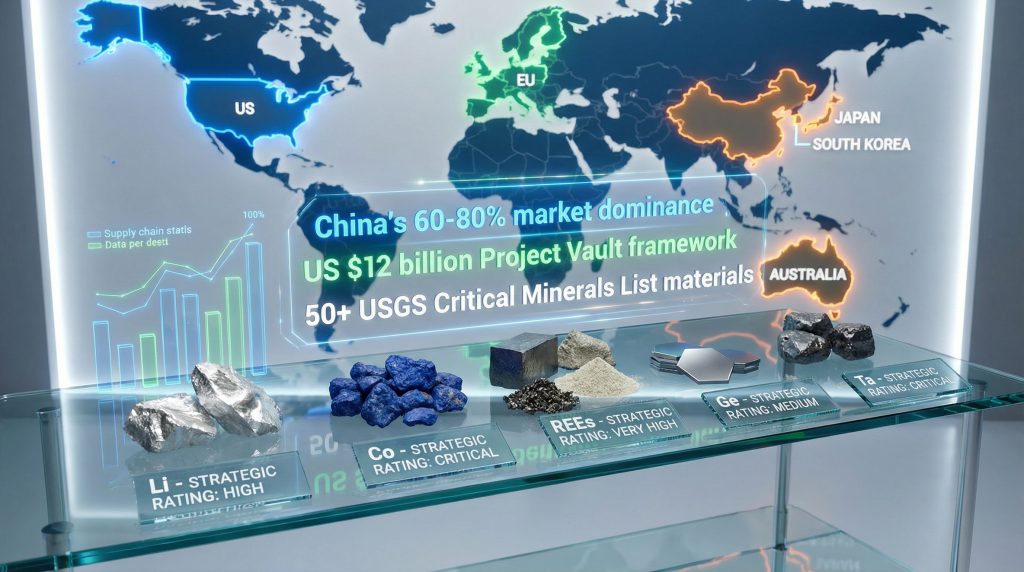
The United States Geological Survey identified 50 critical minerals essential to economic security, ranging from lithium for battery technology to germanium for semiconductor applications. Furthermore, the European CRM facility designated 34 materials as critical raw materials under the Critical Raw Materials Act, while other nations maintain similar classification systems tailored to their industrial priorities.
Reserve sizing methodologies incorporate multiple analytical frameworks:
- Consumption-based calculations that multiply daily national consumption by desired coverage duration
- Supply disruption modelling that estimates restoration timeframes from alternative sources
- Strategic lag time integration that accounts for policy implementation and procurement processes
- Quality maintenance protocols ensuring materials meet industrial specifications throughout storage
| Reserve Characteristic | Strategic Reserve | Commercial Inventory |
|---|---|---|
| Primary Objective | Supply security & price stability | Profit maximisation |
| Holding Duration | Multi-year (1-5 years typical) | Short-term (months) |
| Release Mechanism | Government decision/crisis response | Market signals |
| Quality Standards | Rigorous testing protocols | Standard market specifications |
| Funding Source | Government-backed | Private capital |
The Democratic Republic of Congo's recent initiative to establish strategic reserves for cobalt, germanium, and tantalum ore demonstrates how mineral-rich nations increasingly view stockpiling as both supply security and market leverage tools. This approach reflects broader recognition that resource control translates directly into geopolitical influence.
Why Are Countries Racing to Establish Mineral Stockpiles?
Geographic concentration creates systemic vulnerabilities that traditional market mechanisms cannot address. China controls approximately 60-80% of global rare earth processing capacity, while the Democratic Republic of Congo supplies 65-70% of global cobalt production at roughly 140,000 metric tons annually. This concentration means supply disruptions in single countries can halt manufacturing across entire continents.
Supply Chain Vulnerability Assessment
Historical disruption events demonstrate the cascading economic impact of mineral supply shocks. The 2010-2011 rare earth crisis saw China temporarily restrict exports, causing prices to increase 400-700% for heavy rare earths. Global semiconductor and defence manufacturing experienced supply bottlenecks lasting months, with some production lines shutting down entirely.
Import dependency ratios reveal the scale of vulnerability:
- United States: 100% import-dependent for 17 critical minerals; 90%+ dependent for an additional 23 materials
- European Union: 95%+ dependent on imports for rare earth elements; 85%+ dependent for cobalt
- Japan: 95% dependent on rare earth imports with minimal domestic production capacity
The COVID-19 pandemic provided another stark example when South African platinum group metal production declined 40% due to lockdowns, creating 6-12 month delays across automotive and chemical industries that rely on platinum catalysts.
Economic Security Imperatives
Manufacturing sector dependencies create multiplier effects when supply chains break down. Electric vehicle battery production requires approximately 8kg of lithium carbonate equivalent, 20-40kg of cobalt, and 2-3kg of nickel per vehicle battery pack. A single disruption to any of these inputs can halt entire production lines worth billions in revenue.
Defence manufacturing presents even higher stakes, as highlighted by Australia's emerging defence materials strategy. Advanced missile systems, radar equipment, and electronic warfare platforms require rare earth-heavy permanent magnets, with a single fighter jet containing 400-600kg of rare earth-dependent components. Annual U.S. defence consumption includes approximately:
- 2,500 metric tons of rare earth elements for fighter jet engines
- 1,200 metric tons of germanium, gallium, and rare earths for missile systems
- 800 metric tons of rare earths and tantalum for electronic warfare systems
- 3,500 metric tons of titanium, cobalt, and nickel for naval construction
The clean energy transition creates a paradoxical vulnerability where achieving climate objectives requires massive mineral inputs from geopolitically uncertain regions. However, the growing focus on energy transition minerals demonstrates that lithium demand is projected to increase 42x by 2040, while cobalt demand faces a 21x increase according to International Energy Agency scenarios. This creates what analysts term the "clean energy security trap" where environmental goals conflict with supply security imperatives.
Which Countries Lead Global Critical Minerals Reserve Development?
United States Strategic Initiatives
The United States approach emphasises domestic production capacity alongside strategic stockpiling. Project Vault represents a $12 billion public-private partnership targeting domestic mineral production and processing infrastructure. The Export-Import Bank allocated $10 billion specifically for critical minerals financing, while private sector co-investment totals $2 billion from mining and processing companies.
In addition, the US uranium import ban highlights how geopolitical tensions shape strategic resource policies. The National Defence Stockpile modernisation shifts focus from legacy commodities to emerging critical materials. Current holdings span 42+ commodity types valued at approximately $1.2 billion, with recent emphasis on battery materials, rare earths, and semiconductor-grade minerals.
Key U.S. Priority Framework:
| Mineral Category | Strategic Importance | Supply Risk | Reserve Target |
|---|---|---|---|
| Battery Materials | High | Critical | 180-day supply |
| Rare Earth Elements | Critical | Extreme | 365-day supply |
| Semiconductor Materials | High | High | 120-day supply |
| Defence Applications | Critical | High | 270-day supply |
European Union Resilience Strategy
The Critical Raw Materials Act, enacted in March 2024, establishes regulatory frameworks requiring member states to develop national strategies. The legislation designates 34 critical raw materials across strategic categories and sets ambitious targets:
- Import dependency reduction to 50% by 2030 (from current 85-95% for most rare earths)
- Domestic processing capacity for 25% of critical mineral needs by 2030
- 10% mining capacity within EU by 2030 through expanded exploration
The Strategic Autonomy Plan allocates €1+ billion annually for critical minerals infrastructure development, prioritising partnerships with politically stable suppliers including Australia, Canada, and Norway.
Asia-Pacific Regional Approaches
Australia's Critical Minerals Strategic Reserve, targeting establishment by end-2026, represents one of the most ambitious national programs. Consequently, Australia's critical minerals strategy is designed to provide 12-18 months supply security for lithium, cobalt, rare earth elements, and high-technology minerals, with the initiative committing AUD $300+ million in government investment.
Japan-Australia partnership agreements, signed in 2023, establish joint procurement mechanisms targeting 30-40% of Japan's rare earth supply from Australian sources by 2030. The framework includes technology transfer and joint research initiatives prioritising defence and automotive sectors.
South Korea's diversification strategy aims to reduce China dependency from current 80%+ for rare earths and 60%+ for cobalt. Initiatives include partnerships with Vietnam, Indonesia, and Australian suppliers, plus investment in recycling infrastructure targeting 15-20% of critical mineral supply from secondary sources by 2030.
How Do Different Reserve Models Compare in Effectiveness?
Government-Controlled Stockpile Systems
Traditional government stockpiles adapt the Strategic Petroleum Reserve model to mineral applications. Centralised procurement and storage management provides maximum government control but requires substantial capital investment and ongoing maintenance expenses.
Key advantages:
- Direct government control over release timing and quantities
- Standardised quality and storage protocols
- Clear chain of custody and security management
- Simplified accounting and inventory tracking
Primary challenges:
- High upfront capital requirements for facility construction
- Ongoing storage costs for climate-controlled environments
- Material degradation requiring rotation schedules
- Limited flexibility in storage locations and access
Public-Private Partnership Frameworks
Risk-sharing arrangements between government and industry leverage private sector expertise whilst maintaining public oversight. Project Vault's $12 billion framework exemplifies this approach, combining government financing with private sector storage and management capabilities.
Financing structures typically include:
- Loan guarantee programmes reducing private sector risk
- Performance-based contracts with inventory availability requirements
- Cost-sharing arrangements for facility construction and maintenance
- Revenue-sharing mechanisms from strategic sale timing
Performance metrics focus on:
- Response time for reserve mobilisation during crises
- Quality maintenance throughout storage periods
- Cost efficiency compared to government-only alternatives
- Industry accessibility during authorised release events
Market-Based Reserve Mechanisms
Dynamic inventory management systems adjust reserve levels based on market conditions and risk assessments. Price support systems and floor pricing create market incentives for private sector stockpiling while maintaining government oversight capabilities.
Automatic trigger mechanisms activate reserve releases when:
- Supply disruption events exceed predetermined thresholds
- Price volatility surpasses established parameters
- Geopolitical risk indicators reach critical levels
- Industry demand spikes threaten supply adequacy
What Are the Economic Implications of Reserve Building?
Cost-Benefit Analysis Framework
Reserve establishment requires substantial initial capital but provides economic insurance value that traditional metrics struggle to capture. Storage infrastructure costs range from $50-200 per ton annually depending on material requirements and environmental controls.
Economic value calculations include:
- Supply disruption avoidance worth billions in prevented manufacturing shutdowns
- Price stability benefits reducing volatile input costs for domestic industries
- Strategic autonomy value enabling independent foreign policy decisions
- Employment effects from domestic mining and processing development
Return on investment projections vary significantly by mineral type and market conditions. Rare earth reserves may generate returns through strategic sale timing during price spikes, while battery material stockpiles provide insurance value that's difficult to quantify until crisis events occur.
Market Impact Considerations
Large-scale government purchasing can significantly impact mineral markets, particularly for materials with limited production volumes. Rare earth element markets, with global production around 300,000 tons annually, face substantial price effects when governments purchase strategic quantities.
Mining industry investment incentives create positive feedback loops where critical minerals reserve programmes stimulate domestic production capacity. According to government industry updates, strategic stockpiling commitments encourage private sector mining investments by providing demand certainty.
The next major ASX story will hit our subscribers first
How Do Reserves Address Specific Industry Vulnerabilities?
Automotive Sector Requirements
Electric vehicle production scaling creates unprecedented battery material demands. Tesla's gigafactory model requires consistent access to lithium, cobalt, and nickel supplies that can support 500,000+ vehicle annual production. Supply chain disruptions lasting weeks can force production line shutdowns with daily losses exceeding $10 million.
Quality specifications for automotive applications exceed many industrial standards. Battery-grade lithium carbonate must maintain 99.5% purity levels, while cobalt sulfate requires specific particle size distributions that not all production facilities can achieve.
Defence and Aerospace Applications
Military equipment dependencies create national security vulnerabilities that extend beyond economic considerations. Advanced radar systems require yttrium, terbium, and dysprosium for high-temperature superconducting magnets. Fighter jet engines consume rare earth permanent magnets that enable precision control systems and electronic warfare capabilities.
Space industry applications demand ultra-high purity materials often requiring specialised processing. Satellite communication systems use germanium and gallium arsenide components where supply disruptions can compromise critical infrastructure and military communications.
Technology Manufacturing Dependencies
Semiconductor fabrication represents perhaps the most complex supply chain vulnerability, requiring 35+ critical minerals in precise specifications. Taiwan's dominance in advanced chip production, combined with China's control over many required materials, creates systemic risk for global technology industries.
Advanced semiconductor fabs require:
- Ultra-pure silicon for wafer production
- Rare gas elements for etching and deposition processes
- High-purity metals for interconnect layers
- Specialised compounds for photolithography and cleaning
Lead times from raw mineral to finished semiconductor span 18-24 months, meaning supply shocks propagate through extended periods even after alternative sources are secured.
What Implementation Challenges Must Countries Navigate?
Technical and Logistical Obstacles
Storage infrastructure requirements vary dramatically by material type. Lithium compounds require climate-controlled environments to prevent moisture absorption and quality degradation. Rare earth oxides need specialised containers preventing contamination that could affect magnetic properties.
Material degradation presents ongoing challenges requiring rotation schedules and quality testing. Cobalt sulfate can develop impurities over time that impact battery performance. Germanium ingots require careful temperature control preventing crystal structure changes.
Transportation networks must accommodate materials requiring specialised handling. Radioactive minerals like thorium and uranium ores need licensing and safety protocols. Toxic materials including arsenic compounds require hazmat-certified transportation and storage facilities.
Financial and Economic Constraints
Budget allocation priorities create political challenges when reserve programmes compete with healthcare, education, and infrastructure spending. Multi-billion dollar commitments for strategic materials storage face scepticism from legislators focused on immediate constituent needs.
International trade rule compliance complicates government purchasing programmes. World Trade Organisation regulations limit certain government subsidies and preferential procurement that could violate fair trade agreements.
Currency risk management affects international procurement strategies. Long-term contracts in foreign currencies expose reserves to exchange rate volatility that can significantly impact programme costs.
Political and Regulatory Considerations
Legislative approval processes can delay urgent programme implementation. Congressional authorisation for funding often requires extensive hearings and political negotiations that may not align with strategic timing needs.
Environmental impact assessments for storage facilities face increasingly stringent requirements. Climate change considerations affect facility siting decisions, while community opposition can delay or prevent construction in optimal locations.
Trade policy coordination requires balancing reserve objectives against broader diplomatic relationships. Aggressive stockpiling may trigger retaliatory export restrictions from supplier countries.
How Effective Are Current Reserve Strategies in Practice?
Performance Measurement Frameworks
Supply disruption response metrics evaluate reserve effectiveness during crisis events. Target response times typically range from 48-96 hours for critical material release, though complex logistics may extend delivery timelines.
Industry satisfaction surveys measure private sector confidence in reserve accessibility. Manufacturing companies require certainty that strategic materials will be available during supply emergencies without bureaucratic delays.
Cost efficiency analysis compares reserve programme expenses against estimated economic losses from supply disruptions. Automotive industry shutdowns during semiconductor shortages cost $200+ billion globally, demonstrating potential value from effective critical minerals reserve programs.
Case Study Analysis: Strategic Petroleum Reserve
The Strategic Petroleum Reserve provides valuable lessons for mineral stockpiling. Emergency releases during Hurricane Katrina and the Gulf War demonstrated rapid mobilisation capabilities. Commercial sales during market downturns generated revenue offsetting storage costs.
Key success factors include:
- Clear release criteria preventing political interference
- Multiple storage locations ensuring geographic redundancy
- Established distribution networks enabling rapid deployment
- Regular testing of systems and procedures
Challenges encountered:
- Infrastructure ageing requiring ongoing maintenance investment
- Technology obsolescence as storage and handling systems evolve
- Market timing decisions affecting programme revenue and effectiveness
What Does the Future Hold for Critical Minerals Reserves?
Emerging Technology Integration
Blockchain-based inventory systems promise improved transparency and tracking capabilities. Real-time monitoring of material quality and location data enables more efficient rotation schedules and crisis response planning.
Artificial intelligence applications include:
- Demand forecasting based on economic indicators and industry trends
- Optimal storage allocation balancing geographic risk and access convenience
- Market timing optimisation for strategic purchases and sales
- Supply chain risk assessment incorporating geopolitical and environmental factors
Automated storage systems reduce handling costs and contamination risks. Robotic inventory management enables precise tracking and quality control while minimising human exposure to hazardous materials.
International Cooperation Opportunities
Multilateral reserve sharing agreements could provide mutual insurance whilst reducing individual country costs. NATO nations exploring coordinated critical minerals stockpiling similar to collective defence arrangements.
Joint procurement initiatives leverage combined purchasing power to influence market prices and supplier behaviour. Quad partnership discussions include coordinated critical minerals strategies among the United States, Japan, Australia, and India.
Crisis response coordination mechanisms ensure effective deployment during regional or global supply disruptions. Information sharing protocols enable rapid assessment of supply chain threats and coordinated response strategies.
Long-term Strategic Evolution
Reserve scope expansion will likely include new materials as technology evolves. Quantum computing development may create demand for previously non-critical materials. Advanced battery technologies could shift priorities from current lithium-focused strategies.
Circular economy integration emphasises recycling and secondary material recovery. Urban mining of electronic waste may provide 20-30% of future critical mineral supply, reducing primary material reserve requirements.
Climate adaptation considerations affect storage facility design and material selection. Sea level rise and extreme weather events require resilient infrastructure capable of withstanding environmental challenges.
Strategic Implementation Requirements
Effective critical minerals reserve programmes require: (1) Clear strategic objectives aligned with national economic and security priorities, (2) Adequate financing with sustainable funding mechanisms balancing public investment and private sector participation, (3) Strong public-private partnerships leveraging industry expertise whilst maintaining government oversight, (4) Flexible management systems adaptable to changing market conditions and emerging threats, and (5) International cooperation frameworks enabling coordinated crisis response and mutual support arrangements.
Building Resilient Mineral Security Architecture
Critical minerals reserve systems represent a fundamental transformation in resource security strategy, moving from reactive market dependence toward proactive risk management. Success demands sophisticated balance between immediate security needs and long-term economic efficiency, whilst fostering domestic industry development and strengthening international partnerships.
The effectiveness of these strategic initiatives will ultimately be measured not during stable periods, but during crisis events when supply chains fracture and traditional market mechanisms fail. Nations implementing comprehensive critical minerals reserve programmes today position themselves for strategic autonomy in an increasingly uncertain global resource environment.
Investment decisions in critical minerals reserve programmes should consider multiple risk factors including geopolitical developments, technology evolution, and regulatory changes. This analysis is for informational purposes and does not constitute investment advice.
Want to Capitalise on Australia's Critical Minerals Boom?
Discovery Alert's proprietary Discovery IQ model delivers real-time alerts on significant ASX mineral discoveries, instantly identifying critical minerals opportunities before they reach mainstream attention. With government strategic reserves driving unprecedented demand for lithium, cobalt, and rare earth discoveries, explore Discovery Alert's track record of major mineral discoveries and begin your 14-day free trial today to secure your market-leading advantage.