June 10, 2026
Strategic Cross-Border Partnerships Transform Critical Minerals Landscape
Advanced economies face an unprecedented challenge in securing reliable access to materials essential for modern technological infrastructure. While traditional supply chain models have concentrated production in single geographic regions, emerging geopolitical tensions and strategic vulnerabilities are driving fundamental restructuring of critical minerals processing networks. This transformation extends beyond simple diversification, encompassing sophisticated integration of mining, processing, and manufacturing capabilities across allied nations.
The evolution toward multi-jurisdictional supply chain architecture reflects deeper understanding of strategic materials security. Rather than relying on isolated facilities or single-nation processing capabilities, leading companies are developing integrated networks that span continents whilst maintaining operational coherence. These partnerships leverage complementary national strengths, regulatory frameworks, and industrial capabilities to create resilient alternatives to existing monopolistic processing structures.
This strategic realignment becomes particularly evident in rare earth element processing, where the USA rare earth French connection represents more than bilateral cooperation. It demonstrates systematic reconstruction of Western materials processing infrastructure, establishing precedents for technology transfer, investment frameworks, and operational integration that could define critical minerals security for decades.
When big ASX news breaks, our subscribers know first
Understanding the Transatlantic Critical Minerals Partnership
Strategic Context Behind Cross-Border Rare Earth Integration
The development of transatlantic rare earth processing capabilities reflects calculated responses to systematic vulnerabilities in Western supply chains. China's historical dominance of 85-90% of global rare earth processing capacity created strategic dependencies that became increasingly problematic as geopolitical tensions intensified. This concentration extended beyond simple market share, encompassing specialised technical knowledge, production equipment, and quality standards that Western manufacturers required for permanent magnet production.
Furthermore, the implications of US-China trade war impacts have accelerated Western nations' urgency to develop alternative supply chains. USA Rare Earth's $220 million acquisition of UK-based Less Common Metals in September 2025 represents more than traditional expansion. LCM operates a 67,000-square-foot facility with established capacity for upgrading separated rare earth oxides into metals and alloys required for permanent magnets and downstream products.
This acquisition secured access to rare Western expertise in oxide-to-metal conversion processes, representing technical capabilities that few non-Chinese companies have developed at commercial scale. The strategic significance extends beyond processing capacity to encompass specialised metallurgical knowledge, positioning the USA rare earth French connection as a cornerstone of Western supply chain resilience.
LCM's established capabilities in strip casting technology indicate possession of advanced processes for producing rare earth alloy strips at scale. This technical sophistication becomes critical when serving permanent magnet manufacturers requiring precise material specifications and consistent quality standards.
The Lacq Industrial Hub Model
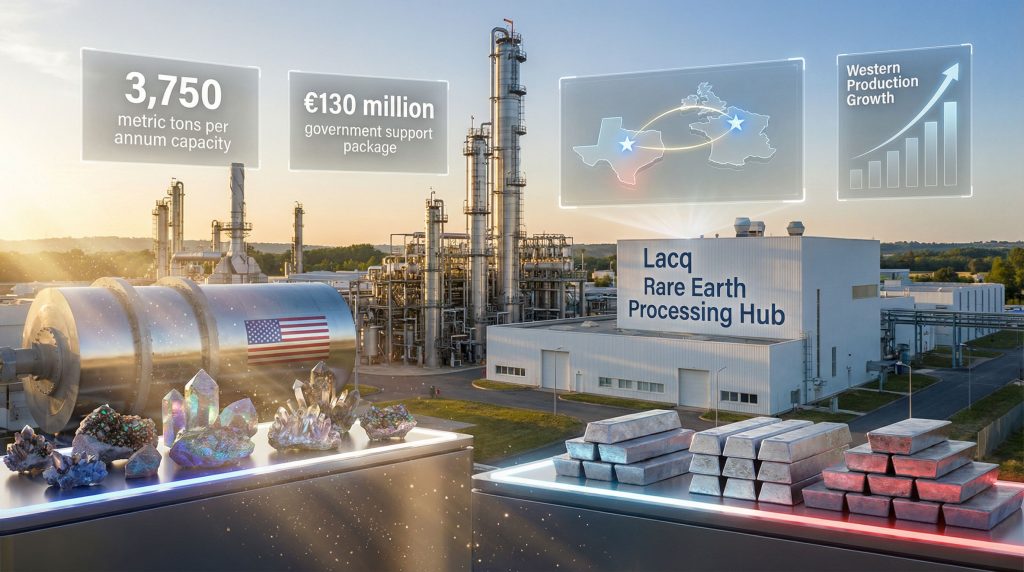
The planned LCM Europe facility in southwestern France will establish 3,750 metric tons per annum production capacity for rare earth metals and alloys. This facility will operate alongside Caremag's 1,600 metric tons per annum oxide processing and recycling plant, establishing an integrated platform for rare earth processing that addresses multiple supply chain stages within a single industrial complex.
Co-location strategy provides significant technical and economic advantages through proximity of complementary processing steps. The oxide product from Caremag's capacity feeds directly into LCM Europe's processing capability, reducing feedstock transportation costs whilst enabling shared utility infrastructure. Moreover, this integration creates processing efficiencies unavailable to facilities operating in isolation, potentially supporting premium pricing through reduced operational costs and enhanced quality control.
The timeline alignment targeting late 2026 commissioning reflects coordinated development planning between the complementary facilities. This synchronisation ensures that oxide separation capacity comes online simultaneously with metal processing capability, avoiding bottlenecks that could emerge from mismatched processing stage development. Additionally, this integrated approach demonstrates how the critical minerals strategy requires systematic rather than piecemeal facility development.
What Makes France an Optimal European Processing Hub?
Government Support Framework Analysis
French government commitment to rare earth processing infrastructure reflects strategic understanding of critical materials security. The C3IV (Crédit d'Impôt pour la Compétitivité et l'Emploi) programme provides up to 45% equipment cost coverage for LCM Europe's Lacq facility, representing substantial direct fiscal support for capital equipment procurement. This level of government backing indicates recognition that rare earth processing capabilities constitute strategic infrastructure requiring national support.
The real estate support package of up to €130 million ($152 million) for the Lacq facility represents approximately 28-30% of typical industrial facility development costs at the 3,750 mtpa production scale. Combined with the Caremag facility receiving €106 million ($124 million) in subsidies, loans, and tax incentives, total government support for the integrated Lacq rare earth processing complex exceeds €230 million.
| Government Support Elements | Value | Facility |
|---|---|---|
| Equipment Cost Coverage (C3IV) | Up to 45% | LCM Europe |
| Real Estate Support | €130M ($152M) | LCM Europe |
| Subsidies/Loans/Incentives | €106M ($124M) | Caremag |
| Total Support Package | €236M+ ($276M+) | Combined |
Workforce development commitments indicate French recognition that rare earth processing requires specialised technical skills currently unavailable in sufficient quantities within European labour markets. Government expressions of interest in supporting hiring and training programmes suggest understanding that facility success depends on developing domestic expertise in rare earth metallurgy and quality control.
Geographic and Infrastructure Advantages
The selection of Lacq in southwestern France leverages existing industrial infrastructure developed for chemical and mineral processing industries. This established foundation reduces site development risk and costs compared to greenfield facility development in regions without industrial processing experience. The presence of utility infrastructure, regulatory frameworks, and skilled workforce capabilities creates operational advantages unavailable in locations lacking industrial heritage.
Transportation networks connecting Lacq to Atlantic shipping routes provide strategic access to global rare earth supply sources whilst supporting product distribution to European manufacturing centres. Consequently, proximity to major European automotive and renewable energy manufacturing regions reduces logistics costs whilst enabling responsive customer service for permanent magnet and advanced materials applications.
The industrial zone's capacity to support simultaneous development of complementary facilities indicates infrastructure robustness that can accommodate expansion should market demand justify additional processing capacity. This scalability provides strategic flexibility for responding to evolving European rare earth demand patterns or supply chain disruptions affecting alternative processing sources, particularly as the European CRM facility model gains traction across the continent.
How Does This Partnership Address Critical Supply Chain Vulnerabilities?
Midstream Processing Gap Resolution
The rare earth oxide-to-metal conversion represents the most critical bottleneck in Western supply chains. LCM previously represented the only proven ex-China producer of rare earth metals and alloys at commercial scale, making this processing gap a strategic vulnerability where Western companies could secure separated rare earth oxides from domestic sources but remained dependent on Chinese conversion services.
The technical complexity of oxide-to-metal conversion requires specialised metallurgical expertise, advanced equipment, and precise process control to produce materials suitable for permanent magnet manufacturing. The process typically involves reducing rare earth oxide compounds to metallic form through high-temperature processing, often utilising molten salt electrolysis or other advanced metallurgical reduction techniques.
These capabilities require substantial capital investment, technical knowledge, and operational experience that few Western companies have developed. China's historical processing dominance created not only capacity constraints but quality and specification challenges for Western manufacturers. Chinese processors optimised their operations for Chinese manufacturing requirements, potentially creating compatibility issues for Western permanent magnet producers requiring different purity levels, alloy compositions, or physical forms.
However, the LCM Europe facility provides opportunity to develop processing capabilities specifically optimised for Western manufacturing requirements. This alignment with the broader energy transition and mineral security objectives demonstrates the strategic importance of the USA rare earth French connection.
Defence and Technology Sector Implications
NATO defence platforms rely extensively on high-performance permanent magnets for radar systems, guidance systems, and sensor technologies. Dependence on Chinese rare earth processing for these critical defence applications created strategic vulnerabilities that became increasingly problematic as geopolitical tensions intensified. The European processing platform provides defence contractors with supply alternatives that align with security clearance requirements and allied nation sourcing preferences.
Electric vehicle manufacturing represents one of the fastest-growing consumption categories for rare earth permanent magnets. European EV manufacturers, including German, Swedish, and French companies producing the highest volumes globally, have faced supply constraints through traditional Chinese-dependent supply chains. Furthermore, the integrated Lacq processing platform provides these manufacturers with supply alternatives that support their expansion plans whilst reducing dependence on non-allied supply sources.
"The establishment of European rare earth processing capabilities addresses strategic vulnerabilities in defence and technology sectors whilst supporting the continent's transition to sustainable energy infrastructure."
Wind turbine permanent magnets represent another major consumption category for rare earth elements, with European renewable energy expansion directly dependent on reliable materials access. The processing capabilities at Lacq support European renewable energy targets by providing domestic supply alternatives that reduce import dependencies whilst supporting climate objectives.
What Are the Competitive Dynamics This Creates?
Market Position Strengthening
USA Rare Earth's vertical integration spanning Round Top mining (Texas, 2028 production target), midstream processing (UK LCM facility plus Lacq LCM Europe facility), magnet manufacturing (Oklahoma facility), and downstream applications represents rare comprehensive integration in Western rare earth industry architecture. This positioning provides competitive advantages through supply chain control, quality assurance, and cost optimisation unavailable to companies relying on external processing arrangements.
The addition of 3,750 mtpa LCM Europe capacity plus existing UK facility capacity represents substantial expansion of Western midstream processing capabilities. This capacity expansion provides operational flexibility to serve growing demand whilst maintaining supply security for the company's integrated operations. Additionally, the processing capabilities support premium pricing through technical customisation and quality differentiation versus basic commodity production.
Strip casting technology possessed by LCM enables production of rare earth alloy products in optimised forms for downstream magnet manufacturing. This capability represents value-added processing beyond simple oxide-to-metal conversion, supporting customer lock-in through technical specialisation and potentially higher profit margins through specialised product offerings.
International Partnership Models
The Japan-France Rare Earth Corporation, formed through joint venture between Japan Organisation for Metals and Energy Security (JOGMEC) and Iwatani Corp., invested €110 million ($129 million) in the Caremag facility. This parallel investment validates France's strategic positioning as a rare earth processing hub whilst creating potential synergies between complementary processing capabilities.
The tri-nation collaboration model (Japan-France-USA) emerging through the integrated Lacq platform suggests potential templates for additional multilateral partnerships. These partnership structures could accelerate Western rare earth processing capacity development whilst distributing investment risk across multiple national stakeholders, particularly as nations develop their own critical minerals reserve strategies.
Key Partnership Elements:
• USA Rare Earth: LCM Europe facility development and midstream processing expertise
• France: Government support, infrastructure, and regulatory framework
• Japan: Capital investment through JOGMEC-Iwatani joint venture
• United Kingdom: Established LCM processing capabilities and technical knowledge
The success of this multi-nation partnership could influence similar arrangements in other critical minerals sectors. Consequently, it may establish precedents for allied nation cooperation in strategic materials processing that extends beyond rare earth elements to lithium, graphite, cobalt, and other critical materials.
How Do Geopolitical Factors Influence This Strategic Alliance?
US-Europe Critical Minerals Diplomacy
The integrated rare earth processing platform aligns with broader Western efforts to reduce Chinese critical materials dependencies whilst strengthening transatlantic supply chain resilience. This partnership demonstrates practical implementation of allied nation cooperation in strategic materials sectors, providing concrete alternatives to existing supply chain vulnerabilities that have emerged through excessive concentration of processing capabilities in single nations.
NATO allies increasingly recognise critical materials security as essential to defence capabilities and technological competitiveness. The rare earth processing partnership provides operational framework for expanding allied cooperation to other strategic materials, potentially accelerating development of comprehensive Western supply chain alternatives across multiple critical minerals categories.
Integration with existing US rare earth operations (Round Top mining, Oklahoma manufacturing) creates transatlantic supply chain architecture that strengthens both American and European materials security. This bilateral approach provides template for additional partnerships that leverage complementary national strengths whilst distributing operational risks across multiple jurisdictions.
Investment Climate and Risk Assessment
Government backing through formal programmes (C3IV) rather than ad-hoc incentives suggests policy stability across political cycles for rare earth processing infrastructure. This systematic support framework reduces regulatory risk whilst providing predictable incentive structures that support long-term capital investment decisions. Moreover, the multi-year commitment timeframe indicates governmental understanding that rare earth processing capabilities require sustained support through facility development, commissioning, and operational optimisation phases.
Currency and cross-border operational risk management becomes critical for facilities operating across multiple jurisdictions. The USA rare earth French connection requires coordination of operations, quality standards, and customer service across different regulatory environments, currencies, and business cultures. Successful management of these complexities could provide competitive advantages through operational expertise that competitors may find difficult to replicate.
The partnership structure distributes political risk across allied nations whilst maintaining operational coherence through integrated management systems. This approach reduces vulnerability to single-nation policy changes whilst preserving the efficiency benefits of coordinated operations across the integrated supply chain.
The next major ASX story will hit our subscribers first
What Does This Mean for Future Rare Earth Market Development?
Production Capacity Scaling Scenarios
European rare earth processing capacity growth projections suggest potential for additional facility development as market demand expands and supply chain security requirements intensify. The Lacq industrial zone's infrastructure capabilities could accommodate expansion should market conditions justify additional processing capacity, providing scalability that supports long-term growth objectives.
The integrated platform model (oxide processing plus metal production plus recycling) represents comprehensive approach to rare earth supply chain development that could serve as template for similar facilities in other strategic locations. Success of the Lacq platform could accelerate similar development in North America, Australia, or other allied regions seeking to establish domestic rare earth processing capabilities.
Projected European Processing Capacity Development:
• Phase 1 (2026-2028): Lacq integrated platform commissioning and optimisation
• Phase 2 (2028-2030): Potential capacity expansion based on market demand
• Phase 3 (2030+): Additional facility development in other European locations
The recycling integration within the Caremag facility creates circular economy capabilities that reduce primary mining dependence whilst creating secondary material supply streams. This approach addresses both supply security and environmental objectives, potentially supporting regulatory preferences for facilities incorporating recycling capabilities.
Technology Transfer and Innovation Implications
Knowledge sharing between US and European rare earth processing technologies creates opportunities for operational optimisation and technical innovation that benefit both sides of the partnership. The combination of LCM's established processing expertise with French industrial capabilities and US market access could accelerate development of advanced processing techniques or specialised product offerings.
Research and development collaboration opportunities emerge through the partnership structure, potentially supporting joint development of improved processing technologies, quality standards, or specialised products. These innovations could provide competitive advantages whilst advancing Western technological capabilities in rare earth processing.
Joint intellectual property development represents potential long-term value creation through the partnership. Collaborative research initiatives could produce patentable technologies or processes that strengthen the competitive position of Western rare earth processors whilst creating additional revenue streams through licensing arrangements.
Strategic Investment Considerations
Market Valuation Impact Analysis
USA Rare Earth's share performance correlation with European expansion announcements demonstrates investor recognition of the strategic value created through transatlantic supply chain integration. The $220 million LCM acquisition and subsequent European facility development represent substantial capital deployment that investors evaluate based on long-term strategic positioning rather than immediate revenue generation.
Market capitalisation growth trajectory reflects investor confidence in vertical integration strategies that provide supply chain control and competitive differentiation. The rare earth industry's strategic importance combined with limited Western processing alternatives creates premium valuations for companies achieving operational integration across multiple processing stages.
Furthermore, recent market reactions to facility announcements demonstrate how the USA rare earth French connection is viewed favourably by institutional investors seeking exposure to critical minerals security themes. Comparison with other vertically integrated rare earth companies provides context for valuation assessment, though USA Rare Earth's transatlantic integration represents relatively unique strategic positioning that may command valuation premiums versus purely domestic operations.
Risk Mitigation Through Geographic Diversification
Operational risk distribution across multiple jurisdictions provides protection against single-nation policy changes, regulatory modifications, or economic disruptions that could affect facility operations. The USA rare earth French connection creates operational flexibility to shift production emphasis between locations based on market conditions, regulatory environment, or supply chain requirements.
Supply chain resilience enhancement through dual-continent processing provides customers with supply alternatives that support their own risk management objectives. This capability becomes particularly valuable for defence contractors or critical infrastructure manufacturers requiring assured supply availability regardless of geopolitical developments.
Political risk hedging through allied nation partnerships reduces vulnerability to policy changes whilst maintaining access to government support programmes that facilitate facility development and operations. The partnership structure leverages governmental backing whilst distributing dependency risks across multiple supportive policy frameworks.
Investment Risk Assessment Matrix:
| Risk Category | Mitigation Strategy | Strategic Benefit |
|---|---|---|
| Political Risk | Allied nation partnerships | Policy stability through multiple jurisdictions |
| Operational Risk | Geographic diversification | Flexible production allocation |
| Market Risk | Vertical integration | Supply chain control and pricing power |
| Technical Risk | Established processing expertise | Proven commercial-scale capabilities |
| Financial Risk | Government support programmes | Reduced capital requirements |
Disclaimer: This analysis presents strategic scenario modelling based on publicly available information and industry research. Investment decisions should consider comprehensive risk assessment, market conditions, and individual financial circumstances. Projections regarding facility development, production capacity, and market conditions involve uncertainties that may affect actual outcomes. Readers should conduct independent research and consult qualified advisors before making investment decisions related to rare earth companies or critical minerals sectors.
Want to Stay Ahead of Critical Minerals Investment Opportunities?
Discovery Alert's proprietary Discovery IQ model delivers instant notifications on significant ASX mineral discoveries, empowering subscribers to identify actionable opportunities in critical minerals and rare earth exploration ahead of the broader market. Start your 30-day free trial today and position yourself to capitalise on the next major discovery that could transform supply chains and generate substantial returns.