July 27, 2026
Strategic Defense Imperatives Drive Critical Mineral Independence
The modern defense establishment faces an unprecedented vulnerability that transcends traditional military concerns. Advanced weapons systems, radar installations, and precision-guided munitions depend entirely on permanent magnets containing rare-earth elements that remain overwhelmingly controlled by foreign adversaries. This dependency represents a strategic miscalculation decades in the making, where cost optimisation superseded supply chain sovereignty in critical national security infrastructure.
The U.S. rare-earth supply chain presents a complex web of technological dependencies stretching from mining operations through metallurgical processing to advanced manufacturing. Unlike conventional strategic materials, rare-earth elements require sophisticated processing techniques that convert raw ores into precision alloys capable of operating under extreme conditions demanded by modern defense applications.
When big ASX news breaks, our subscribers know first
Understanding America's Critical Mineral Vulnerability
Current Supply Chain Dependencies
The American defense industrial base confronts a sobering reality across multiple stages of rare-earth production. Foreign control extends far beyond simple mining operations, encompassing the entire technological ecosystem required for advanced materials production.
Key Vulnerability Metrics:
• Mining operations remain 80% import-dependent despite domestic resource availability
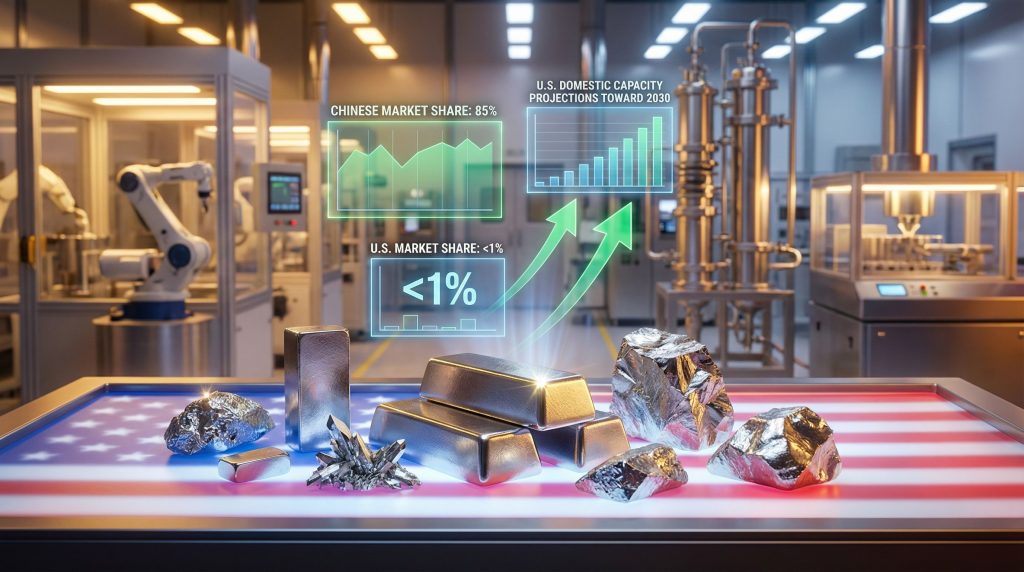
• Processing capabilities represent less than 5% of national requirements
• Metallisation capacity covers under 1% of defense manufacturing needs
• Permanent magnet production operates at virtually zero domestic capacity
These statistics reveal the magnitude of strategic miscalculation that allowed critical capabilities to migrate overseas during previous decades. Furthermore, the challenge extends beyond simple capacity building to encompass technological expertise, industrial processes, and supply chain integration across multiple production stages.
Table: Critical Rare-Earth Applications in Defense Systems
| Defense Application | Required Elements | Performance Requirements | Supply Risk Level |
|---|---|---|---|
| Missile Guidance Systems | Nd, Pr, Dy, Tb | High-temperature stability | Extreme |
| Radar Arrays | Sm, Nd, Pr | Precision magnetic fields | Critical |
| Fighter Jet Components | Dy, Tb, Ho | Extreme environment operation | Extreme |
| Submarine Sonar | Nd, Pr, Sm | Underwater pressure resistance | Critical |
The Technological Foundation of Rare-Earth Processing
Mining to Metal: Understanding the Value Chain
Rare-earth supply chains involve multiple technological stages, each requiring specialised expertise and industrial infrastructure. The complexity begins with geological extraction but extends through chemical separation, metallurgical reduction, and precision alloying before materials become suitable for defense applications.
Primary Processing Stages:
- Mineral Extraction and Concentration: Converting ore bodies into rare-earth concentrates
- Chemical Separation: Isolating individual rare-earth elements from complex mineral matrices
- Oxide Purification: Achieving 99.9%+ purity levels required for advanced applications
- Metallisation: Reducing oxides to pure metals through high-temperature chemical processes
- Alloy Development: Creating precise compositions for specific magnetic properties
Heavy Rare-Earth Processing Challenges
The most critical bottleneck involves heavy rare-earth elements including dysprosium, terbium, and holmium. These materials enable permanent magnets to operate at elevated temperatures exceeding 200°C, essential for military aircraft engines, missile systems, and advanced radar installations.
Heavy rare-earth processing requires specialised separation techniques involving solvent extraction systems, ion-exchange columns, and crystallisation processes. Consequently, the technological complexity explains why processing capabilities remain concentrated in limited geographic regions despite global mining operations.
"Metallisation represents the most technically demanding aspect of rare-earth production, requiring precise control over chemical reduction processes, temperature management, and atmospheric conditions. Without domestic metallisation capability, mining operations alone cannot provide supply chain independence."
Defense Procurement Transformation and Supply Chain Security
The 2027 Compliance Framework
Beginning in fiscal year 2027, U.S. defense procurement regulations implement comprehensive restrictions on rare-earth materials derived from foreign adversary supply chains. These requirements extend beyond simple country-of-origin restrictions to encompass entire supply chain traceability.
Compliance Requirements Include:
• Mining operations must originate from approved allied sources
• Processing facilities require security clearances and supply chain documentation
• Metallisation must occur in approved domestic or allied facilities
• Manufacturing operations need comprehensive traceability systems
• Quality control processes must meet defense specification standards
The regulatory framework creates unprecedented demand for domestic rare-earth capabilities while establishing minimum performance thresholds that challenge existing industrial capacity. In addition, the US critical minerals order has strengthened requirements for defense contractors who face significant supply chain restructuring requirements to maintain procurement eligibility.
Strategic Stockpiling and Market Stabilisation
Reports from industry sources suggest current U.S. strategic reserves contain only months of inventory for certain critical rare-earth elements. This shortage becomes particularly acute during high-tempo military operations that consume advanced weapons systems containing rare-earth permanent magnets.
Emergency Reserve Challenges:
• Limited storage capabilities for reactive rare-earth metals
• Quality degradation over extended storage periods
• Inadequate inventory diversity across heavy rare-earth elements
• Insufficient processing capacity for reserve activation
The Pentagon has implemented price floor guarantees exceeding $110,000 per tonne for rare-earth oxides, designed to provide investment certainty for domestic processing facilities. These guarantees represent a fundamental shift from market-based procurement toward strategic supply chain development, complementing the broader defense critical materials strategy.
Domestic Production Renaissance: Key Players and Capabilities
Mountain Pass Mining Operations
California's Mountain Pass facility represents the cornerstone of domestic rare-earth mining, producing over 50,000 tonnes of rare-earth concentrate annually. The operation demonstrates the geological potential for domestic production while highlighting the challenges of establishing integrated supply chains.
Recent facility upgrades have achieved on-site processing capabilities reaching 99.9% purity levels, eliminating previous requirements for overseas concentrate shipment. However, this technological advancement represents a critical step toward supply chain independence, though downstream processing bottlenecks remain significant.
Production Specifications:
• Annual capacity: 50,000+ tonnes rare-earth concentrate
• Purity levels: 99.9% rare-earth oxide equivalent
• Element composition: Predominantly light rare-earth elements
• Defense allocation: 15% government equity stake secures priority access
Utah Processing Infrastructure
The White Mesa Mill in Utah operates as the only functioning conventional uranium mill in the United States, providing unique capabilities for rare-earth processing. The facility processes monazite concentrates into separated rare-earth carbonates, bridging mining operations with downstream metallisation facilities.
Expansion plans target 60,000 tonnes annual monazite processing capacity, potentially producing 6,000 tonnes of neodymium-praseodymium oxide along with hundreds of tonnes of heavy rare-earth materials. Furthermore, this capacity expansion would significantly reduce domestic processing bottlenecks while maintaining full regulatory compliance.
Ohio Metallisation Capabilities
Advanced metallisation facilities in Ohio represent the most technically sophisticated aspect of domestic rare-earth production. These operations convert rare-earth oxides into pure metals and precision alloys required for permanent magnet manufacturing.
Current capacity includes heavy rare-earth metallisation capabilities unique within North America, producing dysprosium and terbium metals essential for high-temperature defense applications. For instance, expansion plans target 600 tonnes annual metal production capacity, supporting significant increases in domestic magnet manufacturing.
Allied Partnership Integration and Technology Transfer
North American Supply Chain Coordination
The strategic approach toward rare-earth independence emphasises North American integration rather than complete domestic self-sufficiency. This framework leverages Canadian processing expertise while maintaining U.S. manufacturing control over final products.
Canadian Processing Partnership:
• Saskatchewan Research Council operates the first fully integrated commercial rare-earth facility
• Cross-border agreements establish guaranteed supply arrangements
• Shared technology development reduces duplication of research investments
• Integrated quality control ensures defense specification compliance
Canadian facilities provide particular advantages in heavy rare-earth separation, complementing U.S. metallisation and manufacturing capabilities. The partnership creates supply chain redundancy whilst maintaining allied control over critical materials, addressing concerns about critical minerals energy security.
Australian Strategic Cooperation
Australia represents a crucial partner in rare-earth supply diversification, offering both mining resources and processing expertise. Strategic cooperation agreements facilitate technology transfer and investment flows supporting capacity expansion across both nations, including the development of an Australia strategic reserve.
Collaboration Areas:
• Joint research and development programmes for advanced separation techniques
• Investment partnerships supporting facility construction and expansion
• Technology sharing agreements for metallisation processes
• Coordinated stockpiling and reserve management systems
Australian expertise in heavy rare-earth processing complements North American mining and manufacturing capabilities, creating a comprehensive allied supply chain spanning multiple continents.
The next major ASX story will hit our subscribers first
Technical Specifications and Manufacturing Requirements
Defense-Grade Magnet Production
Military applications demand permanent magnets capable of operating under extreme environmental conditions including temperature variations, mechanical stress, and electromagnetic interference. These requirements necessitate precise alloy compositions and manufacturing processes significantly more demanding than commercial applications.
Critical Performance Specifications:
• Operating temperature range: -55°C to +200°C minimum
• Magnetic field stability: Less than 0.1% degradation over service life
• Mechanical strength: Resistance to shock and vibration per military standards
• Corrosion resistance: Extended operation in marine and aerospace environments
Meeting these specifications requires advanced powder metallurgy techniques, precision sintering processes, and specialised coating systems. The manufacturing complexity explains the significant investment requirements for establishing defense-qualified production facilities.
Quality Control and Testing Protocols
Defense applications require comprehensive testing and documentation protocols exceeding commercial standards. Each production batch must demonstrate performance characteristics through accelerated aging tests, environmental exposure simulations, and magnetic property verification.
Testing Requirements Include:
• Magnetic property measurement across full temperature ranges
• Accelerated aging studies simulating 20-year service life
• Environmental resistance testing for corrosion and degradation
• Batch traceability documentation for supply chain verification
Economic Implications and Investment Requirements
Capital Investment Challenges
Establishing comprehensive rare-earth supply chain capabilities requires substantial capital investments across multiple production stages. Individual facility costs range from hundreds of millions to several billion dollars, with payback periods extending 10-15 years under current market conditions.
Investment Requirements by Sector:
• Mining operations: $500 million to $2 billion per major facility
• Processing infrastructure: $1-3 billion for complete separation capability
• Metallisation facilities: $200-500 million for commercial-scale operations
• Magnet manufacturing: $500 million to $1 billion per large-scale facility
These capital requirements exceed typical private sector investment thresholds, necessitating government partnership and long-term procurement guarantees to achieve commercial viability. However, the integration of mining sector innovations is helping to reduce these costs.
Market Manipulation Vulnerabilities
Foreign competitors retain significant leverage to disrupt domestic rare-earth development through strategic market manipulation. Historical patterns include coordinated price warfare timed to coincide with facility commissioning, followed by supply restrictions creating artificial scarcity.
Defensive Measures Include:
• Government price floor guarantees providing revenue certainty
• Strategic stockpiling programmes reducing market vulnerability
• Long-term procurement contracts supporting facility financing
• Allied coordination preventing market isolation tactics
According to supply chain analysis, the U.S. faces critical vulnerabilities that require immediate attention through these defensive measures.
Future Scenarios and Strategic Outcomes
2030 Independence Projections
Current development trajectories suggest potential achievement of strategic rare-earth independence for defense applications by 2030, contingent on continued investment and policy support. Commercial market independence would require additional capacity expansion extending through 2035.
Projected Capacity Targets:
• Mining: 75,000+ tonnes annual concentrate production
• Processing: 50,000+ tonnes separated oxide capacity
• Metallisation: 10,000+ tonnes metal and alloy production
• Manufacturing: 25,000+ tonnes permanent magnet production
These capacity levels would provide strategic independence for defense applications whilst creating export potential for allied nations seeking supply chain diversification.
What Alternative Technologies Are Emerging?
Parallel research efforts focus on developing alternative magnetic materials reducing rare-earth element requirements. Advanced recycling technologies also offer potential for significant primary material demand reduction through circular economy approaches.
Innovation Priorities:
• Alternative magnet chemistries using more abundant materials
• Advanced recycling processes recovering rare-earth elements from end-of-life products
• Improved manufacturing efficiency reducing material waste
• Substitute materials for non-critical applications
The combination of domestic capacity building and technology innovation creates multiple pathways toward supply chain resilience. Furthermore, recent federal commitments of $250 million toward supply chain investment funds demonstrate government commitment to reducing vulnerability to foreign supply disruptions whilst maintaining technological leadership in advanced materials applications.
The U.S. rare-earth supply chain transformation represents more than industrial policy—it embodies a fundamental shift toward strategic autonomy in critical defense capabilities. Through integrated domestic capacity building, allied partnerships, and technological innovation, America can achieve supply chain independence whilst maintaining its technological edge in advanced materials applications.
This analysis presents strategic considerations for rare-earth supply chain development and should not be construed as investment advice. Investors should conduct comprehensive due diligence and consult qualified financial advisors before making investment decisions involving critical mineral companies or defense supply chain investments.
Ready to Invest in the Critical Minerals Revolution?
Discovery Alert's proprietary Discovery IQ model delivers real-time alerts on significant ASX mineral discoveries, instantly empowering subscribers to identify actionable opportunities ahead of the broader market as nations scramble to secure critical mineral supply chains. Begin your 14-day free trial today and understand why historic discoveries can generate substantial returns by positioning yourself ahead of the market.