
July 27, 2026
Strategic Dependencies in Modern Trade Architecture
China EU trade relations face unprecedented pressure as global supply chains encounter significant restructuring challenges across major economic powers. Furthermore, the interconnected nature of modern manufacturing creates cascading effects when export controls and regulatory frameworks shift rapidly. Understanding these dynamics requires examining how businesses adapt to changing geopolitical landscapes while maintaining operational efficiency.
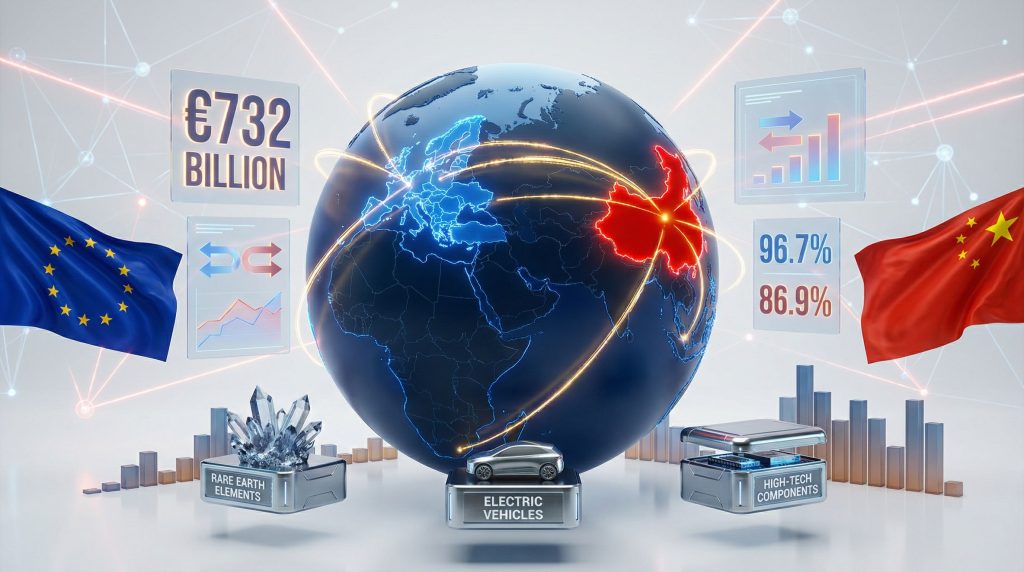
The foundation of contemporary EU-China commercial relationships rests on substantial bilateral flows that reached €732 billion in total goods trade during 2024. This massive exchange volume encompasses complex interdependencies that extend beyond simple import-export calculations into structural economic arrangements.
European markets demonstrate significant reliance on Chinese manufacturing capacity, with 96.7% of Chinese imports consisting of manufactured goods compared to 86.9% of EU exports in the same category. This asymmetry reflects deeper supply chain integration patterns where European companies source components, intermediate goods, and finished products from Chinese facilities.
The €305.8 billion trade deficit experienced by European markets represents more than statistical imbalance. Consequently, it indicates fundamental differences in production costs, manufacturing scale, and consumer demand patterns that shape modern China EU trade relations. Meanwhile, services trade flows in the opposite direction, generating a €21.7 billion surplus for European providers.
Manufacturing Sector Concentration Patterns
Machinery and vehicle sectors dominate bilateral trade flows, accounting for 55% of Chinese exports to European markets and 51% of EU exports to China. This concentration creates vulnerability points where supply disruptions or policy changes generate disproportionate economic impacts across both regions.
German automotive manufacturers exemplify these interdependencies through their extensive Chinese operations and supply relationships. Premium vehicle production requires components from multiple Chinese suppliers while targeting Chinese consumers for significant revenue portions. However, when export controls or trade tensions escalate, these integrated operations face complex navigation challenges.
The high-volume, low-margin characteristics of many Chinese imports contrast sharply with specialized, high-value European exports. In addition, this dynamic shapes competitive positioning where European companies compete on innovation, quality, and technical sophistication rather than production costs.
When big ASX news breaks, our subscribers know first
Critical Materials and Supply Chain Vulnerabilities
Rare earth elements represent strategic leverage points in contemporary China EU trade relations, encompassing 17 critical elements essential for modern technology production. These materials enable smartphone functionality, electric vehicle performance, aerospace systems, and defense equipment capabilities across global supply chains.
Beijing's export controls on rare earth materials, implemented in April 2025, demonstrated the effectiveness of strategic resource management in international negotiations. According to industry analysis, these controls succeeded in forcing diplomatic engagement while highlighting European vulnerability to critical minerals security disruptions.
European companies experienced significant operational and financial damage while navigating these export restrictions. Jens Eskelund, president of the European Union Chamber of Commerce in China, characterised European firms as becoming "collateral damage in disputes not triggered by European actions".
Technology Sector Impact Assessment
Smartphone manufacturing requires rare earth elements for display screens, battery systems, and processing components. Furthermore, European technology companies faced production delays and increased costs when sourcing these essential materials under export control regimes.
Electric vehicle production demonstrates particular vulnerability due to battery technology dependence on lithium, cobalt, and rare earth permanent magnets. For instance, European automotive manufacturers developing electric vehicle capabilities require reliable access to lithium industry innovations for competitive market positioning.
Defense and aerospace systems rely on rare earth elements for radar systems, guidance equipment, and advanced materials applications. Consequently, export controls on these materials create national security considerations beyond commercial disruption for European governments and defense contractors.
Strategic Autonomy Development Requirements
European policymakers increasingly recognise the limitations of reactive positioning in major power trade negotiations. The European Union Chamber of Commerce in China explicitly urged Brussels to avoid becoming a passive recipient of US-China trade war arrangements that affect European commercial interests.
The chamber's report emphasised that Europe cannot simply wait for others to resolve trade disputes impacting European companies. This positioning reflects growing awareness that European economic interests require proactive diplomatic and commercial engagement rather than accepting outcomes determined by other parties.
Three-Pillar China Strategy Framework
European Union policy toward China operates through cooperation, competition, and rivalry elements simultaneously. This multi-dimensional approach attempts to balance commercial opportunities with strategic concerns about market access, intellectual property protection, and fair competition conditions.
Cooperation elements focus on climate change, global health, and multilateral trade governance where shared interests enable productive collaboration. However, competition aspects address market access reciprocity, technology transfer requirements, and regulatory transparency in commercial relationships.
Rivalry components involve strategic industries, defense technologies, and critical infrastructure where national security considerations override pure commercial calculations. Furthermore, this framework requires sophisticated implementation to maintain beneficial China EU trade relations while protecting essential European interests.
Level Playing Field Demands
European negotiators consistently emphasise reciprocity mechanisms in market access arrangements. While Chinese companies can acquire European firms, invest in European infrastructure, and access European public procurement opportunities, European companies face significant restrictions in corresponding Chinese markets.
Industrial policy responses to Chinese subsidies and overcapacity issues reflect European concerns about fair competition conditions. In addition, state-supported Chinese companies can offer below-market pricing that undermines competitive dynamics in global markets.
Sectoral Trade Defense Mechanisms
Anti-dumping investigations represent primary European tools for addressing unfair trade practices. Current European Commission investigations encompass biodiesel imports, tinplate steel products, and construction machinery where evidence suggests below-cost pricing designed to capture market share.
Chinese retaliatory measures include counter-duties on European agricultural exports, particularly affecting pork products beginning September 2025. Dairy product imports face potential duties up to 43%, demonstrating Chinese capacity for proportional responses to European trade defense actions.
WTO Compliance Considerations
Trade dispute escalation patterns increasingly test World Trade Organization frameworks for resolution. Both European and Chinese measures require WTO compliance, but enforcement mechanisms face challenges when major trading partners implement competing interpretations of international trade rules.
The organisation's dispute settlement system experiences significant backlogs and procedural challenges that limit effective resolution of complex trade conflicts. Consequently, this reality forces trading partners toward bilateral negotiations rather than multilateral arbitration for dispute resolution.
Electric Vehicle Market Competition
Battery technology supply chain dependencies create particular vulnerabilities for European electric vehicle manufacturers. Lithium processing capacity, battery cell production, and charging infrastructure development require materials and components largely controlled by Chinese suppliers.
Market access issues affect European automotive companies seeking to establish manufacturing operations or sales networks in Chinese markets. Furthermore, regulatory requirements, joint venture mandates, and technology transfer expectations create barriers that Chinese companies do not face in European markets.
Clean energy transition dependencies extend beyond electric vehicles into solar panel production, wind turbine components, and energy storage systems. European green technology companies require stable access to Chinese supply chains while developing alternative sourcing strategies.
Geopolitical Spillover Effects
Trump administration Liberation Day tariffs triggered Chinese export control responses that affected European companies despite their lack of involvement in US-China trade war disputes. This dynamic illustrates how major power conflicts create unavoidable consequences for third-party commercial relationships.
Trade diversion risks emerge when tariffs global impact redirect Chinese exports toward European markets, potentially disrupting competitive balances and pricing structures. European companies face increased competition from Chinese firms seeking alternative market opportunities following US market access restrictions.
Investment Agreement Stalemate
The 2020 Comprehensive Agreement on Investment between the European Union and China remains unratified due to political obstacles and changing strategic priorities. Parliamentary ratification faces significant opposition from members concerned about human rights issues and strategic dependency risks.
Alternative bilateral engagement mechanisms include sector-specific agreements, technical cooperation frameworks, and city-to-city commercial partnerships that bypass comprehensive investment treaty requirements. In addition, these approaches enable continued commercial collaboration while avoiding contentious political ratification processes.
Future Relationship Trajectories
The $800 billion trade milestone represents approximately 30% of global trade flows, indicating the systemic importance of China EU trade relations for worldwide economic stability. This volume creates mutual dependence that constrains aggressive policy actions despite political tensions.
Leadership visits and dialogue commitments scheduled for July 2025 provided opportunities for strategic recalibration following trade tensions escalation. These high-level engagements focused on establishing communication mechanisms for managing future disputes without complete relationship breakdown.
Long-term Strategic Positioning
Economic security prioritisation frameworks increasingly influence European policy toward China. While commercial benefits remain important, strategic autonomy considerations and supply chain security concerns receive greater weight in policy formulation through initiatives like the critical minerals order.
Complementarity versus competition balance requires sophisticated management as both regions develop advanced manufacturing capabilities and technology sectors. Areas of natural complementarity include European precision engineering with Chinese mass production capacity.
Beijing's engagement increase among EU capitals reflects Chinese recognition that member state relationships require cultivation alongside Brussels-level diplomacy. Furthermore, this approach acknowledges European Union decision-making complexity and varied national interests within the union.
The next major ASX story will hit our subscribers first
Business Navigation Strategies
European companies operating in Chinese markets or dependent on Chinese supply chains require comprehensive risk mitigation frameworks. Supply chain diversification initiatives spread sourcing across multiple countries and suppliers to reduce single-point failure vulnerabilities.
Regulatory compliance frameworks must address both European and Chinese requirements while anticipating potential policy changes that could affect operational permissions or market access rights. Legal compliance systems require regular updates to track evolving regulatory environments.
Opportunity Identification Methods
Services sector surplus expansion potential exists in financial services, consulting, technology licensing, and intellectual property development where European companies maintain competitive advantages. These sectors face fewer physical supply chain vulnerabilities than manufacturing operations.
Technology transfer and joint venture structures enable market access while sharing risks with Chinese partners who understand local regulatory requirements and consumer preferences. However, these arrangements require careful intellectual property protection and technology sharing agreements.
Third-market cooperation possibilities include joint projects in developing countries where European technology expertise combines with Chinese manufacturing capacity and financing capabilities. Infrastructure development, renewable energy projects, and telecommunications systems represent collaborative opportunities.
Risk Management Frameworks
Market access optimisation approaches require understanding Chinese regulatory systems, consumer preferences, and competitive dynamics. European companies successful in Chinese markets typically invest significant resources in local relationship building and cultural adaptation.
Financial hedging strategies address currency volatility, trade policy uncertainty, and market access risks through diversified revenue streams and flexible operational structures. Companies maintain contingency plans for rapid market exit or supply chain reconfiguration if conditions deteriorate.
Scenario planning exercises help management teams prepare for various trade relationship outcomes, from continued integration to significant decoupling pressures. Consequently, these exercises identify critical decision points and resource requirements for different strategic pathways.
Disclaimer: This analysis contains forward-looking statements and strategic assessments that involve inherent uncertainties. Trade relationships, regulatory frameworks, and geopolitical conditions can change rapidly, affecting the relevance and accuracy of strategic projections. Readers should consult current official sources and professional advisors before making business decisions based on this information.
Are You Tracking Global Trade Disruptions That Could Impact Your Portfolio?
European supply chain vulnerabilities in critical minerals and rare earth elements highlight the urgent need for investors to monitor geopolitical developments that affect commodity markets. Discovery Alert's proprietary Discovery IQ model delivers real-time alerts on significant ASX mineral discoveries, helping investors identify opportunities in critical minerals sectors that could benefit from global supply chain restructuring. Begin your 14-day free trial today to stay ahead of market-moving mineral discoveries and secure your competitive advantage in an increasingly complex global trading environment.