June 15, 2026
Strategic Dependencies in Critical Materials Supply Chains
The global race for supply chain independence in critical materials has entered a complex new phase, where traditional competitive frameworks no longer capture the full strategic picture. As nations pursue diversification away from single-source dependencies, they increasingly find themselves navigating competing dependencies rather than achieving true autonomy. This phenomenon appears particularly pronounced in rare earth elements, where the intersection of geological scarcity, processing complexity, and geopolitical manoeuvring creates multi-layered vulnerability matrices that defy simple solutions.
The European Union's recent strategic positioning exemplifies this challenge perfectly. After years of acknowledging dangerous over-reliance on Chinese rare earth processing capabilities, European policymakers have launched ambitious domestic capacity-building initiatives. Yet the very urgency of this transition has opened new vectors for dependency, as external capital and expertise flow into European assets faster than domestic alternatives can be developed. Moreover, the EU's rare earth dependency on United States has emerged as a significant concern for strategic planners.
When big ASX news breaks, our subscribers know first
Understanding Europe's Critical Minerals Vulnerability Matrix
The Strategic Minerals Dependency Framework
Critical rare earth elements form the technological backbone of modern industrial economies, yet their supply chains remain among the most concentrated and vulnerable in global commodity markets. The European Commission's 2023 Critical Raw Materials Assessment identified 34 raw materials as critical to EU economic security, with rare earth elements ranking among the highest-risk categories due to their 100% import dependency across all 17 rare earth elements.
The distinction between light rare earth elements (LREEs) and heavy rare earth elements (HREEs) reveals the complexity underlying seemingly simple dependency statistics. LREEs, including cerium, lanthanum, and neodymium, comprise approximately 80% of global production and serve as essential inputs for renewable energy technologies, electric vehicle motors, and consumer electronics. HREEs, including dysprosium, terbium, and yttrium, represent only 20% of production volumes but prove indispensable for high-temperature applications in aerospace, defence systems, and advanced medical equipment.
| Element Category | Global Production Share | Primary Applications | Supply Concentration |
|---|---|---|---|
| Light REEs | 80% | Wind turbines, EV motors, magnets | China: 85-90% |
| Heavy REEs | 20% | Defence systems, aerospace, MRI | China: 95%+ |
| Processing Capacity | 100% | Separation, refining, alloying | China: 85-95% |
How Geopolitical Supply Chains Create Strategic Dependencies
The architecture of rare earth dependency extends far beyond simple extraction statistics. Furthermore, supply chain vulnerability operates across four distinct stages:
• Mining stage: Initial extraction of ore containing rare earth oxides
• Separation/refining stage: Chemical processing to isolate individual rare earth elements
• Alloying stage: Creating functional materials combining rare earths with other metals
• Manufacturing stage: Integration into final industrial products
China controls approximately 85-90% of global rare earth separation and processing capacity, making the second stage the true chokepoint in global supply chains. This processing dominance represents a far more significant strategic vulnerability than raw material access alone, as separation facilities require massive capital investment, specialised technical expertise, and complex environmental management systems.
Europe currently lacks meaningful capacity at separation and alloying stages, making it vulnerable regardless of potential raw material access through northern European mining projects.
The environmental sensitivity of rare earth processing creates additional barriers to rapid capacity scaling. In addition, separation processes generate substantial radioactive waste streams and require sophisticated water treatment systems, making regulatory approval timelines lengthy and uncertain across most developed economies.
What Is the Current Scale of EU's US Rare Earth Dependency?
Quantifying Direct US-EU Rare Earth Trade Flows
Current bilateral trade flows between the United States and European Union in rare earth materials remain relatively modest, reflecting the nascent state of US processing capabilities rather than lack of strategic interest. The United States exported approximately 8,000-12,000 tonnes of rare earth elements globally in 2023, with EU markets representing a portion of these volumes, though specific bilateral flows are not disaggregated in public trade statistics.
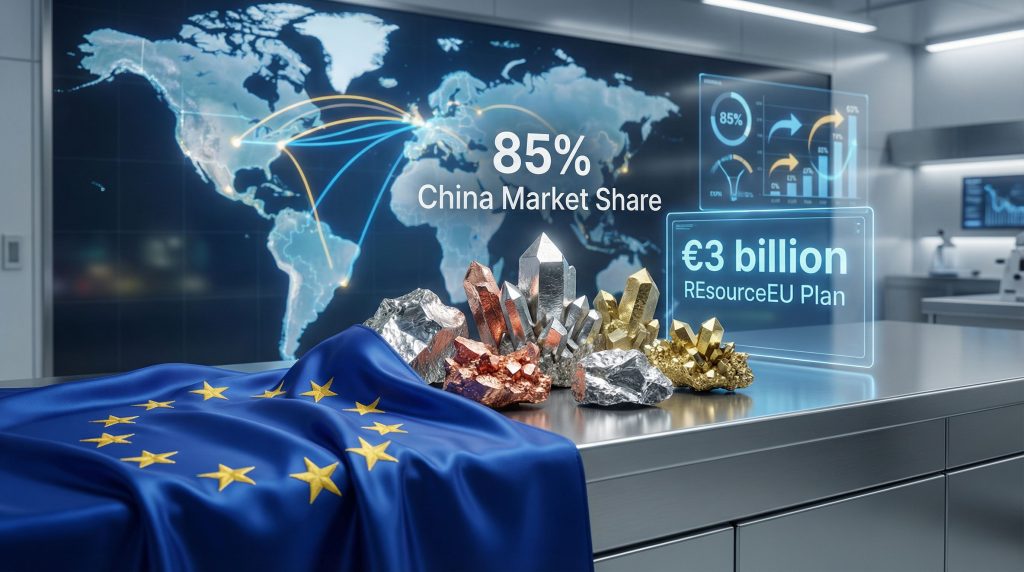
China supplied approximately 85-98% of EU rare earth imports in 2023, maintaining overwhelming market dominance despite European diversification efforts. This concentration reflects both China's processing monopoly and the technical complexity of establishing alternative separation capabilities within politically acceptable timeframes.
| Supplier Country | Market Share | Primary Products | Supply Security |
|---|---|---|---|
| China | 85-98% | All REE categories | High volume, political risk |
| United States | 2-5% | Limited processing | Growing capacity, allied |
| Australia | 1-3% | Raw materials only | Reliable, no processing |
| Others | <2% | Specialty applications | Minimal volumes |
The United States currently operates only one commercial rare earth mine at Mountain Pass, California, producing approximately 50,000 tonnes annually of rare earth ore concentrate. However, US separation capacity remains extremely limited, with most American production requiring further processing in China before reaching final markets.
Indirect Dependencies Through US Corporate Acquisitions
The strategic significance of US rare earth dependency emerges not through current trade flows but through systematic acquisition of European processing assets. USA Rare Earth LLC's acquisition of Less Common Metals (LCM) represents the most visible example of this trend, removing one of Europe's few midstream processing capabilities from European control.
LCM's Swindon, UK facility operated as one of Europe's primary sources of rare earth alloys and metals, serving automotive, aerospace, and renewable energy sectors. The facility represented approximately 15-20% of European midstream processing capacity, making its loss strategically significant despite relatively modest absolute volumes.
Pentagon-backed financing through Defense Production Act (DPA) mechanisms has facilitated multiple US acquisitions of critical minerals assets globally. Consequently, while specific DPA allocations are not publicly disaggregated by transaction, total DPA spending on rare earths has increased from approximately $100-200 million annually in 2020-2021 to an estimated $500+ million annually by 2024.
The LCM acquisition removes a critical link in European magnet production supply chains, forcing EU manufacturers to source alloys from remaining European producers at premium prices, rely on imports from US-controlled or Chinese suppliers, or invest in new midstream capacity requiring years of development time.
Why Is the EU Concerned About Swapping China Dependence for US Dependence?
The Strategic Autonomy Doctrine in Critical Materials
European strategic autonomy doctrine, codified in the EU's 2022 Strategic Compass, defines the goal as maintaining the capacity to act autonomously while upholding cooperation with partners. Applied to critical minerals, this framework explicitly rejects single-source dependencies regardless of the supplier's political alignment or alliance status.
The €3 billion REsourceEU initiative establishes specific metrics for reducing external dependencies:
• 10% domestic extraction of critical minerals by 2030
• 40% processing capacity domestically controlled by 2030
• 15% recycling contribution to total supply by 2030
These targets recognise that meaningful supply chain independence requires controlling multiple stages of production rather than focusing exclusively on mining development. Furthermore, this comprehensive approach relates to broader critical minerals strategy frameworks being developed globally.
Comparing Dependency Risk Profiles: China vs. United States
Historical precedent provides clear evidence for European concerns about single-source supplier risks. China imposed rare earth export quotas in 2010, reducing global supplies by 30-40% and dramatically raising prices across all rare earth categories. In 2023, China restricted exports of gallium and germanium, demonstrating continued willingness to use critical materials as geopolitical leverage.
Russia's natural gas restrictions during 2022 provided an even more direct lesson for European policymakers. Pre-2022, the EU sourced approximately 40% of its natural gas from Russia, creating acute vulnerability when supply relationships deteriorated due to geopolitical conflict.
| Dependency Scenario | Control Mechanism | Historical Precedent | Supply Security Risk |
|---|---|---|---|
| China Dominance | Export quotas, state control | 2010 export restrictions | High political risk |
| US Dependence | Market acquisition, DPA funding | Limited historical restrictions | Moderate political risk |
| EU Independence | Domestic capacity building | No precedent at scale | Technical/financial risk |
The United States has not historically restricted rare earth exports to EU allies, but maintains authority to do so under Defense Production Act provisions and national security regulations. The fundamental risk lies not in likely US export restrictions but in concentrated dependency on any single external supplier. Recent developments such as the US critical minerals order further highlight these strategic considerations.
Bernd Schaefer, CEO of EIT RawMaterials, emphasised this concern, noting that Europe risks replacing Chinese supply chain hegemony with American hegemony rather than achieving meaningful diversification. He highlighted that while European strategies have focused on ambition, the US has moved more aggressively on practical deal-making and asset acquisition.
Market-Driven vs. Mercantilist Supply Control
China employs mercantilist extraction through state-owned enterprises and strategic export quotas designed to maintain domestic processing advantages. This model creates political rather than purely economic supply relationships, making European buyers vulnerable to non-commercial decision-making.
The US employs market-driven acquisition strategies, purchasing strategic assets through private capital supported by government financing mechanisms. While this approach appears more commercially rational, it ultimately creates similar single-source dependency risks for third parties.
The critical distinction lies in strategic intent. US rare earth strategy focuses on rebuilding domestic supply chain capabilities rather than controlling global supply flows. However, the practical effect for European buyers may prove similar if US-controlled assets prioritise American customers during supply constraints. These dynamics are exemplified in recent US‐China trade war impacts on supply chain restructuring.
How Are US Acquisitions Reshaping Europe's Rare Earth Landscape?
The Less Common Metals (LCM) Acquisition Case Study
USA Rare Earth's acquisition of Less Common Metals represents a microcosm of broader strategic competition for European rare earth assets. LCM's facility served automotive, aerospace, and renewable energy customers across Europe, producing intermediate products essential for permanent magnet manufacturing.
The transaction significance extends beyond LCM's modest absolute capacity. Europe possessed only a handful of midstream processing facilities, making each asset strategically important regardless of individual scale. Loss of LCM forces European manufacturers into three challenging alternatives:
• Source alloys from remaining EU producers at premium prices
• Accept imports from US-controlled or Chinese suppliers
• Invest in new midstream capacity requiring 3-5 year development timelines
Pentagon backing through Defense Production Act mechanisms facilitated the acquisition, though specific funding allocations remain undisclosed in public records. This model allows US acquirers to compete with premium valuations while maintaining strategic rather than purely commercial acquisition criteria.
Mapping US Capital Flows into European Critical Minerals
US-based private equity and venture capital firms have systematically increased investment in European critical minerals projects, creating indirect dependency relationships even where formal acquisitions do not occur. Investment flows target companies developing separation technology, recycling processes, and mining industry innovation across multiple European jurisdictions.
The investment pattern reflects strategic rather than opportunistic capital allocation. US investors focus on midstream processing capabilities and technological expertise rather than raw material extraction projects, suggesting coordinated efforts to build supply chain control points.
European venture capital markets have proven unable to match US capital availability and risk tolerance for long-development-cycle critical minerals projects. This financing gap creates systematic vulnerability to external acquisition regardless of European regulatory frameworks or strategic preferences.
What Are the Economic and Security Implications for Europe?
Industrial Competitiveness in the Green Transition
European green transition targets require massive increases in rare earth element consumption across renewable energy technologies. Wind turbines require approximately 200-400 kg of rare earth elements per MW of capacity, while electric vehicle motors consume 1-2 kg of neodymium per vehicle.
The European Green Deal establishes targets for 42.5% renewable energy by 2030, implying substantial increases in rare earth demand precisely when supply chain dependencies create maximum strategic vulnerability. Cost implications of supply chain dependencies compound over time as downstream manufacturers face limited supplier alternatives.
| Technology Sector | REE Intensity | EU Demand Growth | Dependency Risk |
|---|---|---|---|
| Wind Power | 200-400 kg/MW | 300% by 2030 | Critical |
| Electric Vehicles | 1-2 kg neodymium/vehicle | 1000% by 2030 | High |
| Solar Panels | Minimal REE content | 400% by 2030 | Low |
Defence and Aerospace Security Considerations
European defence applications require specific rare earth elements for guidance systems, radar equipment, and advanced propulsion technologies. Heavy rare earth elements prove particularly critical for high-temperature military applications, representing the most supply-constrained segment of rare earth markets.
NATO supply chain resilience requirements mandate allied nations maintain access to critical materials during extended conflict scenarios. Current European rare earth dependencies create potential vulnerabilities in defence industrial base capacity, particularly for precision-guided munitions and electronic warfare systems.
The Ukraine conflict has demonstrated the strategic importance of sustained defence production capabilities, making rare earth supply security a national security priority rather than purely economic consideration. These concerns align with broader discussions about establishing a critical raw materials facility to enhance European supply security.
The next major ASX story will hit our subscribers first
Which European Projects Could Reduce US Dependency?
Domestic Mining Development Pipeline
Norway's rare earth projects represent the most advanced European mining initiatives, with multiple deposits in various stages of environmental approval and financing. Swedish mining operations face longer development timelines due to environmental challenges and indigenous land rights considerations.
| Project Location | Development Stage | Estimated Production | Timeline to Production |
|---|---|---|---|
| Norway (Various) | Environmental approval | 10,000-15,000 tpa REO | 2027-2030 |
| Sweden (Kiruna region) | Early exploration | 5,000-8,000 tpa REO | 2030+ |
| Estonia (Sillamäe) | Pilot operations | 2,000-3,000 tpa REO | 2026-2028 |
| France (Various) | Feasibility studies | <1,000 tpa REO | 2030+ |
The production timelines assume successful environmental approvals and adequate financing, both of which remain uncertain given European regulatory complexity and limited domestic venture capital availability for mining projects.
Processing and Separation Capacity Building
European separation facility development requires substantially more capital and technical expertise than mining operations. Separation plants typically require $300-500 million initial investment and 4-6 year construction timelines, making rapid capacity scaling challenging even with adequate funding.
Technology transfer agreements with non-US partners offer potential pathways for acquiring separation expertise without creating new dependencies. Australian and Canadian companies possess relevant technical capabilities while maintaining strategic alignment with European interests.
Recycling infrastructure development presents more immediate opportunities for reducing import dependencies. Urban mining of rare earth elements from electronic waste requires less complex separation processes and generates fewer environmental concerns than primary processing.
How Might US-EU Rare Earth Competition Evolve?
Scenario Planning for Transatlantic Supply Chain Rivalry
Three primary scenarios capture the range of potential US-EU rare earth relationships over the next decade:
Cooperative Scenario: Joint US-EU supply chain resilience initiatives create complementary rather than competing capabilities. European mining feeds US separation facilities while US technology supports European processing development. This scenario requires explicit policy coordination and shared investment frameworks.
Competitive Scenario: Zero-sum competition for global rare earth assets drives premium valuations and duplicate capacity investment. European and US companies compete aggressively for the same mining projects and processing expertise, creating inefficient capital allocation and supply chain redundancy.
Crisis Scenario: Export restrictions and supply chain weaponisation emerge during geopolitical stress. Both regions prioritise domestic customers over allied nations, creating acute supply disruptions and forcing emergency capacity development.
Investment Flow Predictions and Market Dynamics
Current market dynamics suggest accelerating premium valuations for European-controlled rare earth assets. US capital availability and Pentagon backing create systematic competitive advantages in acquisition processes, driving European asset prices above purely commercial valuations.
European policymakers face a narrow window for securing domestic control over critical assets before market dynamics make acquisition prohibitively expensive. The REsourceEU plan provides €3 billion in public funding, but this allocation may prove insufficient if US private capital continues aggressive acquisition strategies. Furthermore, concerns about European complacency on rare earths highlight the urgency of action.
If European firms cannot secure domestic financing, US buyers will acquire critical processing assets, and Europe's midstream capabilities will gradually migrate to external control through individual transactions.
Policy Response Options for European Decision-Makers
European decision-makers possess several regulatory and financial tools for maintaining strategic asset control:
• Foreign Investment Screening: Enhanced review mechanisms for critical sector acquisitions
• State Aid Frameworks: Accelerated funding for domestic rare earth capacity development
• Technology Transfer Controls: Restrictions on separation technology exports
• Strategic Stockpiling: Government procurement supporting domestic production
The effectiveness of these measures depends on coordination across EU member states and willingness to accept higher short-term costs for long-term supply security. According to industry analysis, Europe must guard against US dominance in rare earths to maintain strategic autonomy.
Key Takeaways for Stakeholders and Investors
Strategic Recommendations for European Policymakers
European policymakers must balance foreign investment benefits against strategic autonomy objectives through carefully calibrated policy frameworks. Accelerated domestic capacity building represents the most sustainable approach to reducing dependencies, but requires patient capital and realistic timeline expectations.
| Policy Tool | Effectiveness | Implementation Timeline | Trade-offs |
|---|---|---|---|
| Investment Screening | High for blocking acquisitions | Immediate | May reduce foreign investment |
| Public Funding | Medium for capacity building | 2-5 years | High fiscal costs |
| Technology Controls | Low without enforcement | 6-12 months | May limit innovation |
| Strategic Stockpiling | High for crisis resilience | 1-2 years | Ongoing storage costs |
Investment Implications for Critical Minerals Markets
Investment opportunities in European rare earth assets will likely generate premium valuations as strategic competition intensifies. Risk-return profiles favour midstream processing capabilities over raw material extraction due to higher barriers to entry and greater strategic value.
Market opportunities in processing and recycling technologies offer attractive returns combined with strategic importance. Companies developing separation efficiency improvements or urban mining capabilities should benefit from both commercial demand and policy support.
Disclaimer: Investment in critical minerals projects involves substantial risks including regulatory delays, technical challenges, and market volatility. This analysis represents current market conditions and policy frameworks, which may change significantly over relevant investment timelines.
Long-term Outlook for EU Rare Earth Independence
Realistic expectations for European rare earth independence suggest partial rather than complete dependency reduction over the next decade. The REsourceEU plan's targets of 10% domestic extraction and 40% domestic processing by 2030 represent ambitious but achievable goals given adequate financing and regulatory support.
Success metrics should focus on diversified supply relationships rather than complete independence. Reducing single-source dependencies while maintaining economic efficiency requires sophisticated portfolio approaches to supply chain management.
The EU's rare earth dependency on United States represents a transitional challenge rather than a permanent strategic problem, provided European policymakers maintain focus on long-term capacity building while managing short-term acquisition competition. Consequently, the outcome depends critically on European ability to accelerate domestic investment and maintain political consensus for patient capital deployment in complex industrial projects.
Ready to invest in the next major mineral discovery?
Discovery Alert's proprietary Discovery IQ model delivers real-time alerts on significant ASX mineral discoveries, instantly empowering subscribers to identify actionable opportunities ahead of the broader market. Understand why major mineral discoveries can lead to significant market returns by exploring Discovery Alert's dedicated discoveries page, showcasing historic examples of exceptional outcomes, and begin your 30-day free trial today to position yourself ahead of the market.