July 24, 2026
Strategic Energy Dependencies in an Interconnected World
Global supply chain resilience depends on diversified sourcing strategies that minimise single-point-of-failure risks across critical commodity sectors. When energy infrastructure becomes concentrated through specific geographic routes, systemic vulnerabilities emerge that can trigger cascading economic disruptions far exceeding the immediate impact of supply constraints. These dependencies create complex risk matrices where geopolitical stability directly influences domestic economic performance.
The interconnected nature of modern energy markets means that regional conflicts can instantly reshape global pricing mechanisms and force rapid strategic realignments. Countries with concentrated import dependencies face particular exposure to supply route disruptions, requiring comprehensive contingency planning frameworks that address both immediate crisis response and long-term structural adaptation.
When big ASX news breaks, our subscribers know first
Japan's Critical Energy Architecture Vulnerability
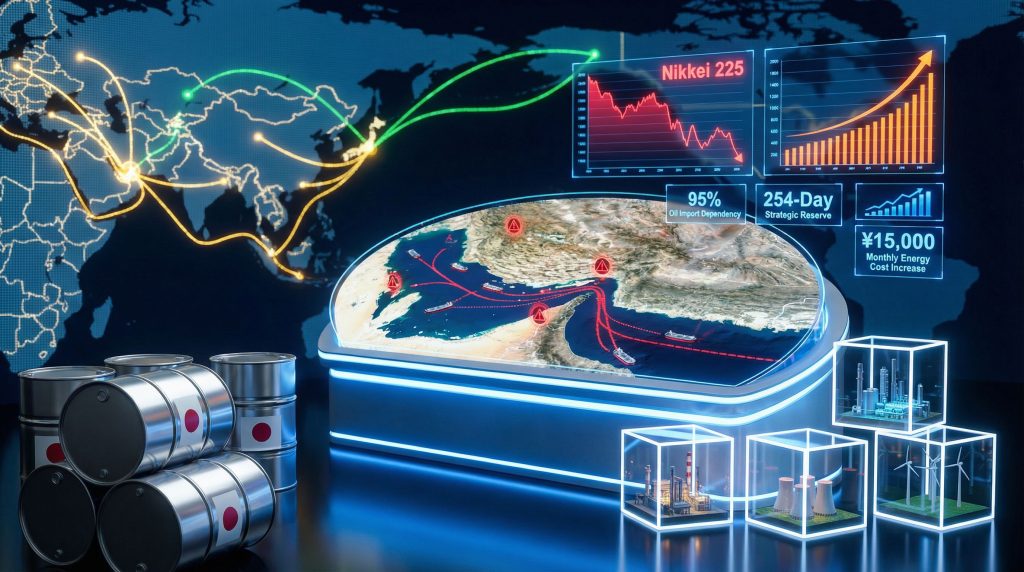
Japan's energy crisis due to Strait of Hormuz closure represents one of the world's most concentrated import structures, creating extraordinary vulnerability to single chokepoint closures. The nation imports over 90% of its crude oil requirements, with approximately 95% of Middle Eastern supplies transiting through the Strait of Hormuz before reaching Japanese refineries.
Critical Dependency Metrics:
| Energy Source | Import Dependency | Geographic Concentration |
|---|---|---|
| Crude Oil | 90%+ total imports | 95% via Hormuz transit |
| LNG Supply | 11% from Middle East | 30-40% total electricity generation |
| Strategic Reserves | 254-day theoretical capacity | 45-50 day crisis deployment |
| Transit Timeline | 20-day Gulf to Japan | Single maritime route dependency |
This concentration creates amplified risk scenarios where infrastructure disruptions generate immediate economic transmission effects rather than gradual adjustment periods. Furthermore, the strategic petroleum reserve system operates with dual-component management involving both national stockpiles and private commercial inventory coordination.
Japan's refinery infrastructure demonstrates additional vulnerability concentration, with major processing facilities like the Keihin refinery specifically configured for Middle Eastern crude inputs. This technical specialisation means that alternative supply sources require both sourcing diversification and potential infrastructure modification.
Financial Market Shock Transmission Mechanisms
Equity Market Volatility Patterns
Japan's energy crisis due to Strait of Hormuz closure has triggered significant financial market disruptions, with the Nikkei 225 experiencing double-digit declines within weeks of the crisis onset. This rapid market response demonstrates how energy security concerns translate directly into investor confidence erosion across multiple sectors.
Economic Projection Framework:
- 2026 GDP Growth: 0.8% baseline projection (IMF consultation, April 2026)
- Crisis Scenario: Potential 3% economic contraction if fuel disruptions persist
- Service Sector Confidence: Lowest levels since pandemic period
The financial transmission operates through multiple channels simultaneously. Energy-intensive manufacturing sectors face immediate margin compression as input costs surge beyond historical ranges. In addition, corporate bond markets demonstrate risk differentiation, with spreads widening significantly for manufacturing and transportation companies facing uncertain energy cost trajectories.
Banking sector stress indicators suggest secondary impact development, where corporate loan performance deteriorates as businesses struggle with elevated operational costs. Similarly, insurance markets experience claims multiplication across business interruption, cargo, and contingent coverage categories.
Currency and Commodity Market Dynamics
Yen depreciation pressure emerges as import costs surge, creating additional inflationary pressure beyond direct energy price increases. This currency weakness compounds the crisis impact by making alternative energy imports more expensive in yen terms, creating a feedback loop that amplifies economic stress.
Regional financial markets demonstrate correlation as Asian economies with similar energy dependency profiles experience sympathetic volatility. Consequently, South Korea, Taiwan, and other energy-importing nations face investor risk reassessment based on their own vulnerability exposure to Middle Eastern supply disruptions.
Industrial Manufacturing System Breakdown
Sectoral Impact Timeline Analysis
Japan's manufacturing ecosystem faces systematic breakdown across multiple industries, with differential crisis timelines reflecting varying energy intensity and input substitution possibilities. However, declining US oil production compounds these challenges by limiting alternative supply sources.
Manufacturing Sector Vulnerability Matrix:
| Industry Sector | Critical Timeline | Primary Constraint |
|---|---|---|
| Steel Production | 45-60 days | Coking coal alternatives required |
| Petrochemicals | 30-45 days | Feedstock shortages |
| Automotive Manufacturing | 60-90 days | Parts supply chain disruption |
| Semiconductor Fabrication | 90-120 days | Energy costs vs. production viability |
Steel Sector Critical Dependencies
Steel production requires both thermal energy inputs and specialised chemical components, particularly coking coal for metallurgical processes. Current inventory depletion timelines suggest a 45-60 day window before alternative sourcing becomes operationally necessary. Australia and Indonesia represent primary alternative suppliers, though transportation logistics and contract negotiations create implementation delays.
The government has authorised older, less efficient coal-fired equipment operation for twelve-month emergency periods starting April 2026. This demonstrates regulatory flexibility prioritising production continuity over environmental compliance during crisis conditions.
Petrochemical Supply Chain Constraints
Petrochemical manufacturing faces dual impact from reduced crude oil availability, limiting both energy inputs and chemical feedstock simultaneously. The 30-45 day timeline reflects existing inventory levels combined with the technical impossibility of rapid feedstock substitution for specialised chemical production processes.
This sector demonstrates particular vulnerability because petrochemical production cannot easily pivot to alternative raw materials. For instance, alternative feedstock requires substantial process modification and quality control validation periods extending far beyond crisis timeline requirements.
Semiconductor Manufacturing Resilience
Semiconductor fabrication facilities demonstrate greater crisis resilience, with 90-120 day timelines before production suspension becomes necessary. This extended timeline reflects both higher value-added production (enabling greater energy cost absorption) and sophisticated power management systems within fab facilities.
However, semiconductor manufacturing energy intensity means that prolonged crisis conditions eventually force production decisions between maintaining output levels and absorbing unsustainable energy costs.
Household Economic Impact and Social Adjustment
Energy Cost Distribution Analysis
Household electricity bills face projected increases of ¥15,000 ($95) monthly, representing a 25-30% surge in average energy costs. This impact demonstrates regressive distribution patterns, with lower-income households dedicating substantially higher income percentages to energy expenses.
Income Impact Distribution:
- Low-income households: 8-12% total income devoted to energy costs
- Middle-class families: 5-7% income impact requiring lifestyle adjustments
- Commercial/Industrial users: 15-20% production cost increases
Transportation System Transformation
Gasoline prices have reached record levels exceeding ¥190 per litre, with projections suggesting potential escalation toward ¥210+ per litre. Government intervention attempts to cap prices at ¥170 per litre through subsidy mechanisms, representing fiscal policy choices to absorb cost increases rather than allowing market-based demand rationing.
Transportation Adjustment Patterns:
- Public transport: Capacity constraints from ridership surge
- Electric vehicle adoption: Accelerated despite grid stress conditions
- Rural mobility: Isolation effects from prohibitive fuel costs
- Commercial freight: 40-50% cost increases within 60 days
Rural transportation demonstrates particular vulnerability due to longer average trip distances and greater personal vehicle dependency compared to urban areas. This creates geographic inequality in crisis impact distribution, with rural populations experiencing disproportionate mobility constraints.
Emergency Response Strategy Implementation
Strategic Reserve Deployment Framework
Japan has authorised the largest strategic reserve release in national history, deploying up to 90 million barrels at approximately 2 million barrels daily. This depletion rate provides 45-50 days of coverage at current consumption levels, establishing clear timeline constraints for additional policy measures.
Reserve Management Timeline:
- Current release rate: 2 million barrels daily
- Total authorised release: 90 million barrels
- Coverage duration: 45-50 days at crisis consumption
- Critical decision point: Day 30 for additional measures
Alternative Energy Source Mobilisation
Coal power expansion represents immediate capacity response, with government authorisation for older, less efficient coal plants to operate through emergency protocols. Australia and Indonesia provide primary coal supply sources, with existing trade relationships enabling rapid volume increases.
Nuclear power acceleration focuses on reactor restart programmes beyond current 50% operational rates. Furthermore, the Kashiwazaki-Kariwa Unit 6 restart provides approximately 2% electricity supply increase to Tokyo area demand, demonstrating the scale requirements for meaningful impact from nuclear capacity additions.
Tokyo Electric Power Company's reactor restart represents the world's largest nuclear facility returning to operation after 15-year shutdown periods. This restart timeline demonstrates both the potential for nuclear capacity expansion and the extended implementation periods required for safety validation and regulatory approval.
The next major ASX story will hit our subscribers first
Long-term Energy Security Restructuring
Geographic Supply Diversification Strategy
Japan's energy crisis due to Strait of Hormuz closure necessitates systematic supplier diversification to reduce Middle Eastern dependency concentration. Central Asian oil supplies offer overland transport routes bypassing maritime chokepoints, though infrastructure development and political relationship management require substantial lead times.
New Supply Partnership Development:
- Venezuelan crude: Sanctions navigation complexity
- Canadian oil sands: 12-day Pacific transit advantages
- Alaskan crude: $550 billion bilateral investment programme
- Central Asian supplies: Overland route development
The U.S.-Japan bilateral investment programme includes Alaskan oil infrastructure development, loading facility construction, and pipeline connectivity studies. In addition, Alaskan crude offers 12-day transit times compared to 20+ days from Middle Eastern suppliers, providing both speed and geographic diversification advantages. Meanwhile, Canada energy transition developments may offer additional partnership opportunities.
Renewable Energy Acceleration Framework
Japan's renewable energy strategy targets 50% electricity mix achievement by 2040, representing substantial acceleration from current deployment levels. Offshore wind development receives particular emphasis, with Exclusive Economic Zone authorisation enabling deep-water installations using floating platform technology.
Renewable Development Targets:
- Overall renewable share: 50% electricity mix by 2040
- Offshore wind capacity: 8% electricity generation (from current 1%)
- Solar power policy: Ground-mounted subsidy phase-out by fiscal 2027
- Industrial integration: Large manufacturer solar requirements
Policy framework changes include subsidy restructuring away from large-scale ground-mounted solar toward rooftop installation incentives. This addresses land-use concerns while maintaining deployment momentum. Moreover, industrial solar integration requirements create mandatory adoption frameworks for large manufacturers, distributing renewable development across economic sectors.
Regional and Global Market Implications
Asian Energy Security Coordination
Japan's vulnerability exposes broader Asian energy dependency patterns, triggering coordinated regional response mechanisms. Saudi Arabia exploration activities may provide alternative supply sources, whilst South Korea has activated strategic reserve protocols and Taiwan implements semiconductor industry energy contingency planning to protect critical technology production.
Regional Response Coordination:
- LNG sharing agreements: Emergency allocation protocols
- Manufacturing capacity shifts: Energy-secure region relocation
- Strategic reserve coordination: Bilateral sharing mechanisms
- Supply chain reorganisation: Resilience prioritisation over cost optimisation
India faces similar challenges with fuel rationing implementation and domestic protest management as energy costs surge. Regional energy security forums emerge as coordination mechanisms for crisis response and long-term vulnerability reduction planning.
Geopolitical Leverage Evolution
The crisis reshapes regional influence patterns, with China offering alternative energy supply routes through Belt and Road Initiative infrastructure. Furthermore, U.S.-Japan energy partnership deepens through Alaskan oil development joint ventures and LNG export capacity expansion targeting Pacific markets.
Energy infrastructure becomes geopolitical leverage, with supplier nations gaining enhanced influence over import-dependent economies. Strategic reserve sharing agreements and emergency response coordination create new bilateral and multilateral relationship frameworks prioritising energy security cooperation.
Global Energy Market Restructuring
Price Discovery Mechanism Transformation
The Hormuz closure creates new global pricing dynamics through regional premium development and supply route differentiation. Asian crude premiums reach unprecedented levels, while Atlantic Basin oil commands geographic premiums reflecting transportation cost advantages and supply reliability. This aligns with broader oil price rally analysis showing how supply disruptions affect global markets.
Market Structure Changes:
- Regional pricing premiums: Asian markets vs. Atlantic Basin
- Long-term contract restructuring: Geographic diversification clauses
- Force majeure provisions: Chokepoint closure specifications
- Alternative delivery mechanisms: Route flexibility requirements
LNG spot market volatility exceeds historical ranges as supply concentration effects amplify price discovery inefficiencies. Contract restructuring incorporates geographic diversification requirements and alternative delivery specifications to reduce future vulnerability exposure. This parallels developments in natural gas price forecast scenarios across global markets.
Strategic Reserve Policy Evolution
International coordination mechanisms evolve through IEA emergency response protocol updates and bilateral reserve sharing agreement expansion. Regional strategic petroleum reserve networks emerge as collective security mechanisms reducing individual nation vulnerability to supply disruptions.
Private sector reserve requirements expand through mandatory commercial inventory levels and industry-specific stockpiling obligations. Emergency allocation priority systems create framework for resource distribution during crisis conditions, balancing market mechanisms with strategic necessity considerations.
What are the long-term implications for Japan's energy policy?
Japan's energy crisis due to Strait of Hormuz closure has fundamentally altered the nation's approach to energy security, forcing a complete reassessment of import dependency strategies. The crisis has accelerated renewable energy deployment timelines whilst simultaneously highlighting the critical importance of domestic energy production capabilities.
Long-term policy implications include mandatory diversification requirements for energy imports, strategic reserve expansion programmes, and accelerated nuclear reactor restarts. Furthermore, the crisis has demonstrated the economic necessity of maintaining energy supply redundancy, even at higher costs than previous efficiency-optimised approaches.
Japan's response to this crisis may serve as a template for other energy-import-dependent nations facing similar vulnerabilities. The combination of emergency response capabilities, supply diversification strategies, and renewable energy acceleration represents a comprehensive approach to energy security that prioritises resilience over cost optimisation.
For additional analysis on global energy market developments, readers may reference the Center for Strategic and International Studies' analysis of Iran conflict implications and Al Jazeera's coverage of Japan's strategic reserve releases during this ongoing crisis.
This analysis is based on current market conditions and policy announcements as of April 2026. Energy security strategies involve complex geopolitical and economic considerations that may evolve rapidly during crisis conditions. Readers should consult current policy updates and market data for the most recent developments in Japan's energy crisis response and long-term strategic planning initiatives.
Ready to Navigate Energy Market Volatility?
Discovery Alert's proprietary Discovery IQ model delivers real-time alerts on significant ASX mineral discoveries, instantly empowering subscribers to identify actionable opportunities in energy and commodity sectors ahead of the broader market. Understand why major mineral discoveries can lead to significant market returns by exploring Discovery Alert's dedicated discoveries page, showcasing historic examples of exceptional outcomes, and begin your 14-day free trial today to position yourself ahead of the market.