May 18, 2026
Understanding Strategic Energy Dependencies in Island Nations
Maritime nations face unique vulnerabilities when global supply chains fracture. Unlike continental powers with pipeline networks and overland transport alternatives, island economies depend entirely on seaborne fuel deliveries through narrow maritime corridors. When these chokepoints close, the clock starts ticking toward economic paralysis.
The Philippines demonstrates this vulnerability in stark terms. With domestic refining capacity insufficient to meet national demand, the country imports virtually all crude oil requirements from Middle Eastern suppliers. This dependency creates a single-point-of-failure scenario where distant geopolitical events can trigger immediate energy security crises. Understanding these oil price rally insights becomes crucial during such volatile periods.
When big ASX news breaks, our subscribers know first
Why Emergency Protocols Create Strategic Leverage
Energy emergency declarations serve multiple functions beyond crisis management. They activate special procurement authorities, suspend normal regulatory constraints, and enable government coordination across sectors. Most critically, they create negotiating leverage by formally acknowledging existential threats to national infrastructure.
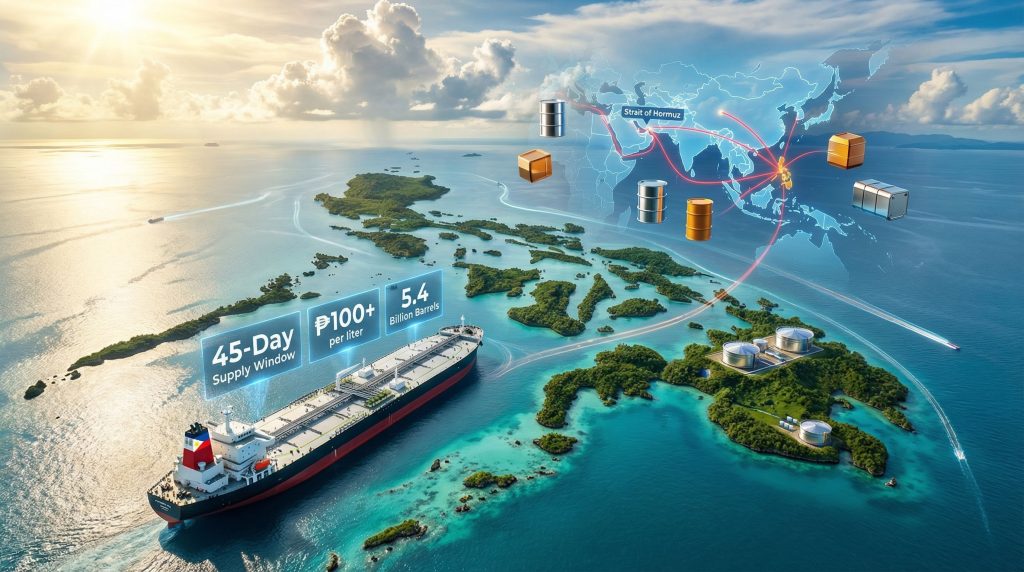
President Ferdinand Marcos Jr. activated these protocols when the Department of Energy calculated remaining fuel supplies at just 45 days under normal consumption patterns. The mathematical precision of this timeline reflects sophisticated supply chain modeling rather than rough estimates. The Philippines declares fuel emergency directly addresses these critical supply constraints.
| Energy Security Metric | Philippines (2026) | Typical Island Nation Benchmark |
|---|---|---|
| Strategic Reserve Duration | 45 days (critical threshold) | 90+ days (adequate) |
| Import Source Concentration | Almost entirely Middle East | Diversified preferred |
| Emergency Response Authority | 1-year presidential powers | Varies by constitution |
| Supply Route Alternatives | Limited (Strait of Hormuz dependent) | Multiple routes preferred |
Geopolitical Cascade Effects Through Energy Markets
The February 28, 2026 military actions against Iranian infrastructure effectively closed the Strait of Hormuz to commercial tanker traffic. This chokepoint normally handles approximately 21% of global petroleum liquids transit, making it the world's most strategically important oil transport route.
For Asia-Pacific economies, Strait of Hormuz closure creates immediate supply shortages across multiple fuel categories:
- Crude oil imports: Primary feedstock for domestic refining operations
- Refined products: Direct imports of gasoline, diesel, and aviation fuel
- Liquefied natural gas: Critical for electricity generation and industrial processes
- Petrochemical feedstocks: Essential for manufacturing and agriculture
The ripple effects extend beyond energy sectors into transportation, agriculture, and manufacturing. When fuel availability drops below 60-day thresholds, businesses begin adjusting operations to conserve supplies. Furthermore, this situation highlights the broader OPEC production impact on global markets.
Economic Stress Testing Under Fuel Constraints
Regional airlines provide early warning indicators of energy system stress. Cebu Pacific's flight reduction announcements signal aviation fuel shortages have reached operational impact levels. Airlines typically maintain 30-45 day fuel inventories, making them among the first sectors to experience supply constraints.
The 45-Day Critical Window Analysis
Energy security analysts consider 45 days the minimum threshold for maintaining normal economic operations while implementing emergency measures. Below this timeframe, fuel rationing becomes necessary to preserve critical infrastructure functions.
"Critical Infrastructure Priority Framework: During fuel emergencies, governments typically prioritise electricity generation first, followed by medical services, food distribution, and public transportation. Commercial aviation and industrial production receive lower priority allocations."
The Philippines' 45-day calculation assumes current consumption levels continue unchanged. However, emergency conditions typically reduce consumption by 15-20% as businesses and consumers modify behaviour patterns. This could extend the effective supply window to 50-55 days under crisis conditions.
Price Transmission Mechanisms During Supply Disruptions
Fuel price escalation follows predictable patterns during supply emergencies. Initial price increases reflect spot market volatility and supply uncertainty. Secondary increases occur as inventory levels decline and emergency procurement costs rise.
Typical Price Escalation Timeline:
- Days 1-7: 10-15% increase due to market uncertainty
- Days 8-21: 25-35% increase as supply constraints emerge
- Days 22-45: 50-75% increase during critical shortage periods
- Beyond 45 days: Price controls and rationing systems typically implemented
Transport workers receive priority assistance during these periods because fuel costs can exceed 40-50% of operating expenses for taxi drivers and jeepney operators. Government subsidy programmes aim to maintain public transportation services while protecting driver incomes. Additionally, these challenges extend beyond the Philippines, as seen in broader energy transition challenges across the region.
Alternative Supply Strategies During Crisis Periods
Emergency fuel procurement operates under different parameters than normal commercial purchasing. Governments activate special authorities to bypass standard bidding processes, accept non-standard fuel grades, and negotiate directly with producing nations.
Geographic Diversification Beyond Traditional Suppliers
The Middle East conflict forces Asia-Pacific importers to identify alternative suppliers rapidly. Several options exist, though each presents logistical and economic challenges:
Alternative Supply Sources:
- Russia: Significant spare capacity but requires new shipping routes
- Venezuela: Heavy crude requiring specialised refining capabilities
- Africa: Nigeria and Angola offer light crude alternatives
- North America: US shale oil exports via Pacific routes
- Southeast Asia: Malaysia and Indonesia limited export capacity
Each alternative involves longer shipping distances, different crude oil specifications, and potentially higher costs. Emergency procurement typically accepts 10-20% price premiums to secure alternative supplies quickly. For instance, US natural gas forecasts indicate potential supply alternatives for the region.
Temporary Quality Standard Adjustments
During emergencies, governments may authorise fuel imports that don't meet standard environmental specifications. Euro-II fuel standards represent a common fallback position, allowing higher sulphur content and different additive packages than normal Euro-IV or Euro-V requirements.
These adjustments require careful risk-benefit analysis:
| Quality Standard | Environmental Impact | Supply Availability | Cost Differential |
|---|---|---|---|
| Euro-V (Normal) | Minimal emissions | Limited during crisis | Highest cost |
| Euro-IV (Backup) | Moderate increase | Somewhat available | 5-10% premium |
| Euro-II (Emergency) | Significant increase | Readily available | 10-15% discount |
Environmental agencies typically authorise temporary standards for 90-180 day periods while alternative supplies are secured through normal channels.
South China Sea Energy Resources as Strategic Options
The Reed Bank represents one of Asia's most significant untapped hydrocarbon reserves, with United States Geological Survey estimates indicating 5.4 billion barrels of oil and 55 trillion cubic feet of natural gas potential.
These figures place Reed Bank among the world's major undeveloped offshore oil fields. For comparison, Norway's Ekofisk field contains approximately 6.4 billion barrels, while the UK's Forties field holds roughly 5.2 billion barrels. Similarly, Saudi exploration licenses demonstrate the global scale of energy resource development.
Joint Development Framework Analysis
The 2018 Philippines-China cooperation agreement established an intergovernmental steering committee to explore resource development options in disputed waters. This framework covered both contested areas within the Philippines' Exclusive Economic Zone and regions under sole Philippine jurisdiction.
However, the arrangement faced immediate criticism on sovereignty grounds. Constitutional scholars argued that joint development in areas under exclusive Philippine jurisdiction could compromise territorial claims under international law.
The Duterte administration terminated discussions in 2022, citing these sovereignty concerns. President Marcos revived interest in early 2023 during his Beijing visit, but formal negotiations have not resumed.
Successful Joint Development Precedents:
- North Sea: UK-Norway median line cooperation since 1965
- Timor Sea: Australia-East Timor joint petroleum development area
- Gulf of Thailand: Thailand-Malaysia overlapping claims cooperation
- Caspian Sea: Multi-nation resource sharing agreements
These precedents demonstrate that joint development can proceed while maintaining sovereignty claims, provided legal frameworks clearly define revenue sharing and operational responsibilities.
Energy Diplomacy During Regional Crises
Energy emergencies create unique diplomatic opportunities by aligning immediate needs with long-term strategic interests. Territorial disputes that seemed intractable during normal conditions may become negotiable when energy security reaches critical levels.
The Beijing-Manila Strategic Calculus
President Marcos acknowledged that territorial disputes had been interfering with energy cooperation but suggested current Middle East developments might motivate both parties toward agreement. This represents classic crisis diplomacy where external pressures create internal negotiating flexibility.
China possesses advanced deepwater drilling capabilities and substantial financial resources for offshore development. The Philippines contributes legal jurisdiction and maritime access. Combined, these assets could accelerate Reed Bank development from concept to production.
Key Negotiation Variables:
- Revenue sharing percentages: Typically 50-70% for territorial claimant
- Operational control: Technical operations vs political oversight
- Infrastructure development: Platform ownership and pipeline routes
- Timeline commitments: Development phases and production targets
Regional Coordination Mechanisms
ASEAN lacks formal energy sharing protocols comparable to the International Energy Agency's emergency response systems. Individual member states maintain bilateral arrangements but no multilateral framework exists for coordinated crisis response.
This coordination gap becomes critical during region-wide supply disruptions. Unlike Europe, where EU energy solidarity mechanisms can redistribute supplies during crises, Southeast Asian nations must compete individually for alternative sources.
"Strategic Policy Gap: ASEAN's energy integration remains limited to normal market conditions. No emergency sharing agreements exist for situations where multiple member states face simultaneous supply shortages."
The next major ASX story will hit our subscribers first
Asia-Pacific Energy Vulnerability Assessment
The Strait of Hormuz closure exposes fundamental structural weaknesses in Asia-Pacific energy architecture. Most regional economies developed energy import strategies assuming reliable access to Middle Eastern suppliers through predictable shipping routes.
Infrastructure Dependencies and System Failures
Single-chokepoint dependency creates systemic vulnerability across multiple countries simultaneously. When the Strait of Hormuz closes, alternative routes cannot handle displaced traffic volumes immediately.
Alternative Route Capacity Analysis:
- Suez Canal/Red Sea: 5.5 million barrels per day maximum
- Cape of Good Hope: Unlimited capacity but 15-20 additional transit days
- Pipeline Networks: Russia-China pipelines partially offset Asian demand
- Alternative Suppliers: Combined spare capacity approximately 3-4 million barrels per day
The mathematics reveal insufficient alternative capacity to replace Strait of Hormuz transit completely. Regional economies must reduce consumption, develop strategic reserves, or accept prolonged supply constraints.
Coal Transition Dynamics During Price Surges
Electricity generation provides the most flexible response to fuel supply disruptions. Power plants designed for dual-fuel operation can switch between natural gas and coal within 24-48 hours, depending on unit configuration.
Philippines Electricity Generation Mix (2026):
- Coal: 43% (baseline capacity available)
- Natural Gas: 22% (supply disrupted by LNG shortages)
- Renewable: 24% (hydroelectric and solar)
- Oil: 11% (diesel generators for peaking power)
Coal stockpiles typically provide 30-60 days of generation capacity, offering temporary buffer during gas supply interruptions. However, increased coal combustion raises environmental concerns and may conflict with climate commitments.
Investment Signal Analysis and Market Psychology
Transport sector disruptions provide reliable indicators of energy crisis severity. Airlines reduce flight schedules, shipping companies adjust routes, and logistics providers implement fuel surcharges simultaneously as supply constraints tighten. According to Reuters analysis, these disruptions reflect deeper systemic vulnerabilities.
Aviation Industry as Crisis Barometer
Cebu Pacific's flight reductions signal aviation fuel availability has dropped below operational comfort levels. Airlines typically maintain fuel inventories equivalent to 15-30 days of normal operations, making them early indicators of supply system stress.
Aviation Fuel Supply Chain Vulnerabilities:
- Limited Storage: Airports maintain 7-14 day fuel inventories
- Specialised Requirements: Jet fuel specifications more stringent than automotive fuels
- Distribution Networks: Fewer suppliers and delivery routes than gasoline/diesel
- Regional Connectivity: Flight reductions isolate island communities quickly
Flight schedule reductions cascade through tourism, business travel, and cargo operations. Regional connectivity degradation accelerates economic impacts beyond direct fuel costs.
Strategic Reserve Adequacy Frameworks
Energy security experts consider 90 days the minimum strategic reserve requirement for oil-importing nations. Current Philippines strategic reserves appear below this threshold based on the 45-day supply calculation.
Strategic Reserve Optimization Variables:
- Government vs Private Storage: Public reserves ensure political control but require significant capital investment
- Product Mix: Crude oil requires refining infrastructure vs refined products ready for distribution
- Geographic Distribution: Centralised storage vs regional distribution network
- Release Mechanisms: Automatic triggers vs political decision processes
Private sector reserves supplement government stockpiles but may be unavailable during crises if companies prioritise business continuity over national emergency response.
Long-Term Energy Independence Strategy Development
Energy emergencies function as stress tests revealing infrastructure vulnerabilities that normal market conditions obscure. The 45-day supply window indicates underlying dependencies that cannot be addressed through short-term procurement alone. The Philippines declares fuel emergency highlights these systemic challenges.
Domestic Refining Capacity as Strategic Infrastructure
Import dependency becomes particularly acute when countries lack domestic refining capability to process crude oil from alternative suppliers. Different crude oil grades require different refining configurations, limiting supply source flexibility.
Refining Capacity Investment Requirements:
- New Refineries: $3-5 billion for 200,000 barrel per day capacity
- Upgrading Existing: $1-2 billion to handle different crude grades
- Strategic Location: Coastal sites with deepwater port access
- Development Timeline: 5-7 years from planning to operation
Regional refining hubs offer alternative approaches through processing agreements where multiple countries share refining capacity and product exchanges.
Building Resilient Energy Supply Architecture
Multi-source procurement strategies require infrastructure investments beyond simple supplier diversification. Each alternative supply source may need different handling facilities, storage configurations, and distribution networks.
Resilience Investment Framework:
- Strategic Reserve Expansion: Target 90-120 day supply capacity
- Supply Source Diversification: Multiple suppliers per fuel category
- Infrastructure Redundancy: Alternative ports and distribution routes
- Emergency Response Protocols: Pre-authorised procurement and distribution procedures
- Regional Cooperation: Bilateral and multilateral sharing agreements
The Philippines fuel emergency demonstrates how energy security requires continuous investment rather than crisis response. Building resilient supply chains takes years of systematic development rather than emergency procurement. Furthermore, the official government response outlines comprehensive measures to address these challenges.
What Does This Mean for Regional Energy Security?
The current crisis reveals fundamental weaknesses in ASEAN energy architecture. Consequently, the Philippines declares fuel emergency serves as a wake-up call for regional cooperation mechanisms.
Regional governments must reassess their energy security frameworks beyond individual national responses. In addition, the crisis demonstrates how quickly localised conflicts can cascade into region-wide supply disruptions affecting millions of citizens.
The strategic implications extend beyond immediate crisis management toward fundamental questions about energy architecture resilience in an interconnected but vulnerable global system. Island economies particularly must balance cost optimisation against supply security in ways that continental nations can avoid through pipeline diversification and overland alternatives.
Disclaimer: This analysis is based on publicly available information and should not be considered investment advice. Energy security assessments involve complex geopolitical and economic variables that may change rapidly. Readers should consult qualified energy analysts and government sources for current situation updates and specific investment guidance.
Ready to Navigate Critical Resource Markets?
Discovery Alert's proprietary Discovery IQ model delivers instant notifications on significant ASX mineral discoveries, empowering subscribers to identify actionable opportunities in resource sectors during volatile periods. Begin your 14-day free trial today at Discovery Alert and position yourself ahead of market movements in critical commodities and energy-related investments.