
July 23, 2026
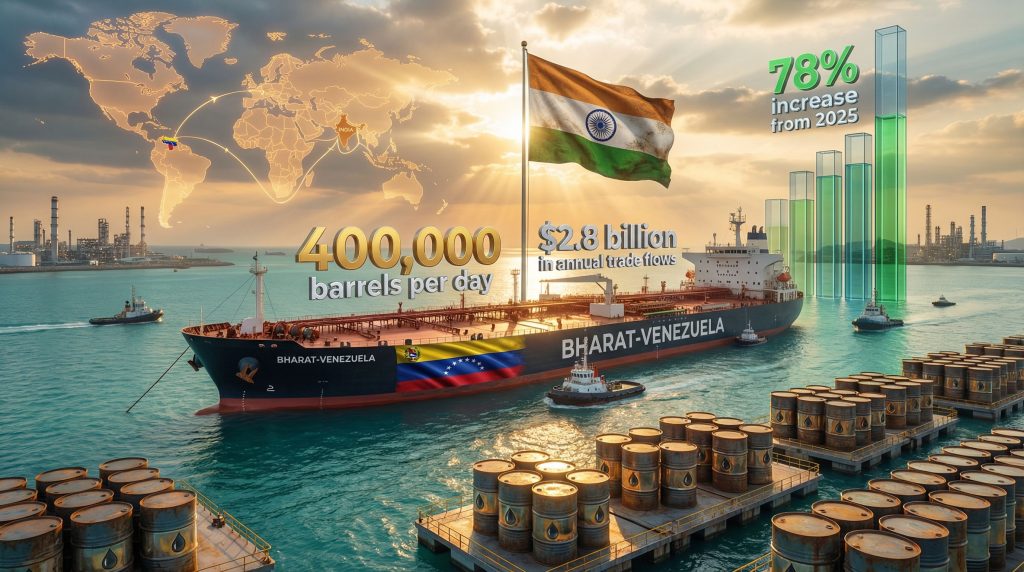
Global energy markets face unprecedented transformation as traditional supply chains encounter geopolitical disruptions, forcing major importing nations to recalibrate their procurement strategies. The world's third-largest crude oil importer has begun implementing sophisticated risk diversification frameworks that extend far beyond immediate crisis response mechanisms. India returns to buying Venezuelan oil as these strategic pivots reflect deeper macroeconomic considerations around supply chain resilience, currency diversification, and regional energy security architecture that will reshape international oil trade patterns for years to come.
Strategic Energy Diversification in an Era of Supply Chain Volatility
India's energy procurement landscape has undergone fundamental restructuring as the nation navigates complex geopolitical tensions while maintaining supply chain resilience. The country's renewed engagement with South American crude represents a calculated macroeconomic strategy rather than an opportunistic response to regional disruptions. With imports accounting for approximately 85-90% of crude oil demand, India processes over 4.06 million barrels per day of imported crude, making strategic supplier diversification a critical national security imperative.
The return to Venezuelan crude procurement demonstrates sophisticated energy diplomacy that prioritises long-term supply chain stability. Historical data reveals that India previously imported over 12 million barrels monthly from Venezuela during peak bilateral trade periods, establishing proven logistical frameworks and refinery compatibility protocols that can be rapidly reactivated during supply disruptions.
Geographic Risk Distribution Across Supply Corridors
India's traditional energy import architecture concentrates significant volumes through critical maritime chokepoints, particularly the Strait of Hormuz, which handles approximately 30-40% of India's crude oil imports. This geographic concentration creates systemic vulnerabilities that strategic diversification can effectively mitigate through:
- Atlantic Basin sourcing reducing dependence on Middle Eastern supply routes
- Alternative shipping corridors bypassing traditional chokepoint risks
- Bilateral trade agreements establishing direct government-to-government procurement channels
- Currency diversification mechanisms reducing exposure to USD-denominated transaction risks
Historical precedent demonstrates India's capacity for rapid supply chain adaptation, as evidenced by the nation's response to previous regional conflicts and sanctions regimes. The country's Strategic Petroleum Reserve expansion to 5 MMT capacity provides additional buffering capacity during transition periods between supplier arrangements. Furthermore, the OPEC production impact on global supply has reinforced India's commitment to procurement diversification strategies.
When big ASX news breaks, our subscribers know first
Economic Fundamentals Driving Venezuela-India Energy Partnership
Complex macroeconomic forces beyond immediate geopolitical considerations drive India's renewed Venezuelan crude procurement strategy. These structural factors create sustainable foundations for expanded bilateral energy trade that extend beyond crisis-response mechanisms.
Refinery Infrastructure Optimisation Analysis
Indian refineries demonstrate exceptional technical compatibility with heavy crude varieties, creating natural economic advantages for Venezuelan crude processing. Reliance Industries' Jamnagar complex, configured with specialised hydrocracking and coking units, can efficiently process extra-heavy crude with API gravity ratings of 8-10° and sulphur content ranging 3-4%.
Indian Refinery Heavy Crude Processing Capacity
| Refinery Complex | Daily Capacity | Heavy Crude Compatibility | Optimal Crude Sources |
|---|---|---|---|
| Reliance Jamnagar | 1.24 million bpd | 85% | Venezuelan, Russian Heavy |
| Indian Oil Paradip | 300,000 bpd | 70% | West African Heavy |
| HPCL Visakhapatnam | 166,000 bpd | 60% | Middle Eastern Heavy |
| BPCL Mumbai | 195,000 bpd | 65% | Latin American Grades |
This technical infrastructure creates higher profit margins through efficient heavy crude processing while enabling product diversification across multiple petroleum derivative streams. The specialised refining capabilities reduce operational costs via existing infrastructure utilisation, enhancing export competitiveness in refined product markets. Additionally, recent oil price rally analysis suggests that efficient processing of heavy crude varieties will become increasingly valuable.
Currency Diversification and Payment Innovation
India's pursuit of alternative payment mechanisms reflects broader de-dollarization trends in international energy trade. The country has successfully implemented rupee-denominated settlement mechanisms in approximately 20% of India-Russia crude transactions as of 2023-2024, establishing proof-of-concept frameworks for expanded non-USD energy trade.
Venezuelan crude procurement enables testing of additional bilateral currency arrangements that could include:
- Direct rupee-bolivar exchange mechanisms reducing third-party currency conversion costs
- Commodity-for-currency swap arrangements enabling trade balance optimisation
- Regional development bank financing through BRICS-affiliated institutions
- Export credit guarantee schemes supporting bilateral trade expansion
These payment innovations address India's current account deficit of approximately $18.6 billion while supporting broader economic diplomacy objectives across Latin American markets. However, tariff economic implications may influence these alternative payment structures.
Maritime Logistics and Transportation Economics
Venezuelan crude transportation to Indian refineries involves sophisticated maritime logistics requiring 8,000-8,500 nautical miles transit via Suez Canal routes. Transportation economics favour Suezmax tanker operations with capacity ranging 120,000-160,000 deadweight tons, optimising cargo size for Indian west coast port infrastructure.
Shipping Cost Structure Analysis
Current maritime freight markets demonstrate favourable economics for Venezuela-India crude trade routes:
- Transit time optimisation: 20-23 days via Mediterranean route
- Tanker rate efficiency: Suezmax vessels average $15,000-$25,000 daily charter rates
- Port infrastructure compatibility: Indian west coast terminals accommodate Suezmax specifications
- Cargo handling efficiency: Ship-to-ship transfer capabilities at Caribbean transshipment hubs
The Ottoman Sincerity vessel's successful delivery of nearly 1 million barrels of Boscan crude demonstrates operational feasibility and establishes logistics precedent for expanded shipment programmes. As reported by Reuters, this transaction marks a significant milestone in renewed bilateral energy cooperation.
Geopolitical Risk Assessment and Scenario Modelling
India's Venezuelan crude procurement strategy operates within complex geopolitical frameworks requiring sophisticated risk assessment across multiple scenarios. The strategic approach balances immediate supply security needs against longer-term diplomatic and economic considerations.
Sanctions Framework Evolution
Recent modifications to sanctions regimes create operational space for expanded India-Venezuela energy trade. These changes reflect broader shifts in international sanctions architecture and regional diplomatic realignments that impact energy market access.
Key Risk Factors:
- Regulatory framework stability affecting long-term procurement agreements
- International financial system integration enabling transaction processing
- Third-party sanctions compliance requirements for shipping and insurance
- Regional conflict spillover effects influencing maritime security considerations
Strategic Partnership Expansion Potential
Beyond immediate crude procurement, India-Venezuela energy cooperation demonstrates potential for broader economic integration:
- Infrastructure development opportunities in Venezuelan upstream sectors
- Technology transfer programmes for refinery modernisation projects
- Joint venture structures in petrochemical production facilities
- Regional energy hub positioning across South Asian and Latin American markets
The strategic partnership model extends traditional buyer-seller relationships toward comprehensive economic cooperation frameworks that enhance long-term bilateral trade stability.
Impact on Global Oil Market Dynamics
India's Venezuelan crude procurement creates significant ripple effects across international energy markets, influencing pricing mechanisms, supplier competition dynamics, and regional trade flow patterns. Moreover, India returns to buying Venezuelan oil amidst broader trade war oil movements that continue to reshape global supply chains.
Market Rebalancing Effects
The renewed India-Venezuela trade relationship contributes to heavy crude market stabilisation by increasing buyer diversity in previously constrained supply segments. This diversification reduces single-source dependency risks while enhancing market competition among crude oil exporters.
Global Market Implications:
- Price discovery mechanisms benefit from increased transaction volume data
- Regional arbitrage opportunities emerge through alternative supply chain routes
- Supplier competition intensification drives improved contract terms for importing nations
- Shipping market optimisation through enhanced route utilisation efficiency
BRICS Economic Cooperation Framework
India's Venezuelan energy procurement aligns with broader BRICS economic cooperation initiatives promoting trade diversification and alternative financial architecture development. This cooperation model demonstrates practical implementation of South-South trade principles that reduce dependency on traditional economic centres.
The partnership creates precedent for other emerging economies seeking supplier diversification strategies while supporting regional economic integration objectives across Asia and Latin America. According to Bloomberg, this renewed trade relationship signals broader shifts in global energy procurement patterns.
Investment Strategy Implications for Energy Markets
Strategic investors monitoring India's Venezuelan crude procurement should evaluate multiple investment vectors spanning infrastructure development, shipping logistics, and financial services innovation. In addition, the global oil futures outlook suggests significant opportunities emerging from these supply chain adaptations.
Sectoral Investment Opportunities
Refinery Modernisation and Expansion:
Infrastructure investments targeting heavy crude processing capabilities demonstrate strong fundamentals given India's expanding supplier diversification strategy. Specialised hydrocracking and coking unit development supports multiple feedstock optimisation strategies.
Maritime Transportation and Logistics:
Tanker fleet investment focusing on Venezuela-India routes presents compelling opportunities given increasing trade volume projections. Suezmax vessel specifications align optimally with cargo requirements and port infrastructure capabilities.
Financial Services Innovation:
Alternative payment mechanism development creates opportunities for cross-border transaction processing platforms supporting non-USD denominated energy trade. Regional development banking services demonstrate expansion potential across emerging market corridors.
Risk-Adjusted Return Considerations
Investment strategies must account for regulatory evolution affecting sanctions frameworks, geopolitical stability influences on trade continuity, and technological advancement impacts on energy transition timelines.
Critical Success Factors:
- Regulatory compliance frameworks ensuring operational continuity across jurisdictions
- Operational flexibility enabling rapid adaptation to changing market conditions
- Partnership structure optimisation balancing risk exposure with growth potential
- Technology integration supporting efficient operations and competitive positioning
The next major ASX story will hit our subscribers first
Future Trajectory Analysis and Strategic Scenarios
India's Venezuelan crude procurement strategy represents initial implementation of broader energy security frameworks that will evolve based on changing geopolitical landscapes, technological developments, and economic conditions. Consequently, India returns to buying Venezuelan oil as part of a comprehensive long-term strategy rather than a temporary adjustment.
Scenario 1: Expanded Integration (Probability Assessment: High)
Continued geopolitical tensions driving supply diversification needs could result in Venezuelan crude representing 25% of India's total procurement within three years. This scenario assumes:
- Sustained sanctions relief maintaining Venezuelan market access
- Infrastructure investment expansion supporting increased shipping capacity
- Bilateral agreement deepening through government-to-government frameworks
- Regional cooperation enhancement across BRICS energy trade mechanisms
Economic Impact Projections:
- Annual bilateral trade volume: $5+ billion
- Indian refinery capacity utilisation: 90%+ efficiency
- Alternative currency transaction volume: 40% of bilateral trade
Scenario 2: Constrained Development (Probability Assessment: Moderate)
Regulatory framework changes or competitive supplier emergence could limit Venezuelan crude to 10-15% of India's imports. Constraining factors include:
- Alternative supplier competitive pricing from African or Central Asian sources
- Technology advancement in renewable energy reducing overall crude demand
- Regional conflict escalation affecting shipping route security
- International pressure influencing bilateral trade policy decisions
Strategic Risk Mitigation Framework
Successful implementation requires comprehensive risk management addressing regulatory, operational, and market uncertainties:
Regulatory Risk Mitigation:
- Legal framework diversification across multiple jurisdictions
- Compliance monitoring systems ensuring adherence to evolving sanctions regimes
- Alternative transaction structures maintaining operational flexibility
Operational Risk Management:
- Supplier portfolio optimisation preventing over-concentration in single sources
- Infrastructure redundancy supporting multiple supply chain pathways
- Insurance and hedging strategies protecting against transportation and price risks
Market Risk Protection:
- Price hedging mechanisms stabilising procurement costs across volatile markets
- Demand forecasting enhancement improving inventory management efficiency
- Alternative product development reducing dependency on specific crude grades
This comprehensive strategic framework positions India's energy procurement strategy for sustained effectiveness across diverse future scenarios while maintaining operational flexibility and economic optimisation objectives.
Disclaimer: This analysis contains forward-looking projections and strategic assessments based on publicly available information. Energy market conditions, geopolitical developments, and regulatory frameworks may change rapidly, affecting the accuracy of scenario analyses and investment implications discussed. Readers should conduct independent research and consult qualified professionals before making investment or strategic decisions.
Want to Capitalise on Energy Market Disruptions?
Discovery Alert's proprietary Discovery IQ model delivers real-time alerts on significant ASX mineral discoveries, including those in the energy and critical minerals sectors that are reshaping global supply chains. As India's strategic energy diversification demonstrates the value of staying ahead of market shifts, subscribers gain instant insights into actionable trading and investment opportunities across commodities that are driving the energy transition. Begin your 14-day free trial today and secure your market-leading advantage in this rapidly evolving landscape.