August 5, 2026
Strategic Energy Interdependence and Geopolitical Leverage
Global energy markets operate within a complex web of strategic interdependencies where economic leverage often supersedes military capabilities. The delicate balance of power in critical maritime chokepoints demonstrates how traditional assumptions about military dominance may not translate into sustainable geopolitical outcomes. When examining scenarios involving major energy supply disruptions, particularly regarding a blockade of Strait of Hormuz, understanding the asymmetric nature of economic pain tolerance becomes crucial for policymakers and investors alike.
Energy blockades represent one of the most severe forms of economic warfare, historically triggering broader conflicts when diplomatic solutions fail. The relationship between energy security and national power creates unique vulnerabilities that even technologically superior nations cannot easily overcome through conventional military means. This dynamic becomes particularly pronounced in narrow maritime passages where small, agile forces can challenge much larger conventional navies.
When big ASX news breaks, our subscribers know first
Economic Tsunami: Understanding the Global Cost of Hormuz Closure
A permanent blockade of Strait of Hormuz would trigger immediate economic consequences that extend far beyond energy markets. The strait facilitates approximately one-fifth of global oil supply, representing roughly 21 million barrels daily flowing through this narrow waterway. Furthermore, the oil price rally would reach unprecedented levels as financial markets would experience unprecedented volatility within the first 72 hours of closure.
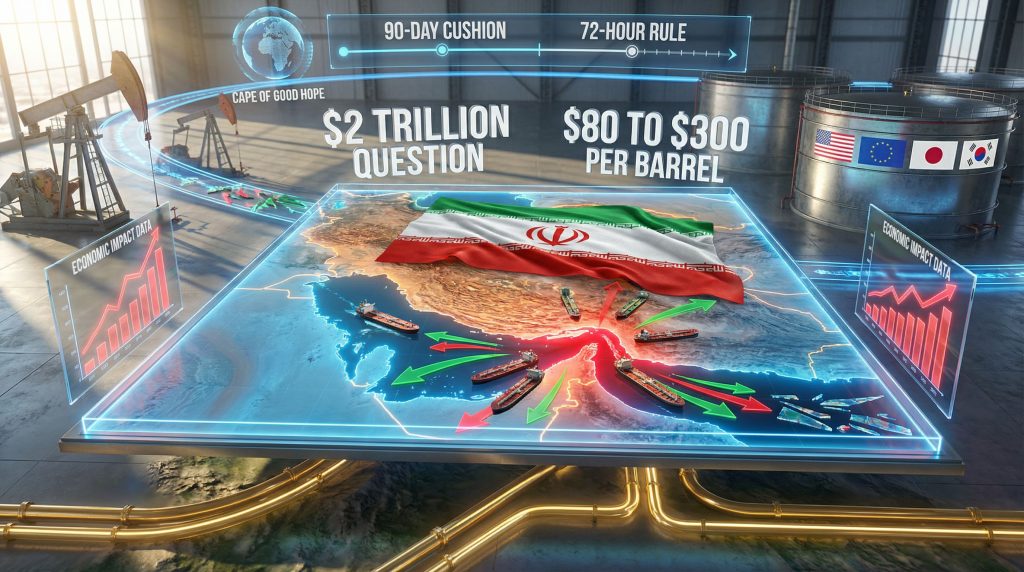
The $2 Trillion Question: Quantifying Global Economic Impact
Economic modelling suggests that sustained closure could generate cumulative global GDP losses exceeding $2 trillion within the first year. This figure accounts for direct energy cost increases, manufacturing disruption multipliers, and cascading effects across interconnected supply chains. Different regions would experience varying degrees of impact based on their energy import dependencies and strategic reserve capabilities.
| Region | Projected GDP Loss (%) | Inflation Increase (%) | Unemployment Rise (%) |
|---|---|---|---|
| European Union | 3.2-4.8 | 12-18 | 2.1-3.5 |
| Japan | 4.5-6.2 | 15-22 | 1.8-2.9 |
| South Korea | 5.1-7.3 | 18-25 | 2.3-3.8 |
| United States | 2.1-3.4 | 8-14 | 1.2-2.1 |
| China | 3.8-5.5 | 10-16 | 1.9-3.2 |
Manufacturing sectors would face immediate disruption as petrochemical feedstocks become scarce. Industries ranging from pharmaceuticals to semiconductors rely heavily on petroleum-derived materials, creating supply chain vulnerabilities that extend well beyond transportation fuel concerns. In addition, these disruptions would amplify the global trade impacts already affecting international commerce.
Energy Price Shock Scenarios: From $80 to $300 Per Barrel
Historical analysis of energy crises provides insight into potential price trajectories during extended supply disruptions. The 1973 oil embargo witnessed crude prices quadrupling within months, but modern market structures create different dynamics. However, oil price movements during such crises differ significantly from past patterns.
Current oil prices averaging $80-85 per barrel could escalate to $200-300 per barrel within weeks of complete strait closure. Price elasticity studies indicate that demand destruction begins accelerating significantly above $150 per barrel, particularly in discretionary transportation and heating applications.
"The 72-Hour Rule: Energy markets typically require 72 hours to fully price in major supply disruptions, after which secondary effects begin cascading through derivative markets and industrial supply chains."
Currency markets would experience severe volatility as energy-importing nations face deteriorating trade balances while energy exporters benefit from windfall revenues. The U.S. dollar's status as the primary energy trading currency could provide some insulation, but sustained high prices would pressure dollar-denominated debt markets globally.
How Long Could Major Economies Survive Without Persian Gulf Oil?
Strategic petroleum reserves represent the primary buffer against supply disruptions, but their effectiveness depends heavily on consumption patterns and alternative supply activation timelines. Most developed nations maintain reserves calculated to provide 90 days of import coverage, yet this figure assumes normal consumption levels rather than emergency rationing scenarios. Consequently, oil price stagnation becomes less likely as reserves dwindle.
Strategic Petroleum Reserve Depletion Timeline
The United States maintains approximately 714 million barrels in its Strategic Petroleum Reserve, theoretically providing 37-40 days of complete supply replacement at current consumption levels of 18-19 million barrels daily. However, maximum drawdown rates are legally limited to 4.4 million barrels daily, extending theoretical coverage but requiring severe demand destruction to maintain supplies.
European Union coordination presents additional complexity, as individual member states control their own strategic reserves despite EU-wide minimum requirements. Germany, France, and Italy each maintain substantial reserves, but bureaucratic coordination procedures could require 7-14 days for full activation during crisis scenarios.
| Country/Region | Reserve Capacity (Days) | Daily Consumption (Million Barrels) | Maximum Drawdown Rate |
|---|---|---|---|
| United States | 37-40 | 18.9 | 4.4 million/day |
| Japan | 240+ | 3.2 | 1.8 million/day |
| Germany | 90-95 | 2.1 | 0.9 million/day |
| South Korea | 110-120 | 2.8 | 1.2 million/day |
| India | 20-24 | 5.1 | 0.8 million/day |
India faces particular vulnerability with approximately 80% of oil imports transiting through Hormuz while maintaining only 20-24 days of strategic reserves. This creates immediate pressure for demand rationing and alternative supply arrangements within weeks of closure.
Alternative Supply Route Feasibility Analysis
Rerouting tanker traffic around Africa's Cape of Good Hope adds approximately 30 days to transit times while increasing per-barrel transportation costs by 15-25%. Global tanker capacity could accommodate perhaps 50-60% of normal Hormuz volumes through alternative routes, assuming optimal coordination and no competing demand increases.
Pipeline alternatives offer limited relief. Saudi Arabia's East-West Pipeline provides 5 million barrels daily capacity to Red Sea terminals, representing substantial bypass capability but insufficient to replace total Hormuz flows. Similar pipeline infrastructure across the region could potentially handle 30-40% of normal transit volumes.
Scenario Modelling Results:
- 30% supply replacement: Achievable within 60-90 days through pipeline and extended tanker routes
- 50% supply replacement: Requires 120-180 days including new tanker charters and route optimisation
- 70% supply replacement: Potentially achievable within 12-18 months through infrastructure expansion and alternative supplier increases
Military Dynamics: Why Naval Supremacy Doesn't Guarantee Success
Modern naval warfare in confined waters creates asymmetric advantages for defending forces equipped with anti-ship missiles and mine-laying capabilities. The blockade of Strait of Hormuz scenario demonstrates how technological superiority may not translate into tactical dominance when geography favours defensive positioning.
The Asymmetric Warfare Challenge in Narrow Waters
Iranian defensive capabilities centre on Khalij Fars and Qader anti-ship missile systems, with ranges extending 290-300 kilometres from coastal launch positions. These systems utilise inertial/GPS guidance packages providing sufficient accuracy to threaten large naval vessels within the strait's confines.
The strait's geographical characteristics create unique challenges for conventional naval operations:
- Length: 100-150 nautical miles of contested waters
- Width: 21-60 kilometres at various transit points
- Depth: 80-100 metres average in shipping lanes
- Chokepoint dynamics: Multiple defensive positions along both shores
Small boat swarm tactics, refined since Operation Praying Mantis (1988), enable rapid deployment of 20-50 fast attack craft equipped with anti-ship missiles, rockets, and machine guns. While individually expendable, such tactics create complex target engagement scenarios for defending naval forces while inflicting disproportionate costs through threatened high-value assets.
Coalition Force Requirements for Sustained Operations
Mine warfare represents perhaps the most challenging aspect of strait clearance operations. Modern Iranian mines reportedly include moored contact mines, pressure-activated systems, and acoustic-triggered devices requiring comprehensive sweeping operations estimated at 3-6 months minimum under contested conditions.
Minesweeping requirements include:
- Mine-hunting vessels: 12-15 specialised ships for comprehensive coverage
- Escort protection: 6-8 destroyers/frigates for anti-missile defence
- Air cover: Continuous fighter patrols requiring 40-60 aircraft rotation
- Support infrastructure: Forward logistics bases and repair facilities
"Critical Insight: The 1988 Operation Praying Mantis engagement required 11 days of sustained operations to achieve limited objectives against Iranian naval forces, despite overwhelming American technological advantages. Even with tactical success, American forces sustained casualties including one helicopter destroyed and three crew members killed."
Historical precedents suggest that clearing operations would require sustained commitment lasting months rather than weeks, with ongoing vulnerability to mine replacement and continued asymmetric attacks throughout the process. For instance, expert analysis on the legality of such blockades reveals complex international law considerations.
Regional Power Shifts: Winners and Losers in a Closed Strait Scenario
Extended strait closure would fundamentally reshape regional power dynamics, creating unexpected beneficiaries while exposing vulnerabilities in traditional alliance structures. Energy export routes and alternative supply arrangements would determine which nations emerge stronger from sustained disruption.
Saudi Arabia's Strategic Opportunity Window
Saudi Arabia possesses unique advantages through its East-West Pipeline system, capable of handling 5 million barrels daily from Arabian Gulf fields to Red Sea terminals. This infrastructure provides substantial bypass capability representing approximately 30-40% of total Saudi export capacity independent of Hormuz transit.
Strategic opportunities for Saudi Arabia include:
- Premium pricing: Red Sea route oil commanding significant market premiums
- Infrastructure expansion: Accelerated pipeline and terminal construction projects
- Geopolitical leverage: Enhanced influence over global energy security discussions
- Investment attraction: International funding for alternative route development
The Kingdom's position as swing producer becomes magnified during crisis scenarios, potentially allowing production increases to partially offset Iranian losses while capturing windfall pricing benefits.
Russia and Venezuela: The Unexpected Beneficiaries
Russia's current production levels of 10-11 million barrels daily position the country as a major beneficiary of sustained high oil prices. Each $50 increase per barrel generates approximately $180-200 billion annually in additional revenue, providing substantial resources for domestic spending and international influence operations.
Venezuela presents a more complex scenario, with production currently limited to 750,000-1 million barrels daily due to infrastructure degradation. However, sustained high prices could justify infrastructure rehabilitation investments, potentially restoring production toward historical levels of 2.5+ million barrels daily within 2-3 years.
Case Study: 2019 Aramco Drone Attacks
The September 14, 2019 attacks on Saudi Aramco facilities demonstrated how asymmetric capabilities could temporarily disable approximately 5% of global production. Oil prices spiked over 20% within hours, providing a preview of market sensitivity to Persian Gulf supply disruptions. The incident highlighted that technological sophistication cannot guarantee protection against determined asymmetric attacks on energy infrastructure.
Technology and Infrastructure: Engineering Solutions to Geopolitical Crises
Engineering responses to sustained strait closure would require massive infrastructure investments and technological innovations on unprecedented timescales. The feasibility of alternative routes and emergency construction projects becomes critical for maintaining global economic stability.
Emergency Pipeline Construction Feasibility
A theoretical UAE-Oman bypass route could potentially transport 2-3 million barrels daily through approximately 400 kilometres of pipeline infrastructure. Construction timelines for such projects typically require 18-24 months under optimal conditions, but emergency scenarios could compress timelines to 12-15 months with massive resource allocation.
Iran's existing Goreh-Jask pipeline provides relevant precedent, delivering 1 million barrels daily through 1,000 kilometres of pipeline bypassing Hormuz entirely. This infrastructure demonstrates technical feasibility while highlighting the substantial time and investment requirements for meaningful alternative capacity.
Engineering challenges include:
- Terrain complexity: Desert and mountainous regions requiring specialised construction techniques
- Environmental considerations: Sensitive ecosystems and water resource protection
- Security requirements: Protection against sabotage during construction and operation
- Financing arrangements: Multi-billion dollar investments requiring international coordination
LNG and Alternative Energy Acceleration
Floating LNG (FLNG) terminal deployment could provide emergency natural gas supplies within 6-12 months, substantially faster than traditional fixed infrastructure. Current global FLNG capacity totals approximately 15 million tonnes annually, with additional units under construction potentially doubling capacity by 2027-2028.
Hypothetical Scenario: Extended energy crisis could accelerate global renewable energy deployment by 5-10 years through emergency investment programmes and regulatory fast-tracking. Historical precedents suggest that sustained high energy prices above $200 per barrel make previously uneconomical renewable projects financially viable while justifying massive public investment in energy independence.
The next major ASX story will hit our subscribers first
Insurance and Financial Markets: The Hidden Multiplier Effects
Maritime insurance markets would face unprecedented stress during extended strait closure, with cascading effects throughout global financial systems. War risk premiums and derivative market volatility could amplify economic disruption beyond direct energy cost increases, particularly affecting the global recession outlook.
Maritime Insurance Market Collapse
War risk insurance premiums for Persian Gulf operations could increase 50-100 fold during active conflict scenarios, effectively pricing most commercial shipping out of the market. Lloyd's of London and other major maritime insurers maintain approximately $50-75 billion in total capacity, insufficient for comprehensive coverage of global shipping during extended crisis periods.
| Vessel Type | Normal Premium Rate | War Risk Premium | Total Crisis Rate |
|---|---|---|---|
| VLCC Tanker | 0.025% | 2.5-5.0% | 2.5-5.025% |
| Container Ship | 0.035% | 3.0-6.0% | 3.035-6.035% |
| Bulk Carrier | 0.030% | 2.0-4.0% | 2.030-4.030% |
| LNG Carrier | 0.045% | 4.0-8.0% | 4.045-8.045% |
Insurance market paralysis would effectively halt commercial shipping regardless of military escort availability, as vessel owners cannot obtain coverage for war-zone operations at sustainable premium levels.
Commodity Trading Chaos and Margin Calls
Futures market volatility during extended supply disruption would trigger massive margin calls across commodity trading firms and financial institutions. Daily price movements of 10-20% could continue for weeks, requiring billions in additional collateral from market participants.
Physical delivery disruption creates particular stress for futures contracts approaching expiration. Traders unable to take physical delivery face forced liquidation at massive losses, while those controlling physical inventories gain extraordinary pricing power.
Central bank intervention would become necessary across multiple markets:
- Currency stabilisation: Supporting energy-importing nation currencies
- Credit provision: Emergency lending to margin-stressed financial institutions
- Market making: Direct intervention in government bond and commodity derivative markets
Diplomatic Endgame: Why Economic Pressure Has Limits
Traditional assumptions about economic sanctions and pressure campaigns may not apply when target nations possess asymmetric leverage over global energy markets. The blockade of Strait of Hormuz scenario reveals fundamental limitations in coercive diplomacy when mutual economic destruction becomes possible.
Iran's Escalation Ladder Strategy
Iranian strategic doctrine emphasises graduated response capabilities designed to impose incrementally increasing costs while avoiding full-scale military confrontation. This approach allows measured escalation while maintaining diplomatic off-ramps throughout crisis progression.
Escalation ladder components include:
- Mining operations: Selective placement threatening but not blocking traffic
- Harassment campaigns: Small boat swarms and close intercepts of commercial vessels
- Precision strikes: Targeting specific vessels or infrastructure with minimal casualties
- Partial closure: Blocking selected shipping while allowing others to transit
- Complete closure: Total traffic interdiction with comprehensive defensive measures
Regional proxy activation represents an additional escalation avenue, with potential involvement of Hezbollah, Houthis, and other aligned groups expanding conflict geography beyond the immediate strait area.
International Mediation Framework Requirements
UN Security Council paralysis seems likely given Russian and Chinese economic interests in sustained high energy prices. Traditional mediation through permanent Security Council members becomes compromised when those members benefit from continued crisis. Moreover, current live coverage of regional tensions illustrates the complexity of international diplomatic responses.
Alternative mediation frameworks might involve:
- Regional organisations: Arab League, Organisation of Islamic Cooperation involvement
- Neutral energy consumers: India, Japan, South Korea as crisis stakeholders
- Economic forums: G20 emergency sessions focused on energy security
- Religious authorities: Potential Islamic leadership mediation given regional dynamics
What legal authority allows nations to close international straits?
The 1982 UN Convention on the Law of the Sea guarantees "innocent passage" through international straits, making closure technically illegal under international law. However, enforcement mechanisms remain limited when coastal states claim security justifications.
Long-Term Implications: Reshaping Global Energy Security
Extended crisis scenarios would accelerate structural changes in global energy infrastructure and security arrangements that persist long after immediate conflicts resolve. Investment patterns and strategic planning horizons would shift permanently toward reduced dependence on vulnerable chokepoints.
Permanent Infrastructure Diversification Trends
Strategic petroleum reserve expansion represents an immediate policy response available to energy-importing nations. Current global reserves totalling approximately 4.1 billion barrels could expand to 6-8 billion barrels within 5-7 years through coordinated international investment programmes.
Alternative chokepoint development would gain priority, with particular focus on:
- Malacca Strait: Southeast Asian bypass routes through Thailand and Myanmar
- Suez Canal: Enhanced pipeline capacity between Red Sea and Mediterranean
- Panama Canal: LNG and refined product routing between Pacific and Atlantic
- Arctic routes: Year-round navigation through Northern Sea Route development
| Global Chokepoint | Vulnerability Ranking | Daily Transit Volume | Alternative Route Viability |
|---|---|---|---|
| Strait of Hormuz | 9.5/10 | 21 million barrels | Limited (pipelines only) |
| Malacca Strait | 7.5/10 | 15 million barrels | Moderate (pipeline options) |
| Suez Canal | 6.5/10 | 12 million barrels | High (pipeline existing) |
| Panama Canal | 4.5/10 | 6 million barrels | High (multiple alternatives) |
| Turkish Straits | 5.5/10 | 3 million barrels | Moderate (limited capacity) |
Geopolitical Realignment Acceleration
Middle Eastern alliance structures would evolve rapidly as traditional security guarantees prove insufficient for economic protection. Energy-exporting nations might develop independent security capabilities while energy importers pursue diversified supply relationships.
Energy independence policies would accelerate across major importing nations, with particular emphasis on:
- Renewable energy deployment: 10-year acceleration of solar, wind, and storage programmes
- Nuclear power revival: Renewed investment in baseload clean energy
- Domestic production: Enhanced oil and gas exploration including controversial methods
- Alternative transportation: Accelerated electric vehicle adoption and infrastructure
Future Scenario Modelling: 2030 Energy Map Without Hormuz Reliability
By 2030, sustained concerns about Hormuz vulnerability could reduce Persian Gulf oil's global market share from current 30% to approximately 15-20%, with compensatory increases in North American production, African supplies, and renewable energy penetration. This transition would require approximately $2-3 trillion in global energy infrastructure investment but could enhance long-term energy security substantially.
The Mutual Destruction Economics of Strait Warfare
The blockade of Strait of Hormuz scenario reveals fundamental paradoxes in contemporary geopolitical leverage, where economic interdependence creates mutual vulnerability that traditional military superiority cannot resolve. Iranian willingness to absorb economic punishment exceeds Western political tolerance for sustained energy prices, creating asymmetric advantages despite conventional military disadvantages.
Why No Side Can Truly Win a Hormuz Blockade
Iranian economic dependency calculations suggest the country could sustain 70-80% revenue losses for 12-18 months based on historical sanctions experience, while maintaining regime legitimacy through nationalist mobilisation. This pain tolerance exceeds democratic nations' political capacity to sustain $300+ per barrel oil prices without electoral consequences.
Global recession probability approaches 85-90% within six months of sustained strait closure, according to economic modelling from multiple international institutions. Such recession would trigger unemployment increases, political instability, and policy reversals that undermine the original strategic objectives of economic pressure campaigns.
Key Takeaway: The interdependent nature of global energy markets creates situations where leverage belongs to those most willing to endure economic catastrophe rather than those with the greatest absolute economic or military power. This dynamic suggests that sustainable solutions require diplomatic engagement rather than coercive strategies that threaten mutual destruction.
Understanding these dynamics becomes crucial for investors, policymakers, and analysts seeking to navigate increasingly complex geopolitical energy environments where traditional assumptions about power and influence may no longer apply.
Ready to Identify Investment Opportunities in Energy Security Markets?
Discovery Alert's proprietary Discovery IQ model delivers real-time alerts on significant ASX mineral discoveries, including critical energy security commodities that could benefit from global supply chain disruptions. With proven track records in identifying major discoveries before they reach mainstream attention, begin your 14-day free trial today to position yourself ahead of market-moving developments in the evolving energy landscape.