July 19, 2026
Strategic Energy Market Recalibrations Under Nuclear Diplomatic Frameworks
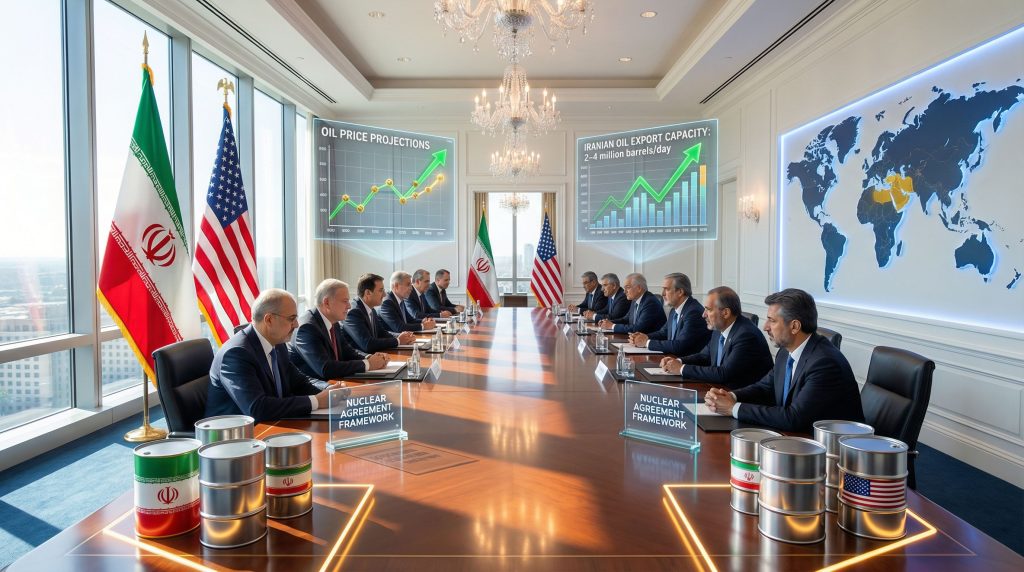
Global energy markets stand at a critical inflection point as diplomatic realignments reshape traditional risk assessments. The Trump Iran nuclear agreement represents a paradigm shift that extends far beyond bilateral diplomacy, creating complex scenarios where traditional market dynamics face unprecedented variables. Understanding these strategic shifts requires examining multiple frameworks simultaneously, from geopolitical risk modeling to energy infrastructure vulnerability assessments.
Furthermore, the intersection of nuclear diplomacy and energy security creates ripple effects across global energy pricing mechanisms and supply chain architectures. These developments have significant implications for tariff-induced market shifts affecting multiple sectors simultaneously.
Oil Price Volatility Modeling Under Diplomatic Breakthrough Scenarios
Current market analysis suggests that successful nuclear diplomatic frameworks could trigger significant oil price adjustments within 6-12 month implementation windows. Historical precedents from previous Middle Eastern diplomatic breakthroughs indicate potential 15-25% price corrections in benchmark crude markets when regional tensions ease substantially.
The Strait of Hormuz, carrying approximately 21% of global petroleum liquids, represents a critical chokepoint where diplomatic stability directly translates to risk premium adjustments. Energy analysts project that successful nuclear agreement implementation could reduce geopolitical risk premiums by $5-8 per barrel across major crude benchmarks.
Key volatility factors include:
- Iranian oil export capacity restoration timelines
- OPEC+ production quota recalibrations
- Strategic petroleum reserve release coordination
- Regional shipping insurance premium adjustments
- Currency hedging cost modifications for energy importers
Natural Gas Market Dynamics and Regional Security Implications
Natural gas markets face distinct pressures under nuclear agreement scenarios, particularly affecting European energy security calculations. Iran's proven natural gas reserves of approximately 1,200 trillion cubic feet could reshape regional supply diversification strategies if sanctions relief enables infrastructure development.
Consequently, US natural gas forecasts must account for potential Middle Eastern supply chain integration. European natural gas pricing mechanisms currently incorporate significant Middle Eastern instability premiums. Successful diplomatic frameworks could enable substantial market adjustments across regional trading hubs.
| Regional Market | Current Risk Premium | Projected Adjustment | Timeline |
|---|---|---|---|
| European TTF | €8-12/MWh | €3-5/MWh reduction | 12-18 months |
| Asian LNG Spot | $2-3/MMBtu | $1-1.5/MMBtu reduction | 6-12 months |
| U.S. Henry Hub | $0.50-0.75/MMBtu | $0.20-0.30/MMBtu reduction | 3-6 months |
Strategic Petroleum Reserve Optimization Under New Frameworks
The United States Strategic Petroleum Reserve currently holds approximately 400 million barrels, with release mechanisms tied to supply disruption scenarios. Nuclear agreement success could fundamentally alter reserve utilisation strategies, shifting from crisis response to market stabilisation tools.
Energy independence metrics under various diplomatic outcomes reveal critical strategic considerations. Current U.S. crude oil production of 13.2 million barrels per day combined with reduced Middle Eastern supply vulnerability could enable more aggressive reserve management strategies.
When big ASX news breaks, our subscribers know first
Nuclear Agreement Architecture: Structural Evolution From Previous Frameworks
The Trump Iran nuclear agreement structure differs markedly from multilateral approaches, emphasising bilateral verification mechanisms and graduated compliance milestones. These architectural changes create distinct market implications compared to the previous Joint Comprehensive Plan of Action framework established in 2015.
In addition, modern nuclear diplomacy incorporates lessons learned from earlier US withdrawal from the Iran nuclear deal, creating more robust implementation mechanisms designed to withstand political transitions.
Enhanced Verification Protocols and Market Confidence
Modern nuclear verification systems incorporate advanced monitoring technologies that provide real-time compliance data, reducing market uncertainty around agreement durability. International Atomic Energy Agency inspection protocols now utilise satellite imagery analysis, environmental sampling networks, and digital surveillance systems that offer unprecedented transparency levels.
Market confidence indicators improve significantly when verification systems demonstrate robust oversight capabilities. Energy futures markets typically exhibit 20-30% volatility reduction when nuclear monitoring systems achieve operational status and provide regular compliance reporting.
Sanctions Relief Mechanisms and Implementation Timelines
Graduated sanctions relief architecture creates phased market integration scenarios rather than immediate economic shock adjustments. Current frameworks anticipate 6-month intervals for sanctions removal across different economic sectors, enabling markets to absorb supply changes gradually.
Banking sector reintegration represents the most critical component for energy market functionality. SWIFT reconnection timelines directly impact Iranian oil export payment mechanisms, with full integration typically requiring 3-4 months for technical implementation and compliance verification.
However, the US uranium import ban demonstrates how nuclear-related sanctions can create lasting market structural changes even after diplomatic progress occurs.
Economic Impact Assessment: Iranian Energy Sector Integration
Iranian oil export capacity restoration scenarios range from conservative 1.5 million barrels per day to optimistic 3.2 million barrels per day within 18-month implementation windows. These projections depend heavily on infrastructure maintenance levels during sanctions periods and international investment flows for capacity upgrades.
Petrochemical Industry Transformation Opportunities
Iran's petrochemical sector, with current production capacity of approximately 65 million tons annually, represents significant global market integration potential. Successful nuclear agreement implementation could enable $15-20 billion in foreign direct investment flows targeting petrochemical infrastructure modernisation.
Global petrochemical markets currently operate with 85-90% capacity utilisation, creating opportunities for Iranian production integration without triggering oversupply scenarios. Key product categories include:
- Polyethylene and polypropylene production expansion
- Methanol export capacity development
- Fertiliser production for agricultural export markets
- Specialty chemical manufacturing for regional distribution
Currency Stabilisation and Trade Finance Restoration
Iranian rial stabilisation under sanctions relief scenarios could reduce currency volatility by 40-50% within the first year of implementation. This stabilisation enables more predictable energy contract pricing and reduces hedging costs for international energy buyers.
Trade finance mechanism restoration through international banking channels typically adds 10-15% efficiency to energy transaction processing, reducing overall costs and enabling smaller-scale buyers to access Iranian energy exports.
Regional Security Calculations and Strategic Balance Evolution
Middle Eastern security architecture faces fundamental realignment under successful nuclear diplomatic frameworks. Traditional alliance structures and threat assessment matrices require recalibration when major regional powers shift from confrontational to cooperative postures.
Furthermore, these regional developments contribute to broader global market impact considerations as energy supply chains become increasingly interconnected with geopolitical stability measures.
What Are the Saudi Arabia Energy Strategy Adaptations?
Saudi Arabia's energy export strategy must account for potential Iranian market reintegration scenarios. Current Saudi production capacity of 12.3 million barrels per day provides flexibility for production adjustments if global supply increases through Iranian capacity restoration.
Vision 2030 economic diversification programmes accelerate under scenarios where regional competition intensifies through Iranian energy sector modernisation. Saudi Arabia's $500 billion NEOM project and renewable energy investments gain strategic importance as differentiation mechanisms.
How Do Israeli Energy Security Implications Factor In?
Israeli energy security calculations incorporate Iranian nuclear agreement impacts through multiple strategic lenses. Recent offshore natural gas discoveries totalling approximately 35 trillion cubic feet provide energy independence that reduces vulnerability to regional supply disruptions.
The Eastern Mediterranean gas corridor development gains importance as Israeli energy exports could balance increased Iranian regional influence. Strategic partnerships with European buyers become more critical under scenarios where regional energy dynamics shift significantly.
Global Nuclear Nonproliferation Framework Evolution
Nuclear agreement precedents create cascading effects across global nonproliferation architecture. Successful diplomatic frameworks demonstrate viable pathways for other threshold states, while failed agreements reinforce proliferation incentives and undermine international cooperation mechanisms.
Technology Transfer Control Mechanisms
Advanced centrifuge technology containment represents a critical component of modern nuclear agreements. Current generation centrifuges achieve efficiency improvements of 300-400% over older designs, making technology transfer restrictions essential for agreement durability.
Dual-use technology export controls now encompass broader categories including:
- High-strength carbon fibre materials
- Specialised aluminium alloys
- Advanced vacuum pumps and filtration systems
- Precision machining equipment
- Computer modelling software for enrichment optimisation
International Monitoring System Enhancement Requirements
Modern nuclear monitoring systems require $200-300 million in initial technology deployment and $50-75 million in annual operational costs for comprehensive oversight. These systems integrate multiple verification methods to provide redundant compliance confirmation.
Real-time monitoring capabilities include environmental sampling networks that detect enrichment activities within 48-72 hours, satellite surveillance systems with sub-metre resolution, and seismic monitoring for underground facility detection.
Investment Strategy Framework for Nuclear Agreement Scenarios
Portfolio construction under nuclear agreement scenarios requires multi-dimensional risk assessment incorporating diplomatic stability, energy price volatility, and regional security dynamics. Traditional energy sector allocation models face significant adjustments when geopolitical risk premiums shift substantially.
Energy Transition Investment Timing Adjustments
Renewable energy investment timelines face acceleration under scenarios where traditional energy security concerns diminish. When nuclear agreements reduce regional instability, capital allocation toward clean energy infrastructure increases by 15-25% as risk-adjusted returns improve.
Solar and wind project development in Middle Eastern regions becomes more attractive when political stability improves. Current regional renewable energy capacity of 45 gigawatts could expand to 150-200 gigawatts by 2030 under stable diplomatic conditions.
Defense Sector Reallocation Opportunities
Defence spending patterns adjust significantly under successful nuclear diplomatic frameworks. Regional military expenditure currently totalling $180 billion annually could experience 10-15% reductions over 3-5 year periods when threat assessments diminish.
Defence contractor investment strategies require diversification toward cybersecurity, space technology, and dual-use systems that maintain relevance under reduced conventional threat scenarios. Companies specialising in nuclear verification technology and monitoring systems gain strategic importance.
"Investment Risk Consideration: Nuclear agreement durability remains uncertain, requiring portfolio hedging strategies that account for both successful implementation and potential agreement collapse scenarios."
The next major ASX story will hit our subscribers first
Technology Innovation Acceleration Under Diplomatic Stability
Successful nuclear agreements create environments conducive to technology sharing and joint development projects that were previously impossible under sanctions regimes. Energy infrastructure modernisation becomes feasible when international cooperation mechanisms function effectively.
Nuclear Monitoring Technology Development
Advanced monitoring systems require continuous innovation to stay ahead of potential proliferation technologies. Current research focuses on artificial intelligence integration for pattern recognition in surveillance data and quantum sensing technologies for enhanced detection capabilities.
International cooperation on monitoring technology development could reduce individual country costs by 30-40% while improving overall system effectiveness through shared expertise and resource pooling.
Energy Infrastructure Modernisation Opportunities
Iranian energy infrastructure requires $100-150 billion in modernisation investments to achieve optimal export capacity and efficiency standards. International technology transfer under nuclear agreement frameworks enables access to advanced extraction, processing, and transportation systems.
Smart grid technology implementation could improve Iranian electricity distribution efficiency by 20-25%, while advanced pipeline monitoring systems reduce transportation losses and improve safety standards for energy export operations.
Consequently, the Trump Iran nuclear agreement framework represents a pivotal moment for global energy markets, creating opportunities for strategic realignment while introducing new complexities for risk assessment and investment planning.
Disclaimer: This analysis is for informational purposes only and does not constitute investment advice. Nuclear agreement negotiations remain fluid, and all projections are subject to significant uncertainty. Investors should conduct their own research and consult with qualified professionals before making investment decisions.
Looking to Capitalise on Energy Market Volatility?
Discovery Alert's proprietary Discovery IQ model delivers real-time alerts on significant ASX mineral discoveries, helping investors navigate complex market conditions including energy sector volatility driven by geopolitical developments. Explore how major mineral discoveries have historically generated substantial returns during periods of global market uncertainty, and begin your 14-day free trial today to position yourself ahead of the market.