
August 5, 2026
Strategic Energy Portfolio Transformation in African Offshore Markets
Global energy companies face unprecedented challenges in portfolio optimisation as traditional hydrocarbon reserves mature and production costs escalate. Major international oil corporations must navigate complex risk-return calculations when evaluating frontier exploration opportunities against established production assets. The oil price dynamics significantly influence these strategic balancing acts, particularly in emerging offshore basins where geological uncertainty intersects with regulatory complexity and infrastructure limitations.
The decision matrix for upstream investment allocation increasingly favours high-impact exploration plays in underexplored regions, despite elevated technical and commercial risks. Energy companies seek to balance portfolio exposure between low-risk, declining production assets and high-potential frontier acreage that could deliver transformational reserve additions. This strategic framework drives major operators toward emerging African offshore basins where recent discoveries have fundamentally altered industry perceptions of exploration potential.
When big ASX news breaks, our subscribers know first
Namibian Offshore Basin Characteristics and Discovery Patterns
Recent Exploration Success Transforming Regional Outlook
The Namibian offshore sector has experienced remarkable transformation following multiple high-impact discoveries that have established the region as a premier exploration destination. Recent exploration campaigns have demonstrated exceptional geological prospectivity across both the Orange Basin and Walvis Basin, attracting significant attention from international energy companies pursuing BP offshore exploration Namibia opportunities.
The Orange Basin has emerged as a particular focal point following discoveries of light oil and gas condensate at the Capricornus 1X and Volans 1X wells. These discoveries, made by Azule Energy (a 50:50 joint venture between BP and Italy's Eni), have validated the basin's hydrocarbon potential and demonstrated favourable reservoir characteristics that support commercial development scenarios.
Industry analysis reveals that Namibia has emerged as one of the oil and gas industry's most closely watched exploration hotspots in recent years, driven by a series of discoveries that have fundamentally altered perceptions of the region's potential. Shell and TotalEnergies have established significant positions in Namibian waters, creating competitive dynamics that have accelerated leasing activity and exploration investment.
Geological Framework Supporting Exploration Success
The structural geology of Namibian offshore basins presents several favourable characteristics for hydrocarbon accumulation:
• Proven source rock systems with demonstrated hydrocarbon generation capacity
• High-quality reservoir formations with excellent porosity and permeability characteristics
• Effective seal mechanisms supporting hydrocarbon retention over geological timescales
• Multiple play concepts including structural and stratigraphic trap configurations
• Favourable migration pathways enabling efficient hydrocarbon charge to reservoir intervals
Water depths across target exploration areas typically range from 1,500 to 3,000 metres, presenting technical challenges but remaining within the operational capabilities of modern deepwater drilling technology. These depths require specialised drilling equipment and support vessels, significantly impacting development economics compared to shallow-water operations.
BP's Strategic Positioning Through Namibian Offshore Expansion
Portfolio Integration and Risk Management Framework
BP's recent acquisition of a 60% interest in three offshore exploration blocks (PEL97, PEL99, and PEL100) in the Walvis Basin represents a strategic expansion of the company's upstream portfolio in a high-potential frontier region. This transaction marks BP's first operated position in Namibia, building upon existing exposure through the Azule Energy joint venture.
The acquisition structure demonstrates sophisticated risk management through partnership arrangements. BP will collaborate with Eco Atlantic Oil and Gas (which remains as a partner after divesting the majority interest) and Namibia's state-owned oil company Namcor, creating a balanced partnership that combines technical expertise, financial capacity, and local market knowledge.
Strategic rationale for the investment includes:
• Frontier basin exposure with long-term growth potential in underexplored acreage
• Operational control through operator status enabling technology deployment and development optimisation
• Risk diversification through partnership structures that share technical and financial exposure
• Resource base expansion targeting significant reserve additions to support future production growth
• Technology application opportunities leveraging BP's deepwater exploration capabilities
Joint Venture Dynamics and Capital Efficiency
The partnership structure reflects industry best practices for frontier exploration risk management. Azule Energy's 50:50 ownership arrangement between BP and Eni provides a framework for cost sharing whilst combining complementary technical capabilities and operational expertise.
Joint venture benefits include:
• Capital efficiency through shared exploration and development costs
• Technical synergies combining partner expertise in deepwater operations
• Risk mitigation reducing individual company exposure to exploration uncertainty
• Operational flexibility enabling phased development approaches based on discovery outcomes
• Market access optimisation leveraging partner networks for offtake arrangements
Technical and Commercial Development Challenges
Deepwater Operations and Infrastructure Requirements
Namibian offshore development faces significant technical challenges related to water depth, distance from shore, and infrastructure limitations. Successful field development requires substantial capital investment in specialised equipment and support infrastructure, particularly considering geopolitical oil risks that could affect global supply chains.
Key Technical Parameters:
| Development Aspect | Specification | Industry Benchmark |
|---|---|---|
| Water Depth | 1,500-3,000 metres | Deepwater classification |
| Distance to Shore | 150-200 kilometres | Extended logistics requirement |
| Drilling Complexity | High-pressure/high-temperature | Advanced technology required |
| Production Systems | Subsea-to-FPSO | Floating production necessary |
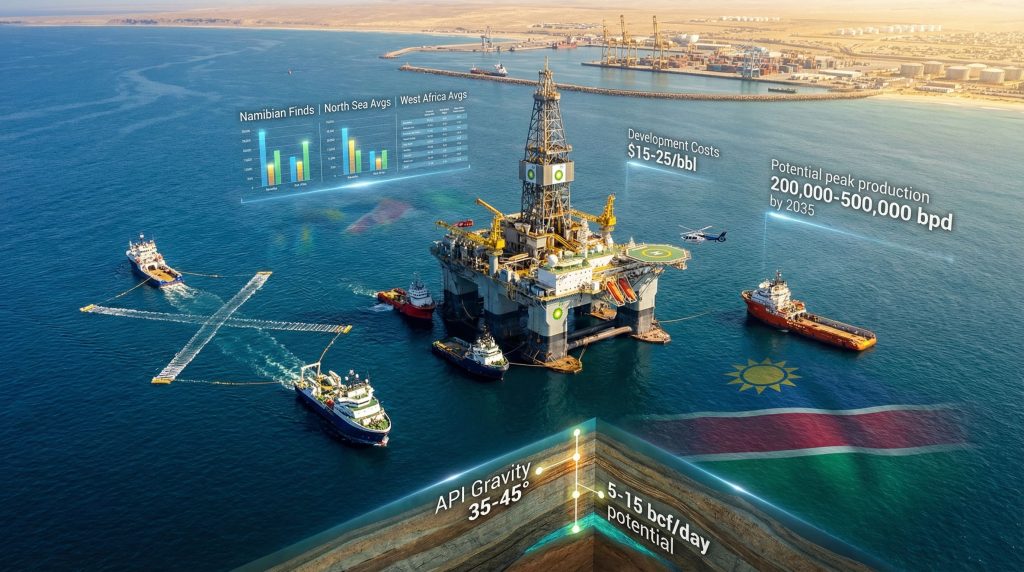
Development costs for BP offshore exploration Namibia projects are estimated at $15-25 per barrel based on current technology and service costs. These figures compare favourably to North Sea developments ($20-35 per barrel) but exceed West African development costs ($10-20 per barrel) due to infrastructure limitations and greater water depths.
Resource Quality and Market Access Considerations
Preliminary analysis of Namibian discoveries indicates favourable resource characteristics that support commercial development scenarios:
• API gravity ranging from 35-45 degrees, indicating high-quality light crude oil
• High gas-to-oil ratios providing potential for associated gas development
• Excellent reservoir quality supporting high recovery factors and production rates
• Low sulphur content reducing refining complexity and enhancing product yields
Market access requires development of export infrastructure including:
- Pipeline connections to onshore processing facilities
- Floating production, storage, and offloading (FPSO) systems for remote field development
- Port facilities capable of handling large crude carriers
- Gas processing infrastructure for associated gas utilisation or export
Regulatory Environment and Investment Framework
Licensing Terms and State Participation
Namibian petroleum exploration and production operates under a regulatory framework that requires mandatory participation by Namcor, the state-owned oil company, in all offshore projects. This participation structure provides the government with direct exposure to project economics whilst ensuring local capacity development.
Key regulatory characteristics include:
• Production sharing contracts with government participation requirements
• Local content obligations supporting domestic supply chain development
• Environmental compliance standards aligned with international best practices
• Fiscal stability provisions protecting against retroactive policy changes
• Technology transfer requirements promoting local technical capability development
The regulatory environment compares favourably to other African petroleum provinces, offering competitive fiscal terms whilst maintaining reasonable government participation levels. Furthermore, stability provisions protect investor interests against policy changes, supporting long-term development planning.
Environmental and Social Governance Framework
BP offshore exploration Namibia operations must comply with comprehensive environmental and social governance (ESG) requirements designed to protect marine ecosystems whilst supporting local economic development:
• Marine protected area coordination ensuring compatibility with conservation objectives
• Seasonal operational restrictions protecting marine wildlife during critical periods
• Community benefit programmes supporting local development initiatives
• Environmental impact assessments evaluating potential ecosystem effects
• Stakeholder engagement protocols ensuring transparent communication with affected communities
Long-Term Supply Chain and Market Integration
Global Energy Market Positioning
Namibian offshore development could significantly impact global energy supply balances, particularly in the Atlantic Basin crude oil and liquefied natural gas markets. Projected production volumes suggest potential for 5-15 billion cubic feet per day of natural gas and 200,000-500,000 barrels per day of crude oil by 2035, subject to successful exploration and development execution.
Regional energy security implications include:
• Reduced import dependence for Southern African countries currently relying on energy imports
• Export revenue generation providing estimated $2-5 billion annually in government revenues
• Infrastructure development catalyst supporting broader economic diversification initiatives
• Regional energy hub potential creating opportunities for cross-border energy trade
However, these developments must consider global trade impact factors that could influence international market dynamics and export strategies.
Export Infrastructure and Logistics Optimisation
Successful commercialisation requires substantial infrastructure investment estimated at $5-10 billion for comprehensive development including:
- Deepwater port facilities capable of handling VLCC crude exports
- Natural gas liquefaction plants for LNG export development
- Pipeline networks connecting offshore production to onshore facilities
- Storage terminals providing operational flexibility and export optimisation
- Support vessel facilities enabling efficient offshore operations
Timeline optimisation suggests 5-7 years from final investment decision to first production for fast-track development scenarios, comparable to similar frontier offshore developments globally.
The next major ASX story will hit our subscribers first
Investment Scenarios and Return Optimisation
Development Strategy Alternatives
Multiple development approaches offer different risk-return profiles for Namibian offshore projects:
Fast-Track Development Scenario:
• Accelerated drilling programmes with parallel development activities
• Simplified processing systems prioritising early production
• Modular expansion capabilities for capacity growth
• Break-even oil prices estimated at $45-55 per barrel
Phased Development Approach:
• Sequential field development reducing initial capital requirements
• Integrated processing systems optimising long-term economics
• Infrastructure sharing across multiple discoveries
• Break-even oil prices estimated at $35-45 per barrel
Integrated Basin Development:
• Comprehensive infrastructure supporting multiple operators
• Shared facilities reducing individual project costs
• Enhanced recovery technologies maximising resource extraction
• Break-even oil prices estimated at $30-40 per barrel
Competitive Positioning and Market Entry Timing
First-mover advantages in Namibian offshore development include:
• Infrastructure control enabling optimisation of development timing and capacity
• Regulatory relationship development supporting favourable future negotiations
• Supply chain establishment securing preferential access to critical services
• Technology deployment leadership demonstrating operational capabilities for additional opportunities
• Market access priority securing optimal offtake arrangements and transportation logistics
Geopolitical Factors and Investment Security
Regional Stability Assessment
Namibia presents a relatively favourable investment climate compared to other African petroleum provinces, supported by:
• Political stability with democratic governance structures and peaceful transitions
• Regulatory predictability through established legal frameworks and dispute resolution mechanisms
• Currency stability linked to South African rand providing regional integration benefits
• Infrastructure development programmes supporting long-term economic growth
• International partnership frameworks enhancing investment security and market access
Risk mitigation strategies include comprehensive insurance coverage, political risk guarantees, and diversified partnership structures that distribute exposure across multiple jurisdictions and entities.
International Energy Security Implications
Namibian offshore development contributes to global energy security through:
• Supply diversification reducing dependence on traditional petroleum exporters
• Atlantic Basin integration enhancing energy trade between Africa, Europe, and the Americas
• Strategic reserve development providing backup supplies for energy importing nations
• Technology transfer acceleration supporting broader African energy sector development
European energy security benefits include access to reliable crude oil and natural gas supplies from a stable, democratic partner outside traditional risk zones.
Future Outlook and Sustainability Considerations
Production Forecasting and Economic Impact
Long-term production scenarios suggest significant economic impact for Namibia and regional partners. Peak production estimates range from 200,000 to 500,000 barrels per day of crude oil and 5-15 billion cubic feet per day of natural gas by 2035, depending on exploration success and development optimisation.
Government revenue projections indicate potential annual income of $2-5 billion from petroleum production, representing a transformational economic opportunity for national development programmes. These revenues could support infrastructure development, education initiatives, healthcare expansion, and economic diversification programmes that address energy exports challenges.
Energy Transition Integration and Carbon Management
Sustainable development approaches for BP offshore exploration Namibia projects include:
• Carbon capture and storage potential utilising depleted reservoirs for CO2 sequestration
• Renewable energy integration powering offshore operations with wind and solar systems
• Low-carbon development technologies minimising environmental footprint through advanced systems
• Methane emissions management implementing best practices for gas handling and processing
• Biodiversity protection programmes supporting marine ecosystem conservation
Long-term viability considerations include alignment with global energy transition timelines and adaptation to evolving carbon pricing mechanisms. Projects incorporate flexibility for future technology integration and emissions reduction requirements, whilst considering the energy transition potential that could reshape global energy markets.
Industry experts emphasise that Namibia's offshore discoveries could fundamentally reshape Southern African energy dynamics, potentially creating a new regional hub that reduces dependence on traditional suppliers whilst generating significant government revenues for economic diversification initiatives.
Disclaimer: This analysis contains forward-looking statements and projections based on current market conditions and available information. Actual results may vary significantly due to exploration risk, market volatility, regulatory changes, and other factors beyond company control. Investment decisions should consider comprehensive due diligence and professional advice regarding specific project characteristics and market conditions.
Looking for Opportunities in African Energy Markets?
Discovery Alert's proprietary Discovery IQ model provides instant notifications on significant ASX mineral and energy discoveries, helping investors identify emerging opportunities in sectors experiencing rapid transformation. Stay ahead of market movements by exploring Discovery Alert's discoveries page to understand how major resource discoveries have generated substantial returns, and begin your 14-day free trial today to position yourself ahead of evolving energy markets.