August 7, 2026
Strategic Energy Shifts Across Southeast Asia's Energy Landscape
Energy independence strategies across Southeast Asia have entered a transformative phase, driven by volatile fossil fuel markets and accelerating renewable technology adoption. The intersection of commodity price cycles, domestic resource utilisation, and energy security imperatives creates complex policy environments where governments must balance immediate economic pressures against long-term sustainability objectives.
Furthermore, Indonesia's approach to biofuel integration demonstrates how energy policy decisions ripple through global commodity markets, affecting everything from agricultural land use to international trade flows. The strategic deployment of palm oil resources for energy applications represents a microcosm of broader renewable energy transitions occurring across emerging economies worldwide.
When big ASX news breaks, our subscribers know first
Understanding Indonesia's Strategic Biofuel Framework
The evolution of Indonesia's biofuel mandates reflects a sophisticated approach to energy security that extends far beyond simple fuel mixing requirements. Currently operating under a B40 mandate requiring 40% palm oil biodiesel content in diesel fuel, the nation has constructed one of the world's most comprehensive renewable fuel programmes.
This strategic framework serves multiple interconnected objectives: reducing petroleum import vulnerability, supporting domestic agricultural sectors, and advancing climate policy commitments. With petroleum product imports reaching 37.75 million tons in 2025 valued at $23.46 billion, representing nearly 10% of total import expenditure according to Indonesia's National Statistics Agency, the economic rationale for enhanced biofuel integration becomes compelling.
The potential advancement to Indonesia B50 biodiesel mandate standards would represent a significant escalation in renewable fuel utilisation, requiring complex infrastructure adaptations and market realignments. This transition involves technical considerations spanning production capacity, distribution networks, and engine compatibility across diverse industrial applications.
Economic Threshold Dynamics for Policy Implementation
Oil price volatility serves as the primary catalyst for Indonesian biodiesel policy adjustments. Historical analysis reveals that mandate increases typically correlate with sustained crude oil pricing above $85 per barrel, creating favourable economic conditions for palm oil-based fuel substitution.
The recent surge in crude oil prices approaching $100 per barrel following geopolitical tensions in February 2026 has reignited policy discussions. Deputy Energy Minister Yuliot Tanjung indicated on March 9, 2026, that Indonesia B50 biodiesel mandate implementation could occur in the second half of 2026, contingent on continued oil price elevations.
However, market reactions to policy announcements demonstrate the interconnected nature of energy and commodity markets. Palm oil futures experienced a 9% single-day surge to 4,774 ringgit per ton on March 9, 2026, highlighting the sensitivity of global vegetable oil markets to Indonesian biofuel policy signals. This oil price rally analysis provides deeper insights into the complex factors driving commodity market volatility.
Global Market Implications of Enhanced Biodiesel Mandates
Supply Chain Disruption Analysis
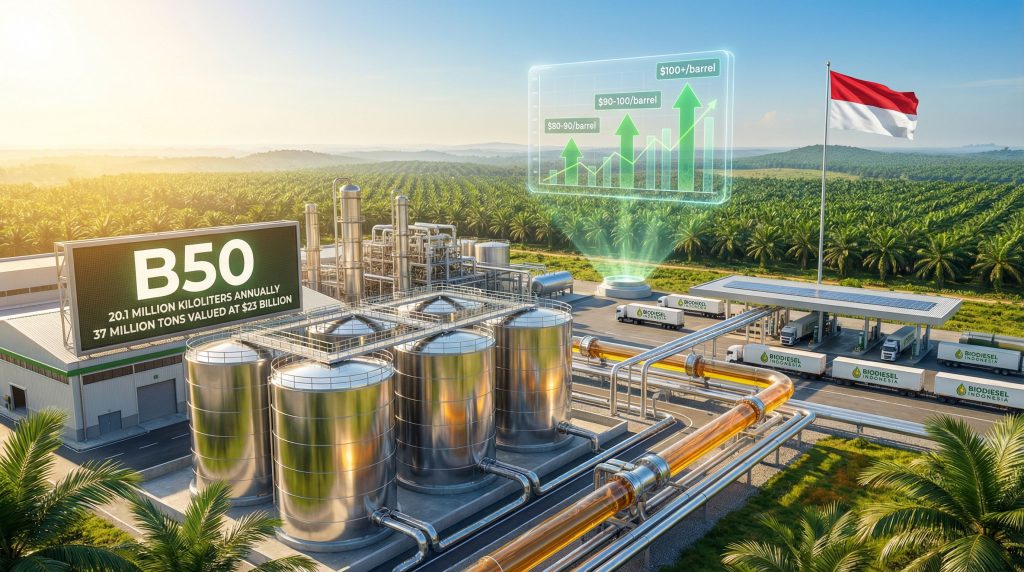
The transition to Indonesia B50 biodiesel mandate standards would fundamentally alter global palm oil supply dynamics. Current B40 consumption absorbs approximately 14.2 million kilolitres annually, while B50 implementation would require roughly 20.1 million kilolitres, representing an additional demand of 17-18 million metric tons of crude palm oil.
This demand increase equals approximately 15-20% of Indonesia's total palm oil production capacity, creating immediate supply tightening effects across international vegetable oil markets. Consequently, the absorption of additional palm oil volumes for domestic biodiesel production reduces export availability, potentially affecting food manufacturing costs and developing nations dependent on Indonesian palm oil imports.
Commodity Price Volatility Amplification
Indonesian biofuel policy decisions have become a primary driver of global vegetable oil price volatility. Each policy adjustment triggers cascading effects through commodity futures markets, affecting not only palm oil but also competing vegetable oils including soybean, sunflower, and rapeseed oils.
The correlation between Indonesian policy announcements and market movements typically manifests within 24-48 hours, with price swings ranging from 5-15% depending on the magnitude of policy changes and prevailing market conditions. This rapid transmission mechanism reflects Indonesia's dominant position in global palm oil production and the interconnected nature of vegetable oil substitution patterns. The tariffs impact markets analysis further explores how policy changes create ripple effects across global trading systems.
Technical Infrastructure Requirements and Challenges
Production Capacity Constraints
Indonesia's biodiesel production infrastructure operates near maximum capacity under current B40 requirements, with facilities producing approximately 19.6 million kilolitres annually. The advancement to Indonesia B50 biodiesel mandate standards would require production exceeding 20.1 million kilolitres, pushing utilisation rates above 97%.
This capacity constraint necessitates significant capital investment in production facility expansion, quality control systems, and distribution network modifications. Moreover, the technical challenges extend beyond simple volume increases to encompass fuel quality optimisation, storage infrastructure adaptation, and transportation system modifications.
Engine Compatibility and Performance Optimization
Higher biodiesel blend ratios introduce technical complexities related to engine performance, fuel system compatibility, and maintenance requirements. B50 implementation requires extensive compatibility testing across diverse applications including:
- Heavy industrial equipment
- Railway transportation systems
- Marine vessel engines
- Agricultural machinery
- Commercial vehicle fleets
Temperature sensitivity becomes particularly critical at higher blend ratios, requiring enhanced fuel management systems and storage protocols. The transition period involves comprehensive testing programmes to validate performance across different operating conditions and equipment configurations.
Investment Landscape and Economic Opportunities
Palm Oil Sector Expansion Dynamics
Enhanced domestic biodiesel demand creates substantial investment incentives for sustainable palm oil plantation development. The Indonesia B50 biodiesel mandate would strengthen domestic price support mechanisms, encouraging productivity improvements and sustainable intensification practices rather than area expansion.
In addition, smallholder integration programmes receive additional government support as domestic demand strengthens, creating opportunities for rural development and income diversification. Investment flows increasingly focus on productivity enhancement technologies, sustainable certification programmes, and supply chain optimisation. These developments align with broader energy transition insights regarding resource allocation in emerging economies.
Technology Innovation Acceleration
B50 implementation drives research and development investment in advanced biodiesel production technologies. Key innovation areas include:
- Enhanced refining processes for higher blend ratio optimisation
- Cold weather performance improvement systems
- Engine compatibility solutions for diverse applications
- Storage and distribution infrastructure modernisation
- Alternative feedstock development programmes
The technology development ecosystem extends beyond production to encompass quality control, logistics optimisation, and performance monitoring systems. These innovations create exportable technology solutions for other countries implementing similar biofuel programmes. The broader commodity trading trends reflect increasing focus on technological adaptation within traditional commodity sectors.
Regional Geopolitical and Strategic Considerations
ASEAN Energy Cooperation Framework
Indonesia's biodiesel strategy operates within broader ASEAN energy security cooperation mechanisms, where renewable fuel mandates create regional supply chain interdependencies. Malaysia's palm oil exports benefit from Indonesian domestic absorption increases, while Singapore's refining sector adapts to changing feedstock availability patterns.
The Indonesia B50 biodiesel mandate aligns with regional energy security objectives, reducing collective dependence on petroleum imports while strengthening intra-regional agricultural commodity trade. This approach creates strategic depth in energy supply chains, enhancing resilience against external supply disruptions.
Climate Policy Integration Mechanisms
The enhanced biodiesel mandate supports Indonesia's nationally determined contributions under the Paris Agreement, targeting 29% emissions reduction by 2030. The policy generates climate co-benefits while delivering economic advantages through import substitution and rural development programmes.
Furthermore, international climate finance mechanisms increasingly recognise sustainable biofuel programmes as eligible activities, creating potential funding sources for infrastructure development and technology deployment. The integration of climate objectives with energy security creates multiple revenue streams and policy support mechanisms. However, countries worldwide face similar energy transition challenges when balancing economic and environmental priorities.
The next major ASX story will hit our subscribers first
Food Security and Agricultural Market Impacts
Food vs. Fuel Competition Analysis
Increased palm oil absorption for biodiesel production potentially reduces availability for food manufacturing applications, creating upward price pressure on cooking oils and processed food ingredients. This dynamic particularly affects developing nations dependent on Indonesian palm oil exports for food security.
The Indonesia B50 biodiesel mandate would absorb an additional 6-8 million metric tons of palm oil annually, representing a significant portion of global traded volumes. This absorption rate requires careful balancing mechanisms to ensure food security objectives are maintained while advancing energy independence goals.
Sustainable Intensification Strategies
Government policies increasingly emphasise sustainable intensification rather than plantation area expansion to meet growing demand. This approach focuses on:
- Productivity improvement through enhanced cultivation practices
- Yield optimisation technologies and research programmes
- Sustainable certification and environmental compliance
- Smallholder integration and capacity building initiatives
- Biodiversity conservation within existing plantation areas
The sustainable intensification approach addresses environmental concerns while supporting economic objectives, creating frameworks for responsible biofuel expansion that maintains ecosystem integrity.
Long-Term Strategic Implications and Market Evolution
Energy Independence Trajectory
The Indonesia B50 biodiesel mandate represents an intermediate milestone toward comprehensive energy self-sufficiency through renewable sources. Successful implementation establishes technical and economic foundations for potential advancement to B60 or B70 mandates, further reducing petroleum import dependency.
This progression creates learning curves and technological development that strengthen Indonesia's position in global renewable energy markets. For instance, the experience gained through higher blend ratio implementation becomes exportable expertise for other countries developing similar programmes.
Global Commodity Market Leadership
Indonesian biodiesel policy decisions increasingly function as primary drivers of global vegetable oil price volatility, with implications extending beyond energy markets into food security, agricultural investment, and international trade patterns. This influence creates strategic leverage in global commodity markets.
The leadership position in renewable fuel development potentially influences similar programmes across Southeast Asia and other palm oil-producing regions. Technology transfer, policy coordination, and market integration mechanisms strengthen regional renewable energy cooperation. Current biodiesel policy discussions highlight the complexity of implementing ambitious renewable fuel targets.
Future Market Structure Evolution
The Indonesia B50 biodiesel mandate will reshape supply chains, investment flows, and geopolitical relationships across the Asia-Pacific region. These structural changes create new market dynamics that extend far beyond the energy sector into agriculture, manufacturing, and international trade.
Investment patterns increasingly favour integrated production systems that combine palm oil cultivation, biodiesel production, and distribution networks. This vertical integration creates efficiencies while strengthening strategic control over renewable fuel supply chains.
Consequently, the implementation of enhanced biodiesel mandates represents more than energy policy adjustment. It constitutes strategic repositioning within global commodity markets that fundamentally alters how nations approach energy security, agricultural development, and international economic relationships in an increasingly interconnected world.
Disclaimer: This analysis contains forward-looking statements and projections based on current market conditions and policy discussions. Actual outcomes may vary due to changing economic, political, and technical factors. Investment decisions should consider multiple risk factors and professional financial advice.
Ready to Invest in the Next Major Commodity Opportunity?
Discovery Alert's proprietary Discovery IQ model delivers real-time alerts on significant ASX mineral discoveries, instantly empowering subscribers to identify actionable opportunities ahead of the broader market. Begin your 14-day free trial today and secure your market-leading advantage whilst major commodity cycles continue to reshape investment landscapes.