
July 24, 2026
Strategic Export Infrastructure Under Regional Pressure
Global energy markets face unprecedented vulnerability as approximately one-fifth of world oil supply originates from geopolitically unstable regions where chokepoint disruptions can cascade across international supply chains. Saudi Arabia's Red Sea export route has become increasingly critical as tensions threaten traditional Gulf export pathways. While consuming nations maintain strategic petroleum reserves and alternative sourcing arrangements, the concentration of production capacity in areas prone to maritime blockades and infrastructure attacks exposes fundamental weaknesses in current energy security frameworks.
The mathematical reality of backup systems reveals their limitations when primary routes face sustained disruption. Even sophisticated pipeline networks designed specifically for crisis scenarios cannot fully compensate for the scale of supply disruption possible in major producing regions. This capacity gap between primary and alternative infrastructure creates systemic vulnerabilities that extend far beyond regional conflicts.
When big ASX news breaks, our subscribers know first
Understanding Saudi Arabia's Strategic Export Diversification Framework
The East-West Pipeline System as Critical Infrastructure
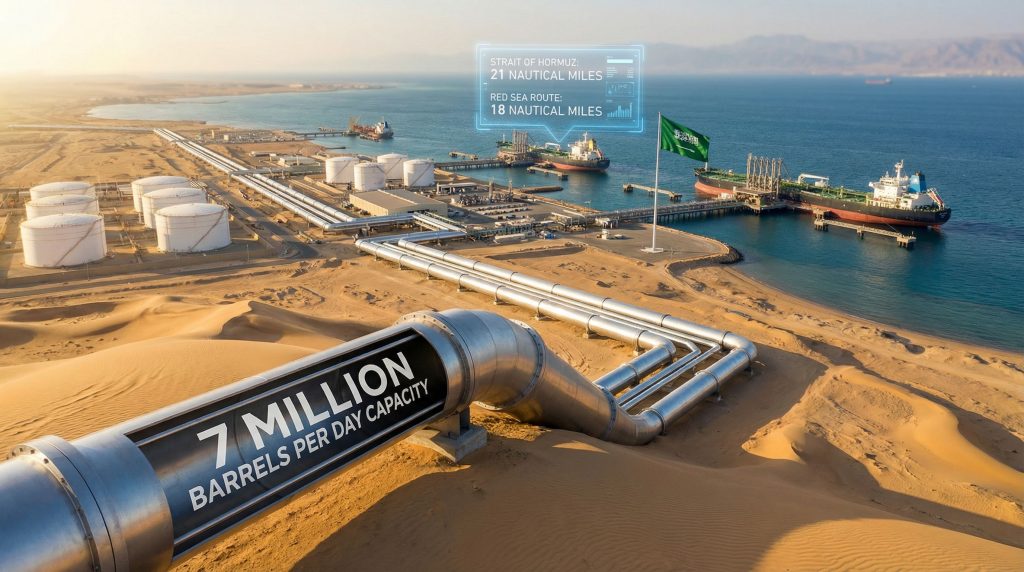
Saudi Arabia's East-West pipeline represents one of the most strategically important pieces of energy infrastructure in the Middle East, spanning 1,200 kilometres from the Kingdom's eastern oil fields to Red Sea terminals. Originally constructed during the 1980s Iran-Iraq conflict, this system demonstrates how geopolitical tensions drive infrastructure development decades before crises fully materialise.
The pipeline's 7 million barrels per day maximum capacity reflects systematic upgrades conducted over four decades, though actual operational flows typically remain below theoretical limits. Current loading data from Yanbu terminal shows sustained operations at 3.8-4.0 million barrels daily, representing record-high utilisation rates that still fall short of pre-crisis export volumes.
Engineering specifications include multiple pump stations designed for both crude oil and refined product transportation, with routing carefully planned to avoid Persian Gulf chokepoint dependencies. Furthermore, the infrastructure investment over multiple decades illustrates Saudi Arabia's long-term strategic planning for scenarios involving Strait of Hormuz disruptions.
Yanbu Port's Role in Emergency Export Operations
The Red Sea terminal at Yanbu functions as Saudi Arabia's primary alternative export hub during Persian Gulf route disruptions. Recent operational data indicates 4.355 million barrels daily average loading rates across all Saudi export terminals since early March, with Yanbu specifically handling the majority of alternative route volumes.
Current loading operations show tankers queuing for export slots, demonstrating both sustained international demand and infrastructure constraints that limit throughput expansion. The port's joint refinery operations with international partners like ExxonMobil create additional complexity during crisis periods, as these facilities become potential targets for regional conflicts.
Key Yanbu Terminal Statistics:
• Daily loading capacity: 4.0 million barrels (current operations)
• Historical peak utilisation: 3.8 million barrels (all-time high)
• Infrastructure partnerships: Joint Aramco-ExxonMobil refinery operations
• Strategic positioning: Primary Red Sea export alternative to Gulf routes
What Makes the Red Sea Route Both Solution and Risk?
Comparative Vulnerability Assessment Between Critical Chokepoints
Maritime chokepoint analysis reveals similar vulnerability profiles across both primary and backup export routes, challenging assumptions about geographic diversification benefits. In addition, these global market impacts extend beyond regional boundaries.
| Vulnerability Factor | Strait of Hormuz | Red Sea Route (Bab-el-Mandeb) |
|---|---|---|
| Chokepoint width | 21 nautical miles | 18 nautical miles |
| Daily oil transit | 20% of global supply | 12% of global trade |
| Alternative routing | Limited pipeline capacity | Cape of Good Hope (+21-28 days) |
| Regional threat actors | Iranian naval forces | Houthi maritime capabilities |
| Transit fees (crisis) | $2 million per vessel | Variable regional controls |
The comparative analysis demonstrates that backup routes face similar geographic constraints to primary chokepoints. Bab-el-Mandeb's narrower width compared to Hormuz creates potential for equivalent disruption scenarios, while longer alternative routing around Africa adds 3-4 weeks to delivery schedules and substantial fuel costs.
Infrastructure Resilience Under Asymmetric Threats
Recent attacks on Saudi energy infrastructure, including the joint Aramco-ExxonMobil facility at Yanbu, illustrate how alternative export routes remain exposed to similar threat environments as primary infrastructure. These incidents demonstrate that geographic diversification does not eliminate vulnerability when regional conflicts expand beyond traditional boundaries.
The targeting of Red Sea facilities reveals coordination capabilities among regional actors that can extend threats across multiple maritime zones simultaneously. This interconnected risk profile challenges traditional backup system assumptions and highlights the limitations of single-route diversification strategies.
Iranian-affiliated groups across multiple theatres, including Houthis in Yemen and various militia organisations in Iraq and Syria, create scenarios where backup routes face coordinated rather than isolated threats. Saudi Arabia's Red Sea export route demonstrates that this coordination multiplies risk rather than distributing it across geographic alternatives.
Current Export Volume Analysis Against Pre-Crisis Baselines
Production and Export Impact Quantification
Middle Eastern oil producers have implemented production reductions totalling 7-12 million barrels daily since February 2025, with Saudi Arabia's exports declining from 7.1 million barrels daily in February to current combined terminal levels of 4.0-4.4 million barrels daily through all export routes.
This 43-38% reduction in Saudi export capacity illustrates the limitations of alternative infrastructure during crisis periods. Even at maximum East-West pipeline utilisation, total export volumes remain substantially below pre-conflict baselines, forcing supply allocation adjustments across international markets.
Monthly Export Comparison Data:
• February 2025 baseline: 7.1 million barrels daily (all terminals)
• March 2026 average: 4.355 million barrels daily (all terminals)
• Yanbu specific loading: 3.8-4.0 million barrels daily (record high)
• Overall reduction: 2.7-3.1 million barrels daily (-38% to -43%)
Asian Market Supply Allocation Adjustments
Saudi Arabia has implemented systematic supply reduction protocols for Asian customers, with India facing particular exposure due to its 50% dependency on Gulf state crude imports. These allocation reductions demonstrate how regional supply disruptions translate into specific customer impact patterns.
Indian refineries, which historically received substantial Saudi crude volumes, now face supply constraints that require alternative sourcing strategies or refined product imports. The geographic concentration of supply sources creates vulnerability multiplication when multiple suppliers in the same region face simultaneous disruptions.
However, the broader OPEC production impact continues to influence global market dynamics as the organisation adjusts output levels in response to regional instability.
Market Signal Analysis: Despite record-high Red Sea loading rates, total export volumes remain insufficient to meet pre-crisis demand levels, forcing consuming nations to activate strategic reserve releases and alternative sourcing arrangements.
Long-Term Strategic Implications for Global Energy Security
Scenario Planning for Extended Regional Instability
Scenario 1: Prolonged Hormuz Closure (6-12 months)
Extended Persian Gulf route disruption could drive global oil prices toward $150-200 per barrel ranges, representing substantial increases from current market levels. This pricing scenario would trigger coordinated strategic petroleum reserve releases and accelerated development of non-Middle Eastern production capacity.
Economic modelling suggests these price levels would create recession risks in consuming economies while incentivising rapid deployment of alternative energy infrastructure and efficiency measures. Historical precedent from 2008 oil price spikes provides baseline comparison for economic impact assessment.
Scenario 2: Red Sea Route Escalation
Complete Middle Eastern export isolation would require fundamental restructuring of global energy trade flows, with emergency activation of spare capacity in North America and Brazil becoming critical for market stability. This scenario would test the limits of strategic reserve systems and alternative sourcing capabilities.
Scenario 3: Coordinated Infrastructure Targeting
Simultaneous attacks on both Gulf and Red Sea export infrastructure would create unprecedented supply disruption, potentially requiring demand destruction measures including transportation restrictions and industrial output reductions in consuming nations.
Investment and Infrastructure Development Responses
Energy companies are reassessing long-term capital allocation strategies in response to heightened chokepoint risks. Furthermore, these energy export challenges affect not only Middle Eastern producers but also major exporters like Australia.
Infrastructure Investment Priorities:
• Alternative pipeline development: Gulf-to-Asia undersea corridors and expanded Saudi-UAE connections
• Strategic storage expansion: Increased inventory capacity in consuming regions
• Non-Middle Eastern production: Accelerated development in Brazil, North America, and Sub-Saharan Africa
• Alternative energy acceleration: Reduced dependence on oil imports through renewable energy deployment
Japan's signalling of additional strategic petroleum reserve releases beyond current commitments illustrates consuming nation responses to prolonged supply uncertainty. Coordinated release strategies among major consuming nations provide temporary market stabilisation but cannot replace sustained supply disruptions indefinitely.
Why Backup Routes Remain Insufficient for Complete Supply Replacement
Fundamental Capacity Constraints and Technical Limitations
Even at maximum theoretical utilisation, Saudi Arabia's Red Sea export route demonstrates the mathematical impossibility of fully replacing Persian Gulf export capacity. The 7 million barrel daily pipeline capacity represents substantial infrastructure investment but falls short of the Kingdom's total pre-crisis export potential.
Current operational reality shows utilisation rates consistently below theoretical maximum capacity, with 3.8-4.0 million barrels daily at Yanbu representing peak performance levels. This gap between theoretical and practical capacity highlights additional constraints including port facilities, tanker availability, and loading infrastructure limitations.
Capacity Analysis:
• Pipeline theoretical maximum: 7.0 million barrels daily
• Current operational peak: 4.0 million barrels daily
• Pre-crisis total exports: 7.1 million barrels daily (all terminals)
• Backup system coverage: 56-57% of pre-crisis volumes (at maximum utilisation)
Regional Threat Interconnectedness and Spillover Effects
The involvement of Iranian-affiliated groups across multiple geographic theatres creates interconnected risk scenarios where backup routes face coordinated threats rather than isolated incidents. Houthi capabilities in the Red Sea, combined with militia group activities in Iraq and Syria, demonstrate how regional conflicts can expand beyond traditional boundaries.
This threat multiplication challenges the fundamental assumption that geographic diversification reduces risk exposure. When the same conflict ecosystem affects both primary and backup systems, diversification strategies provide limited protection against coordinated escalation.
Historical precedent from previous Houthi disruptions of Red Sea shipping illustrates actual implementation of maritime chokepoint control, diverting substantial portions of global trade around African cape routes with corresponding time and cost increases.
The next major ASX story will hit our subscribers first
Global Market Adaptation to New Risk Paradigms
Shipping and Insurance Market Adjustments
Maritime insurance markets have implemented substantial premium increases for Red Sea transit routes, while major shipping lines execute selective routing strategies based on risk assessment frameworks. Some carriers maintain operations through Jeddah and King Abdullah Port while suspending services to eastern Gulf terminals.
Insurance and Logistics Impact:
• War risk premiums: Substantial increases for Red Sea routing
• Carrier strategies: Selective route suspension and alternative port utilisation
• Demurrage costs: Extended waiting times for loading slots at alternative terminals
• Fuel surcharges: Cape of Good Hope routing adds 3-4 weeks transit time
Strategic Petroleum Reserve Utilisation Patterns
Consuming nations coordinate release strategies from strategic reserves, with Japan demonstrating readiness for additional emergency releases beyond current commitments. These coordinated approaches provide market stabilisation during acute supply disruption periods.
Reserve Release Coordination:
• Current inventory levels: Major consuming nations maintain substantial strategic reserves
• Release rate limitations: Maximum daily extraction capabilities constrain rapid deployment
• International coordination: Synchronised release timing maximises market impact
• Replenishment strategies: Long-term planning for reserve restoration post-crisis
The International Energy Agency's coordination of member nation reserves provides institutional framework for managing supply disruptions, though sustained releases cannot replace indefinite production losses without depleting strategic inventory levels.
Revealing Global Energy System Vulnerabilities
Concentration Risk in Critical Infrastructure
Current crisis conditions highlight how approximately 20% of global oil supply originates from geographically concentrated regions with elevated geopolitical risks. This concentration creates systemic vulnerabilities that backup routes can mitigate but not completely eliminate.
The mathematical relationship between backup capacity and total system requirements reveals inherent limitations in diversification strategies. When primary systems handle volumes exceeding backup capacity by substantial margins, alternative routes provide partial rather than complete risk mitigation. Moreover, these oil price stagnation factors complicate market responses to supply disruptions.
Systemic Risk Indicators:
• Geographic concentration: 20% of global supply from single vulnerable region
• Backup capacity gaps: Alternative routes handle 50-60% of primary system volumes
• Infrastructure interdependence: Similar threat environments affect primary and backup systems
• Market psychology: Alternative route existence provides sentiment benefits despite capacity limitations
The Practical Limits of Diversification Strategies
While Saudi Arabia's Red Sea export route provides valuable supply continuity during Persian Gulf disruptions, the broader crisis demonstrates that backup systems face similar threat environments to primary infrastructure. This similarity limits effectiveness as complete risk mitigation tools.
The current situation reveals how backup infrastructure designed for specific threat scenarios may prove insufficient when those threats expand beyond original planning parameters. Regional conflicts that affect multiple maritime zones simultaneously challenge single-route diversification strategies.
Strategic Planning Implications:
• Multiple backup requirements: Single alternative routes insufficient for complete risk mitigation
• Threat environment similarity: Geographic alternatives may face coordinated rather than isolated risks
• Capacity planning: Backup systems require substantial over-capacity to provide meaningful alternatives
• Time horizon considerations: Infrastructure development timelines exceed crisis duration planning
Furthermore, this comprehensive oil price rally analysis demonstrates how geopolitical tensions interact with other market factors to create complex pricing dynamics.
The Strategic Infrastructure Balance
Saudi Arabia's Red Sea export route represents both the potential and limitations of strategic infrastructure diversification. Current operations demonstrate record-high utilisation levels at Yanbu terminal, yet total export capacity remains substantially below pre-crisis volumes. This gap illustrates the mathematical reality that backup systems, regardless of sophistication, cannot completely replace primary infrastructure capacity.
The oil supply risks from Middle East tensions continue to affect global energy markets as conflicts extend beyond traditional boundaries. However, the Kingdom's investment in alternative export infrastructure provides critical supply continuity during regional disruptions.
Consequently, the current crisis reveals that effective energy security requires multiple layers of diversification, substantial overcapacity in backup systems, and coordinated international responses that extend beyond infrastructure alone. While the Red Sea route offers vital alternatives during Persian Gulf disruptions, the broader energy security challenge requires systemic solutions that address geographic concentration risks and threat environment similarities across alternative pathways.
This analysis is provided for educational and informational purposes only and should not be considered as financial or investment advice. Oil market conditions and geopolitical situations can change rapidly, and readers should consult qualified professionals before making investment decisions. Scenario projections involve substantial uncertainty and should be evaluated within comprehensive risk management frameworks.
Looking to Capitalise on Energy Market Volatility?
Discovery Alert's proprietary Discovery IQ model instantly identifies ASX mineral discoveries across critical commodities, including energy-transition metals that become increasingly valuable during global supply disruptions. While geopolitical tensions create uncertainty in traditional energy markets, significant mineral discoveries often emerge as investors seek alternative investment opportunities beyond oil and gas. Begin your 14-day free trial today to position yourself ahead of market shifts.