May 26, 2026
Strategic Framework for Understanding Domestic REE Development
The global rare earth elements market stands at a critical inflection point, driven by technological demands that far exceed traditional supply chain configurations. Within this landscape, carbonatite-hosted deposits represent a particularly significant geological opportunity due to their concentrated mineralization patterns and processing characteristics. Understanding how domestic projects like the Magnum Mining Wet Mountains REE Project fit into broader strategic frameworks requires examining multiple intersecting factors: geological potential, market positioning, regulatory alignment, and technical feasibility.
Colorado's positioning within the North American critical minerals corridor reflects decades of mining infrastructure development and regulatory frameworks optimised for mineral extraction. The state's geological diversity encompasses numerous carbonatite intrusions, though few have undergone systematic exploration for rare earth potential. This creates an environment where early-stage projects can leverage existing industrial knowledge while accessing untapped geological systems.
The technical assessment of early-stage REE projects demands rigorous evaluation of both surface indicators and subsurface potential. Surface assay results, while valuable for initial targeting, represent only the preliminary phase of resource development. Furthermore, the transition from surface anomalies to defined resources requires comprehensive drilling programmes, metallurgical characterisation, and economic modelling that extends well beyond initial discovery phases.
When big ASX news breaks, our subscribers know first
Colorado's Strategic Position in Critical Minerals Security
The Wet Mountains region occupies a unique position within America's broader critical minerals security framework. Located in south-central Colorado, this geological terrain features multiple carbonatite intrusions that remain largely unexplored for rare earth potential. The region's accessibility, combined with Colorado's established mining regulatory environment, creates favourable conditions for systematic exploration programmes.
Current U.S. rare earth supply chains demonstrate significant strategic vulnerabilities. According to the U.S. Geological Survey, America imported approximately 100% of its heavy rare earth elements in 2023, with China controlling roughly 60-70% of global rare earth production and 90% of processing capacity. This concentration creates systemic risks for defence applications, renewable energy infrastructure, and advanced manufacturing sectors.
The strategic importance extends beyond simple supply diversification. Defence applications alone require rare earth elements in over 200 critical systems, including missile guidance, radar technologies, and communications equipment. The Defence Logistics Agency has identified rare earth supply security as a national security priority, driving policy support for domestic development initiatives.
Federal policy mandates established through Executive Order 14017 specifically target rare earth supply chain resilience. The order mandates reducing foreign dependence within defined timelines: one year for critical minerals identification and three years for processing capability development. This policy alignment creates potential pathways for federal support of qualifying domestic projects.
Key Strategic Advantages:
- Established mining infrastructure and workforce availability
- Regulatory frameworks optimised for mineral development
- Transportation networks connecting to processing facilities
- Academic and research institutions supporting technical development
- Political environment favourable to domestic mineral development
Geological Framework and Global Deposit Comparisons
Carbonatite-hosted rare earth deposits represent a specific geological environment characterised by alkaline igneous intrusions enriched in REE-bearing minerals. These systems typically contain primary mineralisation that can be more readily processed than weathered or altered deposit types. The Magnum Mining Wet Mountains REE Project exhibits characteristics consistent with this geological model.
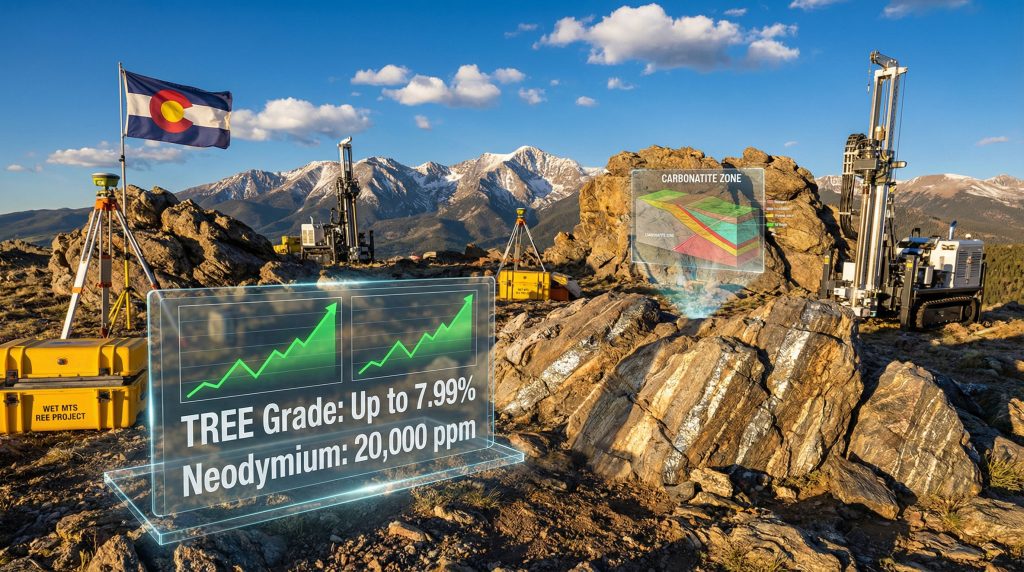
Historical surface sampling from the project area has reported concentrations reaching 7.99% total rare earth elements (TREE), with significant concentrations of magnet-critical elements. Neodymium concentrations of 20,000 ppm, praseodymium at 5,000 ppm, and samarium at 2,000 ppm represent elevated levels compared to many global deposits. Heavy rare earth content approaching 1,900 ppm suggests potential for high-value product streams.
Global Carbonatite Deposit Comparison:
| Deposit | Location | TREE Grade | HREE Content | Development Status |
|---|---|---|---|---|
| Mountain Pass | California, USA | 8-10% | 300-400 ppm | Operating |
| Bayan Obo | China | 3-5% | 100-300 ppm | Operating |
| Mount Weld | Australia | 7-9% | 1,500-2,500 ppm | Operating |
| Wet Mountains | Colorado, USA | Up to 7.99%* | 1,900 ppm* | Exploration |
*Surface samples only – not systematic resource estimate
The outcropping nature of carbonatite dykes in the Wet Mountains area suggests minimal overburden and potential for near-surface mining scenarios. However, dyke geometry typically results in narrow, linear ore bodies that may limit overall tonnage potential compared to larger carbonatite complexes like Mountain Pass or Bayan Obo.
In addition, mineralogical composition remains undefined without detailed characterisation studies. Primary REE minerals in carbonatite systems typically include bastnäsite, monazite, and xenotime, each requiring different beneficiation approaches. The specific mineral assemblage directly impacts processing costs, which can range from $600-$1,200 per metric ton of REE oxide depending on complexity and scale.
Technical Exploration Gaps and Development Challenges
The Magnum Mining Wet Mountains REE Project currently lacks fundamental technical datasets required for resource evaluation and economic assessment. This absence of systematic exploration creates significant uncertainty regarding project viability and development timelines.
Critical Missing Components:
- Drilling Data: No subsurface sampling has been conducted to establish grade continuity, ore body geometry, or tonnage potential
- Systematic Surface Sampling: Historical samples represent selective point data rather than grid-based statistical sampling
- Mineralogical Studies: REE mineral phases, liberation characteristics, and beneficiation requirements remain undefined
- Metallurgical Testing: No bench-scale or pilot-scale processing trials have been completed
- Geophysical Surveys: Subsurface structure and carbonatite extent have not been systematically mapped
Industry standards for early-stage rare earth exploration require progressive data development across multiple technical disciplines. Surface exploration typically progresses through systematic grid sampling at 50-250 metre intervals, followed by ground-based geophysical surveys to define subsurface targets. Only after these preliminary phases do projects advance to drilling programmes, which often require streamlined permitting process procedures.
Exploration Programme Timeline and Costs:
| Phase | Duration | Activities | Typical Cost |
|---|---|---|---|
| Phase 1 | 6-12 months | Surface sampling, mapping | $50,000-$200,000 |
| Phase 2 | 12-36 months | Initial drilling, metallurgy | $500,000-$2,000,000 |
| Phase 3 | 24-60 months | Resource definition | $2,000,000-$10,000,000 |
Metallurgical uncertainty represents perhaps the greatest technical risk for early-stage rare earth projects. Processing flowsheet design depends on specific mineral phases present, grain size distribution, and associated gangue minerals. Without this characterisation, economic modelling relies on theoretical assumptions rather than empirical test work results.
Environmental baseline studies also remain incomplete. Rare earth processing can generate significant tailings volumes and may require management of radioactive elements (thorium, uranium) commonly associated with REE deposits. Early identification of these factors influences permitting timelines and capital requirements.
Acquisition Structure and Risk Distribution
The binding term sheet structure between Magnum Mining and Wyoming Critical Minerals reflects typical early-stage exploration risk allocation strategies. This approach allows acquiring companies to secure projects while limiting initial capital exposure pending technical validation.
Deal Structure Components:
- Acquisition Method: Binding term sheet with conditional completion requirements
- Payment Structure: Milestone-based payments tied to exploration progress
- Royalty Terms: 2% net smelter return (NSR) royalty retained by seller
- Timeline: Rapid surface assessment programme planned for initial validation
The milestone-based payment approach aligns capital deployment with technical risk reduction. Early payments typically secure land position and initial exploration rights, while larger payments depend on successful completion of drilling programmes or resource definition milestones.
The 2% NSR royalty structure provides ongoing revenue participation for the seller while transferring operational control and development risk to the acquiring company. This arrangement is common in early-stage mineral acquisitions where resource potential remains unproven.
Risk allocation heavily favours the seller at current project stages. With no drilling completed and limited technical data available, the acquiring company assumes responsibility for all technical validation, permitting, and development activities. Consequently, success depends entirely on the ability to advance the project through systematic exploration phases.
Capital Deployment Strategy
The rapid assessment programme planned by Magnum suggests a phased approach designed to quickly evaluate surface potential before committing to larger exploration expenditures. This strategy minimises initial risk while maintaining option value for further development if early results prove encouraging.
Federal Support Mechanisms and Policy Alignment
U.S. government policy frameworks have established multiple potential support mechanisms for domestic rare earth development projects. These programmes reflect strategic priorities for critical minerals supply chain security and may provide funding, technical assistance, or regulatory facilitation for qualifying projects.
Primary Federal Support Programmes:
- Department of Energy Critical Materials Grants: Funding for technology development and demonstration projects
- Defence Production Act Title III: Investments in domestic production capacity for defence-critical materials
- USGS Earth Mapping Resources Initiative: Geological mapping and resource assessment support
- State-Level Colorado Incentives: Mining-specific tax credits and regulatory streamlining programmes
The Department of Energy's Bipartisan Infrastructure Law allocated $140 million specifically for rare earth and critical minerals projects. These funds target technology development, processing facility construction, and supply chain demonstration programmes. However, funding eligibility typically requires demonstrated resource potential through drilling and preliminary economic studies.
Defence Production Act authorities enable government investment in domestic production capabilities deemed critical to national security. Rare earth processing facilities and upstream mining operations qualify for consideration, but projects must demonstrate technical and economic viability to access these funding sources.
Regulatory Pathway Advantages
Colorado's established mining regulatory framework provides several advantages compared to other western states. For instance, the state has implemented streamlined permitting processes for exploration activities, which is particularly relevant given recent discussions about the need for a comprehensive pivot in critical minerals strategy.
The state also benefits from experienced regulatory staff familiar with mineral development, established environmental review procedures, and a supportive political environment for responsible mining development.
The state's existing mining infrastructure, including skilled workforce availability and transportation networks, reduces development costs and timeline risks compared to remote or undeveloped regions.
The next major ASX story will hit our subscribers first
Investment Evaluation Framework for Early-Stage REE Projects
Evaluating early-stage rare earth exploration projects requires specialised analytical frameworks that account for geological uncertainty, metallurgical complexity, and market dynamics specific to REE development. Traditional mining investment metrics often prove inadequate for assessing projects in preliminary exploration phases.
Technical Risk Assessment Matrix:
| Risk Category | Current Status | Resolution Timeline | Impact Level |
|---|---|---|---|
| Geological Continuity | Unknown | 6-12 months (drilling) | High |
| Grade Consistency | Surface samples only | 12-18 months (systematic) | High |
| Metallurgical Viability | Untested | 18-24 months (test work) | Critical |
| Resource Scale | Undefined | 24-36 months (resource) | High |
| Environmental Factors | Unassessed | 12-24 months (studies) | Moderate |
Early-stage rare earth projects typically trade on exploration potential rather than defined resources or cash flow projections. Valuation drivers focus on technical indicators, management capabilities, and strategic positioning rather than traditional financial metrics.
Key Valuation Factors:
- Quality and consistency of initial geological results
- Management team experience in rare earth development
- Strategic location advantages and infrastructure access
- Potential for federal support or strategic partnerships
- Peer company valuations and market sentiment
Comparative analysis suggests that early-stage REE projects with high-grade surface results but no drilling typically trade at significant discounts to companies with defined resources. The market generally applies valuation multiples only after systematic exploration demonstrates resource continuity and preliminary economic viability.
Due Diligence Considerations
Investors should prioritise several critical factors when evaluating early-stage rare earth projects:
- Systematic review of all available geological data and sampling methodologies
- Assessment of management team technical capabilities and prior development experience
- Analysis of local regulatory environment and permitting requirements
- Evaluation of processing infrastructure access and transportation logistics
- Understanding of competitive landscape and market positioning
Technical Milestone Progression and Development Pathways
Advancing the Magnum Mining Wet Mountains REE Project from current early exploration status to potential production requires systematic progression through multiple technical and regulatory milestones. Each phase builds upon previous work while reducing specific risk categories.
Phase 1: Rapid Assessment Programme (0-6 months)
Initial validation activities focus on confirming surface potential and establishing geological framework:
- Systematic Surface Sampling: Grid-based sampling across the 10.5 km² claim area at 100-200 metre intervals
- Geological Mapping: Detailed structural analysis of carbonatite dyke systems and host rock relationships
- Initial Mineralogical Studies: X-ray diffraction analysis of surface samples to identify REE-bearing mineral phases
- Environmental Baseline: Preliminary assessment of surface water, soil, and vegetation conditions
This phase typically requires $100,000-$300,000 investment and provides fundamental data for targeting subsequent drilling programmes. Results determine whether surface grades represent isolated occurrences or systematic mineralisation.
Phase 2: Resource Definition Programme (6-18 months)
Systematic exploration expands to subsurface characterisation:
- Maiden Drilling Programme: 500-2,000 metres of diamond drilling targeting high-grade surface areas
- Geophysical Surveys: Ground magnetic and gravity surveys to map subsurface carbonatite extent
- Comprehensive Metallurgical Testing: Bench-scale flotation and hydrometallurgical test work on drill core samples
- Environmental Studies: Water quality monitoring, wildlife surveys, and cultural resource assessments
Investment requirements typically range from $500,000-$2,500,000 depending on drilling intensity and metallurgical complexity. Recent industry developments have shown how systematic drilling programmes can validate surface potential. Successful completion of this phase enables preliminary resource estimation and economic modelling.
Phase 3: Feasibility Assessment (18-36 months)
Advanced technical studies support development decision-making:
- Expanded Resource Drilling: Additional 2,000-5,000 metres drilling for resource confidence upgrade
- Pilot-Scale Metallurgy: Continuous processing tests to validate flowsheet design and recovery projections
- Environmental Impact Assessment: Comprehensive studies supporting permit applications
- Preliminary Economic Assessment: Initial capital cost estimates, operating cost modelling, and project economics
Capital requirements for this phase typically exceed $2,000,000-$5,000,000 but provide data necessary for project financing and development partnerships.
Critical Success Factors
- Demonstration of grade continuity across multiple drill holes and geological domains
- Metallurgical test work achieving >75% rare earth recovery with acceptable reagent consumption
- Environmental studies confirming manageable impact mitigation requirements
- Economic modelling demonstrating positive project returns under conservative price assumptions
Surface Sampling Limitations and Statistical Confidence
Surface assay results, while valuable for initial exploration targeting, provide limited statistical confidence for resource estimation or economic evaluation. Understanding these limitations is critical for appropriate risk assessment and investment decision-making.
Statistical Limitations of Historical Surface Data
Historical surface samples from the Wet Mountains project represent selective point-source data collected over unknown time periods using unspecified sampling methodologies. This approach introduces multiple sources of uncertainty:
- Sample Bias: Historical sampling likely targeted visually anomalous areas rather than systematic grid coverage
- Temporal Variability: Samples collected across different time periods may not represent consistent geological conditions
- Analytical Inconsistency: Different laboratories and analytical methods may have been used across sample populations
- Spatial Distribution: Sample locations may not adequately represent the full claim area or geological diversity
Industry Precedents for Surface vs. Subsurface Grade Performance
Analysis of global rare earth projects reveals significant variations between surface and subsurface grade performance:
| Project | Initial Surface Grades | Defined Resource Grades | Variance |
|---|---|---|---|
| Nechalacho (Canada) | 1.5-2.5% TREE | 0.8-1.2% TREE | 40-50% lower |
| Bokan Mountain (Alaska) | 0.5-1.5% TREE | 0.6-0.9% TREE | 20-30% lower |
| Round Top (Texas) | 0.2-0.8% TREE | 0.05-0.15% TREE | 60-75% lower |
These examples demonstrate that surface grades frequently overestimate subsurface resource potential due to weathering effects, sampling bias, and geological complexity not apparent from surface observations.
Factors Affecting Grade Continuity
Several geological processes can create disconnects between surface and subsurface mineralisation:
- Supergene Enrichment: Surface weathering may concentrate rare earth elements through leaching of non-REE minerals
- Structural Complexity: Faulting or dyke segmentation may limit lateral or vertical grade continuity
- Mineralogical Variation: Surface alteration may change REE mineral assemblages affecting processing characteristics
- Dilution Effects: Bulk mining scenarios typically include lower-grade material not represented in selective surface samples
Statistical Requirements for Resource Confidence
Industry standards require systematic sampling programmes meeting specific statistical criteria:
- Minimum sample density of 1 sample per 5,000-10,000 square metres for early exploration
- Regular grid patterns ensuring unbiased spatial distribution
- Consistent sampling and analytical methodologies across all samples
- Duplicate sampling at 10-15% frequency for quality control verification
- Independent laboratory analysis confirmation for critical samples
Current surface data from the Wet Mountains project does not meet these standards, preventing statistical analysis or resource estimation modelling.
Colorado Mining Infrastructure and Regional Development Advantages
Colorado's established mining sector provides significant infrastructure and operational advantages for rare earth development projects. The state's century-plus mining history has created specialised workforce capabilities, regulatory frameworks, and supporting industries that reduce development costs and timeline risks.
Regional Infrastructure Assets
- Transportation Networks: Interstate highway and rail connections to processing facilities and markets
- Power Infrastructure: Reliable electrical grid with renewable energy integration capabilities
- Water Resources: Access to industrial water supplies, though allocation requires permitting
- Skilled Workforce: Mining engineers, geologists, and operational personnel with relevant experience
- Support Industries: Mining equipment suppliers, drilling contractors, and analytical laboratories
The state's mining services sector encompasses over 200 companies providing specialised capabilities from exploration through production. This competitive environment reduces service costs while ensuring technical capability availability.
Academic and Research Institution Support
Colorado's academic institutions provide world-class expertise in mineral processing and rare earth technologies:
- Colorado School of Mines: Leading research programmes in extractive metallurgy and mineral processing
- National Renewable Energy Laboratory: Critical materials research and technology development
- U.S. Geological Survey Denver Office: Geological expertise and analytical capabilities
- Colorado State University: Environmental and materials science research programmes
These institutions offer potential collaboration opportunities for technology development, workforce training, and technical problem-solving support.
Processing Infrastructure Considerations
Colorado currently lacks commercial rare earth processing facilities, creating strategic decisions for project development. However, the state's interest in developing a strategic minerals reserve capability suggests potential future infrastructure development.
On-Site Processing Options:
- Construct dedicated processing facility at or near mine site
- Estimated capital cost: $50-200 million depending on capacity and complexity
- Advantages: Complete supply chain control, optimised for specific ore characteristics
- Disadvantages: High capital requirements, technical risk, regulatory complexity
Off-Site Processing Alternatives:
- Transport concentrate to existing facilities in other states or internationally
- Processing options include MP Materials (California) or international facilities
- Advantages: Lower capital requirements, proven processing capabilities
- Disadvantages: Transportation costs, supply chain dependencies, reduced margins
Regulatory Environment Assessment
Colorado's mining regulatory framework balances development promotion with environmental protection:
- Streamlined Exploration Permits: Established procedures for early-stage activities
- Experienced Regulatory Staff: Colorado Division of Reclamation, Mining and Safety personnel familiar with mineral development
- Predictable Timeline: Defined review periods for permit applications
- Stakeholder Engagement: Established processes for community and environmental group consultation
The state's pro-mining political environment, combined with environmental stewardship requirements, creates a balanced framework supporting responsible mineral development.
Market Dynamics and Investment Timing Considerations
Rare earth element markets demonstrate significant volatility driven by supply-demand imbalances, geopolitical factors, and technology sector demand fluctuations. Understanding these dynamics is essential for evaluating project development timing and investment risk-return profiles.
Current Market Fundamentals
Global rare earth demand continues expanding driven by multiple technology sectors. The current energy transition outlook suggests sustained long-term demand growth:
- Permanent Magnet Applications: Electric vehicles require 1-2 kg rare earths per vehicle, with EV production growing 20-30% annually
- Wind Energy Infrastructure: Each megawatt of wind capacity requires 200-600 kg of rare earth elements
- Defence and Aerospace: High-performance applications demanding consistent, secure supply sources
- Consumer Electronics: Smartphones, computers, and advanced displays incorporating rare earth components
Supply Chain Concentration Risks
Current supply chain concentration creates both risks and opportunities for domestic projects:
- Processing Bottlenecks: China controls 90% of global rare earth processing capacity
- Technology Transfer: Advanced separation technologies remain concentrated in Asia
- Price Volatility: Supply disruptions can create dramatic price fluctuations
- Quality Standards: Defence and aerospace applications require strict quality specifications
Investment Climate Assessment
Institutional investment interest in domestic critical minerals projects has increased significantly:
Positive Factors:
- ESG investment criteria favouring domestic supply chains
- Government policy support reducing development risks
- Technology sector demand growth creating market opportunities
- Geopolitical tensions highlighting supply security importance
Risk Factors:
- High capital requirements for processing infrastructure development
- Technical complexity requiring specialised expertise
- Long development timelines from exploration to production
- Market price volatility affecting project economics
Strategic Timing Considerations
The current market environment presents both opportunities and challenges for early-stage rare earth projects:
- Policy Window: Federal support programmes currently available with defined funding timelines
- Market Demand: Growing demand from multiple sectors supporting long-term price fundamentals
- Competition: Limited number of advanced domestic projects creating potential strategic value
- Technology Development: Processing technology improvements potentially reducing development costs
Risk Management Framework
Investors should consider several risk mitigation strategies:
- Diversification: Portfolio approach across multiple rare earth projects and development stages
- Technical Due Diligence: Independent verification of geological and metallurgical claims
- Market Analysis: Understanding end-user demand patterns and supply chain requirements
- Policy Monitoring: Tracking federal support programme evolution and eligibility requirements
Disclaimer: This analysis is based on publicly available information and general industry knowledge. Furthermore, critical minerals exploration and development involves significant technical, financial, and market risks. Potential investors should conduct independent due diligence and consult with qualified professionals before making investment decisions. Forward-looking statements regarding project development, market conditions, or policy support involve uncertainties and assumptions that may not prove accurate.
Ready to Capitalise on the Next Major Critical Minerals Discovery?
Discovery Alert's proprietary Discovery IQ model delivers instant notifications on significant ASX mineral discoveries, transforming complex geological data into actionable investment insights ahead of the broader market. With critical minerals becoming increasingly strategic and rare earth elements driving the energy transition, explore Discovery Alert's track record of identifying major discoveries that delivered exceptional returns, then begin your 30-day free trial today to position yourself at the forefront of Australia's critical minerals sector.