
August 24, 2026
Understanding the Strategic Framework Behind Transatlantic Cooperation
Supply chain vulnerabilities and technological dependencies have fundamentally transformed how major economies approach resource security. The evolution of clean energy infrastructure demands unprecedented coordination between allied nations, particularly as traditional market-driven allocation mechanisms prove insufficient for addressing geopolitical risks inherent in critical minerals and energy security.
Recent diplomatic engagements between Brussels and Washington reflect a sophisticated understanding that energy transition goals cannot be achieved through conventional trade mechanisms alone. This recognition has prompted development of hybrid frameworks combining economic cooperation with national security considerations, creating new precedents for international resource coordination.
The significance of these developments extends beyond bilateral arrangements. EU exports to the United States reached 637 billion USD in 2025, establishing America as the European Union's largest trading partner. This economic interdependence provides both opportunity and vulnerability, necessitating carefully structured agreements that maintain commercial flows while addressing strategic dependencies.
Policy coordination between these economies reflects broader concerns about concentration risks in processing capabilities. Current global mineral flows expose significant chokepoints where disruption could cascade through multiple industrial sectors simultaneously, from automotive manufacturing to renewable energy deployment.
When big ASX news breaks, our subscribers know first
What Drives the Urgency for EU-US Critical Minerals Alignment?
Supply Chain Vulnerabilities in Clean Energy Infrastructure
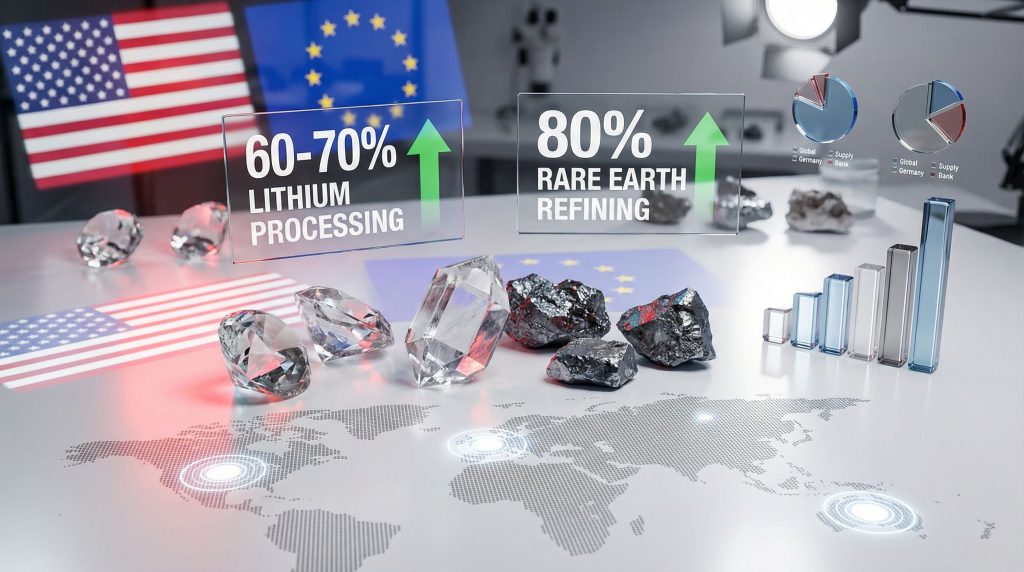
Global critical mineral processing exhibits dangerous concentration patterns that threaten energy transition timelines across Western economies. Lithium processing capabilities remain heavily concentrated in Asian facilities, while rare earth element refining demonstrates similar geographic clustering that creates systematic vulnerabilities for clean technology deployment.
These concentration risks manifest most acutely in battery manufacturing supply chains, where multiple processing stages often occur within single jurisdictions. Cobalt refining, graphite processing, and lithium hydroxide production demonstrate particular vulnerability to supply disruptions, with limited alternative processing capacity available in Western markets.
European and American policymakers recognise that achieving climate objectives requires diversified processing infrastructure capable of supporting domestic manufacturing requirements. The transition timeline for electric vehicle adoption and grid-scale energy storage deployment leaves insufficient time for traditional market mechanisms to develop adequate alternative capacity.
| Critical Mineral | Primary Processing Location | Alternative Capacity | Strategic Risk Level |
|---|---|---|---|
| Lithium Hydroxide | Asia-Pacific dominance | Limited Western facilities | High |
| Cobalt Refining | Concentrated in few countries | Minimal backup capacity | Critical |
| Rare Earth Processing | Heavily concentrated | Very limited alternatives | Critical |
| Graphite Production | Asian majority | Emerging Western projects | Moderate-High |
Advanced manufacturing sectors beyond clean energy also depend on these same mineral inputs, creating competition between industrial priorities during potential supply constraints. Semiconductor manufacturing, aerospace applications, and defence systems all require access to processed critical minerals, intensifying the strategic importance of supply chain diversification.
Economic Security Through Diversified Sourcing Networks
The Biden Administration's Inflation Reduction Act established precedent for linking domestic subsidies to supply chain geography, requiring electric vehicle battery components to originate from trusted partner nations to qualify for consumer tax credits. This framework created immediate incentives for companies to restructure procurement practices, though implementation timelines proved challenging for established supply relationships.
Following the 2024 elections and transition to the Trump administration in 2025, uncertainty emerged regarding continuity of these provisions. However, the US critical minerals order has provided renewed clarity on strategic priorities.
The March 28, 2026 meeting between EU Trade Commissioner Maroš Šefčovič and US Trade Representative Jamieson Greer in Yaoundé, Cameroon, addressed these concerns through renewed commitment to existing arrangements. According to Reuters reporting, the discussion was characterised as very positive, with both sides demonstrating willingness to advance shared economic priorities despite global uncertainties.
This diplomatic engagement occurred alongside broader ministerial discussions involving multiple trading partners, suggesting multilateral approaches to critical mineral security. The trusted partner designation mechanism requires formal agreements establishing preferential treatment for qualifying nations.
Companies adapting to these requirements face complex decisions regarding facility location, technology transfer arrangements, and long-term procurement contracts. The transition costs for supply chain reconfiguration often exceed traditional market-driven optimisation, requiring policy support to maintain commercial viability.
How Do Critical Minerals Agreements Differ from Traditional Trade Frameworks?
Beyond Tariff Reduction: Strategic Resource Coordination
Critical Minerals Agreements represent fundamental departures from conventional trade liberalisation by incorporating strategic stockpiling requirements, coordinated procurement mechanisms, and technology sharing protocols. These frameworks prioritise supply chain resilience over pure cost optimisation, creating new metrics for evaluating trade relationship success.
Traditional free trade agreements focus primarily on tariff elimination and regulatory harmonisation to facilitate market access. Critical Minerals Agreements instead establish:
- Preferential sourcing requirements linking government procurement to partner nation suppliers
- Coordinated stockpiling strategies designed to buffer supply disruptions across multiple jurisdictions
- Joint investment frameworks providing financial mechanisms for mining and processing infrastructure development
- Technology sharing protocols facilitating innovation transfer for extraction and refining improvements
- Regulatory harmonisation specifically targeting environmental and safety standards for mineral operations
The strategic nature of these agreements reflects recognition that critical mineral markets cannot function according to traditional economic models during periods of geopolitical tension. Furthermore, the development of a comprehensive critical minerals strategy requires coordination beyond traditional trade mechanisms.
Investment frameworks within Critical Minerals Agreements typically include risk-sharing mechanisms between public and private sectors. Government backing for mining projects in partner countries reduces commercial risk while ensuring strategic access to processed materials.
Implementation Challenges and Timing Considerations
The European Union's authorisation process for Critical Minerals Agreement negotiations began during 2023, establishing institutional frameworks for comprehensive partnerships. However, implementation faced delays due to political transitions and regulatory complexity across multiple jurisdictions.
A significant trade arrangement between the EU and US was agreed in July 2025 at Turnberry, Scotland, following months of uncertainty regarding tariff policies under the Trump presidency. European Parliamentary approval occurred in March 2026, though European officials included safeguard provisions reflecting concerns about American commitment levels.
These safeguards demonstrate persistent trust limitations despite diplomatic progress. European policymakers remain cautious about potential policy reversals, particularly given historical precedents for trade agreement modifications following American political transitions.
The inclusion of automatic termination clauses and performance monitoring systems indicates European determination to maintain leverage throughout implementation phases.
Regulatory coordination between EU environmental standards and US industrial policies presents ongoing challenges. Differences in permitting processes, environmental impact assessment requirements, and community consultation procedures create implementation complexity for multinational projects.
Industry adaptation timelines often exceed political agreement schedules. Mining and processing facility development requires multi-year construction periods, while companies need certainty about regulatory frameworks before committing capital to large infrastructure projects.
What Role Do Tariff Negotiations Play in Broader Economic Strategy?
The 15% Tariff Ceiling Framework
The July 2025 political agreement establishing a 15% maximum tariff rate on most EU exports represented a significant compromise from higher rates initially proposed during early Trump administration trade discussions. This ceiling provided predictability for European exporters while maintaining American flexibility for protecting strategic industries.
Washington's agreement to apply the 15% rate rather than more punitive levels helped avoid serious trade disputes that could have disrupted broader cooperation frameworks. The compromise reflected mutual recognition that excessive trade tensions would undermine critical mineral cooperation objectives, particularly as tariffs impact on markets becomes increasingly evident.
Specific sector exemptions were negotiated for pharmaceutical and aerospace industries, maintaining zero-tariff status for products where American and European companies maintain deeply integrated supply chains. Steel and aluminium products received special treatment addressing global overcapacity concerns while preserving transatlantic trade flows.
The tariff framework incorporates flexibility mechanisms allowing for temporary adjustments during supply chain emergencies or market disruptions. This approach recognises that rigid trade rules may prove counterproductive during periods requiring rapid industrial adaptation.
Implementation includes sunset provisions requiring periodic review and renewal, ensuring that trade arrangements remain aligned with evolving strategic priorities. Both sides retain ability to modify terms based on changing global economic conditions or technological developments.
Parliamentary Safeguards and Implementation Mechanisms
European Parliamentary approval in March 2026 included automatic termination clauses requiring reciprocal steel and aluminium arrangements by March 2028. These provisions ensure that American commitments translate into concrete policy changes rather than remaining diplomatic promises.
Performance monitoring systems track tariff compliance rates and measure progress toward shared objectives including supply chain diversification and processing capacity development. Regular reporting requirements provide transparency for both legislative oversight and industry planning purposes.
Dispute resolution protocols establish clear procedures for addressing implementation disagreements before they escalate into broader trade conflicts. These mechanisms include expert panel reviews and binding arbitration options for technical disputes.
Review mechanisms allow for agreement modification as global conditions evolve, particularly regarding technological developments or new geopolitical challenges. Flexibility provisions prevent agreements from becoming obsolete as industry requirements change.
The safeguard framework reflects European concerns about American policy continuity across different political administrations. Automatic enforcement mechanisms reduce dependence on ongoing diplomatic cooperation for agreement implementation.
How Do These Agreements Address China's Market Position?
Coordinated Response to State-Subsidised Competition
Recent ministerial discussions involving 54 nations demonstrate broader multilateral recognition that traditional trade rules prove insufficient for addressing state-subsidised competition in critical mineral markets. Coordinated responses include development of alternative pricing mechanisms and preferential trading arrangements excluding non-market economies.
Price floor mechanisms under consideration would establish minimum pricing levels for critical minerals, preventing below-cost dumping that undermines investment in alternative processing capacity. These approaches require careful coordination to avoid triggering World Trade Organization disputes while maintaining effectiveness.
Preferential trading zones linking allied economies create competitive advantages for companies operating within cooperative frameworks. Market access benefits provide incentives for supply chain reconfiguration while reducing dependence on concentrated processing capabilities.
Joint procurement initiatives leverage collective buying power to support alternative suppliers and encourage processing capacity development in partner countries. Government coordination amplifies market signals that might otherwise prove insufficient to justify infrastructure investments.
Investment screening protocols examine critical infrastructure projects for security implications, particularly regarding technology transfer and supply chain vulnerabilities. These mechanisms complement trade agreements by addressing non-commercial aspects of critical mineral security.
Technology Transfer and Intellectual Property Protections
Strategic coordination extends beyond raw materials to encompass processing technology development through joint research initiatives. Shared innovation programs accelerate development of alternative processing methods while reducing individual nation research costs.
Patent sharing arrangements facilitate technology dissemination among partner countries while maintaining competitive advantages over non-aligned economies. Intellectual property frameworks balance innovation incentives with strategic cooperation requirements.
Workforce development programs address specialised technical skills needed for advanced mineral processing operations. International cooperation in training and education ensures adequate human capital for supply chain diversification initiatives.
Environmental technology standards promote sustainable mining practices while creating additional competitive advantages for partner nation operations. Higher environmental performance requirements can differentiate allied production from less regulated alternatives.
What Are the Investment Implications for Global Mining Companies?
Shifting Capital Allocation Patterns
Policy coordination between the EU and US creates fundamental changes in investment evaluation criteria for mining and processing operations. Geographic location now carries strategic value beyond traditional cost considerations, with trusted partner jurisdictions receiving preferential treatment for major projects.
Companies must now evaluate geopolitical alignment of host countries with major consumer markets when making facility location decisions. Projects in aligned countries receive regulatory advantages and market access benefits that can offset higher operational costs compared to traditional low-cost locations.
Processing facility development particularly benefits from this strategic reorientation, as governments prioritise domestic or partner-country processing capacity over raw material exports. Value-added manufacturing receives enhanced support through multiple policy channels including preferential procurement and investment incentives.
Technology research and development increasingly follows collaborative models rather than proprietary development approaches. Companies participating in joint innovation programs gain access to shared research facilities and government funding while contributing to broader strategic objectives.
Infrastructure investments must consider strategic geographic distribution requirements alongside traditional market proximity factors. Resilient supply chains require redundant processing capacity across multiple aligned jurisdictions rather than concentrated facilities optimised purely for cost efficiency.
Risk Assessment for Mining Operations
Modern mining investment evaluation requires comprehensive geopolitical risk assessment incorporating potential policy changes across multiple jurisdictions. Companies must model scenarios including trade agreement modifications, regulatory framework evolution, and changing strategic partnership arrangements.
Regulatory compliance costs vary significantly between jurisdictions implementing different environmental and safety standards. Higher compliance requirements in partner countries may be offset by market access advantages and reduced political risk over project lifecycles.
Supply chain resilience considerations now outweigh traditional cost optimisation for many strategic minerals. Companies developing multiple sourcing options and processing redundancy position themselves advantageously for policy-driven market preferences.
Technology access through partnership agreements provides competitive advantages for companies operating within aligned frameworks. Exclusion from technology sharing arrangements could disadvantage operations in non-partner countries over long time horizons.
The next major ASX story will hit our subscribers first
How Might These Frameworks Evolve Under Different Political Scenarios?
Scenario Analysis for Policy Continuity
Scenario 1: Sustained Bipartisan Support
Expansion of Critical Minerals Agreement frameworks to additional partners including Australia, Canada, and Chile would create broader coalitions for strategic resource cooperation. Deeper technology sharing agreements could accelerate alternative processing capacity development across allied economies.
Integration with Indo-Pacific Economic Framework initiatives would link Atlantic and Pacific partnership structures, creating comprehensive alternatives to China-centred supply chains. Coordinated investment programs could achieve sufficient scale to compete with established processing hubs.
Scenario 2: Political Transition Disruption
Potential renegotiation of tariff arrangements following future political changes could create uncertainty for long-term investment planning. Bilateral rather than multilateral approaches might emerge, reducing coordination efficiency while maintaining basic cooperation frameworks.
Modifications to Inflation Reduction Act provisions could alter incentive structures for supply chain reconfiguration, though existing infrastructure investments would likely continue operating regardless of policy changes. The broader implications for the US economy and tariffs would need careful monitoring.
Scenario 3: Global Economic Stress
Economic pressures could accelerate strategic stockpiling programs while triggering emergency supply sharing protocols among partner nations. Temporary suspension of environmental standards might occur during severe supply disruptions, prioritising security over sustainability objectives.
Resource nationalism could intensify across multiple regions, making international cooperation more difficult while increasing the value of existing partnership agreements for maintaining access to critical materials.
What Metrics Should Stakeholders Monitor for Success Assessment?
Quantitative Performance Indicators
Supply chain diversification ratios measuring dependence reduction provide clear metrics for evaluating progress toward strategic objectives. Tracking processing capacity distribution across partner countries indicates whether alternative infrastructure development meets targeted timelines.
Investment flow redirection from concentrated processing hubs toward partner country facilities demonstrates private sector response to policy incentives. Measuring capital allocation changes helps assess framework effectiveness for achieving supply chain resilience goals.
Technology transfer volumes through collaborative programs indicate whether innovation sharing mechanisms function effectively. Patent applications and research publication patterns reveal depth of technical cooperation beyond formal agreement structures.
Processing capacity growth in allied nations compared to global averages shows whether policy coordination successfully encourages infrastructure development in strategic locations. Capacity utilisation rates indicate whether new facilities achieve commercial viability alongside strategic objectives.
Qualitative Success Factors
Regulatory harmonisation progress across jurisdictions affects implementation efficiency for multinational projects. Standardisation of environmental assessment procedures and safety requirements reduces compliance complexity while maintaining high operational standards.
Industry adaptation rates to new sourcing requirements demonstrate private sector acceptance of policy frameworks. Company willingness to restructure supply chains indicates confidence in policy continuity and commercial viability of alternative arrangements.
Third-country participation in expanded frameworks shows whether cooperation models attract broader international support. Regional economic integration beyond initial bilateral agreements could amplify strategic benefits through network effects.
Environmental standard maintenance during rapid scaling ensures that supply chain diversification doesn't compromise sustainability objectives. Monitoring mining and processing operations for environmental compliance prevents strategic cooperation from undermining broader climate goals.
The trajectory of EU–US talks on critical minerals and tariffs represents a fundamental transformation in how major economies balance commercial interests with strategic imperatives. Success depends on maintaining political commitment across electoral cycles while demonstrating economic benefits sufficient to sustain private sector participation in restructured supply chains.
As detailed in recent EU-US cooperation developments, both sides continue to advance comprehensive approaches that balance commercial interests with strategic security requirements. These ongoing discussions will likely shape global mineral markets for years to come.
Investment Disclaimer: This analysis is for informational purposes only and does not constitute investment advice. Mining and commodity investments involve significant risks including price volatility, regulatory changes, and geopolitical uncertainties. Consult qualified financial advisors before making investment decisions.
Looking to Capitalise on Critical Minerals Investment Opportunities?
Discovery Alert's proprietary Discovery IQ model delivers real-time alerts on significant ASX mineral discoveries, instantly empowering subscribers to identify actionable opportunities ahead of the broader market. Understand why historic discoveries can generate substantial returns by visiting Discovery Alert's dedicated discoveries page, showcasing exceptional market outcomes from major mineral finds.