
August 25, 2026
Strategic Frameworks for Understanding Global Gas Market Disruption
The intersection of geopolitical risk management, state-capital deployment, and resource monetisation creates unique investment opportunities in previously inaccessible energy markets. Modern energy security frameworks increasingly depend on diversified supply chains that can withstand sanctions volatility while maintaining operational flexibility. Furthermore, the recent Venezuela policy shift has created new opportunities for international energy companies to reassess their strategic positions in Latin American markets.
Contemporary energy investment decisions now occur within what analysts term "managed reopening frameworks" where previously sanctioned markets become selectively accessible through structured oversight mechanisms. This approach represents a fundamental shift from binary sanctions enforcement toward granular sectoral engagement that balances market access with regulatory supervision.
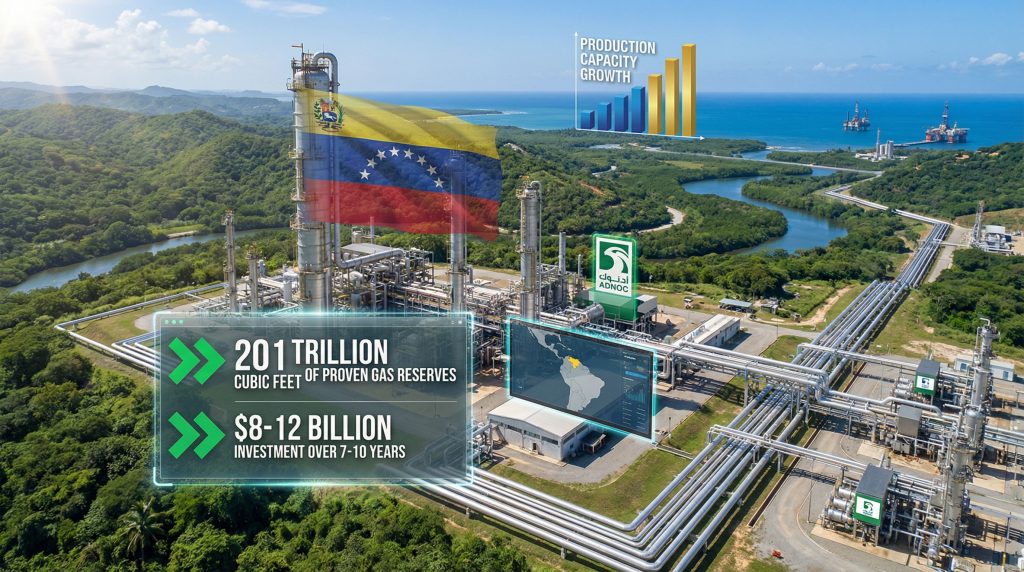
Venezuela's natural gas reserves, totaling approximately 201 trillion cubic feet of proven resources, represent one of the hemisphere's largest undeveloped energy assets. Current production levels of 28 billion cubic meters annually operate at roughly 60% below technical potential, creating substantial opportunity for capital deployment and production optimisation. The dramatic decline in Venezuelan oil output from 1.6 million barrels per day in November 2025 to 880,000 barrels per day as of early 2026 demonstrates both the severity of infrastructure degradation and the urgency of investment requirements.
When big ASX news breaks, our subscribers know first
ADNOC Venezuela Gas Investment Strategy Through Multiple Operational Lenses
Geographic Diversification and Portfolio Optimisation Framework
The ADNOC Venezuela gas investment represents a strategic portfolio expansion beyond traditional Middle Eastern production bases into Atlantic Basin markets. Venezuelan reserve distribution across multiple geographic zones creates operational flexibility unavailable in single-field developments. Moreover, this diversification strategy aligns with broader investment strategy components that emphasise geographic risk distribution.
Reserve Distribution Analysis:
- Offshore Mariscal Sucre Field: 9.7 trillion cubic feet proven reserves
- Deltana Platform: 35+ trillion cubic feet development potential
- Orinoco Belt Associated Gas: 150+ trillion cubic feet integrated with oil operations
- Onshore Conventional Fields: 45 trillion cubic feet in politically stable eastern regions
This geographic concentration in Venezuela's eastern provinces provides relative political stability compared to western oil-producing regions while maintaining access to existing pipeline infrastructure connecting to Colombia and potential Caribbean export terminals.
Infrastructure Investment Requirements and Competitive Positioning
Venezuela's gas processing infrastructure experienced severe degradation during the sanctions period, declining from 8.5 billion cubic meters annual capacity in 2015 to approximately 4.2 billion cubic meters currently. This 51% capacity reduction creates substantial capital requirements but also ensures limited competition for early-stage investors willing to deploy patient capital.
Critical Infrastructure Investment Framework:
| Infrastructure Component | Investment Requirement | Timeline |
|---|---|---|
| Gas Processing Facilities | $3-4 billion | 2027-2030 |
| Pipeline Rehabilitation | $1.5-2 billion | 2026-2029 |
| LNG Export Terminals | $8-10 billion | 2028-2035 |
| Compression and Storage | $800 million-1.2 billion | 2027-2031 |
The substantial infrastructure deficit, while requiring significant capital deployment, creates first-mover advantages for investors capable of staged development approaches that align capital deployment with regulatory approvals and market conditions. Additionally, these developments may influence broader oil price dynamics across regional energy markets.
How Does U.S. Regulatory Architecture Enable Structured Investment?
Managed Reopening Framework Implementation
The Trump administration's approach to Venezuelan energy sector engagement emphasises "controlled participation through licensed partnerships rather than comprehensive sanctions relief." This framework maintains U.S. enforcement authority while selectively enabling foreign investment through explicit authorisation mechanisms. However, these developments must be viewed alongside considerations of OPEC production impact on global energy markets.
A critical regulatory development occurred on January 9, 2026, when a U.S. executive order established "targeted regimes to protect certain Venezuelan oil-related revenues held in designated U.S. Treasury accounts from attachment." This framework creates the institutional infrastructure for investment capital deployment while ensuring revenue transparency and compliance monitoring.
Regulatory Framework Components:
- Specific General License 44A: Authorises selective gas sector activities under Treasury supervision
- Revenue Account Structures: Designated U.S. Treasury accounts for Venezuelan energy revenues
- Compliance Reporting: Mandatory transaction monitoring and third-party auditing requirements
- Maritime Enforcement: Coordinated interdiction operations maintaining sanctions boundaries
State-Capital Investment Advantages in Supervised Markets
State-owned enterprises like ADNOC operate comfortably within Washington-supervised investment frameworks due to their institutional experience with "strong political alignment and long-term investment horizons." This structural advantage enables participation in complex regulatory environments where commercial investors face compliance constraints or domestic political considerations.
The regulatory architecture creates what analysts describe as "structured toxicity that remains investable" for state-capital platforms capable of operating under external oversight while maintaining operational autonomy. This framework particularly benefits Gulf sovereign wealth entities with established relationships with U.S. energy companies and proven track records in politically complex investment environments.
Risk Mitigation Through Escrow and Third-Party Mechanisms
The U.S. Treasury's establishment of designated Venezuelan revenue accounts provides a template for gas sector investment structures that balance commercial opportunity with regulatory compliance. These mechanisms enable foreign capital deployment while ensuring revenue flow transparency.
Investment Protection Framework:
- Escrow Account Structures: Investment capital deployment through supervised mechanisms
- Political Risk Insurance: Coverage through U.S. and multilateral development agencies
- Force Majeure Protections: Sanctions-related disruption coverage for authorised operations
- Third-Party Auditing: Independent verification of production volumes and revenue flows
Technical and Operational Challenges in Venezuelan Gas Development
Reservoir Characteristics and Processing Complexities
Venezuelan gas fields present significant technical challenges requiring specialised expertise and substantial capital investment. High CO2 content in several major fields ranges from 15-20%, necessitating advanced processing technologies for commercial gas production. These technical considerations must also account for broader regional trends, including US natural gas forecast patterns that may influence project economics.
Primary Technical Challenges:
- Sour Gas Processing: Elevated hydrogen sulfide and CO2 content requiring specialised treatment
- Pipeline Infrastructure: Comprehensive rehabilitation of ageing transmission systems
- Integration Complexity: Coordination with existing oil production operations
- Processing Capacity: Substantial expansion from current 4.2 BCM to potential 20-25 BCM annually
ADNOC's technical capabilities in "sour gas processing expertise from UAE operations" become directly relevant to Venezuelan field conditions. The company's experience with enhanced recovery techniques and integrated upstream-midstream development models provides technological synergies for Venezuelan applications.
Modular Development Approaches and Phased Investment
Natural gas development permits "phased and modularised" capital deployment contrasting with heavy crude projects requiring large-scale infrastructure investment. This flexibility enables staged development aligned with regulatory approvals and market conditions.
Development Modularity Advantages:
- Phase-Gate Investment: Capital deployment tied to regulatory milestone achievement
- Market Responsiveness: Production scaling aligned with regional demand growth
- Technical Flexibility: Processing facility expansion based on reservoir performance
- Political Risk Management: Staged commitment reducing exposure to regulatory changes
Regional Market Impact and Competitive Dynamics
Caribbean Basin Energy Security Transformation
Successful Venezuelan gas development could fundamentally alter energy security dynamics across the Caribbean Basin, reducing dependence on U.S. LNG imports while creating new regional supply chains with enhanced price stability.
Regional Market Integration Scenarios:
| Market Segment | Current Supply Sources | Venezuelan Market Share Potential | Implementation Timeline |
|---|---|---|---|
| Colombia | 85% domestic production | 15-25% pipeline imports | 2028-2030 |
| Caribbean Islands | 90% LNG imports | 30-40% regional pipeline supply | 2030-2032 |
| Central America | 70% imported LNG | 20-30% Venezuelan regional supply | 2029-2031 |
Venezuelan pipeline gas development offers substantial cost advantages compared to LNG imports, with potential delivered costs of $2-3 per MMBtu versus $8-10 per MMBtu for imported LNG. This pricing differential creates compelling economic incentives for regional supply contract restructuring.
Competitive Pressure on U.S. LNG Export Markets
Venezuelan gas production growth could create competitive pressure on U.S. LNG exports to Latin American markets, potentially altering long-term contract pricing and supply security dynamics. Regional pipeline gas offers transportation cost advantages and reduced infrastructure requirements compared to LNG import terminals.
Competitive Analysis Framework:
- Cost Structure: Venezuelan pipeline gas cost advantage of $5-7 per MMBtu versus U.S. LNG
- Supply Security: Regional production reduces transportation risks and price volatility
- Infrastructure Requirements: Pipeline connections versus LNG terminal development costs
- Contract Flexibility: Potential for long-term pricing below global LNG benchmark indices
Partnership Structures and Financial Architecture
Joint Venture Models for Risk Distribution
ADNOC's preference for partnership-based investments suggests potential collaboration with established Latin American operators or international majors with Venezuelan operational experience. This approach distributes political risk while combining complementary technical capabilities. According to recent reports from Bloomberg, these partnership discussions are already underway with several potential collaborators.
Partnership Configuration Framework:
| Partner Category | Strategic Advantages | Risk Sharing Structure | Investment Timeline |
|---|---|---|---|
| European Majors | Regulatory compliance experience | 40-60% equity participation | 2027-2030 initial phase |
| Latin American NOCs | Regional market access | 30-50% local partnership | 2026-2028 framework development |
| U.S. Independents | Midstream capabilities | 20-40% strategic stakes | 2028-2032 development phase |
Partnership structures enable risk distribution while satisfying U.S. licensing requirements for international collaboration in Venezuelan energy development. Joint ventures provide technical burden sharing and political exposure management essential for complex regulatory environments.
Financing Structure Optimisation for Large-Scale Investment
The estimated $8-12 billion investment requirement over 7-10 years necessitates creative financing approaches balancing commercial returns with political risk management. ADNOC's access to UAE sovereign wealth backing enables patient capital deployment unavailable to commercial operators. Industry sources from Reuters indicate that these financing structures are currently being refined through multiple channels.
Capital Structure Components:
- ADNOC Direct Investment: $3-4 billion primary capital commitment
- Development Finance Institutions: $2-3 billion multilateral agency participation
- Commercial Bank Syndication: $1-2 billion international banking consortium
- Equipment Financing: $500 million-1 billion vendor financing arrangements
The next major ASX story will hit our subscribers first
Performance Measurement and Strategic Success Metrics
Production and Financial Target Framework
Success metrics for the ADNOC Venezuela gas investment emphasise production growth trajectory and financial returns while maintaining compliance with international regulatory standards and environmental requirements.
Key Performance Indicator Targets:
| Metric Category | 2027 Milestone | 2030 Target | 2035 Projection |
|---|---|---|---|
| Gas Production (BCM annually) | 8-10 | 15-18 | 25-30 |
| Processing Capacity (BCM annually) | 6-8 | 12-15 | 20-25 |
| Export Revenue ($B annually) | 1.5-2.0 | 3.5-4.5 | 6.0-8.0 |
| Local Employment (thousands) | 8-12 | 15-20 | 25-35 |
These targets assume successful infrastructure rehabilitation and regulatory framework stability enabling sustained production growth and market access expansion across Caribbean Basin and potential Atlantic export markets.
Strategic Portfolio Impact Assessment
Beyond financial metrics, the Venezuelan investment contributes to ADNOC's global positioning objectives and strategic portfolio diversification across multiple dimensions including geographic risk distribution, technology transfer capabilities, and regional market relationships.
Strategic Success Indicators:
- Market Share Growth: Atlantic Basin gas market penetration and contract portfolio expansion
- Technology Transfer: Enhanced recovery technique development and operational capability building
- Regional Relationships: Latin American energy sector partnership development and institutional cooperation
- Portfolio Optimisation: Geographic diversification and integrated value chain development across multiple markets
What Are the Broader Implications for Global Energy Investment Patterns?
Precedent Setting for State-Capital Deployment in Recovering Markets
The ADNOC Venezuela gas investment could establish new frameworks for Gulf sovereign wealth and state-owned enterprise engagement with previously sanctioned energy markets under managed reopening structures. This approach may influence similar investments in other recovering energy markets.
Framework Elements for Replication:
- Structured Political Risk: Managed exposure through regulatory supervision and revenue transparency
- State-Capital Advantages: Patient capital and political alignment enabling complex market entry
- Partnership Requirements: Risk distribution and technical capability combination through international collaboration
- Regulatory Coordination: Explicit authorisation and compliance monitoring ensuring legitimate market participation
Evolution of South-South Energy Cooperation Models
The investment represents significant expansion of Gulf-Latin American energy partnerships, potentially catalysing broader economic cooperation between these regions while reducing traditional dependence on North American and European energy relationships.
This framework creates templates for structured engagement balancing commercial opportunity with geopolitical compliance requirements, potentially applicable to other energy markets experiencing political transitions or sanctions relief processes.
Consequently, the ADNOC Venezuela gas investment opportunity represents a convergence of technical expertise, patient capital availability, and regulatory framework evolution that could reshape regional energy markets while establishing new precedents for state-capital deployment in complex political environments. Success depends on sustained regulatory coordination, technical execution, and market development across multiple dimensions requiring integrated strategic approach and risk management capabilities.
Investment Disclaimer: This analysis involves forecasts, speculation, and assumptions about future market developments that are subject to significant uncertainty. Political risk, regulatory changes, and technical challenges could substantially impact investment outcomes. Potential investors should conduct independent due diligence and consider multiple scenario analyses before making investment decisions.
Ready to Capitalise on Major Energy Discoveries?
Discovery Alert's proprietary Discovery IQ model delivers real-time alerts on significant ASX mineral and energy discoveries, empowering subscribers to identify actionable opportunities ahead of the broader market. Begin your 30-day free trial today and secure your market-leading advantage in energy sector investments.