August 8, 2026
Strategic Implications of Shifting Global Energy Control
The contemporary energy landscape faces unprecedented transformation as traditional power structures encounter new challenges. America's historical dominance in global petroleum markets has relied heavily on strategic partnerships, technological advantages, and the petrodollar system that emerged in the 1970s. However, recent decades have witnessed the rise of alternative payment mechanisms, diversified supply chains, and competing regional blocs that threaten this established order.
Within this context, control over major hydrocarbon reserves becomes increasingly critical for maintaining geopolitical influence. The US removal of Maduro represents a pivotal moment where energy security intersects with national security considerations. Furthermore, the ability to influence global supply chains, pricing mechanisms, and distribution networks determines not just economic outcomes, but broader strategic positioning in an increasingly multipolar world.
Understanding these dynamics requires examining how resource control translates into market power, particularly when combined with advanced extraction technologies, robust infrastructure networks, and established refining capabilities. The integration of major hydrocarbon reserves under unified control systems can fundamentally alter global energy flows, reshape pricing mechanisms, and redefine the strategic balance between producing and consuming nations.
When big ASX news breaks, our subscribers know first
What Does American Control of Venezuelan Oil Reserves Mean for Global Energy Security?
The Strategic Significance of World's Largest Proven Oil Reserves
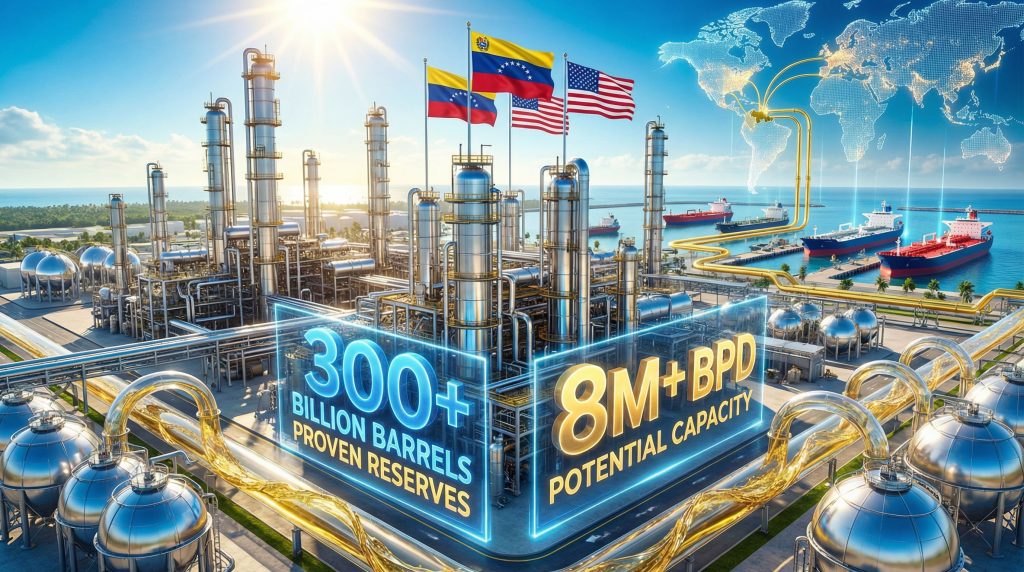
Venezuela's position as holder of the world's largest proven oil reserves fundamentally alters global energy calculations. With approximately 303 billion barrels in proven reserves according to OPEC data, Venezuela surpasses even Saudi Arabia's 267 billion barrels, representing nearly 18% of global proven reserves. This vast resource base, concentrated primarily in the Orinoco Oil Belt, contains heavy crude deposits that require specialized extraction and refining techniques.
Current production capacity stands at a fraction of the country's potential. Recent estimates indicate Venezuelan output at approximately 800,000 barrels per day, dramatically below the country's peak production of 3.2 million barrels per day achieved in the late 1990s. This production decline resulted from infrastructure deterioration, limited investment, and operational challenges that modern extraction technologies could potentially address.
The geographic positioning of Venezuelan reserves offers significant advantages for Atlantic Basin crude flows. Located on South America's Caribbean coast, Venezuelan oil fields provide direct access to major shipping routes connecting to North American Gulf Coast refineries, European markets, and Asian destinations. Consequently, this positioning reduces transportation costs compared to Middle Eastern or African suppliers serving similar markets.
Immediate Market Disruption vs. Long-Term Supply Transformation
Short-term market reactions typically involve 2-5% crude price increases during periods of geopolitical uncertainty, as traders factor in potential supply disruptions and regime change risks. However, the US removal of Maduro scenarios present unique dynamics where immediate disruption could transition rapidly to increased supply availability once operational control stabilizes.
Medium-term infrastructure rebuilding timelines present the most critical variable for market transformation. Industry assessments suggest 3-5 year periods for substantial production restoration, requiring coordinated investment in:
- Wellhead rehabilitation and drilling equipment upgrades
- Pipeline network reconstruction and expansion
- Refinery modernization and capacity enhancement
- Port facility improvements for export operations
- Power grid stabilization for industrial operations
Long-term production scenarios envision Venezuelan capacity reaching 5-15 million barrels per day under optimal infrastructure development. In addition, this range reflects different investment levels and technological deployment strategies, with higher estimates assuming comprehensive field development using enhanced oil recovery techniques specifically suited to heavy crude extraction.
| Timeline | Conservative Output | Optimistic Output | Global Market Impact |
|---|---|---|---|
| 2024-2025 | 1.2M bpd | 1.8M bpd | Limited disruption |
| 2026-2028 | 2.5M bpd | 4.2M bpd | Moderate supply increase |
| 2029-2032 | 4.8M bpd | 8.5M bpd | Significant market shift |
| 2033+ | 6.5M bpd | 12M+ bpd | Major structural change |
How Could This Reshape America's Petrodollar Strategy?
Strengthening Dollar-Denominated Energy Trade
The petrodollar system faces mounting pressure from alternative payment mechanisms, particularly Chinese yuan-denominated crude contracts and Russian efforts to bypass SWIFT-based transactions. Venezuelan oil integration under American control could reinforce dollar-based energy trade by adding substantial supply volumes to existing dollar-denominated markets.
This integration would counter China-Russia alternative payment systems by providing American allies and trading partners with reliable dollar-based energy supplies. Current estimates suggest over 60% of global oil transactions still occur in US dollars, but this percentage has declined from approximately 75% in 2015 as alternative mechanisms gain acceptance.
However, the impact on yuan-denominated crude contracts could prove particularly significant. China's petroleum futures contracts, launched in 2018, have gained traction among suppliers seeking alternatives to dollar-based pricing. Nevertheless, increased Venezuelan supply under American control would provide dollar-based alternatives for traditional Chinese suppliers, potentially limiting yuan contract growth.
Strategic Resource Control in Multipolar World
Historical precedents for American energy interventions provide context for Venezuelan integration strategies. The 1991 Gulf War demonstrated how resource protection translates into sustained market influence, while the 2003 Iraq intervention illustrated both opportunities and challenges in managing complex hydrocarbon infrastructure under foreign control.
Balancing domestic shale production with Venezuelan heavy crude presents both synergies and complications. American shale production, currently exceeding 13 million barrels per day, consists primarily of light sweet crude optimal for gasoline production. Furthermore, Venezuelan heavy crude requires different refining configurations, potentially complementing rather than competing with domestic production.
Export capacity implications extend beyond crude oil to include refined products and liquefied natural gas. Venezuelan control could enable integrated supply chain management, optimizing refinery outputs for specific market demands while maintaining strategic petroleum reserve flexibility.
What Are the Geopolitical Implications for China's Energy Security?
Disruption to China-Venezuela Energy Partnership
China's extensive financial commitments to Venezuelan oil sector development face uncertainty under new control structures. Chinese institutions have provided over $50 billion in loans to Venezuelan oil projects since 2007, with repayment structures typically involving crude oil deliveries at predetermined prices.
These arrangements formed a crucial component of China's crude import diversification strategy, designed to reduce dependence on Middle Eastern suppliers and volatile spot markets. Venezuelan heavy crude, while requiring specialized refining capabilities, offered China long-term supply security through bilateral agreements that bypassed traditional commodity markets.
Impact assessment on China's alternative supplier relationships reveals potential acceleration of existing diversification efforts. The oil price movements demonstrate how these disruptions affect global trading patterns. Current Chinese crude imports derive from multiple sources:
- Middle Eastern suppliers: 45-50% of total imports
- Russian Federation: 18-22% of imports
- African suppliers: 15-18% of imports
- Latin American sources: 8-12% of imports
- Other Asian suppliers: 5-8% of imports
Broader Implications for Belt and Road Energy Infrastructure
Venezuelan projects under Chinese financing encompass upstream development, refinery construction, and transportation infrastructure that collectively represent $15-20 billion in committed investments. These projects include enhanced oil recovery systems, heavy crude upgrading facilities, and pipeline networks designed to increase export capacity.
The precedent for resource nationalism affecting Belt and Road Initiative investments extends beyond Venezuela to include concerns about similar scenarios in Central Asia, Africa, and Southeast Asia. Countries hosting significant Chinese energy infrastructure investments may reassess risk-benefit calculations regarding foreign control of strategic resources.
Strategic recalibration of energy security planning involves both geographic and technological diversification. China's response strategies likely include accelerated development of alternative supplier relationships, increased strategic petroleum reserve capacity, and enhanced domestic energy production capabilities including renewable energy deployment. Moreover, US–China trade strategies will play a crucial role in shaping these energy relationships.
How Will This Affect Global Oil Market Dynamics?
OPEC+ Response and Production Coordination
Saudi Arabia and Russia's strategic positioning within OPEC+ becomes crucial for managing increased Venezuelan supply integration. Current OPEC+ production agreements limit member output through coordinated quotas designed to maintain price stability, but Venezuelan integration under non-OPEC control complicates these arrangements.
Potential quota adjustments could involve compensatory production cuts by existing OPEC+ members to maintain market balance. However, the scale of potential Venezuelan production increases may exceed OPEC+ flexibility, particularly given current spare capacity limitations among major producers. The OPEC+ production impact on global markets becomes increasingly complex under these circumstances.
Global spare capacity calculations currently estimate 2-3 million barrels per day of readily available production increases across all major suppliers. Venezuelan production restoration could add 3-8 million barrels per day over medium-term timeframes, potentially overwhelming existing market management mechanisms.
Heavy Crude vs. Light Sweet Crude Market Segmentation
Venezuelan heavy crude characteristics require specialized refining configurations that limit processing flexibility compared to light sweet crude grades. This heavy crude trades at discounts ranging from $8-15 per barrel relative to light sweet benchmarks, reflecting additional processing costs and yield limitations.
US Gulf Coast refinery optimization opportunities emerge from existing infrastructure designed for heavy crude processing. American refineries currently process significant volumes of Canadian heavy crude and Mexican Maya crude, providing operational expertise and equipment configurations suitable for Venezuelan integration.
Price differential implications for heavy crude benchmarks could narrow as increased supply availability improves market liquidity and processing efficiency. Consequently, greater supply volumes typically reduce location-specific premiums and enhance price discovery mechanisms across different crude quality specifications. The oil price rally analysis provides insights into these market dynamics.
"Integration of substantial heavy crude reserves under unified control represents a fundamental shift in petroleum market structure that could reshape pricing relationships between different crude quality grades and geographic markets."
What Infrastructure Investments Will Be Required?
Rebuilding Venezuelan Oil Production Capacity
Infrastructure investment requirements for Venezuelan oil sector rehabilitation range from $50-100 billion depending on production targets and technological deployment strategies. These investments must address decades of deferred maintenance and equipment obsolescence across upstream, midstream, and downstream operations.
Timeline considerations for major field rehabilitation projects typically span 5-10 years for comprehensive development programs. Critical path elements include:
- Drilling and completion operations: 18-24 months per major field
- Processing facility reconstruction: 24-36 months for complex installations
- Pipeline and gathering system upgrades: 12-18 months for network segments
- Power and utilities infrastructure: 24-30 months for grid integration
- Environmental compliance systems: 12-24 months for regulatory approval
Technology transfer and operational expertise requirements involve deploying advanced extraction techniques specifically suited to heavy crude production. Enhanced oil recovery methods, thermal extraction processes, and horizontal drilling capabilities could significantly increase recovery rates compared to conventional extraction approaches.
Transportation and Export Infrastructure Development
Pipeline capacity expansion projects focus on connecting inland production areas with coastal export terminals. Current pipeline infrastructure operates substantially below designed capacity due to maintenance limitations and operational constraints that modern investment could address.
Refinery modernization programs require upgrading heavy crude processing capabilities and increasing conversion efficiency. Venezuelan refineries currently process approximately 1.3 million barrels per day but operate at reduced capacity due to equipment limitations and feedstock availability constraints.
Storage and logistics infrastructure upgrades encompass tank farm expansion, loading terminal improvements, and maritime facility enhancements. For instance, export terminal capacity currently limits Venezuelan crude shipments to approximately 600,000-800,000 barrels per day, substantially below potential production levels.
The next major ASX story will hit our subscribers first
How Might This Impact Regional Energy Markets?
Caribbean and Latin American Energy Flows
PetroCaribe subsidized oil programs historically provided preferential financing terms for Caribbean and Central American nations, creating regional energy dependencies that new control structures might not maintain. These arrangements involved 14 Caribbean nations receiving Venezuelan crude at below-market prices with extended payment terms.
Regional refining and petrochemical industries developed operational configurations optimized for Venezuelan crude characteristics. Refineries in Jamaica, Trinidad and Tobago, and other Caribbean locations invested in heavy crude processing capabilities that might require feedstock security guarantees under new supply arrangements.
Alternative energy security arrangements for neighboring countries may involve transitioning to different supplier relationships or accelerating renewable energy deployment. Furthermore, several Caribbean nations have initiated natural gas import projects and solar development programs as hedge strategies against supply uncertainty.
North American Energy Integration
Venezuelan crude integration with US refining capacity offers operational synergies with existing Gulf Coast infrastructure. American refineries process approximately 17-18 million barrels per day with significant heavy crude processing capabilities developed for Canadian and Mexican supplies.
Impact on Canadian heavy oil market positioning involves potential competition for refinery capacity and transportation infrastructure. Canadian oil sands production currently supplies approximately 3.5 million barrels per day to American markets, primarily through pipeline networks connecting to Midwest and Gulf Coast refineries.
Mexico's energy security considerations include potential impacts on traditional crude export relationships with the United States. Mexican crude exports to America average 600,000-700,000 barrels per day, representing an important revenue source that could face increased competition from Venezuelan supplies. The recent military action in Venezuela has already begun affecting regional energy dynamics.
What Are the Long-Term Strategic Scenarios?
Scenario 1: Successful Integration and Production Ramp-Up
Optimal development scenarios envision Venezuelan production reaching 5-8 million barrels per day by 2035, establishing the United States as the dominant Western Hemisphere oil power. This outcome requires sustained infrastructure investment, technological deployment, and operational expertise that addresses historical production constraints.
Market impact projections suggest significant downward pressure on global oil prices, potentially reducing benchmark crude costs by $10-20 per barrel over extended timeframes. Such price reductions would affect global economic dynamics, energy transition economics, and geopolitical relationships between producing and consuming nations.
Strategic implications include strengthened American energy security, reduced import dependence, and enhanced capacity to influence global energy markets through supply management. This scenario assumes successful resolution of operational challenges and sustained political stability within Venezuelan territory. The US military's strategic positioning suggests long-term commitment to this approach.
Scenario 2: Operational Challenges and Limited Success
Infrastructure degradation scenarios acknowledge that decades of deferred maintenance may prove more extensive than initial assessments indicate. Complex heavy crude extraction requires specialized expertise and equipment that may face operational constraints limiting production growth to 2-3 million barrels per day.
Security and operational challenges could include workforce limitations, equipment supply constraints, and environmental compliance requirements that extend development timelines and increase investment costs. These factors might limit production restoration to 50-60% of theoretical capacity even under favorable political conditions.
Modest impact on global supply dynamics would maintain existing market structures while providing incremental production increases insufficient to fundamentally alter pricing mechanisms or geopolitical relationships. This scenario represents partial success with limited strategic transformation.
Scenario 3: International Resistance and Market Fragmentation
Alternative payment system development could accelerate as major importing nations seek to reduce dollar dependence and establish parallel trading mechanisms. Countries opposing American control of Venezuelan resources might develop bilateral arrangements bypassing traditional market structures.
Regional bloc formation around energy security could create fragmented markets with different pricing mechanisms, currency arrangements, and supply relationships. Such fragmentation would reduce market efficiency but might provide alternative options for nations seeking energy security independence. OPEC's global influence demonstrates how these dynamics could evolve.
Bifurcated global oil market emergence involves separate trading systems serving different geopolitical alignments. This scenario could result in price differentials between markets, reduced liquidity, and increased transaction costs that affect global economic efficiency.
How quickly could Venezuelan oil production increase under new management?
Industry assessments suggest 18-24 months for initial production increases of 200,000-500,000 barrels per day, while significant capacity additions requiring comprehensive infrastructure rebuilding would need 3-5 years of sustained investment totaling $50-75 billion.
What impact will increased Venezuelan supply have on global oil prices?
Short-term uncertainty typically increases prices 2-5% during transition periods, but long-term supply additions of 3-5 million barrels per day could reduce global benchmark prices by $10-20 per barrel over 5-10 year timeframes, depending on demand growth and OPEC+ response strategies.
How does expanded oil supply availability affect renewable energy transition economics?
Lower petroleum prices can slow renewable adoption in price-sensitive markets while potentially accelerating energy independence strategies in regions prioritizing security over cost considerations. The net effect depends on policy frameworks and geopolitical stability concerns.
Reshaping 21st Century Energy Geopolitics
Strategic Implications for Global Power Balance
American energy dominance reinforcement in the Western Hemisphere creates opportunities for enhanced strategic influence while potentially accelerating competing power arrangements in other regions. The US removal of Maduro demonstrates how control over substantial hydrocarbon reserves provides leverage in international negotiations and economic relationships that extends beyond pure energy considerations.
Challenges to emerging multipolar energy order involve testing alternative payment systems, regional cooperation mechanisms, and technological development strategies designed to reduce dependence on dollar-based energy markets. The success or failure of Venezuelan integration could influence similar scenarios in other resource-rich regions.
Acceleration of energy security nationalism globally may result from demonstrated precedents of resource control transitions. Countries possessing significant hydrocarbon reserves might reassess foreign investment frameworks, partnership structures, and strategic asset protection mechanisms to maintain sovereign control over energy resources.
Market Structure Evolution and Investment Implications
Fundamental shifts in oil market concentration affect pricing power dynamics, supply chain resilience, and investment risk calculations across global energy markets. Increased concentration under American control provides opportunities for supply management while potentially creating new vulnerabilities to operational disruptions or policy changes.
Venezuelan energy sector investment opportunities encompass upstream development, infrastructure rehabilitation, technological deployment, and downstream integration that could generate substantial returns while carrying corresponding political and operational risks requiring careful assessment.
Broader implications for resource-rich developing nations include reassessment of foreign investment frameworks, strategic asset protection mechanisms, and international partnership structures that balance development needs with sovereignty considerations in an increasingly competitive global environment. The US removal of Maduro sets a precedent that will influence energy geopolitics for decades to come.
Disclaimer: This analysis presents potential scenarios based on current market conditions and historical precedents. Actual outcomes may differ significantly due to political, economic, and operational factors that cannot be precisely predicted. Investment decisions should incorporate comprehensive risk assessment and professional guidance.
Looking for the Next Major Energy Discovery?
Discovery Alert's proprietary Discovery IQ model delivers real-time alerts on significant ASX mineral discoveries, instantly empowering subscribers to identify actionable opportunities ahead of the broader market. Understand why major mineral discoveries can lead to substantial market returns by exploring historic examples of exceptional outcomes, then begin your 30-day free trial today to position yourself ahead of the market.