May 20, 2026
Strategic Infrastructure Development in African Mining Operations
The global mining landscape faces unprecedented pressures as traditional supply chains encounter geopolitical volatility and operational constraints. African mining development represents a critical evolution in resource security, particularly as established production centers experience political instability and infrastructure limitations. This transformation creates opportunities for new market entrants to establish strategic positioning within global commodity supply chains, especially when considering the geopolitical mining landscape dynamics.
Mining operations across Central and West Africa are transitioning from exploration phases into active production, fundamentally reshaping regional economic development patterns. The emergence of integrated mine-to-port logistics networks demonstrates how infrastructure investment can unlock previously inaccessible mineral resources while creating sustainable competitive advantages for early-stage developers.
When big ASX news breaks, our subscribers know first
Understanding Cameroon's Strategic Position in Global Bauxite Markets
Geographic Advantages and Market Entry Timing
Cameroon's emergence as a bauxite producer occurs during a period of significant supply chain disruption in traditional producing regions. The timing coincides with Guinea's ongoing political volatility following the 2021 military coup, which has created uncertainty around approximately 35% of global bauxite production according to U.S. Geological Survey data.
This market dynamic creates premium pricing opportunities for new entrants capable of delivering consistent, high-quality ore to global refineries. Central African production offers geographic diversification benefits that reduce supply chain concentration risks for aluminium producers heavily dependent on West African sources.
Key Strategic Advantages:
• Direct shipping ore quality reducing downstream processing requirements
• Central African rail connectivity to Atlantic shipping lanes
• Lower geopolitical risk profile compared to established producing regions
• First-mover positioning in underexplored geological provinces
Operational Scale and Production Economics
The Canyon Resources Minim Martap bauxite project represents a significant development in Cameroon's mining sector, with production targets ranging from initial 2 million tonnes per annum (Mtpa) scaling to 10+ Mtpa capacity. Operating cost structures projected at approximately US$35 per tonne to port position the operation competitively within global cost curves.
Surface mining operations on the Danielle Plateau provide operational advantages through:
• Reduced capital intensity compared to underground extraction
• Simplified ore handling and processing requirements
• Enhanced operational flexibility during market volatility
• Lower environmental impact footprint
The project's economics benefit from Cameroon's established rail infrastructure, with the 800-kilometer connection from inland rail facilities to Douala Port providing cost-effective bulk commodity transportation. This development aligns with broader trends in renewable energy mining solutions that emphasise operational efficiency.
Resource Quality Analysis and Global Competitiveness
Geological Characteristics and Ore Grade Standards
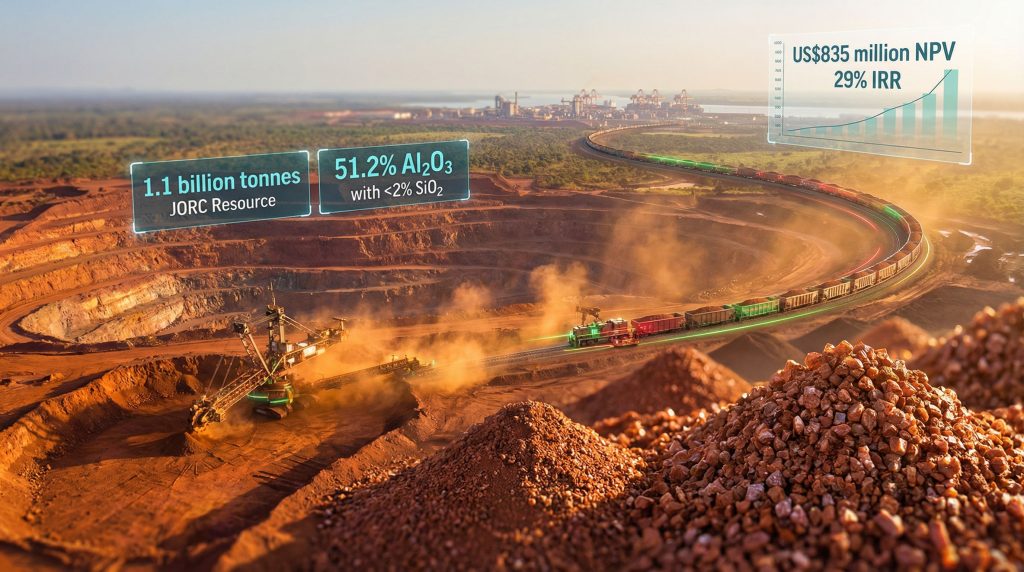
The Minim Martap deposit contains 1.1 billion tonnes of JORC-compliant resources averaging 45.3% alumina (Al₂O₃) content. Premium ore reserves demonstrate 51.2% Al₂O₃ with silica content below 2%, positioning the material within the highest quality categories for direct shipping ore specifications.
According to U.S. Geological Survey classifications, typical bauxite contains 45-55% alumina, placing Minim Martap's reserve grade at the premium end of industry standards. The gibbsite-dominated mineralogy provides significant processing advantages for downstream refineries.
Technical Quality Specifications:
| Parameter | Minim Martap | Industry Standard | Advantage |
|---|---|---|---|
| Al₂O₃ Content | 51.2% | 45-55% | Upper range positioning |
| SiO₂ Content | <2% | Variable 2-8% | Premium low-silica grade |
| Mineralogy | Gibbsite-dominant | Mixed | Enhanced refinery compatibility |
| Reactive Silica | Low | Variable | Reduced processing costs |
Processing Economics and Refinery Compatibility
Low-silica, high-grade bauxite commands premium pricing in global markets due to:
• Reduced alumina refinery processing costs through lower silica removal requirements
• Higher alumina yield rates improving refinery economics
• Decreased processing time enhancing throughput efficiency
• Lower environmental remediation costs during refining operations
The direct shipping ore classification eliminates beneficiation requirements, reducing operational complexity and capital investment compared to lower-grade deposits requiring extensive processing infrastructure.
Critical Infrastructure Development and Logistics Strategy
Rail Network Investment and Operational Control
Canyon Resources' strategy to increase its Camrail ownership from 9.1% to 35% represents a significant derisking initiative for mine-to-port logistics. This infrastructure investment approach provides operational control over critical transportation assets while supporting broader rail network upgrades.
The PQ2 upgrade project enhances rail capacity and reliability across the 800-kilometer route from inland rail facilities to Douala Port. Enhanced participation in infrastructure development creates long-term competitive advantages through:
• Prioritised rail scheduling during peak shipping periods
• Reduced transportation cost volatility through ownership participation
• Enhanced service reliability minimising operational disruptions
• Future expansion capability supporting production scaling
Furthermore, this strategic approach mirrors successful models seen in Australian operations such as Onslow iron haulage operations.
Equipment Procurement and Deployment Timeline
Surface mining operations commence with February 2026 surface miner commissioning, marking the transition from development to active mining phases. Equipment supplier CRRC Ziyang has encountered production delays affecting locomotive delivery schedules, with impacts managed through revised operational sequencing.
Operational Timeline Milestones:
• Q1 2026: Surface miner commissioning and mining commencement
• Q2 2026: Ore haulage operations begin with haul road upgrades completed
• Q3 2026: Trial shipment execution following locomotive delivery
• Q4 2026: Full-scale export operations launch
Equipment delivery contingencies demonstrate project management adaptability, with trial shipment timing adjusted to align with actual locomotive availability rather than attempting to maintain unrealistic schedules.
Port Infrastructure and Marine Logistics
Port of Douala development includes access channel dredging to accommodate increased bauxite export volumes. Final contractor selection for dredging operations targets late Q1 2026 commencement, supporting Q4 2026 full-scale shipping operations.
Transshipping contractor evaluation processes parallel infrastructure development, with Q1 2026 contract awards enabling coordinated logistics chain activation. The Wouri River provides barge-loading capabilities creating operational flexibility for bulk commodity handling.
Global Market Dynamics Supporting Commercial Viability
Aluminium Demand Growth and Clean Energy Transition
Global aluminium demand projections indicate growth to 335 million tonnes by 2050, representing a 4.2% compound annual growth rate driven by clean energy transition requirements. The International Energy Agency identifies aluminium as one of the critical minerals energy transition necessities for achieving net-zero emissions targets.
Primary Growth Drivers:
• Electric vehicle production: Aluminium represents 10-15% of vehicle weight versus 2% in conventional vehicles
• Wind energy infrastructure: Modern turbines contain 300+ tonnes of aluminium per megawatt installed
• Solar mounting systems: Frames and electrical components driving demand acceleration
• Grid infrastructure expansion: Transmission lines and transformer requirements
According to the International Aluminium Institute, clean energy applications experience exponential demand growth as global renewable capacity expands to meet climate commitments.
Supply Chain Diversification and Security
Guinea's dominance in global bauxite production creates concentration risk for aluminium supply chains, particularly given recent political instability following the 2021 military coup. Chinese market dynamics remain central to global demand patterns, with China accounting for approximately 60% of global aluminium smelting capacity.
Central African production development provides strategic supply diversification benefits:
• Alternative supply routes for Asian and European markets
• Reduced dependence on politically volatile regions
• Enhanced supply chain resilience for integrated aluminium producers
• Regional hub potential for broader Central African mineral development
Financial Performance Metrics and Investment Attractiveness
Capital Allocation and Returns Analysis
Project economics demonstrate exceptional financial attractiveness through relatively low capital requirements combined with strong cash flow generation potential. The US$97 million initial capital expenditure represents significantly lower investment compared to typical 10 Mtpa greenfield mining operations.
Investment Performance Indicators:
| Financial Metric | Value | Industry Comparison |
|---|---|---|
| Initial Capex | US$97 million | Exceptionally low for capacity |
| Pre-tax NPV | US$835 million | Strong development-stage project |
| Internal Rate of Return | 29% | Above industry benchmarks |
| Payback Period | ~3.5 years | Rapid for mining investments |
| Annual Cash Flow | US$174 million | Sustainable at full production |
Investment Perspective: The combination of low capital intensity with premium ore grades creates exceptional return profiles typically associated with late-stage, proven operations rather than development-stage projects.
Funding Structure and Capital Markets Access
Equity financing completion through Afriland Bourse & Investissement provides A$70 million in development capital, with additional A$100 million Eagle Eye placement pending shareholder approval scheduled for March 9, 2026. Settlement expectations target Q2 2026 enabling full project financing completion.
The funding structure reflects confidence from institutional investors familiar with African mining operations and Central African political environments. Regulatory approvals from Banque des États de l'Afrique Centrale and Commission de Surveillance du marché financier de l'Afrique Centrale progress parallel to operational development.
The next major ASX story will hit our subscribers first
Operational Development Timeline Through 2026
What Are the Critical Q1 2026 Milestones?
February 2026 surface miner commissioning marks the fundamental transition from development to active mining operations. This milestone establishes operational capability while validating equipment performance under actual mining conditions.
Parallel Development Activities:
• Mining contractor mobilisation completing operational team deployment
• Haul road upgrade finalisation connecting Danielle Plateau to rail facilities
• Camrail investment completion achieving 35% ownership target
• Port dredging commencement supporting future shipping operations
Production Ramp-Up Strategy Q2-Q4 2026
Q2 2026 ore haulage commencement validates integrated mine-to-rail logistics while building operational experience ahead of full-scale production. Trial operations provide opportunity for system optimisation and performance validation.
Q3 2026 trial shipment execution demonstrates complete mine-to-port capability while establishing relationships with international buyers. This milestone proves operational competence and market acceptance of ore quality specifications.
Q4 2026 full-scale operations launch targets sustained production rates supporting long-term commercial commitments. Operational ramp-up follows proven mining industry practices emphasising reliability over aggressive production targets. This approach contrasts with projects like the Julimar West bauxite project benefits, which focus on immediate economic returns.
Downstream Integration and Value Creation Opportunities
Alumina Refinery Feasibility and Strategic Positioning
The Q3 2026 completion of alumina refinery feasibility studies represents potential vertical integration beyond basic ore extraction. Cameroon-based processing leverages low-cost operational environment while capturing value-added processing margins.
Integration Benefits Analysis:
• Enhanced profit margins through downstream processing
• Supply chain control from ore to refined alumina
• Reduced transportation costs for processed materials
• Technology transfer opportunities supporting local economic development
The feasibility study specifically emphasises cost benefits of operating in Cameroon, indicating competitive advantages in labour costs, energy availability, and regulatory environment compared to traditional refining locations.
Global Aluminium Value Chain Participation
Strategic positioning as an integrated participant in global aluminium value chains creates long-term competitive advantages beyond commodity price exposure. Vertical integration provides market diversification opportunities while reducing dependence on spot pricing volatility.
Processing capability development supports broader economic development objectives while enhancing project economics through premium product positioning. Technical expertise development creates foundation for regional mineral processing hub establishment.
Regulatory Framework and Political Risk Assessment
Government Partnership and Mining Licence Security
Cameroon's stable political environment provides predictable regulatory framework for long-term mining investment. Government support for economic diversification through mineral development creates aligned interests between project developers and national economic objectives.
Regulatory Compliance Framework:
• Mining licence approvals completed supporting operational development
• Local content requirements contributing to community development
• Environmental compliance meeting international standards
• Investment protection measures supporting foreign capital security
Regional Development Impact and Community Engagement
Operations in Adamawa Region generate direct and indirect employment while supporting infrastructure development benefiting broader community development. Economic diversification reduces dependence on traditional agricultural activities while preserving environmental sustainability.
Socioeconomic Benefits:
• Direct employment generation in mining and support services
• Infrastructure development improving regional connectivity
• Skill development programmes enhancing local technical capabilities
• Economic diversification reducing regional economic vulnerability
Risk Assessment and Mitigation Strategies
Operational and Equipment Risk Management
CRRC Ziyang locomotive delivery delays demonstrate typical equipment procurement challenges in African mining development. Mitigation strategies include revised operational sequencing and contingency planning rather than attempting to maintain unrealistic timelines.
Primary Risk Categories:
• Equipment delivery delays managed through supplier diversification
• Weather-related disruptions addressed through seasonal planning
• Transportation constraints mitigated through infrastructure ownership
• Port capacity limitations managed through dedicated terminal development
Market and Commodity Price Exposure
Bauxite pricing volatility represents inherent commodity market exposure requiring active risk management through contract structuring and potential hedging strategies. Premium ore grades provide partial protection through quality-based pricing differentials.
Financial Risk Mitigation:
• Long-term supply contracts reducing spot price exposure
• Currency hedging strategies managing exchange rate volatility
• Operating cost flexibility through surface mining advantages
• Market diversification across multiple customer relationships
Strategic Significance for Global Supply Security
Supply Chain Diversification Benefits
Development of Central African bauxite production reduces global supply chain dependence on Guinea-dominated production while creating alternative supply routes for Asian and European markets. Regional diversification enhances supply chain resilience for integrated aluminium producers.
The emergence of Cameroon as a reliable supplier provides strategic alternatives during geopolitical volatility affecting traditional producing regions. Stable political environment and established infrastructure create sustainable competitive positioning.
Long-Term Market Positioning and Expansion Potential
Current development represents initial phase of potential 15+ Mtpa production capacity supporting long-term market positioning as a major global supplier. Regional hub development creates opportunities for broader Central African mineral resource development.
Future Development Opportunities:
• Production capacity expansion beyond current 10 Mtpa targets
• Regional processing hub development for Central African minerals
• Technology centre establishment supporting mining sector advancement
• Infrastructure network expansion connecting additional mineral provinces
The Canyon Resources Minim Martap bauxite project establishes foundational infrastructure and operational expertise supporting broader regional mineral development while contributing to global supply security through geographic diversification. Furthermore, this development supports broader understanding of Minim Martap project development within international mining contexts. Additionally, recent analysis from Crux Investor highlights the project's significance for Cameroon's economic development.
Disclaimer: This analysis is based on publicly available information and company guidance. Financial projections, production targets, and development timelines represent company estimates and should not be considered investment advice. Mineral resource estimates and technical specifications are subject to ongoing evaluation and may change based on additional exploration and development activities. Potential investors should conduct independent research and consult qualified professionals before making investment decisions.
Looking to Capitalise on Strategic Mineral Infrastructure Development?
Discovery Alert instantly identifies major ASX mineral discoveries through its proprietary Discovery IQ model, transforming complex geological developments into actionable investment opportunities before they reach mainstream attention. Explore how historic mineral discoveries have generated substantial returns for early investors and begin your 14-day free trial today to position yourself ahead of the market.