
May 21, 2026
Strategic Infrastructure Transforming Global Critical Minerals Access
African mineral logistics face unprecedented transformation as infrastructure investments reshape traditional supply chain dynamics. The integration of rail networks, port facilities, and multi-national partnerships creates new pathways for critical battery materials reaching Western markets. These developments challenge established Asian processing dominance while offering alternative routes for the cobalt and copper LoBito corridor seeking competitive transport solutions.
When big ASX news breaks, our subscribers know first
Revolutionary Transport Network Reshapes Mining Economics
The Lobito Atlantic Railway establishes a comprehensive 1,750-kilometer transport corridor connecting Central Africa's mineral-rich regions to Atlantic shipping routes. This infrastructure breakthrough fundamentally alters the economic calculations for mining operations across the Democratic Republic of Congo and neighbouring regions.
Network Configuration Details:
- Primary rail segment: 1,300 kilometers from Lobito port to Luau border crossing
- Strategic extension: 450 kilometers reaching Kolwezi mining district
- Deep-water port capabilities enabling direct vessel loading
- Multi-user operational framework ensuring open access
The railway's operational model emphasises regional integration, functioning as what industry leaders describe as a true regional asset accessible to all mining operations regardless of ownership structure. This approach positions the infrastructure as a catalyst for enhanced mineral export capabilities across multiple countries.
Recent financing developments demonstrate strong institutional support, with $753 million in debt financing secured from the International Development Finance Corporation and Development Bank of Southern Africa. This funding enables comprehensive rehabilitation and expansion activities throughout the network.
Operational Efficiency Metrics Transform Industry Standards
| Performance Indicator | Traditional Eastern Routes | Lobito Corridor | Improvement Factor |
|---|---|---|---|
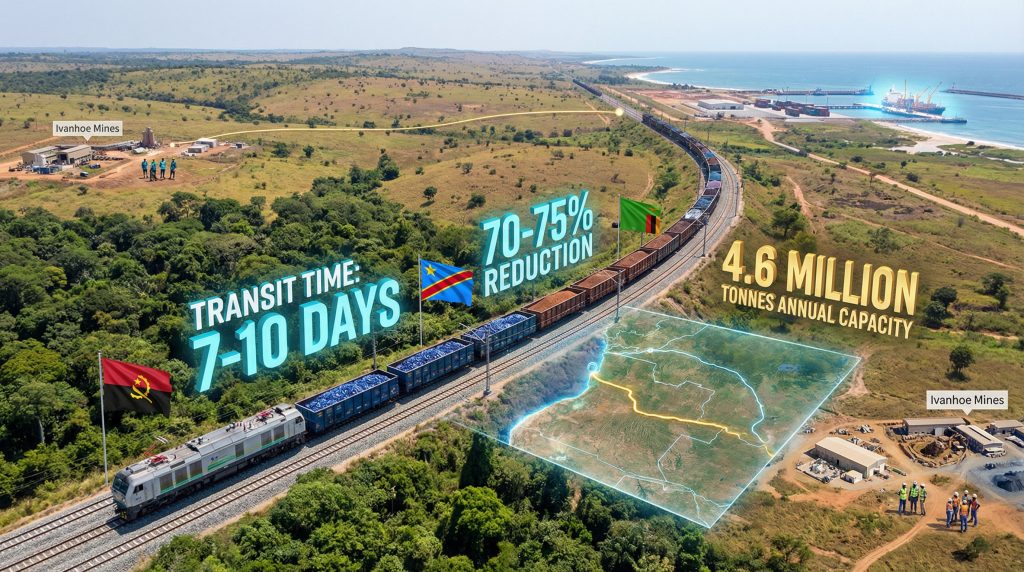
| Port Transit Time | 30-45 days | 7-10 days | 70-75% reduction |
| Transport Distance (DRC-Atlantic) | 3,000+ kilometers | 1,300 kilometers | 57% shorter route |
| Annual Throughput Capacity | Variable | 4.6 million tonnes | Enhanced predictability |
| Route Accessibility | Limited options | Open-access framework | Competitive alternatives |
Critical Minerals Supply Chain Diversification Strategy
Western markets increasingly recognise the strategic importance of alternative cobalt and copper supply routes, particularly given the Democratic Republic of Congo's control over approximately 76% of global cobalt production. Furthermore, the corridor addresses fundamental supply security concerns by creating competitive alternatives to established Asian-controlled transport networks.
The inaugural commercial partnership between Entreprise Générale du Cobalt and Trafigura demonstrates practical implementation of responsible sourcing frameworks. This collaboration creates formal market channels for artisanal mining operations whilst establishing traceable supply chains meeting Western market requirements.
Artisanal Mining Integration Framework:
- State-owned aggregation through EGC purchasing mandates
- Formal documentation creating chain-of-custody verification
- Commercial distribution via established global marketing networks
- Compliance verification aligned with US strategic partnership requirements
Industry leaders emphasise that progress toward ethical, traceable and transparent sourcing of artisanal cobalt and copper at scale represents both achievable and sustainable objectives through strategic corridor utilisation.
The initial shipment destinations focus on US customers, aligning with broader strategic partnership agreements between the United States and Democratic Republic of Congo. This alignment demonstrates how infrastructure development supports geopolitical objectives while addressing commercial mineral supply requirements.
Investment Dynamics Driving Infrastructure Development
The financial architecture supporting corridor development reflects sophisticated multi-institutional coordination involving development finance institutions, regional banks, and private sector partnerships. In addition, this structure distributes risk whilst ensuring adequate capital availability for comprehensive infrastructure rehabilitation.
Primary Funding Sources and Commitments:
| Institution | Contribution | Geographic Focus | Strategic Objective |
|---|---|---|---|
| International Development Finance Corporation | $753M (combined package) | United States | Western market access |
| Development Bank of Southern Africa | Portion of $753M package | Regional integration | African economic development |
| European Union | €43 million | Skills development | Human capital enhancement |
| Africa Finance Corporation | Additional agreements | Continental scope | Infrastructure financing |
This funding represents cornerstone investment within the Partnership for Global Infrastructure initiative, positioning Western capital as a strategic alternative to Belt and Road Initiative projects throughout African infrastructure sectors. The competitive dynamic creates favourable conditions for participating nations whilst advancing donor country strategic objectives.
Geopolitical Investment Competition:
The corridor exemplifies strategic infrastructure competition between Western development institutions and Chinese state-backed funding mechanisms. Consequently, this competition generates benefits including:
- Accelerated project implementation timelines
- Enhanced financing terms for recipient nations
- Multi-stakeholder participation ensuring broader economic integration
- Alternative development models emphasising transparency and accountability
Mining Operations Benefiting from Enhanced Logistics
Several major mining operations demonstrate practical corridor utilisation, validating projected efficiency gains through documented performance improvements. These early adopters establish proof-of-concept for broader industry integration whilst quantifying competitive advantages, reflecting the broader mining industry evolution.
Ivanhoe Mines Kamoa-Kakula Complex achieved significant logistics optimisation by shipping 10,000 tonnes of copper concentrate via the corridor, reducing transport distances by approximately 66% compared to traditional southern African routes. This documented performance improvement validates projected cost savings and efficiency gains for other potential users.
The Entreprise Générale du Cobalt partnership creates formal market access for thousands of small-scale cobalt producers throughout the region. This integration potentially brings estimated populations of artisanal miners into regulated supply chains, addressing long-standing concerns about informal market participation.
Regional Mining Districts Served by Enhanced Access
Kolwezi District (DRC):
- Contains world's largest cobalt reserve concentrations
- Direct rail connection via 450-kilometer extension
- Primary source for global artisanal cobalt production
- Strategic importance for battery material supply chains
Katanga Province (DRC):
- Produces over 60% of Democratic Republic of Congo's mineral output
- Regional production hub serving international markets
- Enhanced competitiveness through reduced logistics costs
- Integration with existing mining infrastructure
Future Zambian Copperbelt Integration:
- Planned network extensions targeting additional copper producers
- Potential capacity expansion serving regional production centres
- Multi-country economic integration objectives
- Enhanced regional competitiveness for copper exports
Global Battery Materials Market Impact
The corridor creates fundamental shifts in battery metal logistics by offering manufacturers alternative sourcing pathways that circumvent traditional Asian processing concentration. This development influences pricing mechanisms, contract structures, and strategic supply arrangements for electric vehicle production.
Supply Chain Architecture Transformation:
Traditional Eastern Route Model:
- DRC mining operations → South African port consolidation → Asian processing facilities → Global distribution
- Multiple intermediary markups affecting final pricing
- Processing capacity concentrated in Chinese-controlled facilities
- Extended vulnerability points throughout supply chain
Atlantic Corridor Model:
- DRC mining operations → Direct Lobito port consolidation → North American/European delivery
- Shortened intermediary chain reducing cost components
- Processing facility choice diversification opportunities
- Enhanced negotiating position for Western manufacturers
European and American battery manufacturers gain enhanced access to critical materials through direct shipping arrangements, potentially reducing dependence on Asian processing intermediaries. This geographic diversification creates more competitive pricing environments whilst supporting supply security objectives for electric vehicle manufacturers.
The corridor enables Western markets to participate more directly in African mineral value chains, bypassing traditional concentration points that historically limited supplier alternatives and pricing competition. These developments align with Australia's evolving critical minerals strategy and the broader critical raw materials transition.
The next major ASX story will hit our subscribers first
Long-Term Strategic Implications and Regional Development
Infrastructure development extends beyond mineral transport to encompass broader economic integration across Angola, Democratic Republic of Congo, and Zambia. Secondary investments include water systems, renewable energy projects, and agricultural logistics improvements supporting comprehensive regional development.
Multi-Country Economic Integration Effects:
- Cross-border trade normalisation reducing barriers
- Investment coordination creating synergistic development opportunities
- Revenue generation for participating governments through transit fees and export taxation
- Employment creation in logistics, port operations, and rail maintenance sectors
The corridor functions as an infrastructure anchor enabling sustained economic cooperation whilst generating multiple revenue streams for participating nations. This foundation supports broader industrialisation objectives and regional value chain development.
Chinese-Western Mineral Supply Coexistence:
Complex dynamics emerge where Chinese-owned mining operations may utilise Western-funded infrastructure, highlighting interconnected aspects of global mineral supply chains despite geopolitical competition. For instance, this coexistence demonstrates practical cooperation possibilities whilst maintaining strategic competition in financing and development approaches.
Future expansion potential includes planned extensions into Zambia's Copperbelt region, potentially increasing corridor capacity to serve additional copper producers. These extensions would expand the network's strategic importance whilst creating additional competitive pressure on existing transport alternatives.
Risk Assessment and Operational Vulnerabilities
Infrastructure Dependencies:
Single-route concentration creates potential chokepoint vulnerabilities, though the corridor's strategic importance ensures sustained international support for maintenance and security operations. The infrastructure's multi-national backing provides stability incentives whilst distributing operational risks across multiple stakeholder groups.
Political Coordination Requirements:
- Multi-country infrastructure requires sustained political cooperation
- International financial backing creates stability incentives
- Regional economic benefits encourage continued participation
- Dispute resolution mechanisms ensure operational continuity
Market Competition Dynamics:
Existing transport routes remain operational, creating beneficial competitive pressure that improves service levels and pricing across all logistics options. This competition ensures mining companies retain alternative options whilst encouraging continuous improvement in corridor operations, complementing innovations showcased at events like the global resources expo.
Operational Resilience Factors:
- Deep-water port capabilities enable large vessel accommodation
- Rail infrastructure rehabilitation addresses maintenance backlogs
- Multi-user operational model distributes capacity utilisation
- International financing ensures adequate capital for ongoing improvements
Investment Outlook and Strategic Positioning
The cobalt and copper LoBito corridor represents transformative infrastructure realigning global mineral supply chains toward enhanced Western market access. For investors, mining companies, and policy makers, the corridor provides opportunities to participate in critical mineral logistics transformation whilst supporting responsible mining practices throughout Central Africa.
Strategic Investment Considerations:
- Enhanced mineral supply security for Western manufacturers
- Competitive transport cost advantages for mining operations
- Diversified supply chain options reducing concentration risk
- Integration of artisanal mining through formal market channels
The successful integration of small-scale mining operations demonstrates potential for inclusive economic development whilst maintaining commercial viability. Infrastructure strategic backing ensures long-term operational sustainability despite regional political complexities, similar to how enhanced safety protocols have improved iron haulage operations elsewhere in the industry.
Market Development Opportunities:
- Processing facility development in Western markets
- Enhanced competition in battery material supply contracts
- Regional economic integration supporting broader industrialisation
- Alternative development models emphasising transparency and accountability
The corridor's strategic importance extends beyond current mineral transport capabilities to encompass broader objectives of supply chain diversification, responsible sourcing implementation, and regional economic development throughout Central and Southern Africa. However, understanding broader regional dynamics remains crucial for assessing long-term success factors.
Disclaimer: This analysis involves forward-looking assessments of infrastructure development, geopolitical dynamics, and market evolution. Actual results may differ from projected outcomes due to political, economic, or operational factors. Investment decisions should consider comprehensive risk assessment and professional advisory consultation.
Looking to Capitalise on African Critical Minerals Infrastructure?
Discovery Alert's proprietary Discovery IQ model delivers real-time alerts on significant cobalt and copper discoveries across ASX-listed companies, helping investors identify opportunities in the rapidly evolving critical minerals sector. With major infrastructure developments like the LoBito corridor reshaping global supply chains, explore Discovery Alert's discoveries page to understand how historic mineral discoveries have generated substantial returns, then begin your 14-day free trial to position yourself ahead of the market.