
July 3, 2026
Strategic Investment Transformation in Critical Resource Sectors
Global resource security has entered a fundamentally different era, where traditional market mechanisms prove insufficient for addressing supply chain vulnerabilities that threaten both economic stability and national defense capabilities. The US plans more stakes in minerals companies represent a pivotal shift in how governments approach strategic resource control. The intersection of geopolitical tensions, technological advancement, and resource scarcity has created conditions requiring unprecedented government intervention in mineral extraction and processing sectors.
This transformation reflects broader shifts in how nations conceptualise resource security, moving beyond simple procurement strategies toward comprehensive supply chain ownership models that integrate private sector efficiency with strategic state interests. Furthermore, this approach aligns with the critical minerals strategy developed to address long-term supply vulnerabilities.
When big ASX news breaks, our subscribers know first
Government-Led Mining Investment Reaches Historic Scale
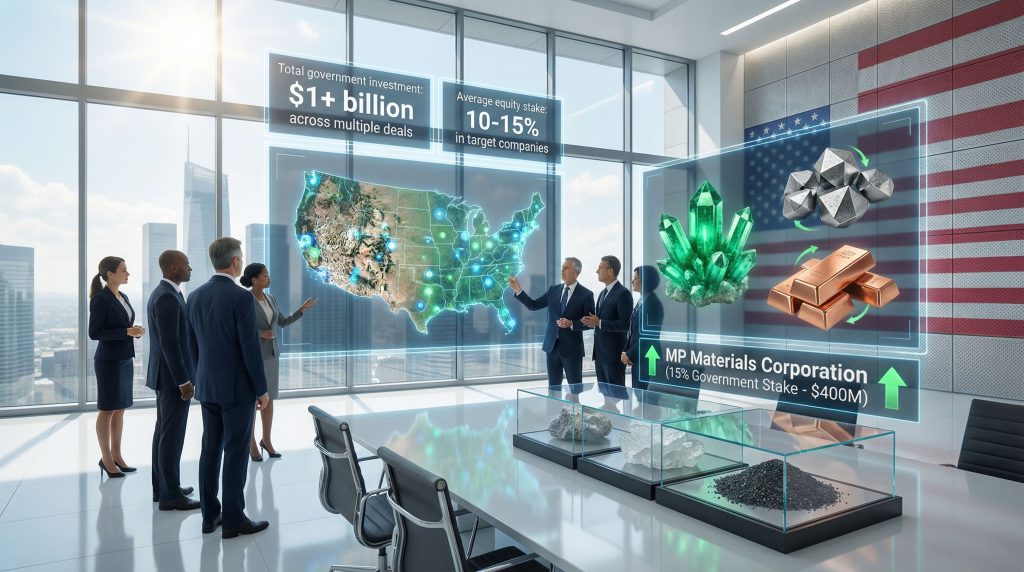
The United States has deployed over $1 billion in direct equity investments across critical minerals companies throughout 2025, representing the most aggressive government participation in mining markets since World War II-era resource mobilisation efforts.
According to Jarrod Agen, Executive Director of the National Energy Dominance Council, this approach has become standard operating procedure for addressing supply chain vulnerabilities. The administration views equity stakes as essential tools for competing with China's state-backed resource infrastructure.
Investment Portfolio Breakdown
The government's strategic investments span multiple critical mineral categories:
| Company | Investment Amount | Equity Stake | Primary Focus | Deal Date |
|---|---|---|---|---|
| MP Materials Corp | $400 million | 15% | Rare earth mining | July 2025 |
| Vulcan Elements Inc | $670 million | Undisclosed | Magnet manufacturing | 2025 |
| Lithium Americas Corp | Loan restructuring | Warrant position | Lithium development | September 2025 |
| Trilogy Metals Inc | $35.6 million | 10% | Canadian exploration | 2025 |
These investments target different segments of the critical minerals value chain, from raw extraction through advanced manufacturing processes. The strategy emphasises both domestic production capacity and processing capabilities that reduce reliance on foreign supply chains. Moreover, these developments complement the recent critical minerals executive order aimed at strengthening domestic supply chains.
Market Response Dynamics
Companies receiving government backing have experienced substantial stock price appreciation, with market participants viewing federal investment as validation of both strategic importance and reduced execution risk. The combination of guaranteed government support and enhanced financing access creates competitive advantages that extend beyond initial capital injection.
Strategic Drivers Behind Federal Mining Participation
Supply Chain Vulnerability Matrix
Critical minerals essential for defence systems, renewable energy infrastructure, and advanced technology manufacturing remain concentrated in geographically and politically unstable regions. This concentration creates systematic vulnerabilities that traditional market mechanisms cannot adequately address.
Defence-Critical Applications Include:
- Missile guidance systems requiring rare earth permanent magnets
- Radar equipment dependent on gallium-based semiconductors
- Jet engine components utilising cobalt-based superalloys
- Electronic warfare systems incorporating specialised ceramic materials
The Biden administration's 2022 critical minerals assessment identified 60 distinct materials where supply disruptions could compromise national security or economic stability. These materials support industries generating over $3 trillion annually in economic output across manufacturing, defence, and technology sectors. Consequently, the defence-critical materials strategy has become increasingly important for allied nations.
China's Processing Dominance
China controls significant portions of global mineral processing capacity, creating bottlenecks that persist regardless of mining location. Even minerals extracted in allied nations often require Chinese processing facilities for conversion into usable industrial inputs.
Recent trade tensions have demonstrated how rapidly supply restrictions can propagate through global markets. Beijing's temporary limitations on rare earth exports disrupted production schedules across multiple industries before diplomatic resolution restored normal trading patterns.
Investment Target Analysis and Strategic Selection
MP Materials: Rare Earth Mining Foundation
MP Materials operates the Mountain Pass rare earth mine in California, representing the only significant rare earth extraction facility in North America. The $400 million government investment provides 15% ownership alongside strategic influence over production allocation during supply emergencies.
The company's asset base includes both extraction capabilities and processing infrastructure designed to reduce dependence on Chinese rare earth refining. Government backing enhances the facility's expansion prospects and provides guaranteed market access for strategic mineral products.
Lithium Americas: Battery Metal Security
The government's warrant position in Lithium Americas, coupled with restructuring of an existing $2.23 billion Department of Energy loan, positions the United States for enhanced lithium supply security. The company's Thacker Pass project in Nevada represents one of the largest undeveloped lithium resources globally.
This investment addresses battery metal supply chains essential for electric vehicle manufacturing, grid-scale energy storage, and portable electronics that support both civilian and military applications. Additionally, these developments are shaping the broader battery metals investment landscape for 2025.
Vulcan Elements: Value-Added Processing
The $670 million investment in Vulcan Elements targets permanent magnet manufacturing rather than raw material extraction. This positioning reflects recognition that processing and value-added manufacturing create more strategic value than commodity mining alone.
Permanent magnets incorporating rare earth elements are essential for wind turbine generators, electric vehicle motors, and precision guidance systems used in defence applications.
International Investment Model Comparisons
Global Government Mining Strategies
| Country/Region | Investment Approach | Primary Focus | Capital Commitment |
|---|---|---|---|
| Australia | Export financing partnerships | Rare earth processing | $3+ billion AUD |
| European Union | Strategic autonomy funding | Processing independence | €3 billion |
| Canada | Crown corporation stakes | Battery metal supply | $500+ million CAD |
| United States | Direct equity ownership | Comprehensive security | $1+ billion USD |
The American model distinguishes itself through direct ownership rather than financing or partnership arrangements. This approach provides greater supply security but requires higher capital commitments and longer-term government involvement in commercial operations.
Competitive Implications
Government backing fundamentally alters competitive dynamics within mining sectors. Companies receiving federal investment gain access to:
- Reduced financing costs through implicit government guarantees
- Accelerated permitting via interagency coordination
- Strategic buyer status in international partnerships
- Technical assistance from federal research institutions
These advantages create market segmentation between government-backed and purely private mining ventures, potentially reshaping industry structure over time. Furthermore, these changes are part of broader mining industry innovation trends transforming the sector.
Market Transformation and Investment Scaling
Expansion Criteria Framework
Future government investments likely target companies meeting specific strategic criteria:
Primary Selection Factors:
- Critical mineral designation alignment with federal priority lists
- Geographic preference for North American or allied nation assets
- Production timeline enabling near-term capacity increases
- Technology integration supporting advanced processing capabilities
- Supply chain position offering vertical integration opportunities
Sector-Wide Investment Projections
Based on current investment patterns and strategic objectives, additional government participation may target:
- Battery metals processing: $2-3 billion for lithium, cobalt, and nickel refining capacity
- Rare earth separation: $1.5 billion for advanced processing technology
- Copper mining: $500 million for strategic reserve building
- Defence materials: $1 billion for specialised alloy production
The next major ASX story will hit our subscribers first
Implementation Challenges and Risk Factors
Fiscal Constraints and Political Sustainability
Large-scale government equity investments require sustained Congressional appropriations across multiple budget cycles. Political transitions could alter strategic priorities or funding availability, creating uncertainty for long-term mining development projects.
Budget Allocation Pressures:
- Competing national security priorities requiring federal funding
- Long-term return expectations from taxpayer investments
- International trade compliance with subsidy regulations
Operational Risk Management
Government ownership introduces operational complexities not present in purely private mining ventures:
- Technical expertise limitations within federal agencies overseeing mining operations
- Political interference potential in commercial decision-making processes
- Bureaucratic delays affecting operational approvals and strategic pivots
- Public accountability requirements for investment performance and environmental compliance
How Will Strategic Success Be Measured?
Supply Security Objectives
2030 Strategic Targets:
- Domestic rare earth processing: 25% of US consumption capacity
- Lithium production: 200,000+ tonnes annually from North American sources
- Critical mineral import dependency: Reduction below 50% for designated materials
Economic Performance Indicators
Government investment success will be measured through multiple metrics:
- Investment returns: Target 8-12% annually across portfolio
- Job creation: 50,000+ positions in mining and processing sectors
- Manufacturing reshoring: $10+ billion in downstream investment attraction
- Supply chain resilience: Reduced disruption frequency during geopolitical tensions
Long-Term Strategic Positioning
The ultimate objective involves transforming the United States from a critical minerals importer to a vertically integrated producer and processor. This transformation reduces strategic vulnerabilities while creating economic value through government ownership positions in essential resource supply chains.
Success requires sustained political commitment, technical expertise development, and international partnership coordination. However, as industry experts indicate, companies are actively seeking greater government support to compete effectively with Chinese state-backed competitors.
The strategy's effectiveness will ultimately be measured by enhanced supply security during future geopolitical crises and reduced dependence on potentially hostile nations for essential materials.
Investment Risk Disclaimer: Government equity stakes in mining companies carry inherent risks including commodity price volatility, regulatory changes, and operational challenges. Strategic supply chain security objectives may justify lower financial returns compared to traditional investment criteria.
Future Development Pathways
The government's critical minerals investment strategy represents a multi-decade commitment requiring sustained execution across political transitions. Success depends on maintaining strategic focus while adapting to evolving technological requirements and geopolitical conditions.
As global resource competition intensifies, nations implementing comprehensive supply chain ownership models may gain decisive advantages in advanced manufacturing, defence capabilities, and energy transition technologies. The current investment program establishes foundational capacity for this strategic transformation, ensuring that the US plans more stakes in minerals companies continues as a cornerstone of national security policy.
Looking to Capitalise on Government Mining Investment Trends?
Discovery Alert's proprietary Discovery IQ model delivers real-time alerts on significant ASX mineral discoveries, helping subscribers identify actionable opportunities in the rapidly evolving critical minerals sector ahead of the broader market. Explore Discovery Alert's dedicated discoveries page to understand why historic mineral discoveries can generate substantial returns, then begin your 30-day free trial to position yourself ahead of government investment trends and market developments.