
August 7, 2026
Strategic Maritime Energy Security Challenges
Energy market volatility has reached unprecedented levels in recent decades, driven by geopolitical tensions, supply chain vulnerabilities, and the complex interdependencies of global petroleum distribution networks. The potential for a US naval blockade Hormuz scenario represents one of the most significant threats to global energy security, given the strait's critical role in petroleum transit. Understanding how naval enforcement scenarios would reshape energy flows requires examining the strategic mechanisms, economic vulnerabilities, and alternative pathways that define contemporary energy security.
The concentration of global oil transit through narrow maritime passages creates systemic risks that extend far beyond regional conflicts, influencing everything from currency markets to manufacturing supply chains across continents.
When big ASX news breaks, our subscribers know first
Strategic Mechanisms Behind Maritime Energy Enforcement
Naval blockades function as economic pressure instruments by exploiting geographic vulnerabilities where alternative routing becomes economically prohibitive within critical timeframes. This approach leverages geography as a strategic multiplier for political influence without requiring direct military confrontation on land.
Historical analysis reveals that effective maritime enforcement requires sustained operational capacity, diplomatic coordination among participating nations, and credible mechanisms to discourage circumvention attempts. Furthermore, the distinction between pacific blockades during peacetime and belligerent blockades during active warfare affects their legal status under international maritime law.
Historical Maritime Enforcement Precedents
The Allied blockade of Germany during World War I reduced imports to approximately 55% of pre-war levels by 1918, with German food consumption declining by roughly 25%. This contributed significantly to domestic hardship and social unrest, demonstrating how maritime pressure can influence internal political dynamics.
During World War II, the Atlantic theater witnessed approximately 2,828 ships sunk by German U-boats, totaling about 14.5 million tons, while Allied counter-blockade operations systematically reduced German merchant fleet capacity. These historical examples illustrate the sustained naval force requirements necessary for effective enforcement operations.
The Iran-Iraq War's "Tanker War" phase between 1984-1988 saw attacks on approximately 546 merchant vessels, with roughly 217 ships struck by missiles or mines. Consequently, oil exports from the Persian Gulf dropped by approximately 2-3 million barrels per day during peak disruption periods, providing modern precedents for chokepoint vulnerability.
Key Maritime Enforcement Requirements:
• Naval Force Composition: Minimum 2 carrier strike groups, 12 destroyers, 8 submarines for sustained operations
• Logistics Support: 15 replenishment ships required for 90-day enforcement capability
• Air Superiority: 200+ combat aircraft deployment for comprehensive coverage
• Intelligence Networks: Satellite and drone surveillance systems for real-time monitoring
International maritime law under the United Nations Convention on the Law of the Sea permits coastal state jurisdiction over territorial waters extending 12 nautical miles and economic zones reaching 200 nautical miles. Blockade legality depends on whether operations constitute lawful visit and search procedures or violate innocent passage provisions.
Global Energy Transit Vulnerability Assessment
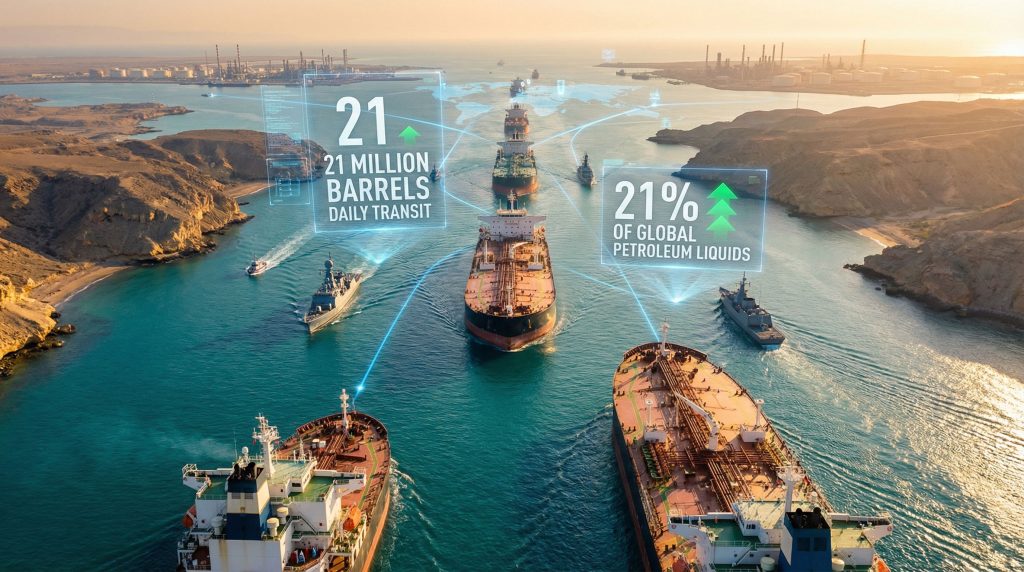
The Strait of Hormuz processes approximately 20.9 million barrels per day of crude oil and petroleum products, representing roughly 21% of global petroleum liquids transit. This concentration creates systemic vulnerability where disruption effects extend far beyond regional boundaries, particularly affecting the oil price rally dynamics in global markets.
Primary Export Dependencies Through Hormuz:
| Country | Daily Export Volume | Percentage of Gulf Exports |
|---|---|---|
| Saudi Arabia | 6.5-7.0 million bpd | 31-33% |
| Iraq | 4.5-4.8 million bpd | 21-23% |
| UAE | 2.4-2.6 million bpd | 12-13% |
| Kuwait | 2.0-2.2 million bpd | 9-11% |
| Iran | 0.5-0.9 million bpd | 3-5% (post-sanctions) |
Asia-Pacific refineries process approximately 55-60% of Middle Eastern crude exports, with China accounting for 25-30% of total Gulf exports, India 10-15%, Japan 8-10%, and South Korea 6-8%. This concentration means disruption effects would immediately impact global manufacturing and transportation sectors.
Technical Constraints and Operational Limitations
The Strait's minimum navigable width measures approximately 21 nautical miles, with water depths of 55-75 meters in the main channel. These physical constraints limit Very Large Crude Carrier drafts to approximately 15-15.5 meters, requiring precise tidal and loading coordination for full-capacity transits.
Tanker Fleet Composition Transiting Hormuz:
• VLCCs (280,000+ DWT): 40% of traffic volume
• Suezmaxes (130,000-180,000 DWT): 30% of traffic volume
• Aframaxes and smaller vessels: 30% of traffic volume
The June 2019 tanker incidents involving Front Altair and Kokuka Courageous demonstrated rapid market responsiveness to chokepoint vulnerabilities. For instance, the reported mine attacks caused immediate 3-5% oil price spikes and 400-500% increases in insurance premiums for Gulf transits within 48 hours.
Alternative Route Capacity Limitations
The Suez Canal faces critical capacity constraints at approximately 800,000-1,200,000 barrels per day maximum throughput for tanker traffic, fundamentally inadequate for absorbing significant volumes from Hormuz disruption scenarios. In addition, the canal's convoy system separates northbound and southbound traffic into alternate 12-hour transit windows, with maximum vessel dimensions limiting accommodation of larger tankers.
Suez Canal Technical Specifications:
• Maximum vessel length: 240 meters (Suezmax equivalent)
• Maximum beam width: 32.2 meters
• Maximum draft: 18 meters (seasonal variation)
• Daily capacity: 50-60 VLCCs maximum
Cape of Good Hope routing adds 3,000-3,500 nautical miles versus direct Hormuz-to-Europe routes, increasing transit times by 14-18 days. This generates 15-20% additional fuel consumption for VLCC transits and 0.3-0.5% increased insurance premiums for cargo values traversing West African waters.
The 2021 Ever Given canal blockage provided real-world validation of alternative route limitations. Six days of disruption affected $9.6 billion in daily trade flows, created a 422-vessel queue, and required 10 days for traffic normalisation. Average delay costs reached $300,000-$500,000 per vessel.
Economic Impact Cascades and Market Response Scenarios
Maritime chokepoint disruptions trigger exponential rather than linear economic effects, as demand concentrates on limited alternative capacity. However, queuing effects can increase effective transit times by 50-100% beyond simple distance calculations, amplifying cost pressures throughout global supply chains and influencing oil price movements across multiple sectors.
Immediate Market Response Timeline:
| Time Frame | Oil Prices | Natural Gas | Shipping Rates | Equity Markets |
|---|---|---|---|---|
| 24 Hours | +15-25% spike | +10-20% correlation | +200-300% tanker rates | -3-5% energy indices |
| 7 Days | +40-60% sustained | +25-40% supply concerns | +400-600% charter costs | -8-12% broad decline |
| 30 Days | +80-120% prolonged | +50-80% winter demand | +800-1000% sustained | -15-25% recession fears |
Regional economic vulnerabilities vary significantly based on import dependencies and strategic reserve capacities. Furthermore, European energy security faces particular challenges with 40% crude oil import dependency on Middle Eastern sources, while strategic reserve depletion timelines typically extend 90 days under emergency protocols.
Manufacturing Sector Disruption Patterns
Petrochemical supply chain impacts extend beyond direct energy costs to affect industrial feedstocks essential for plastics, fertilisers, and synthetic materials production. Asian manufacturing centres face acute vulnerability given their 85% dependency on Middle Eastern crude as production inputs rather than merely energy sources.
Strategic Reserve Utilisation Scenarios:
• United States: 714 million barrel Strategic Petroleum Reserve capacity
• European Union: Coordinated 90-day supply sharing mechanisms under IEA protocols
• China: Strategic petroleum reserve supporting 90-day consumption buffer
• India: Emergency protocols targeting 85% to 60% Middle East dependency reduction
The interconnected nature of global energy markets means disruption effects cascade through currency markets, with petrodollar recycling mechanisms facing significant volatility. Consequently, energy-exporter sovereign credit ratings experience immediate pressure, while import-dependent economies face current account deficit expansion.
National Response Strategies and Contingency Frameworks
Major economies maintain sophisticated contingency protocols designed to manage energy supply disruptions, though implementation effectiveness varies significantly based on domestic production capacity and alternative supplier relationships. The potential for US economy tariffs to complicate international cooperation during a US naval blockade Hormuz scenario adds additional complexity to response strategies.
United States Strategic Response Architecture
American energy security benefits from substantial domestic production capacity in the Permian Basin, which can surge output during supply emergencies. Strategic Petroleum Reserve releases provide immediate market intervention capability, while established partnerships with Canada, Mexico, and Brazil offer alternative supply arrangements.
Domestic shale oil production has fundamentally altered US vulnerability profiles compared to historical dependency patterns. However, the ability to accelerate drilling activity within 6-12 month timeframes provides strategic flexibility unavailable to most major economies.
European Union Emergency Coordination Mechanisms
EU emergency oil sharing protocols under International Energy Agency frameworks enable coordinated response across member states. Nevertheless, Russian energy dependency reduction strategies remain incomplete, creating ongoing vulnerability to supply disruption scenarios.
European Contingency Priorities:
• Accelerated renewable deployment: Emergency green transition funding
• Industrial rationing protocols: Critical sector prioritisation systems
• Alternative supplier agreements: Norwegian, Algerian, American partnerships
• Strategic reserve coordination: Multinational emergency sharing mechanisms
China's Energy Security Countermeasures
Chinese energy security strategy emphasises supply diversification through Belt and Road Initiative energy corridors, particularly Russian and Central Asian pipeline networks. Strategic petroleum reserves support 90-day consumption buffers, while domestic coal-to-liquids production provides emergency conversion capacity.
China's approach includes long-term supply contracts with Russia, Venezuela, and Iran designed to reduce Middle Eastern dependency from current 85% levels to targeted 60% within strategic planning timeframes.
India's Supply Diversification Imperatives
Indian energy security faces acute vulnerability given 85% dependency on Middle Eastern crude imports. Emergency response protocols emphasise strategic partnership expansion with Russia, Venezuela, and Iran, while refinery optimisation enables processing heavier crude grades from alternative suppliers.
Transportation sector rationing protocols represent critical emergency measures, given India's limited strategic reserve capacity compared to consumption requirements.
Military and Technological Enforcement Factors
Sustained naval enforcement operations require sophisticated logistical support systems extending far beyond initial deployment capabilities. Modern US naval doctrine emphasises carrier strike group deployment with integrated air superiority, submarine warfare, and mine countermeasures capabilities that would be essential for implementing a US naval blockade Hormuz strategy.
Naval Force Requirements for 90-Day Operations:
• Surface Combat Vessels: 2 carrier strike groups, 12 destroyers, 6 cruisers
• Submarine Assets: 8 attack submarines for underwater domain control
• Logistics Support: 15 replenishment ships, 5 ammunition vessels
• Air Assets: 200+ combat aircraft for sustained air superiority
• Intelligence Systems: Real-time satellite surveillance, drone networks
Counter-enforcement capabilities include asymmetric warfare options such as fast attack craft, submarine threats, and mine warfare designed to increase enforcement costs rather than achieve conventional naval victory. Regional proxy force coordination can extend disruption beyond primary chokepoint areas to secondary maritime routes.
Technological Countermeasures and Escalation Risks
Modern maritime enforcement faces cyber warfare escalation risks targeting critical infrastructure systems. Potential attacks on port facilities, navigation systems, and energy distribution networks could amplify disruption effects beyond purely maritime domains.
International coalition building represents a critical factor in enforcement sustainability, with diplomatic support from major powers affecting operational legitimacy and economic effectiveness. Recent developments regarding US military operations in the region highlight the complex nature of such naval operations.
The next major ASX story will hit our subscribers first
Alternative Energy Infrastructure Strategic Importance
Pipeline network activation becomes critical during maritime chokepoint disruptions, though capacity limitations prevent complete compensation for lost maritime transit. The Trans-Arabian Pipeline offers 5 million barrels per day theoretical capacity, representing only 24% of typical Hormuz daily throughput.
Pipeline Alternative Capacity Assessment:
• Trans-Arabian Pipeline: 5 million bpd maximum capacity
• Iraq-Turkey Pipeline: 1.6 million bpd alternative route
• Central Asia-China corridors: Kazakhstan, Turkmenistan supply increases
• Arctic shipping routes: Seasonal navigation feasibility limitations
Emergency renewable energy acceleration represents a longer-term strategic response, with crisis scenarios triggering $2-5 trillion global investment surges in green transition technologies. Strategic mineral security for lithium, cobalt, and rare earth elements becomes critical for sustainable energy transition security.
Grid Modernisation and Industrial Electrification
Energy storage deployment acceleration and transportation sector electrification gain strategic priority during supply security crises. Industrial heating sector conversion from petroleum products to electric systems reduces vulnerability to maritime supply disruptions.
However, renewable energy transitions require 5-15 year implementation timeframes, providing limited immediate relief during acute supply crises.
Financial Market Implications and Investment Reallocation
Energy sector investment experiences dramatic reallocation during chokepoint crisis scenarios, with traditional oil and gas assets outside Middle Eastern regions commanding valuation premiums. Renewable energy stocks typically surge 50-100% during sustained supply disruption periods.
Investment Flow Patterns During Energy Crises:
• Non-Middle East oil assets: 25-40% valuation premiums
• Renewable energy equities: 50-100% price appreciation
• Tanker fleet valuations: 200-400% asset value increases
• Strategic materials: Uranium, lithium, copper correlation trading
Currency market volatility intensifies through petrodollar recycling disruptions, affecting USD demand patterns and emerging market stability. Furthermore, energy-exporter sovereign debt faces immediate credit rating pressures, while import-dependent economies experience current account deterioration.
Long-term Energy Security Investment Themes
Institutional investors increasingly prioritise energy security themes over pure cost optimisation, recognising geopolitical supply risks as permanent portfolio considerations. Infrastructure investments in pipeline networks, renewable generation, and energy storage gain strategic premium valuations due to their ability to mitigate oil markets impact during crisis scenarios.
Gold, commodities, and real estate experience increased demand as inflation hedge assets during prolonged energy price volatility periods.
Diplomatic Resolution and International Mediation Frameworks
United Nations Security Council emergency protocols provide formal mechanisms for crisis mediation, though great power disagreements can limit effectiveness. The International Energy Agency coordinates strategic reserve release programmes among member nations, offering technical cooperation frameworks.
Regional diplomatic initiatives through Gulf Cooperation Council mediation represent alternative pathways, particularly when combined with economic incentive structures for conflict de-escalation.
Diplomatic Resolution Mechanisms:
• Graduated sanctions relief: Phased conflict resolution approaches
• Infrastructure investment partnerships: Post-crisis reconstruction cooperation
• Technology transfer agreements: Renewable energy collaboration frameworks
• Multilateral security arrangements: Regional maritime protection protocols
Great power negotiations involving US-China-Russia trilateral discussions become essential for sustainable resolution, given these nations' combined influence over global energy markets and maritime security.
Economic incentive structures emphasising energy infrastructure investment and technology cooperation provide sustainable alternatives to purely punitive enforcement approaches.
Investment Disclaimer: This analysis explores hypothetical scenarios for educational purposes and should not be construed as investment advice. Energy market investments carry significant risks including geopolitical volatility, regulatory changes, and commodity price fluctuations. Readers should conduct thorough due diligence and consult qualified financial advisors before making investment decisions.
Understanding maritime energy security requires comprehensive analysis of geopolitical risks, alternative supply mechanisms, and international cooperation frameworks that shape global energy market stability.
Looking to capitalise on energy security market volatility?
Discovery Alert's proprietary Discovery IQ model delivers real-time alerts on significant ASX mineral discoveries, including critical energy transition minerals that become increasingly valuable during geopolitical supply disruptions. Subscribers receive instant notifications about actionable opportunities in uranium, lithium, and other strategic commodities, positioning themselves ahead of market-moving announcements. Begin your 14-day free trial today to secure your competitive advantage during these uncertain energy markets.