June 24, 2026
Strategic Maritime Security Architecture in Critical Energy Transit Zones
Complex global energy supply chains face unprecedented vulnerability windows where geopolitical tensions intersect with critical infrastructure chokepoints. Modern naval strategy increasingly focuses on protective frameworks that secure energy transportation arteries whilst maintaining operational flexibility across multiple threat scenarios. This strategic paradigm shift reflects the evolution from traditional coastal defence models toward comprehensive maritime domain awareness systems that integrate diplomatic, economic, and military elements into unified operational architectures.
The intersection of energy security and blue-water naval capabilities represents a fundamental transformation in how maritime powers approach regional stability. As supply chain dependencies deepen and conflict zones expand, nations develop sophisticated escort protocols and multi-platform deployment strategies that extend far beyond conventional territorial waters. These operations require sustained coordination between defence establishments, energy ministries, and commercial shipping sectors to maintain continuity during periods of heightened regional instability.
When big ASX news breaks, our subscribers know first
What Strategic Imperatives Drive India's Naval Deployment in Global Energy Chokepoints?
Energy Security Dependencies Shaping Naval Strategy
India's energy import requirements create substantial vulnerability exposure across multiple maritime corridors, with petroleum products representing critical infrastructure dependencies. The Arabian Sea and Persian Gulf region serve as primary transit routes for crude oil and LPG shipments destined for Indian refineries and distribution networks. Regional instability patterns directly impact supply chain reliability, requiring sophisticated risk assessment frameworks and protective response mechanisms.
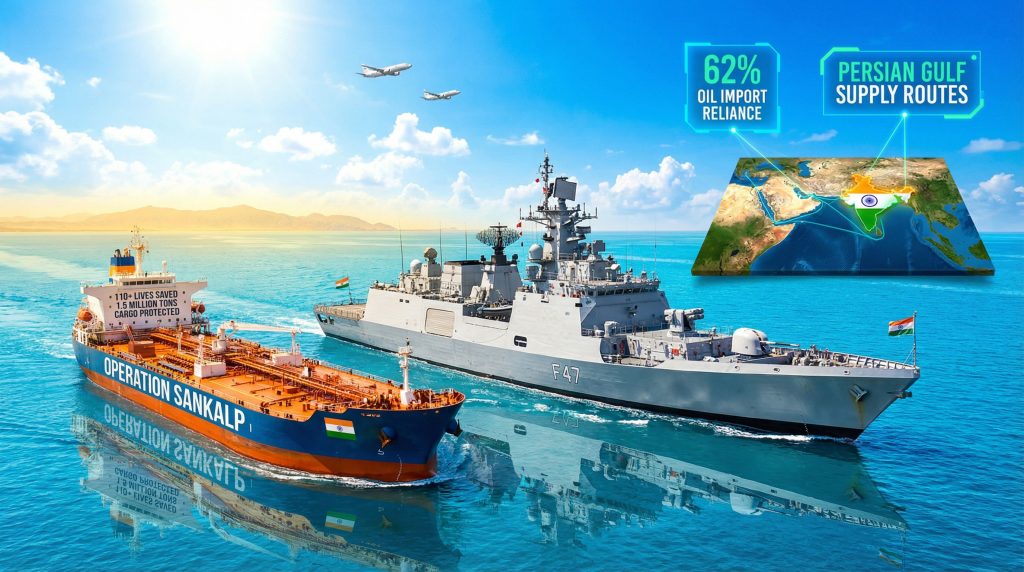
Operation Sankalp emerged as India's strategic answer to mounting security pressures affecting energy transportation since 2019. The initiative coordinates naval assets with multiple government agencies to ensure continuous protective coverage for India-flagged vessels operating in high-risk maritime zones. Current deployments include two Indian warships stationed strategically near the Strait of Hormuz, maintaining escort capabilities for tankers and cargo vessels carrying essential energy supplies.
Recent incidents demonstrate the immediate nature of these vulnerabilities. In March 2026, the India-flagged vessel Jag Laadki experienced direct threat exposure whilst loading crude oil at Fujairah port in the UAE when oil facilities came under attack from suspected Iranian drones. The vessel escaped without damage but required immediate naval escort protection, illustrating the real-time threat response capabilities embedded in Operation Sankalp's operational framework.
Geopolitical Risk Matrices in Maritime Domain Awareness
Regional conflict dynamics create cascading effects that extend far beyond immediate combat zones, affecting commercial shipping operations across vast maritime areas. The ongoing Gulf conflict generates continuous security pressures that require adaptive naval positioning and enhanced surveillance protocols, which directly influences energy security dynamics across global markets. Iranian drone capabilities targeting energy infrastructure create particular challenges for vessels loading or transiting near UAE and regional oil facilities.
Intelligence coordination mechanisms link defence, external affairs, and energy ministry resources to provide comprehensive threat assessment capabilities. This multi-agency approach enables real-time response to emerging security situations whilst maintaining diplomatic coordination with regional partners. The coordination structure includes the Ministry of Defence, Ministry of External Affairs, Ministry of Shipping, Ministry of Petroleum and Natural Gas, and DG Shipping, creating integrated command and control frameworks.
Maritime domain awareness systems track multiple threat categories simultaneously:
• State-sponsored attacks targeting energy infrastructure
• Asymmetric warfare tactics including drone and missile threats
• Regional conflict spillover affecting commercial transit routes
• Piracy and criminal activities in international waters
• Cyber threats targeting navigation and communication systems
How Does Operation Sankalp's Operational Architecture Ensure Maritime Domain Control?
Multi-Platform Naval Asset Deployment Strategy
Operation Sankalp employs two task forces consisting of warships positioned strategically to provide comprehensive coverage of critical transit zones. These naval assets maintain continuous presence near the Strait of Hormuz whilst conducting active escort missions for India-flagged vessels carrying LPG and crude oil shipments. The deployment strategy emphasises rapid response capabilities and sustained operational endurance in challenging maritime environments.
The task force composition reflects blue-water naval capabilities designed for extended operations far from home ports. Warships deployed under Operation Sankalp maintain sophisticated communication systems enabling direct coordination with escorted merchant vessels and shore-based command structures. This integrated approach ensures seamless information flow between naval assets, commercial operators, and government coordination centres.
Real-time threat assessment protocols enable immediate escalation of protective measures when security situations deteriorate. The Operation Sankalp mission demonstrated these response capabilities when an Indian warship was rapidly deployed to escort the Jag Laadki following the drone attacks on oil facilities. This incident response timeline illustrates the operation's ability to provide immediate protective coverage during evolving threat scenarios.
Escort Mission Tactical Framework
Escort protocols under Operation Sankalp provide comprehensive protection services for India-bound vessels throughout their transit across high-risk maritime zones. Naval assets maintain direct communication with escorted vessels whilst monitoring regional threat indicators and coordinating with international maritime security frameworks. All possible assistance is provided to vessels under escort, creating a protective envelope that extends beyond traditional naval patrol functions.
Furthermore, coordination mechanisms between naval forces and merchant vessel operators ensure continuous situational awareness and rapid response capabilities. Commercial vessels receive detailed threat briefings and communication protocols that enable immediate contact with escorting warships during emergency situations. This civilian-military integration represents a sophisticated approach to maritime security that extends protective capabilities across the entire supply chain.
The tactical framework includes:
• Direct vessel-to-warship communication systems
• Pre-positioning protocols for high-risk transit zones
• Emergency response procedures for various threat scenarios
• Integration with international maritime security coalitions
• Diplomatic coordination with regional coastal states
What Operational Metrics Define Success in India's Maritime Security Operations?
Quantitative Performance Framework
Operation Sankalp's effectiveness requires measurement across multiple performance dimensions that extend beyond traditional military metrics. Success indicators include vessel protection rates, incident response times, coordination efficiency between agencies, and sustained operational presence in challenging maritime environments. These metrics provide comprehensive assessment capabilities for strategic decision-making and resource allocation.
The operation's sustained deployment since 2019 demonstrates long-term commitment to maritime security in critical energy corridors. Continuous presence near the Strait of Hormuz and active escort missions represent significant operational achievements that require extensive logistical support and strategic coordination. The ability to maintain two task forces in distant waters whilst coordinating with multiple government agencies reflects sophisticated organisational capabilities.
Performance Assessment Categories:
| Metric Type | Operational Focus | Strategic Impact |
|---|---|---|
| Vessel Protection | Direct escort services | Supply chain continuity |
| Response Time | Emergency deployment | Threat mitigation |
| Coordination Efficiency | Inter-agency integration | Strategic coherence |
| Regional Presence | Sustained operations | Deterrence capability |
Critical Incident Response Capabilities
The Fujairah port attack incident in March 2026 provides concrete evidence of Operation Sankalp's incident response capabilities. When suspected Iranian drones targeted oil facilities whilst the Jag Laadki was loading crude oil, naval forces immediately deployed escort protection to ensure safe transit. This rapid response demonstrates the operation's ability to provide immediate protective coverage during evolving security situations.
In addition, incident response protocols enable naval assets to transition quickly between routine patrol functions and active escort duties based on threat assessment indicators. The ability to provide immediate protective services during crisis situations represents a critical capability that extends beyond traditional naval operations. Commercial vessel operators benefit from this responsive framework through reduced security exposure and enhanced operational confidence.
Emergency response capabilities include:
• Immediate escort deployment for threatened vessels
• Communication support during security incidents
• Coordination with regional maritime authorities
• Integration with international rescue and security frameworks
• Medical and humanitarian assistance when required
Which Legal and Regulatory Frameworks Enable India's Maritime Security Operations?
Inter-Ministerial Coordination Structures
Operation Sankalp operates through established legal frameworks that enable multi-agency coordination and sustained naval deployment in international waters. The coordination structure involves five key government entities: Ministry of Defence, Ministry of External Affairs, Ministry of Shipping, Ministry of Petroleum and Natural Gas, and DG Shipping. This integrated approach ensures legal compliance whilst maintaining operational effectiveness across multiple jurisdictions.
However, inter-ministerial agreements provide the legal foundation for sustained naval operations that protect commercial shipping interests whilst maintaining diplomatic relationships with regional partners. The coordination framework enables rapid decision-making during crisis situations whilst ensuring appropriate oversight and accountability mechanisms. Each participating ministry contributes specialised expertise and resources to support comprehensive maritime security objectives.
Legal authority structures enable naval forces to provide escort services and protective coverage in international waters whilst respecting maritime law and regional sovereignty. Operations maintain careful balance between security requirements and diplomatic considerations, ensuring that protective measures enhance regional stability rather than contributing to escalation dynamics.
Maritime Security Legal Framework
The regulatory environment supporting Operation Sankalp reflects India's commitment to international maritime law whilst asserting legitimate security interests in critical energy transit corridors. Legal frameworks enable naval forces to provide protective services for India-flagged vessels whilst coordinating with international maritime security initiatives and regional partners.
Operational authorities include provisions for:
• Naval escort services in international waters
• Coordination with commercial vessel operators
• Integration with international maritime security frameworks
• Emergency response and humanitarian assistance capabilities
• Intelligence sharing with regional maritime security partners
How Do Regional Conflict Dynamics Impact India's Energy Supply Chain Security?
Gulf Tensions and Maritime Route Vulnerabilities
The ongoing conflict in the Gulf region creates persistent security challenges that directly affect energy supply chain reliability. Iranian drone capabilities targeting regional energy infrastructure pose immediate threats to vessels loading petroleum products at UAE ports and other regional facilities. These attack patterns require continuous threat assessment and adaptive response strategies that can provide protective coverage during volatile security situations.
The March 2026 Fujairah incident illustrates the direct causal relationship between regional conflict escalation and immediate maritime security requirements. When suspected Iranian drones attacked oil facilities, the India-flagged Jag Laadki became immediately vulnerable whilst loading crude oil, requiring emergency naval escort protection. This incident pattern demonstrates how regional conflicts generate cascading security effects that extend far beyond immediate combat zones, often contributing to broader trade war market impact scenarios.
Regional instability creates multiple vulnerability pathways that affect energy supply chains:
• Direct attacks on port infrastructure during loading operations
• Threats to vessels transiting through conflict-affected waters
• Insurance premium increases affecting commercial viability
• Alternative routing requirements increasing transit times and costs
• Regional partnership complications affecting diplomatic coordination
Economic Risk Assessment Models
Supply chain disruptions resulting from security incidents create substantial economic impacts across India's energy sector. Oil price volatility correlates directly with maritime security incidents in critical transit corridors, affecting refinery operations, distribution networks, and consumer pricing structures. Regional conflict escalation patterns require sophisticated economic modeling to assess potential disruption costs and develop appropriate mitigation strategies, particularly when considering the broader economic implications of tariffs in global trade.
For instance, the economic dimension of maritime security extends beyond immediate vessel protection to include broader supply chain reliability considerations. Insurance markets respond to security incident patterns by adjusting premium structures and coverage terms, affecting the overall economics of energy imports. Strategic petroleum reserve utilisation becomes critical during extended security crises that disrupt normal supply patterns.
Economic impact categories include:
• Direct costs of security incidents affecting specific shipments
• Insurance premium variations based on threat assessment levels
• Alternative routing costs during high-risk periods
• Strategic reserve utilisation during supply disruptions
• Broader economic effects of energy price volatility
The next major ASX story will hit our subscribers first
What Future Scenarios Shape India's Blue Water Navy Evolution?
Capability Enhancement Trajectories
Operation Sankalp represents an intermediate stage in India's blue-water naval capability development, demonstrating sustained operational presence in distant waters whilst maintaining sophisticated coordination with multiple government agencies. Future capability enhancements will likely focus on advanced surveillance technologies, autonomous vessel protection systems, and expanded regional partnership frameworks that provide comprehensive maritime security coverage.
The operation's success in maintaining two task forces near the Strait of Hormuz whilst providing active escort services indicates substantial logistical and operational capabilities. These achievements provide the foundation for expanded operations that could include broader geographic coverage, enhanced threat detection systems, and integration with emerging technologies that provide autonomous or semi-autonomous protective capabilities.
Technological integration pathways include:
• Advanced maritime surveillance and reconnaissance systems
• Autonomous underwater and surface vehicle deployment
• Satellite-based communication and navigation systems
• Artificial intelligence threat assessment and response protocols
• Integrated command and control systems linking multiple platforms
Long-term Strategic Positioning in Indian Ocean Region
India's sustained commitment to Operation Sankalp demonstrates strategic intent to maintain permanent blue-water presence in critical energy corridors. This positioning reflects broader strategic competition dynamics in the Indian Ocean region where multiple powers assert security interests and economic influence. China's Belt and Road Initiative maritime components create competitive pressures that require sophisticated Indian responses combining military, diplomatic, and economic elements.
Consequently, regional security provider capabilities demonstrated through Operation Sankalp establish India as a reliable partner for maritime security cooperation with regional states and commercial shipping operators. This reputation provides strategic advantages in broader diplomatic and economic relationships whilst contributing to regional stability objectives. Commercial shipping industry partnership models create sustainable frameworks for continued operations that benefit multiple stakeholders.
Strategic positioning advantages include:
• Enhanced diplomatic relationships with regional energy producers
• Commercial shipping industry confidence in India-flagged vessels
• Regional security leadership recognition among international partners
• Strategic deterrence capabilities affecting competitor decision-making
• Economic benefits from reduced energy supply chain vulnerabilities
Frequently Asked Questions About Operation Sankalp
What distinguishes Operation Sankalp from traditional naval patrols?
Operation Sankalp provides comprehensive escort services with real-time threat response capabilities rather than passive patrol functions. The multi-agency coordination structure integrates defence, diplomatic, and commercial considerations into unified operational frameworks that provide sustained protective coverage for specific vessels and cargo shipments.
How does India coordinate with international naval forces in the region?
Coordination occurs through established maritime security frameworks whilst maintaining operational independence and strategic autonomy. Indian naval forces participate in information sharing and coordinated response protocols whilst retaining primary responsibility for protecting India-flagged vessels and maintaining national security interests.
What economic benefits does Operation Sankalp provide to Indian commerce?
The operation reduces insurance premiums through demonstrated security capabilities whilst guaranteeing supply chain continuity during regional instability. Enhanced investor confidence in India-flagged shipping creates broader economic advantages that extend beyond immediate vessel protection to include strategic market positioning and diplomatic relationship benefits.
Strategic Implications for India's Maritime Security Doctrine
Blue Water Navy Capabilities Demonstration
Operation Sankalp provides concrete evidence of India's ability to project naval power beyond traditional coastal defence parameters into distant waters where sustained operations require sophisticated logistical support and strategic coordination. The deployment of two task forces near the Strait of Hormuz whilst maintaining active escort missions demonstrates blue-water capabilities that few naval forces can sustain effectively.
Moreover, integration of conventional naval assets with special operations capabilities creates comprehensive response frameworks that can address multiple threat categories simultaneously. The ability to provide immediate protective coverage during crisis situations whilst maintaining sustained presence during normal operations reflects advanced operational planning and resource management capabilities, particularly given the current oil price rally analysis affecting global energy markets.
Power projection capabilities demonstrated through Operation Sankalp include:
• Sustained operations in distant maritime theatres
• Integration of conventional and specialised forces
• Multi-agency coordination across government departments
• Real-time threat assessment and response protocols
• Diplomatic coordination with regional partners and international frameworks
Economic Diplomacy Through Naval Presence
Naval security operations create positive diplomatic externalities that enhance broader economic and strategic relationships with regional partners. Commercial shipping industry confidence building measures generate economic benefits that extend beyond immediate security provisions to include strategic market positioning and enhanced bilateral trade relationships, especially when considering tariffs and market impact on global trade flows.
Furthermore, regional partnership development through security cooperation creates sustainable frameworks for long-term strategic engagement. Energy sector stability provided through naval protective services establishes foundation conditions for economic growth whilst demonstrating India's commitment to regional security and stability objectives. The Indian Navy's comprehensive mission profile reflects this broader strategic approach to maritime security.
Disclaimer: This analysis is based on publicly available information and should not be considered as investment advice or official policy guidance. Readers should conduct independent research and consult appropriate experts before making decisions based on this content. Maritime security operations involve complex geopolitical considerations that may change rapidly based on regional developments and international diplomatic frameworks.
Looking to capitalise on energy sector developments?
Discovery Alert's proprietary Discovery IQ model delivers real-time notifications on significant ASX mineral discoveries, including critical materials powering the global energy transition. Experience how major discoveries can generate substantial returns by exploring Discovery Alert's discoveries page, then begin your 14-day free trial to position yourself ahead of market movements.