July 15, 2026
Strategic Material Dependencies in Next-Generation Air Superiority Systems
The evolution of air warfare technology has reached a critical inflection point where material science constraints may determine geopolitical outcomes more decisively than traditional military doctrine. As nations develop sixth-generation fighter capabilities, rare earths in sixth-generation fighter jets create a complex web of dependencies that threatens to reshape global power dynamics through supply chain vulnerabilities rather than conventional deterrence mechanisms.
Modern aerospace engineering demands materials that can withstand extreme operational environments whilst maintaining precision performance across multiple integrated systems. These requirements have created an unprecedented reliance on specific rare earth elements that exist in concentrated geographic locations, processed through highly specialised industrial infrastructure controlled by a single nation.
When big ASX news breaks, our subscribers know first
What Makes Sixth-Generation Fighters Dependent on Critical Minerals?
The technological architecture of sixth-generation fighter aircraft represents a fundamental departure from previous generations, integrating artificial intelligence-driven systems, directed energy weapons, and advanced sensor arrays that demand materials operating at the edge of current scientific capabilities. Unlike earlier aircraft generations that relied primarily on mechanical systems, these platforms function as flying supercomputers requiring materials with precisely engineered electromagnetic, thermal, and mechanical properties.
Advanced Electrical System Architecture
Sixth-generation fighters employ brushless permanent magnet motors throughout their flight control systems, replacing traditional hydraulic actuators with electrical alternatives that offer superior response times and reduced maintenance requirements. These systems demand neodymium-iron-boron magnets capable of maintaining magnetic field strength across temperature ranges from -50°C to +200°C whilst withstanding gravitational forces exceeding 9G.
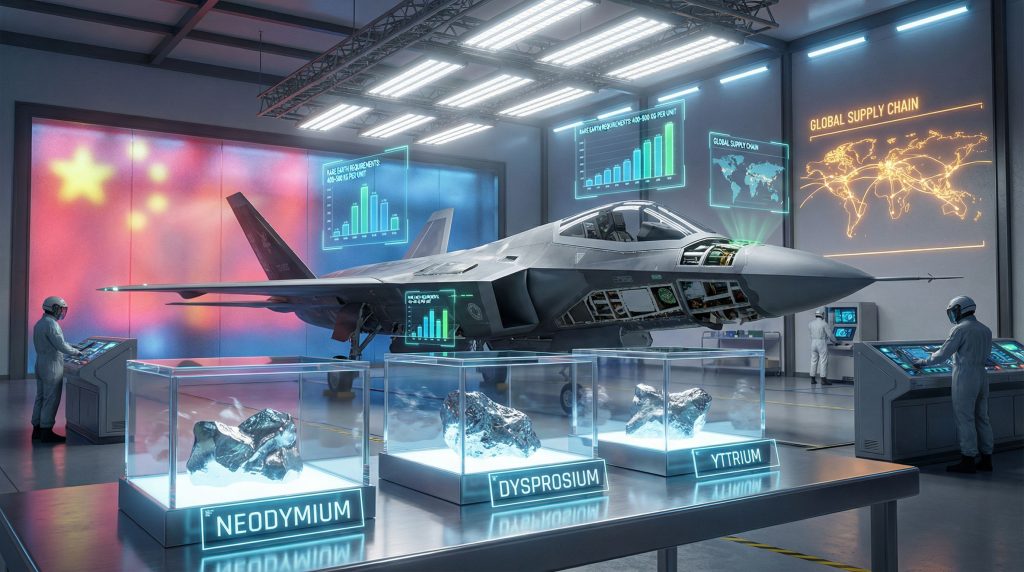
Each aircraft incorporates approximately 400-500 kilograms of rare earth elements across various subsystems, representing a 40% increase from fifth-generation platforms. This material intensity stems from the integration of:
- Electric flight control actuators requiring high-torque permanent magnet motors
- Advanced radar arrays utilising yttrium iron garnet filters for frequency discrimination
- Power generation systems employing rare earth permanent magnet generators
- Thermal management components incorporating yttrium-stabilised zirconia coatings
- Weapons targeting systems using neodymium-yttrium-aluminium-garnet laser crystals
Performance Requirements Driving Material Selection
The operational demands of sixth-generation platforms create non-negotiable material specifications that cannot be met through conventional alternatives. Engine bay temperatures routinely exceed 400°C in localised regions, whilst electronic systems must function reliably across electromagnetic interference levels that would disable civilian equipment.
| System Component | Temperature Range | Magnetic Field Strength | Weight Constraint |
|---|---|---|---|
| Flight Control Actuators | -40°C to +85°C | >1.4 Tesla | <15 kg per unit |
| Engine Bay Sensors | +200°C to +400°C | >0.8 Tesla | <5 kg per unit |
| Radar Components | -55°C to +125°C | >1.2 Tesla | <25 kg per array |
| Weapons Systems | -40°C to +160°C | >1.0 Tesla | <10 kg per subsystem |
These specifications can only be achieved through rare earth-enhanced materials, particularly dysprosium-doped neodymium magnets that maintain magnetic coercivity at elevated temperatures. Furthermore, standard ferrite magnets achieve only 25-30% of the magnetic field strength required whilst weighing 2-3 times more than rare earth alternatives.
Integration Complexity and System Dependencies
Modern fighter aircraft function as integrated weapon systems where individual component failures can compromise overall platform effectiveness. The F-35 program demonstrated this integration complexity, with each aircraft containing over 420 kilograms of rare earth elements distributed across 47 major subsystems.
Sixth-generation platforms extend this integration philosophy through:
Networked Sensor Fusion
- Multi-spectral radar arrays requiring yttrium-based frequency filters
- Infrared targeting systems using rare earth-doped detector materials
- Electronic warfare packages employing specialised magnetic components
Artificial Intelligence Integration
- High-performance computing systems demanding advanced thermal management
- Machine learning processors requiring precise electromagnetic shielding
- Autonomous flight systems utilising rare earth permanent magnet actuators
Directed Energy Weapons
- Laser targeting systems incorporating neodymium-yttrium-aluminium-garnet crystals
- High-power microwave systems using yttrium iron garnet components
- Precision pointing mechanisms employing rare earth permanent magnet motors
Why Has China's Export Policy Created a Strategic Bottleneck?
China's dominance in rare earth processing extends far beyond raw material extraction, encompassing the entire value chain from mining through finished magnet production. This vertical integration creates multiple simultaneous chokepoints that can cascade through defence supply chains with minimal advance warning.
The April 2025 Export Licensing Regime
Beijing's implementation of export licensing requirements in April 2025 targeted seven specific rare earth elements critical to defence applications: dysprosium, terbium, samarium, yttrium, gadolinium, holmium, and lutetium. This selective approach demonstrates sophisticated understanding of Western military supply chains, focusing on elements where Chinese processing dominance exceeds 95%.
The immediate market impact proved more severe than anticipated:
- Magnet shipments decreased 74% year-over-year in May 2025
- Dysprosium prices increased 180% within 60 days of implementation
- Terbium availability declined 65% for non-Chinese purchasers
- Defence contractor lead times extended to 18-24 months for critical components
Processing Infrastructure as Strategic Weapon
China's rare earth processing capabilities represent decades of coordinated industrial development that cannot be rapidly replicated. In addition, the country operates 99% of global dysprosium and terbium refining capacity, utilising specialised hydrometallurgical facilities requiring:
- Corrosion-resistant equipment capable of handling acidic rare earth solutions
- Trained technical workforce familiar with complex separation chemistry
- Environmental containment systems managing radioactive waste streams
- Quality control infrastructure achieving 99.9%+ purity specifications
This infrastructure concentration creates vulnerabilities that extend beyond traditional trade relationships. Even allied nations like Japan and South Korea depend on Chinese processing for 80-90% of their rare earth requirements, limiting their ability to support alternative supply chains.
Economic Leverage Through Material Control
Chinese policymakers have explicitly characterised rare earth export restrictions as trade-war countermeasures designed to apply precise pressure on Western defence capabilities without disrupting broader economic relationships. This approach enables Beijing to:
Target High-Value Military Applications
- Focus restrictions on defence-critical elements whilst maintaining commercial exports
- Create supply uncertainties that force longer-term procurement commitments
- Demonstrate capability to disrupt Western military production schedules
Minimise Collateral Economic Damage
- Maintain exports of consumer electronics components
- Preserve rare earth demand from renewable energy sectors
- Avoid triggering broad retaliatory trade measures
Extract Political Concessions
- Link rare earth availability to broader diplomatic negotiations
- Create incentives for technology sharing agreements
- Pressure allies to limit cooperation with US military programmes
Which Rare Earth Elements Are Most Critical for Fighter Performance?
The material requirements for sixth-generation fighters centre on specific rare earth elements that enable performance characteristics impossible to achieve through conventional materials. Understanding these dependencies reveals both the technical constraints and potential vulnerabilities facing next-generation air power development.
Neodymium and Praseodymium: Foundation of Magnetic Systems
Neodymium (Nd) and praseodymium (Pr) constitute the primary magnetic components in rare earth permanent magnets, typically comprising 25-30% of magnet weight in NdFeB alloy systems. These light rare earth elements provide the fundamental magnetic strength that enables compact, high-performance motor systems throughout fighter aircraft.
Primary Applications:
- Electric flight control actuators requiring rapid response times
- Starter-generator systems for main engine operation
- Gimbal-mounted sensor platforms demanding precision positioning
- Hydraulic pump motors providing backup power systems
Performance Characteristics:
- Magnetic energy density: 35-52 megagauss-oersteds (MGOe)
- Operating temperature range: -40°C to +150°C (standard grades)
- Coercivity ratings: 880-1,200 kA/m depending on composition
- Weight advantage: 40-50% lighter than equivalent ferrite magnet systems
Supply Vulnerability Assessment: Moderate
Multiple global sources exist for neodymium and praseodymium, including operations in Australia, Brazil, Canada, and the United States. However, processing capacity remains concentrated in China, creating bottlenecks in refined material availability.
Dysprosium and Terbium: High-Temperature Performance Enablers
Dysprosium (Dy) and terbium (Tb) serve as critical dopant materials that enable rare earth magnets to maintain performance at elevated temperatures encountered in fighter aircraft operations. These heavy rare earth elements represent the most strategic vulnerability in defence supply chains.
Critical Functions:
- Temperature stability enhancement: Maintains magnetic coercivity above 200°C
- Stress resistance: Preserves magnetic alignment under high G-force conditions
- Longevity improvement: Reduces magnetic degradation over operational lifetime
Application-Specific Requirements:
| Aircraft System | Operating Temperature | Dy/Tb Content | Performance Impact |
|---|---|---|---|
| Engine Bay Actuators | 180-220°C | 4-6% by weight | Critical for operation |
| Weapons Bay Motors | 60-120°C | 2-3% by weight | Performance optimisation |
| Radar Gimbal Systems | 40-80°C | 1-2% by weight | Precision enhancement |
| Environmental Control | 150-200°C | 3-5% by weight | System reliability |
Supply Vulnerability Assessment: Extreme
China controls 99% of global dysprosium and terbium processing capacity. No alternative sources can provide military-grade materials at required volumes within current infrastructure. Alternative suppliers would require 5-7 years to establish comparable processing capabilities.
Yttrium: Thermal and Optical System Foundation
Yttrium (Y) enables multiple critical applications in sixth-generation fighters through its unique thermal stability and optical properties. Unlike magnetic applications, yttrium serves as a foundational element in thermal barrier coatings and laser systems.
Primary Applications:
- Thermal barrier coatings: Yttrium-stabilised zirconia (YSZ) protects turbine components
- Laser targeting systems: Nd:YAG crystals provide precision weapons guidance
- Radar components: Yttrium iron garnet (YIG) filters enable frequency discrimination
- Electronic warfare systems: Specialised ceramic components for electromagnetic protection
Technical Performance Requirements:
- Thermal conductivity: <2.5 W/m·K for barrier coating applications
- Optical transparency: >95% transmission at 1064 nm wavelength
- Chemical stability: Resistance to oxidation at 1200°C+ temperatures
- Electromagnetic properties: Precise permeability characteristics for radar applications
Supply Vulnerability Assessment: High
Whilst yttrium deposits exist globally, processing infrastructure remains concentrated in China and Malaysia. European and North American processing capacity can meet only 15-20% of projected military requirements.
Substitution Challenges and Performance Penalties
Alternative materials exist for some rare earth applications, but performance penalties typically render them impractical for military specifications demanding optimal capability rather than acceptable compromises.
Magnetic System Alternatives:
- Iron-nitride magnets: Achieve 60-70% of NdFeB performance with zero rare earth content
- Ferrite magnets: Provide adequate magnetic strength but require 200-300% additional weight
- Electromagnetic actuators: Eliminate permanent magnets but consume 40-50% more electrical power
Thermal System Alternatives:
- Conventional superalloys: Operate at lower temperatures, reducing engine efficiency
- Ceramic matrix composites: Require exotic manufacturing processes and higher costs
- Refractory metals: Provide adequate thermal performance but significantly increase weight
Critical Design Constraint: Military specifications typically demand optimal performance across multiple parameters simultaneously. Alternative materials may match rare earth performance in single characteristics but fail to achieve the combination of properties required for integrated military systems.
How Are Global Powers Responding to Supply Chain Vulnerabilities?
The recognition that rare earth supply chains represent critical national security infrastructure has triggered coordinated responses across allied nations, involving unprecedented public-private partnerships and strategic industrial policy initiatives designed to reduce dependencies within a compressed timeframe.
United States: Comprehensive Industrial Base Reconstruction
The Trump administration's approach to rare earth supply chain security involves direct federal investment in domestic production capacity, regulatory streamlining, and long-term strategic partnerships with private industry. The US mineral production order represents a fundamental shift from market-based solutions toward active government participation in critical materials production.
Federal Investment Framework – $1.4 Billion Total Allocation:
MP Materials Expansion – $550 Million Partnership
- Equity investment: $400 million for majority government stake
- Low-interest loans: $150 million at 2.5% annual interest rate
- Production targets: 10,000 tonnes annual magnet capacity by 2028
- Employment goals: 500+ high-skilled manufacturing positions
ReElement Technologies – $80 Million Recycling Initiative
- Focus on end-of-life magnet recovery from defence equipment
- Target recovery rates of 95% for neodymium, praseodymium, and dysprosium
- Projected capacity of 2,000 tonnes annually by 2027
- Integration with existing defence logistics networks
Vulcan Elements – $670 Million Integrated Processing
- Complete processing chain from mining through finished magnets
- Geographic distribution across Texas, Colorado, and Montana
- Strategic partnership with Department of Energy national laboratories
- Technology sharing agreements with allied nation processors
USA Rare Earth – $200 Million Oklahoma Facility
- Specialised focus on samarium-cobalt magnet production
- High-temperature applications for aerospace and defence
- Coordinated development with major defence contractors
- Initial production capacity of 1,500 tonnes annually
Policy Architecture and Regulatory Framework
Defence Production Act Utilisation
- Title III authorities activated for rare earth processing infrastructure
- Fast-track permitting for critical materials projects
- Government-guaranteed markets through long-term contracts
- Priority allocation of strategic materials during supply disruptions
Buy America Requirements Enhancement
- Mandatory domestic sourcing for all defence-critical rare earth components
- Gradual phase-in schedule allowing supply chain transition
- Exception procedures limited to cases of technical impossibility
- Regular compliance auditing and supply chain verification
Strategic National Defence Stockpile Expansion
- Target inventory: 24-month supply buffer for critical defence applications
- Geographic distribution across multiple secure storage facilities
- Quality maintenance programmes ensuring material viability
- Coordinated release mechanisms during supply emergencies
Allied Nations: Coordinated Diversification Strategies
European Union Critical Raw Materials Act Implementation
The EU's €3.4 billion Critical Raw Materials Initiative focuses on developing integrated European processing capabilities whilst establishing strategic partnerships with allied suppliers outside Chinese control.
Key Investment Priorities:
- REETec Norway: €180 million for integrated heavy rare earth processing
- Solvay Belgium: €220 million expansion of separation and purification capabilities
- EuroGeoSurvey: €150 million geological survey programme across member nations
- Strategic autonomy fund: €500 million for cross-border industrial cooperation
Japan-Australia Strategic Partnership
The Japan-Australia Rare Earth Cooperation Agreement establishes integrated supply chains linking Australian mining with Japanese processing expertise, specifically designed to support the Global Combat Air Programme (GCAP) requirements.
Partnership Elements:
- Bilateral processing agreements: Technology sharing for separation and refining
- Joint research initiatives: $200 million fund for recycling and substitution research
- Integrated logistics: Coordinated shipping and quality control systems
- Strategic reserves: Combined stockpiling with shared access during emergencies
Alternative Supplier Development Timeline
2025-2027: Infrastructure Development Phase
| Region | Current Capacity | Investment Committed | Primary Projects |
|---|---|---|---|
| North America | 3,000 tonnes/year | $850 million | MP Materials, USA Rare Earth |
| European Union | 500 tonnes/year | €600 million | REETec, Solvay expansion |
| Australia-Japan | 2,000 tonnes/year | AUD $400 million | Lynas expansion, joint facilities |
| Other Allied | 1,000 tonnes/year | $250 million | Various smaller initiatives |
2027-2030: Production Scale-Up Phase
- Target combined capacity: 45,000-50,000 tonnes annually across allied nations
- Chinese dependency reduction: From 85% to 35% for defence-critical materials
- Quality certification: Military-grade specifications for all major suppliers
- Strategic redundancy: Multiple suppliers for each critical rare earth element
Economic Implications of Supply Diversification
Short-term cost increases: 15-25% premium for non-Chinese sourcing
- Higher labour costs in developed nations
- Infrastructure development expenses
- Quality assurance and certification requirements
- Transportation and logistics modifications
Long-term strategic benefits: Enhanced supply security and reduced geopolitical risk
- Elimination of single-point supply failures
- Competitive pricing through supplier diversification
- Technology spillover effects to civilian applications
- Industrial base strengthening across allied nations
Furthermore, Australia's critical minerals reserve initiative demonstrates how allied nations are coordinating their response to supply chain vulnerabilities.
What Technical Innovations Could Reduce REE Dependencies?
The quest to reduce rare earth dependencies in sixth-generation fighters has accelerated research into alternative materials, recycling technologies, and system architecture modifications that could fundamentally alter the strategic materials landscape within the next decade.
Advanced Magnetic Material Alternatives
Iron-Nitride Permanent Magnets
Recent breakthroughs in iron-nitride (Fe16N2) synthesis have demonstrated potential for rare earth-free magnets achieving 85% of neodymium magnet performance. This represents the most promising near-term alternative for reducing critical material dependencies.
Technical Specifications:
- Magnetic energy density: 42-45 MGOe (compared to 52 MGOe for NdFeB)
- Operating temperature: Stable to 200°C without degradation
- Corrosion resistance: Superior to rare earth magnets in marine environments
- Manufacturing cost: Projected 40% reduction compared to dysprosium-doped NdFeB
Development Timeline:
- 2025-2027: Laboratory-scale production optimisation
- 2027-2029: Pilot manufacturing and military testing
- 2029-2031: Full-scale production and system integration
- 2031+: Widespread deployment in new fighter programmes
Limitations and Challenges:
- Slightly reduced magnetic performance may require larger motor housings
- Manufacturing processes still under development
- Unknown long-term stability characteristics under combat conditions
Hybrid Ceramic-Metal Composites
Samarium-cobalt alternatives incorporating ceramic reinforcement offer reduced rare earth content whilst maintaining high-temperature performance characteristics essential for aerospace applications.
Composite Advantages:
- 50% reduction in rare earth content compared to conventional SmCo magnets
- Enhanced thermal stability up to 300°C operational temperature
- Improved shock resistance under high-G combat manoeuvres
- Reduced supply chain risk through cobalt substitution strategies
System Architecture Innovations
Distributed Electrical Architecture
Advanced power management systems can reduce peak magnetic field requirements through intelligent load distribution, potentially enabling use of lower-performance magnets in critical applications.
Technical Approaches:
- Modular actuator systems: Multiple smaller motors replacing single high-power units
- Adaptive power management: Real-time optimisation reducing peak demand by 25-30%
- Energy storage integration: Capacitor banks smoothing electrical load variations
- Regenerative systems: Energy recovery from actuator movement reducing total power requirements
Software-Defined Hardware Capabilities
Artificial intelligence-driven control systems can compensate for reduced hardware performance through sophisticated algorithms that optimise system efficiency in real-time.
Compensation Strategies:
- Predictive control algorithms anticipating system demands and pre-positioning actuators
- Machine learning optimisation adapting to component degradation over operational lifetime
- Multi-sensor fusion reducing individual sensor performance requirements
- Dynamic reconfiguration shifting functions between systems as component capabilities change
Recycling and Circular Economy Technologies
Advanced Disassembly and Recovery Systems
Military aircraft retirement programmes increasingly focus on systematic rare earth recovery, with 95% recovery rates achievable for most elements through specialised processing techniques.
Recovery Process Architecture:
| Processing Stage | Recovery Efficiency | Technology Required | Timeline |
|---|---|---|---|
| Component Identification | 98% accuracy | X-ray fluorescence scanning | 2-4 hours |
| Mechanical Disassembly | 90% material separation | Automated robotic systems | 8-12 hours |
| Chemical Processing | 95% elemental recovery | Hydrometallurgical refining | 3-5 days |
| Purification and Refining | 99%+ purity achieved | Ion exchange systems | 1-2 weeks |
Economic Viability Thresholds
Rare earth recycling becomes cost-competitive with primary mining when processing volumes exceed 1,000 tonnes annually. Current defence retirement schedules project sufficient material availability to support economically viable recycling operations by 2027.
Urban Mining Integration
Consumer electronics provide supplementary rare earth sources that can augment military recycling programmes, particularly for neodymium and praseodymium recovery from hard disk drives and speakers.
Combined Recovery Potential:
- Consumer electronics: 15,000 tonnes annually of recoverable rare earths
- Military equipment: 3,000 tonnes annually from aircraft and systems retirement
- Industrial equipment: 8,000 tonnes annually from wind turbines and motors
- Total potential: 26,000 tonnes annually within North American recycling infrastructure
Emerging Technologies and Research Frontiers
Superconducting Motor Systems
High-temperature superconductors operating at liquid nitrogen temperatures (77K) can eliminate permanent magnet requirements in certain applications, though current technology remains impractical for mobile military platforms.
Research Priorities:
- Room-temperature superconductors: Theoretical possibility with revolutionary implications
- Practical cooling systems: Reducing power requirements for cryogenic operation
- Fault tolerance: Maintaining superconductivity under combat damage conditions
- Manufacturing scalability: Industrial production of superconducting components
Biomimetic Material Design
Nature-inspired approaches to magnetic field generation and control offer potential pathways to eliminate rare earth dependencies through fundamentally different technological approaches.
Research Directions:
- Magnetotactic bacteria: Understanding biological magnetic field sensors
- Organic magnetic materials: Carbon-based alternatives to metallic magnets
- Hybrid bio-synthetic systems: Combining biological and engineered components
- Self-assembling structures: Programmable material systems reducing manufacturing complexity
The next major ASX story will hit our subscribers first
How Will REE Constraints Affect Fighter Program Timelines?
Rare earths in sixth-generation fighter jets represent a critical path dependency that could determine the pace of deployment across major military powers, with implications extending far beyond simple procurement delays into fundamental questions of air power balance and deterrent capability.
Programme-Specific Vulnerability Analysis
US F-47 NGAD Programme – Critical Timeline Factors
The F-47 Next Generation Air Dominance programme faces the most immediate rare earth supply risks due to its ambitious timeline and unprecedented material requirements.
Current Programme Status:
- First flight target: 2028 (confirmed by Air Force leadership, September 2025)
- Initial operational capability: 2032-2033
- Full-rate production: 2034-2036
- Total aircraft requirement: 185 units in initial procurement
Material Requirements and Supply Risks:
| Programme Phase | REE Requirements | Supply Risk Level | Potential Delay Impact |
|---|---|---|---|
| Prototype Development | 15 aircraft, ~6 tonnes REE | Medium | 6-12 months |
| Low-Rate Production | 25 aircraft, ~11 tonnes REE | High | 12-18 months |
| Full-Rate Production | 145 aircraft, ~65 tonnes REE | Extreme | 24-36 months |
Mitigation Strategies Currently Implemented:
- Domestic sourcing mandates requiring 75% US-origin materials by 2030
- Strategic stockpiling covering 18-month production requirements
- Alternative material qualification programmes reducing dysprosium content by 30%
- Supplier diversification agreements with Australian and Canadian processors
European GCAP/Tempest Programme – Coordinated Allied Response
The Global Combat Air Programme benefits from tri-national cooperation but faces unique challenges in coordinating supply chains across three different regulatory and industrial environments.
Programme Timeline Structure:
- Technology demonstration: 2027-2028
- Engineering and manufacturing development: 2028-2032
- Initial operational capability: 2035-2037
- Multi-national production: 2037-2045
Supply Chain Coordination Mechanisms:
- Joint procurement agreements leveraging combined buying power
- Shared strategic reserves accessible during supply disruptions
- Technology transfer arrangements enabling production flexibility
- Alternative supplier development through coordinated industrial policy
Risk Assessment: Medium to High
- Longer development timeline provides opportunity for supply chain maturation
- Multi-national coordination complicates rapid response to supply disruptions
- European processing capacity improvements reduce but do not eliminate Chinese dependencies
Chinese J-36/J-50 Programmes – Strategic Advantages Through Domestic Control
China's sixth-generation fighter development benefits from complete domestic rare earth supply chain control, potentially enabling first-mover advantages in capability deployment.
Projected Timeline Advantages:
- Prototype testing: Already commenced with both J-36 and J-50 designs (late 2024)
- Initial operational capability: 2026-2028 (2-4 years ahead of Western programmes)
- Full squadron deployment: 2029-2031
- Export availability: 2032-2035 for allied nations
Strategic Implications:
- Temporary air superiority window in Asia-Pacific region
- Technology demonstration effects influencing regional ally decisions
- Industrial capacity advantages enabling rapid production scale-up
- Export leverage through early availability to strategic partners
Cost Implications and Financial Risk Assessment
Development Cost Increases Due to Supply Chain Diversification
Rare earth supply chain constraints directly translate into measurable cost impacts across all aspects of fighter development programmes.
Alternative Material Qualification Costs:
- Research and development: $200-350 million per programme
- Testing and certification: $150-250 million across all systems
- Manufacturing process modification: $100-200 million in tooling changes
- Performance validation: $50-100 million in extended testing requirements
Supply Chain Diversification Premiums:
- Raw material costs: 15-25% increase for non-Chinese sourcing
- Processing charges: 20-35% premium for allied nation facilities
- Transportation and logistics: 5-10% additional cost for longer supply chains
- Quality assurance: 3-8% increase for enhanced certification requirements
Long-Term Economic Benefits Analysis
Despite short-term cost increases, supply chain diversification generates substantial strategic and economic benefits that justify the additional investment.
Risk Mitigation Value:
- Programme schedule protection: Avoiding 24-36 month delays worth $2-4 billion per programme
- Capability assurance: Maintaining technological superiority during crisis periods
- Industrial base preservation: Sustaining domestic manufacturing capabilities
- Technology spillover effects: Commercial applications in renewable energy and electronics
Industrial Capacity Development Benefits:
- Employment creation: 2,500-4,000 high-skilled manufacturing jobs
- Technology advancement: Research and development spillovers to civilian sectors
- Export potential: Eventual competition in global rare earth markets
- Strategic autonomy: Reduced dependence on potentially hostile suppliers
Scenario-Based Timeline Projections
Scenario 1: Successful Supply Chain Diversification (65% probability)
Allied nations successfully establish alternative rare earth processing capacity meeting 60-70% of defence requirements by 2030, with Chinese dependencies reduced to manageable levels.
Timeline Implications:
- US F-47 programme: 6-12 month delay in initial operational capability
- European GCAP programme: Minimal delay due to longer development timeline
- Chinese advantage period: Limited to 12-18 months in early deployment
- Overall assessment: Manageable impact with long-term strategic benefits
Scenario 2: Prolonged Supply Dependencies (30% probability)
Alternative supply chain development proves more difficult than anticipated, with allied processing capacity reaching only 30-40% of requirements by 2030.
Timeline Implications:
- US F-47 programme: 18-24 month delay with potential capability reductions
- European GCAP programme: 12-18 month delay requiring design modifications
- Chinese advantage period: 3-5 years of technological superiority
- Overall assessment: Significant strategic implications requiring alternative approaches
Scenario 3: Technology Breakthrough (5% probability)
Successful development of rare earth-free alternatives or revolutionary recycling technologies eliminates supply chain constraints within 3-5 years.
Timeline Implications:
- All Western programmes: Accelerated development as constraints removed
- Chinese advantage: Negated through superior technological solutions
- Global dynamics: Shift to other strategic material competitions
- Overall assessment: Fundamental transformation of strategic materials landscape
What Are the Strategic Implications for Air Power Balance?
The intersection of rare earth supply chains and sixth-generation fighter development creates unprecedented scenarios where material science capabilities may determine military outcomes more directly than traditional measures of defence industrial capacity or technological sophistication. Consequently, the big pivot in critical minerals strategy represents a fundamental shift in how nations approach defence procurement.
Regional Power Dynamics and Capability Deployment
Asia-Pacific Theatre: First-Mover Advantage Scenarios
China's domestic rare earth supply chain control potentially enables deployment of sixth-generation fighters 2-4 years ahead of US and allied programmes, creating temporary but significant air superiority advantages in contested regions.
Taiwan Strait Implications:
- Chinese J-36/J-50 deployment by 2026-2028 versus US F-47 availability after 2032
- Technology demonstration effects influencing regional ally commitment levels
- Deterrent capability shifts as advanced Chinese fighters patrol disputed airspace
- Escalation dynamics where material constraints affect crisis response options
Allied Response Mechanisms:
- Forward deployment of existing fifth-generation fighters to maintain presence
- Accelerated technology sharing among AUKUS and Quad partners
- Enhanced missile defence systems compensating for temporary fighter gaps
- Economic pressure coordination targeting Chinese rare earth export capabilities
European Security Architecture Evolution
European sixth-generation fighter development through the GCAP programme represents a critical test of strategic autonomy concepts, where success or failure in rare earth supply chain management directly impacts continental security independence.
Strategic Autonomy Implications:
- Technological sovereignty requiring independent materials supply chains
- Industrial base preservation through coordinated European Union policies
- Transatlantic cooperation balancing independence with allied coordination
- Defence industrial competition with both US and Chinese alternatives
NATO Integration Challenges:
- Interoperability requirements for multinational fighter programmes
- Standardisation pressures favouring US-developed systems and suppliers
- Capability gap management during transition periods between generations
- Burden sharing negotiations reflecting differential supply chain vulnerabilities
Economic Warfare and Strategic Competition
Material-Based Coercion Mechanisms
Rare earth supply control represents a precision instrument for economic coercion that can target specific military capabilities without triggering broad economic retaliation, fundamentally altering the toolkit available for strategic competition.
Chinese Strategic Options:
- Selective restriction targeting specific allied nations or defence programmes
- Price manipulation creating economic pressure on alternative supplier development
- Technology transfer demands linking rare earth access to broader concessions
- Timeline coordination synchronising restrictions with geopolitical pressure campaigns
Allied Counter-Strategy Development:
- Coordinated stockpiling creating strategic buffers against supply shocks
- Joint procurement mechanisms leveraging collective bargaining power
- Alternative supplier subsidisation accelerating competitive processing capacity
- Recycling infrastructure investment reducing primary material dependencies
Technology Competition and Future Implications
Innovation Acceleration Through Constraint
Supply chain vulnerabilities are driving unprecedented innovation in materials science and system architecture design, potentially leading to technological breakthroughs that eliminate strategic dependencies entirely.
Research Investment Patterns:
- $2.1 billion committed to alternative magnet development across allied nations
- $850 million invested in recycling and circular economy technologies
- $600 million allocated to superconductor research programmes
- $450 million for artificial intelligence compensation systems
Ultimately, mining industry evolution trends suggest that these challenges may accelerate technological development in ways that permanently alter the strategic materials landscape. The current constraints facing rare earths in sixth-generation fighter jets may prove to be the catalyst for fundamental innovations that reduce or eliminate these dependencies altogether.
However, China's export restrictions continue to threaten US defence supply chains, creating urgency around these development programmes. The timeline for resolving these vulnerabilities will ultimately determine whether material constraints reshape global air power dynamics or serve as a temporary challenge overcome through technological innovation and strategic cooperation among allied nations.
Ready to Stay Ahead of Critical Mineral Discoveries That Could Shape Defence Supply Chains?
Discovery Alert delivers instant notifications on significant ASX mineral discoveries using its proprietary Discovery IQ model, transforming complex geological announcements into actionable investment opportunities. Understand how major mineral discoveries can generate substantial returns by examining historic examples of exceptional market outcomes, then begin your 30-day free trial today to position yourself ahead of critical materials developments.