July 21, 2026
Strategic Mineral Supply Chain Vulnerabilities in Critical Technology Manufacturing
The global transition toward electrification and renewable energy systems has exposed fundamental weaknesses in critical mineral supply chains, particularly within rare earth element processing capabilities. While geological surveys identify substantial reserve bases across multiple continents, the concentration of refining and separation technologies within specific geographic regions creates systemic vulnerabilities for advanced manufacturing sectors. Understanding these processing bottlenecks requires examining the intersection of regulatory frameworks, technological capabilities, and strategic policy decisions that determine which nations can transform raw materials into industrial power. India's rare earth processing challenges exemplify how geological advantages fail to translate into strategic leverage without corresponding industrial infrastructure.
When big ASX news breaks, our subscribers know first
What Makes India's Rare Earth Processing Deficit So Strategically Critical?
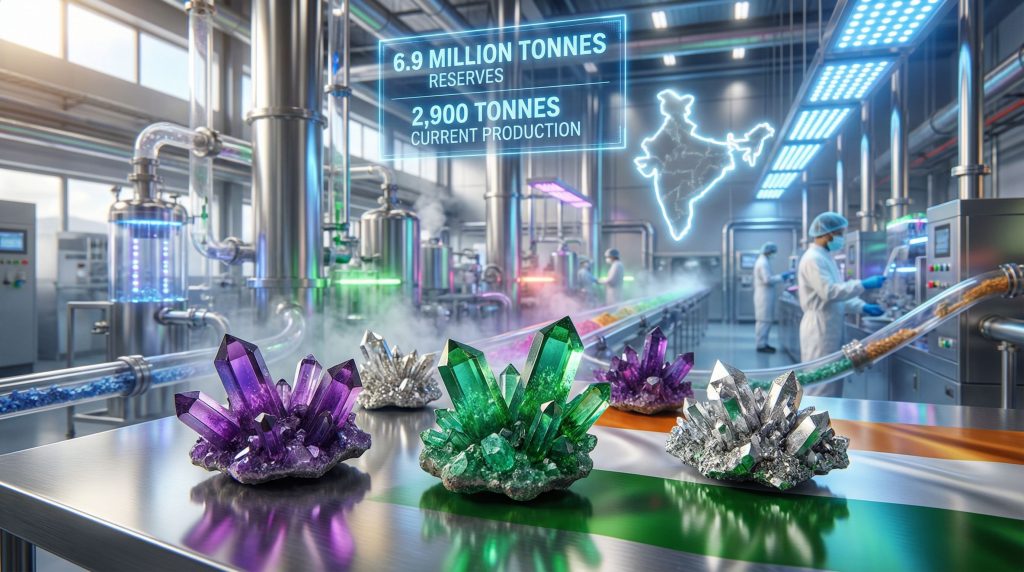
India's position within global rare earth markets represents one of the most striking disconnects between resource endowment and industrial capability in the critical minerals sector. The nation's 6.9 million tonnes of rare earth oxide reserves rank as the world's third-largest, yet annual production reaches only 2,900 tonnes compared to China's 270,000 tonnes. This disparity illustrates how geological advantages translate poorly into strategic leverage without corresponding processing infrastructure. Furthermore, the intersection with critical minerals energy security demonstrates why processing capabilities determine national industrial competitiveness.
The Scale of India's Untapped Resource Potential
The magnitude of India's underutilized rare earth reserves becomes apparent when examining production efficiency metrics across major reserve holders. India contributes less than 1% of global production despite controlling approximately 12% of known reserves. This production-to-reserve ratio suggests systemic constraints beyond simple extraction challenges.
Key production metrics reveal the depth of India's processing deficit:
• Reserve utilization rate: 0.04% annually versus global average of 0.15%
• Processing capacity utilization: Indian Rare Earths Limited operates at approximately 5% of theoretical capacity
• Value-added processing: Virtually no separation capabilities for heavy rare earth elements
• Export composition: Raw concentrates rather than refined products
The concentration of India's reserves within monazite-bearing coastal sand deposits provides both opportunities and complications. These deposits contain not only rare earth elements but also thorium, creating regulatory complexities that traditional hard-rock rare earth operations avoid.
Strategic Implications for Global Supply Chain Security
China's control over 90% of global rare earth refining creates single-point vulnerabilities throughout advanced technology supply chains. India's processing capacity deficit represents a missed opportunity for supply chain diversification precisely when Western nations seek alternatives to Chinese dependence. The US critical minerals strategy specifically identifies processing bottlenecks as key vulnerabilities requiring urgent attention.
The strategic importance extends beyond immediate supply concerns to encompass technological sovereignty. Nations that process rare earths develop expertise in separation chemistry, metallurgy, and downstream applications that enhance their position across multiple high-technology sectors. India's processing gap therefore represents not just lost economic value but diminished technological capabilities.
Critical applications requiring rare earth elements include:
• Permanent magnet motors for electric vehicles and wind turbines
• Precision-guided weapons systems and radar technologies
• Advanced electronics including smartphones and computers
• Catalysts for petroleum refining and industrial processes
• Specialised alloys for aerospace applications
How Do Regulatory Frameworks Create Processing Bottlenecks in India?
India's rare earth processing challenges stem significantly from regulatory structures designed for nuclear materials rather than industrial minerals. The intersection of rare earth extraction with radioactive thorium creates jurisdictional complexities that traditional mining operations circumvent. However, contemporary mining innovation trends suggest adaptive regulatory frameworks can facilitate strategic mineral development.
The Thorium Radioactivity Challenge
Monazite deposits, which constitute India's primary rare earth resource, typically contain 8-12% thorium oxide. This concentration triggers oversight by the Atomic Energy Regulatory Board (AERB), introducing nuclear regulatory requirements into what would otherwise be conventional mineral processing operations.
The regulatory implications include:
• Licensing delays: AERB approval processes extend 18-24 months beyond standard mining permits
• Specialised facility requirements: Processing plants must meet radiological safety standards
• Waste management protocols: Thorium-bearing residues require specialised disposal procedures
• Personnel certification: Workers must complete nuclear safety training programmes
These requirements create barriers to entry that extend far beyond environmental compliance. The intersection of atomic energy regulations with mineral processing effectively restricts rare earth development to entities capable of navigating nuclear regulatory frameworks.
State Monopoly Constraints Under IREL
Indian Rare Earths Limited maintains exclusive rights over rare earth mining and processing, creating structural limitations on industry development. This monopoly approach reflects historical policy decisions when rare earths were considered primarily nuclear materials rather than critical industrial inputs.
The monopoly constraints manifest through:
• Limited capital availability: State-owned enterprise investment cycles constrain rapid scaling
• Bureaucratic decision-making: Project approvals require multiple ministerial clearances
• Risk aversion: Public sector entities typically avoid high-capital, long-payback investments
• Innovation limitations: Restricted private sector participation reduces technological advancement
This structure contrasts sharply with countries that developed rare earth capabilities through competitive private sector investment or strategic public-private partnerships. The monopoly framework that may have been appropriate for nuclear material oversight becomes counterproductive when applied to strategic mineral development.
What Processing Technologies Does India Lack for Rare Earth Value Addition?
The transformation of rare earth concentrates into refined products requires sophisticated separation technologies that India has not developed at industrial scale. Understanding these technological gaps requires examining each stage of the rare earth value chain and identifying where capabilities fall short of commercial requirements. Moreover, India's strategic position in rare earth markets remains constrained by processing limitations despite substantial resource endowments.
Separation and Refining Infrastructure Gaps
Current Capabilities vs. Required Technologies:
| Processing Stage | India's Current Level | Global Standard Required | Technology Gap |
|---|---|---|---|
| Mining & Concentration | Basic operations | Advanced beneficiation | Moderate |
| Chemical Separation | Limited pilot scale | Industrial-scale plants | Severe |
| Metal Production | Minimal capacity | High-purity metallurgy | Critical |
| Magnet Manufacturing | Research phase only | Commercial production | Extreme |
The most critical deficiency exists in chemical separation capabilities. Converting rare earth concentrates into individual elements requires complex solvent extraction systems that can achieve high-purity separation of chemically similar elements. China's dominance stems largely from investments in large-scale separation facilities that achieve both volume and purity requirements for industrial applications.
India's separation technology limitations include:
• Scale constraints: Pilot-scale operations insufficient for commercial viability
• Efficiency gaps: Lower recovery rates increase per-unit processing costs
• Purity limitations: Products fail to meet specifications for high-performance applications
• Heavy rare earth deficiencies: Limited capability for critical elements like dysprosium and terbium
Heavy Rare Earth Processing Deficiencies
China controls 95% of global heavy rare earth separation capabilities, creating particular vulnerabilities for applications requiring these elements. India's monazite deposits contain predominantly light rare earth elements, but developing heavy rare earth processing capabilities remains strategically important for several reasons.
Heavy rare earth elements possess unique properties essential for high-performance applications:
• Dysprosium: Critical for high-temperature permanent magnets in electric vehicle motors
• Terbium: Essential for green phosphors in LED lighting and displays
• Holmium: Required for specialised magnetic applications and laser systems
• Erbium: Used in fiber optic amplifiers and specialised alloys
India's inability to process these elements forces downstream manufacturers to rely on Chinese suppliers even when alternative sources exist for raw materials. This processing bottleneck effectively extends Chinese control throughout the supply chain regardless of mining diversification efforts.
How Do Economic Factors Undermine India's Processing Development?
The economics of rare earth processing involve substantial upfront capital requirements, extended payback periods, and competition with established supply chains that benefit from economies of scale. India's processing development faces particular economic headwinds that extend beyond simple capital availability. Additionally, the US-China trade war impact has disrupted traditional trading patterns, creating both challenges and opportunities for alternative processors.
Capital Investment Requirements vs. Available Funding
Establishing commercial-scale rare earth processing facilities requires capital investments ranging from $500 million to $2 billion depending on processing complexity and throughput capacity. These facilities must achieve minimum economic scale to compete with established operations, creating barriers to incremental development approaches.
Investment requirement breakdown:
• Separation facilities: $300-800 million for industrial-scale solvent extraction systems
• Metallurgical processing: $150-400 million for metal production capabilities
• Environmental infrastructure: $50-200 million for waste treatment and disposal systems
• Research and development: $25-100 million for process optimisation and technology adaptation
The extended payback periods of 8-15 years reflect the time required to establish market position, optimise operations, and achieve full capacity utilisation. Private investors often find these timelines incompatible with return expectations, particularly in markets subject to geopolitical manipulation.
Market Access and Pricing Challenges
China's integrated supply chain structure creates cost advantages estimated at 30-40% compared to standalone processing operations. These advantages stem from vertical integration linking mining, separation, metallurgy, and downstream manufacturing within coordinated industrial ecosystems.
China's structural cost advantages include:
• Scale economies: Concentrated production volumes reduce per-unit costs
• Integration benefits: Elimination of intermediate transportation and handling costs
• Technology optimisation: Decades of process refinement and efficiency improvement
• Supply chain coordination: Synchronised operations from extraction through end-use manufacturing
Indian rare earth processors would enter markets where pricing reflects these integrated cost structures, making standalone processing facilities economically vulnerable to price competition or supply manipulation.
What Role Does Technology Transfer Play in India's Processing Limitations?
Access to advanced rare earth separation and processing technologies remains constrained by strategic considerations and commercial competition. Countries that developed rare earth capabilities typically guard technological advantages while nations seeking to establish processing capacity struggle to access state-of-the-art methods. Furthermore, existing rare earth sector bottlenecks demonstrate how technology gaps affect downstream industries.
International Partnership Constraints
The Japan-India joint venture in Visakhapatnam represents a significant but limited technology transfer initiative. While operationally active, this facility remains at pilot scale and does not provide the full range of technologies required for industrial-scale rare earth processing.
Technology transfer limitations include:
• Scale restrictions: Partners typically transfer pilot-scale rather than industrial technologies
• Process limitations: Critical separation techniques often remain proprietary
• Equipment constraints: Advanced machinery requires ongoing technical support and spare parts
• Know-how gaps: Operational expertise requires years of development beyond equipment installation
Western nations seeking rare earth supply diversification face competing priorities. While geopolitical interests support Indian processing development, commercial interests often favour protecting technological advantages that took decades to develop.
Indigenous R&D Development Gaps
India's domestic research and development capabilities in rare earth processing remain underdeveloped relative to the scale of technological challenges involved. University-industry collaboration in rare earth research occurs sporadically, and brain drain affects the availability of specialised metallurgical expertise.
R&D development challenges include:
• Limited specialised facilities: Few universities possess rare earth separation equipment
• Talent migration: Metallurgical engineers often seek opportunities in developed countries
• Patent deficiencies: Minimal intellectual property development in separation technologies
• Industry disconnect: Insufficient collaboration between research institutions and IREL
The complex chemistry of rare earth separation requires sustained research investment and specialised expertise that cannot be developed quickly. Countries with successful rare earth industries typically invested decades in building this knowledge base.
The next major ASX story will hit our subscribers first
How Do Geopolitical Factors Influence India's Processing Strategy?
India's rare earth processing development occurs within a broader geopolitical context where supply chain control intersects with strategic competition. Understanding these dynamics requires examining how various nations leverage rare earth capabilities for geopolitical advantage and how India might position itself within these competitions. Consequently, Australia's critical minerals reserve strategy provides insights into alternative approaches to strategic mineral security.
China's Strategic Export Controls Impact
China's approach to rare earth exports reflects strategic thinking about supply chain leverage rather than purely commercial considerations. Export quotas, processing restrictions, and technology embargoes shape global rare earth markets in ways that extend beyond normal commodity trading patterns.
Chinese strategic controls include:
• Export quotas: Limiting raw material exports to encourage domestic processing
• Processing restrictions: Prioritising domestic value-added production over exports
• Price manipulation: Using supply restrictions to influence global pricing
• Technology embargoes: Restricting access to advanced separation equipment
These policies create opportunities for alternative processors while simultaneously making such development more challenging. Countries seeking to establish rare earth processing capabilities must compete not only commercially but also navigate deliberate supply chain manipulation.
Western Supply Chain Diversification Opportunities
The United States, European Union, and allies increasingly recognise rare earth supply security as a strategic priority. Critical minerals partnerships and supply chain diversification initiatives create potential opportunities for Indian processing development.
Diversification initiatives include:
• Critical minerals partnerships: Bilateral agreements supporting alternative supply development
• Defence cooperation: Military applications driving secure supply requirements
• Technology sharing: Potential for advanced country technology transfer to reduce Chinese dependence
• Investment incentives: Financial support for rare earth processing development outside China
These opportunities require India to position rare earth processing within broader strategic partnerships rather than viewing it as a standalone industrial development challenge.
What Processing Models Could Transform India's Rare Earth Industry?
Developing India's rare earth processing capabilities requires choosing among different strategic approaches that vary in timeline, capital requirements, and probability of success. Each model involves different trade-offs between speed, cost, technological advancement, and strategic autonomy.
Integrated Value Chain Development Scenarios
Scenario Analysis: Three Development Pathways
| Development Model | Timeline | Investment Required | Processing Capacity Target |
|---|---|---|---|
| Gradual Expansion | 10-15 years | $2-3 billion | 15,000 tonnes REO/year |
| Accelerated Partnership | 5-8 years | $5-7 billion | 35,000 tonnes REO/year |
| Strategic Leap | 3-5 years | $10-15 billion | 75,000 tonnes REO/year |
Gradual Expansion Model involves building processing capabilities incrementally through IREL expansion and limited private sector participation. This approach minimises risk but may fail to achieve competitive scale within relevant timeframes.
Accelerated Partnership Model leverages international technology transfer and joint venture arrangements to compress development timelines. Success depends on securing genuine technology transfer rather than superficial cooperation arrangements.
Strategic Leap Model requires massive upfront investment to establish world-class processing capabilities within compressed timeframes. This approach offers the potential for rapid market entry but involves substantial execution risks.
Public-Private Partnership Framework Requirements
Successful rare earth processing development likely requires hybrid approaches combining public sector strategic direction with private sector efficiency and capital access. International examples suggest that purely state-driven or entirely private approaches often fail to achieve optimal outcomes.
Partnership framework elements include:
• Risk sharing: Government guarantees for strategic components, private sector operation of commercial elements
• Technology access: International partnerships providing advanced separation technologies
• Regulatory streamlining: Fast-track approval processes for strategically important projects
• Market development: Domestic demand creation through procurement policies and industrial development
The framework must balance strategic objectives with commercial viability to attract private investment while ensuring national control over critical capabilities.
What Are the Long-term Consequences of India's Processing Delays?
Continued delays in developing rare earth processing capabilities create cascading consequences that extend far beyond immediate supply chain vulnerabilities. Understanding these long-term implications requires examining how rare earth processing connects to broader industrial development and strategic autonomy.
Strategic Autonomy Implications
India's continued dependence on processed rare earth imports undermines strategic autonomy across multiple technology sectors. This dependence becomes particularly problematic during periods of geopolitical tension when supply security trumps commercial considerations.
Autonomy vulnerabilities include:
• Defence technology dependence: Critical weapons systems require Chinese-processed materials
• Renewable energy constraints: Electric vehicle and wind turbine manufacturing depends on foreign processing
• Electronics industry limitations: Smartphone and computer production vulnerable to supply disruptions
• Industrial catalyst dependence: Petroleum refining and chemical production affected by rare earth supply security
These dependencies create leverage opportunities for suppliers and constrain India's foreign policy flexibility during strategic competitions.
Economic Opportunity Costs
The failure to develop rare earth processing capabilities represents foregone economic value estimated at $2-4 billion annually based on the difference between concentrate exports and processed material imports. This calculation understates broader opportunity costs including technological development, employment generation, and industrial ecosystem effects.
Opportunity cost categories include:
• Direct value addition: Lost revenues from processing rather than exporting concentrates
• Employment generation: High-skill manufacturing jobs in metallurgy and separation technologies
• Technology development: Reduced capabilities in advanced materials and processing technologies
• Industrial ecosystem: Missed opportunities for downstream manufacturing development
The cumulative effect of these opportunity costs compounds over time, making delayed entry into rare earth processing increasingly expensive.
How Can India Overcome Its Rare Earth Processing Challenges?
Overcoming India's rare earth processing challenges requires coordinated action across regulatory reform, technology development, and strategic investment. Success depends on treating rare earth processing as a strategic industrial priority rather than a conventional mining operation.
Policy Reform Priorities
Regulatory frameworks designed for nuclear materials require adaptation for strategic mineral processing. While maintaining appropriate safety standards, regulations should facilitate rather than obstruct rare earth development when thorium separation occurs for disposal rather than utilisation.
Reform priorities include:
• Regulatory streamlining: Consolidated approval processes combining nuclear, environmental, and mining permits
• Private sector participation: Limited competition in non-strategic processing stages
• Investment incentives: Tax benefits and infrastructure support for rare earth processing development
• Technology zones: Specialised industrial parks with pre-approved regulatory frameworks
These reforms must balance strategic control with operational efficiency to create an enabling environment for processing development.
Technology Development Roadmap
Developing indigenous rare earth processing capabilities requires sustained investment in research institutions, international partnerships, and technology transfer arrangements. The approach should prioritise building long-term technological capabilities rather than simply importing turnkey solutions.
Development roadmap elements include:
• Centres of Excellence: Specialised research facilities at premier technical institutions
• International collaboration: Technology sharing agreements with processing leaders
• Industry partnerships: Joint ventures providing operational experience and market access
• Innovation incentives: Support for indigenous separation technology development
The roadmap requires balancing immediate capability needs with long-term technological sovereignty objectives.
Key Insight: India's rare earth processing challenges represent a convergence of regulatory complexity, technological gaps, and insufficient strategic investment rather than fundamental resource constraints. Success requires treating rare earth processing as critical infrastructure development with corresponding policy priority and resource allocation. The window for achieving competitive positioning may narrow as alternative supply chains develop without Indian participation.
Disclaimer: This analysis presents forward-looking scenarios and strategic assessments based on current information and industry trends. Actual outcomes may vary significantly based on policy decisions, technological developments, and changing geopolitical circumstances. Investment and strategic decisions should consider multiple scenarios and seek additional expert consultation.
Could India Transform Its Rare Earth Potential Into Market-Leading Returns?
Discovery Alert's proprietary Discovery IQ model delivers real-time alerts on significant rare earth and critical mineral discoveries across the ASX, instantly empowering subscribers to identify actionable opportunities ahead of the broader market. Understand why major mineral discoveries can lead to substantial market returns by exploring Discovery Alert's dedicated discoveries page, showcasing historic examples of exceptional outcomes, and begin your 30-day free trial today to position yourself ahead of the market.