June 7, 2026
The Strategic Minerals Paradox: How Critical Resource Security Collides With Indigenous Rights
American dependency on foreign copper sources has reached unprecedented levels, with domestic mining production satisfying less than 70% of national consumption demands. This supply vulnerability becomes particularly acute when examining the infrastructure requirements for electric vehicle manufacturing, renewable energy deployment, and grid modernisation initiatives. The strategic imperative to develop domestic copper resources intersects with complex questions of federal authority, tribal sovereignty, and sacred land protection in ways that extend far beyond traditional mining economics.
The Resolution Copper Arizona land dispute represents a convergence of these competing priorities, where national security considerations encounter constitutionally protected religious practices. Understanding this intersection requires examining the technical complexities of underground mining operations, the legal frameworks governing federal land exchanges, and the broader implications for America's critical minerals strategy.
When big ASX news breaks, our subscribers know first
Underground Mining Economics and Technical Realities
Block Caving Operations at Unprecedented Depths
Resolution Copper's underground mining approach utilises block caving methodology at depths ranging from 5,000 to 7,000 feet below surface. This technique represents one of the deepest block caving operations planned in North America, requiring sophisticated engineering to manage ore flow and structural stability. Unlike surface mining operations that progressively expand outward, block caving creates controlled subsidence zones directly above extraction areas.
The technical specifications reveal significant engineering challenges. Block caving requires undercutting ore bodies to destabilise rock formations, allowing gravity to facilitate ore movement toward collection points positioned below extraction zones. At the depths planned for Resolution Copper, hydrostatic pressure and rock stress conditions necessitate advanced support systems and continuous monitoring protocols.
Key Technical Parameters:
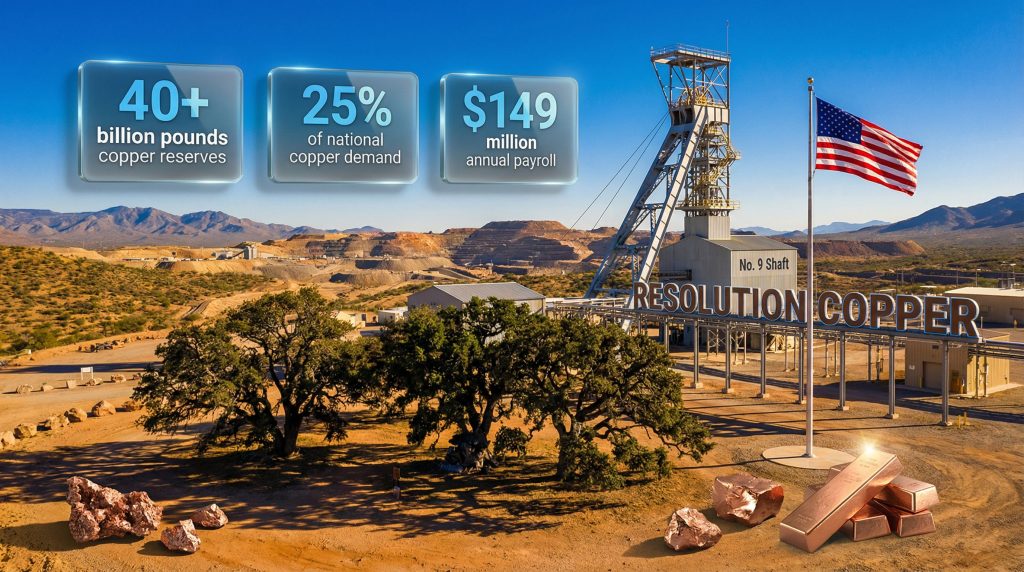
• Ore Reserve Capacity: 40+ billion pounds of copper equivalent to 18.1 million metric tonnes
• Mining Depth Range: 5,000-7,000 feet below surface elevation
• Subsidence Zone Impact: 1-3 meters vertical displacement expected above extraction areas
• Dewatering Requirements: Estimated 5-15 million gallons daily during peak operations
• Infrastructure Investment: $200 million rehabilitation of existing No. 9 Shaft access point
Comparative Environmental Footprint Analysis
Block caving mining reduces surface disturbance compared to open-pit alternatives for the same ore volume. However, this approach creates distinct environmental considerations including controlled subsidence patterns and extensive dewatering requirements. The subsidence zones extend beyond immediate extraction areas, affecting surface topography over multi-year timeframes.
Water management becomes critical given Arizona's arid climate and limited aquifer resources. Mining operations at proposed depths intersect multiple groundwater zones, requiring comprehensive dewatering to maintain operational safety. The environmental impact assessment projects significant aquifer drawdown effects extending several miles from the immediate mining area.
Furthermore, copper-uranium investment insights reveal that similar deep mining projects face comparable technical challenges globally. However, the unique geological conditions and regulatory environment in Arizona create specific operational requirements that influence project economics.
Federal Land Exchange Framework and Legal Precedents
Congressional Authorisation Mechanisms
The Southeast Arizona Land Exchange and Conservation Act of 2014 established the legislative framework enabling private land acquisition for Resolution Copper development. This congressional authorisation represents an unusual federal approach, where legislative action mandated specific land transfers rather than allowing administrative discretion through federal land management agencies.
The 2014 legislation required Resolution Copper to convey 5,400 acres of private Arizona land to federal ownership in exchange for 2,400 acres containing the copper deposit. This exchange ratio reflects the strategic value assigned to the mineral resources compared to the conservation benefits of the private lands offered in return.
| Exchange Component | Acreage | Current Status |
|---|---|---|
| Federal Land to Resolution Copper | 2,400 acres | Transfer completed March 2026 |
| Private Land to Federal Government | 5,400 acres | Transfer completed March 2026 |
| Oak Flat Sacred Site | ~760 acres | Included in federal land transfer |
| Surrounding Conservation Areas | ~1,640 acres | Protected under exchange agreement |
Environmental Review Requirements and Timeline
The Final Environmental Impact Statement (FEIS) completed in 2025 represents the culmination of environmental review processes initiated in 2014. This comprehensive assessment evaluated alternatives including no-action scenarios, alternative mining methods, and modified project boundaries. The FEIS process required consultation with 26 Native American tribes, extensive public comment periods, and coordination across multiple federal agencies.
The environmental review timeline illustrates the complexity of permitting major mining operations on federal lands. From congressional authorisation to final environmental approval required 11 years, reflecting the intersection of technical assessments, legal challenges, and stakeholder consultation requirements.
Consequently, this extended timeline demonstrates how the Resolution Copper Arizona land dispute became emblematic of broader challenges facing domestic resource development. Recent Arizona court rulings have cleared the way for Resolution Copper to begin operations following years of legal challenges.
Sacred Site Protection and Religious Freedom Litigation
Apache Stronghold Constitutional Strategy
Apache Stronghold's litigation strategy centred on Religious Freedom Restoration Act (RFRA) claims arguing that federal land transfer substantially burdened Apache religious practices at Oak Flat (Chi'chil Biłdagoteel). This legal approach required demonstrating that specific ceremonial activities would be prevented or significantly impaired by mining operations.
The constitutional framework under RFRA requires federal agencies to demonstrate compelling governmental interests and utilise the least restrictive means available to achieve those interests when actions substantially burden religious exercise. Apache Stronghold's legal team documented specific ceremonial practices including traditional gathering activities and spiritual ceremonies conducted at Oak Flat.
Legal Milestones and Court Decisions:
• 2021: Initial Apache Stronghold federal court filing challenging land exchange
• 2022-2024: Multiple 9th Circuit Court of Appeals procedural decisions
• May 2025: Supreme Court denial of emergency relief petitions
• March 2026: Final Forest Service Record of Decision implementation
Tribal Sovereignty and Federal Trust Responsibilities
The Resolution Copper dispute highlights tensions between congressional authority to authorise land exchanges and federal trust responsibilities to tribal nations. Federal Indian law establishes fiduciary obligations requiring consultation with affected tribes and consideration of impacts on tribal interests, even when congressional authorisation provides clear legal authority.
The San Carlos Apache argued that inadequate consultation occurred prior to the 2014 congressional authorisation, creating procedural violations of federal trust responsibilities. However, courts determined that explicit congressional authorisation superseded normal consultation requirements, establishing precedent for legislative action affecting tribal interests.
In addition, Apache women have continued seeking court intervention as federal land transfer proceeds, demonstrating the ongoing nature of this dispute.
Economic Impact Assessment and Regional Development
Employment and Economic Multiplier Effects
Resolution Copper projects direct employment of approximately 1,400 workers with additional indirect employment estimated at 2,100 positions. These employment projections reflect typical multiplier effects for large-scale mining operations in rural areas, where direct mining employment supports service sector and supply chain employment in surrounding communities.
The economic impact extends beyond immediate employment to include substantial tax revenue generation. Annual state and local tax contributions are projected at $80-120 million, with federal tax obligations estimated at $200 million annually during full production phases. These revenue projections depend heavily on copper price assumptions and operational cost management.
Projected Economic Contributions:
• Direct Employment: 1,400 full-time positions
• Annual Payroll: $149 million in direct wages
• Indirect Employment: 2,100 additional regional positions
• State/Local Tax Revenue: $80-120 million annually
• Federal Tax Contributions: $200 million annually
Investment Capital and Development Timelines
Rio Tinto and BHP have invested over $2 billion in project development without achieving commercial production, illustrating the extended development timelines typical of major mining projects. The March 2026 land transfer enables a $500 million drilling campaign to further define ore reserves and optimise mining plans.
The investment timeline reflects the financial commitment required for developing deep underground mining operations. Pre-production capital expenditure typically ranges from $2-5 billion for projects of Resolution Copper's scale, with payback periods extending 10-15 years depending on copper price cycles.
Moreover, this investment pattern aligns with broader trends in gold and copper exploration where companies face increasing capital requirements and extended development timelines for major deposits.
Copper Market Dynamics and Strategic Resource Implications
Domestic Supply Security and Import Dependencies
United States copper consumption approximates 1.7-1.8 million metric tonnes annually, with domestic production supplying approximately 1.2 million metric tonnes. Resolution Copper's projected annual production capacity of 300,000+ metric tonnes would significantly reduce import dependency, particularly for refined copper products used in electrical applications.
The strategic importance becomes apparent when examining end-use applications driving copper demand growth. Electric vehicle battery systems require 180-220 pounds of copper per vehicle compared to 50-80 pounds in conventional vehicles. Renewable energy infrastructure similarly demands substantial copper quantities, with wind turbines requiring 3-5 tonnes of copper per megawatt of capacity.
Price Volatility and Project Economics
Copper price volatility creates significant uncertainty for project economics, with prices ranging from $2.00 to $5.00 per pound over the 2015-2025 period. Resolution Copper's financial viability depends heavily on long-term price assumptions, as underground mining operations typically require $2.50-3.00 per pound copper prices to achieve acceptable returns on investment.
The project's economic sensitivity to copper prices reflects the capital-intensive nature of deep underground mining. Operating costs for block caving operations typically range from $1.50-2.50 per pound of copper produced, requiring sustained higher copper prices to justify continued development investment.
However, the Resolution Copper Arizona land dispute has also highlighted how regulatory uncertainty can significantly impact project economics beyond commodity price considerations.
The next major ASX story will hit our subscribers first
Regulatory Precedents and Policy Implications
Critical Minerals Strategy Integration
Resolution Copper development aligns with federal critical minerals initiatives emphasising domestic supply chain resilience. The project's designation as a critical minerals operation provides certain regulatory advantages, including streamlined permitting processes and priority status in federal agency coordination.
However, the 12-year development timeline from congressional authorisation to land transfer illustrates the challenges facing critical minerals projects, even with legislative support. This extended timeline reflects the intersection of environmental review requirements, legal challenges, and stakeholder opposition that characterises major resource development projects.
Implications for Future Sacred Site Disputes
The Resolution Copper precedent establishes important legal principles for future conflicts between resource development and sacred site protection. The Supreme Court's refusal to intervene in May 2025 suggests limited federal court jurisdiction when Congress explicitly authorises land transfers, even when RFRA claims are involved.
This precedent may influence future congressional approaches to authorising resource development on federal lands near sacred sites. The legal framework suggests that explicit legislative authorisation provides substantial protection against subsequent judicial challenges, encouraging more direct congressional involvement in contentious resource development decisions.
Furthermore, the Resolution Copper Arizona land dispute demonstrates how mining industry evolution must consider not only technological advancement but also evolving stakeholder expectations and legal frameworks.
Environmental Mitigation and Conservation Offsets
Habitat Restoration and Offset Requirements
The Forest Service Final Environmental Impact Statement requires comprehensive habitat mitigation to offset environmental impacts from mining operations. These mitigation requirements include habitat restoration in adjacent areas, water quality monitoring programmes, and wildlife corridor protection measures.
Conservation offset ratios typically require 2:1 or 3:1 habitat replacement for areas directly disturbed by mining operations. Resolution Copper's mitigation plan includes restoration activities across multiple ecological zones to address impacts on desert grassland, riparian areas, and oak woodland habitats.
Environmental Mitigation Components:
• Habitat Offset Ratio: 2.5:1 replacement for disturbed areas
• Water Quality Monitoring: 15-year post-closure monitoring programme
• Wildlife Corridor Protection: 3,200 acres of permanent conservation easements
• Air Quality Controls: Advanced dust suppression and emission monitoring systems
Long-term Ecological Monitoring Requirements
Mining operations at Resolution Copper's scale require extensive long-term monitoring to assess environmental performance and mitigation effectiveness. Monitoring programmes extend 20-30 years post-closure, focusing on groundwater recovery, habitat restoration success, and subsidence stabilisation.
The monitoring framework includes adaptive management provisions allowing modification of mitigation measures based on performance data. This approach reflects recognition that environmental impacts from deep underground mining may manifest over extended timeframes requiring flexible response strategies.
Consequently, mine reclamation innovation becomes increasingly important for projects like Resolution Copper, where environmental stewardship extends well beyond operational phases.
Investment Community Perspectives and Risk Assessment
Resource Development Risk Factors
Resolution Copper illustrates multiple risk categories affecting major mining investment decisions. Regulatory risk, demonstrated by the 12-year permitting timeline, creates substantial uncertainty for project economics and return calculations. Legal challenge risk, evidenced by extensive Apache Stronghold litigation, adds additional layers of uncertainty affecting project timelines.
Commodity price risk represents another significant factor, as copper price volatility directly affects project net present value calculations. Environmental compliance risk, including potential additional mitigation requirements, creates ongoing cost uncertainties throughout operational phases.
Primary Investment Risk Categories:
• Regulatory Timeline Risk: Extended permitting and approval processes
• Legal Challenge Risk: Ongoing litigation affecting operational certainty
• Commodity Price Risk: Copper price volatility impacting project economics
• Environmental Compliance Risk: Evolving mitigation and monitoring requirements
• Community Relations Risk: Ongoing opposition affecting operational continuity
Strategic Resource Investment Implications
The Resolution Copper experience provides insights for evaluating other critical minerals projects facing similar challenges. Investors increasingly factor extended development timelines and legal challenge probabilities into financial models for domestic resource development projects.
The successful completion of land transfer suggests that explicit congressional authorisation provides substantial protection for major resource development investments, even when facing significant opposition. This precedent may encourage similar legislative approaches for other strategic mineral projects facing comparable challenges.
Future Scenarios and Strategic Implications
Production Timeline and Market Impact Projections
Resolution Copper's progression to commercial production depends on successful completion of the $500 million exploration programme and subsequent environmental permitting for mining operations. Conservative estimates suggest commercial production beginning 2030-2032, with full production capacity achieved by 2035-2040.
The production timeline affects broader U.S. copper supply planning and import dependency reduction strategies. Delayed production timelines require alternative supply arrangements or continued import dependency for critical applications including electric vehicle manufacturing and renewable energy infrastructure deployment.
Precedent Effects on Similar Projects
The Resolution Copper precedent influences evaluation of other major copper projects including the Pebble Project in Alaska and various western United States porphyry copper deposits. The successful navigation of legal challenges and environmental review processes provides a framework for similar projects facing comparable opposition.
However, the 12-year development timeline and extensive litigation costs demonstrate the substantial investment required to advance major resource projects through current regulatory frameworks. These factors may influence corporate investment strategies and project selection criteria for future domestic mining development.
Critical Investment Considerations
The Resolution Copper Arizona land dispute demonstrates the complex intersection of national security interests, indigenous rights, and environmental protection in domestic resource development. While the project advances toward production, the extended timeline and legal challenges illustrate the evolving landscape for critical minerals investment in the United States.
The Resolution Copper Arizona land dispute provides important insights for understanding how federal policy priorities intersect with constitutional protections and environmental stewardship requirements. As domestic critical minerals development becomes increasingly important for national security and economic competitiveness, the frameworks established through this dispute will likely influence similar projects across the United States.
Disclaimer: This analysis is based on publicly available information through March 2026. Mining project development involves substantial risks including commodity price volatility, regulatory changes, and operational challenges. Investment decisions should consider comprehensive due diligence and professional financial advice.
Ready to Capitalise on Critical Minerals Investment Opportunities?
Discovery Alert's proprietary Discovery IQ model delivers real-time alerts on significant mineral discoveries across critical commodities like copper, instantly empowering subscribers to identify actionable opportunities ahead of the broader market. Understand why historic discoveries can generate substantial returns by visiting Discovery Alert's dedicated discoveries page, and begin your 14-day free trial today at discoveryalert.com.au to secure your market-leading advantage.