June 4, 2026
Strategic Nuclear Power Supply Chains Transform Global Energy Security
Major nuclear-powered nations face unprecedented challenges securing reliable uranium supplies as global energy transitions accelerate. China's investment in Namibia's uranium sector represents a strategic response to these supply chain vulnerabilities, as approximately 70 nuclear power plants under construction worldwide and projected capacity expansions reaching 150 gigawatts by 2035 create intense competition for reliable uranium sources. Furthermore, the complex dynamics of uranium market volatility have prompted nations to seek long-term supply security through direct investment partnerships.
Market concentration within uranium production creates strategic vulnerabilities that extend far beyond traditional commodity trading patterns. When examining current supply frameworks, three nations control approximately 65% of global uranium production, creating bottlenecks that influence both pricing mechanisms and long-term availability for reactor fuel cycles.
When big ASX news breaks, our subscribers know first
China's Nuclear Expansion Strategy Drives Uranium Demand
Beijing's nuclear power development program represents the world's most ambitious atomic energy expansion, targeting capacity increases from current levels of 60 gigawatts to 150 gigawatts by 2035. This tripling of nuclear capacity requires systematic supply chain planning that extends across multiple continents and involves complex international partnerships.
The Chinese nuclear supply strategy operates through three distinct channels designed to minimize supply disruption risks:
• Domestic production initiatives targeting one-third of total uranium requirements through indigenous mining operations
• Strategic equity partnerships in overseas uranium projects providing secure supply agreements
• Commercial market procurement for remaining capacity through spot and long-term contract mechanisms
More than 30 nuclear reactors totaling 35 gigawatts are currently under construction to support these capacity targets, according to World Nuclear Association data. This construction pipeline necessitates uranium procurement planning extending through 2040 and beyond.
The scale of China's nuclear expansion creates ripple effects throughout global uranium markets. Industry analysts project Chinese uranium demand could reach 25,000-30,000 tonnes annually by 2035, compared to current consumption levels of approximately 15,000 tonnes. However, recent uranium spot price trends demonstrate how quickly market dynamics can shift, influencing long-term procurement strategies.
Namibia's Position in Global Uranium Supply Networks
Southern Africa's uranium production landscape centers heavily on Namibian operations, which contribute approximately 5,500-6,000 tonnes of uranium annually to global markets. The country's geological formations in the Erongo region contain some of the world's most accessible uranium deposits, with mining operations benefiting from open-pit extraction methods that reduce production costs compared to underground operations elsewhere.
Namibian uranium operations offer several strategic advantages for international investors:
• Geological accessibility through large-scale, open-pit mining suitable for mechanized extraction
• Established infrastructure including transportation corridors connecting mines to export facilities
• Regulatory stability with transparent licensing frameworks and foreign investment protections
• Skilled workforce developed through decades of mining industry experience
The country's proven uranium reserves exceed 470,000 tonnes, providing a reserve-to-production ratio of approximately 60+ years at current extraction rates. However, expansion plans under development could increase annual production to 20,000+ tonnes by 2030, significantly altering both Namibian economic prospects and global supply balances.
Transportation infrastructure connecting Namibian mines to international markets includes established rail links to the port of Walvis Bay, where specialised facilities handle uranium oxide concentrate shipments to processing facilities worldwide. This logistical framework reduces transportation costs compared to landlocked uranium producers in other regions.
Chinese Investment Projects Reshape Namibian Uranium Sector
Husab Mine Operations
China General Nuclear Power Group's Husab mine acquisition in 2012 established Chinese control over one of Africa's largest uranium operations. The facility represents a $2.1 billion investment supported by China Development Bank financing, demonstrating long-term Chinese commitment to African uranium supply security.
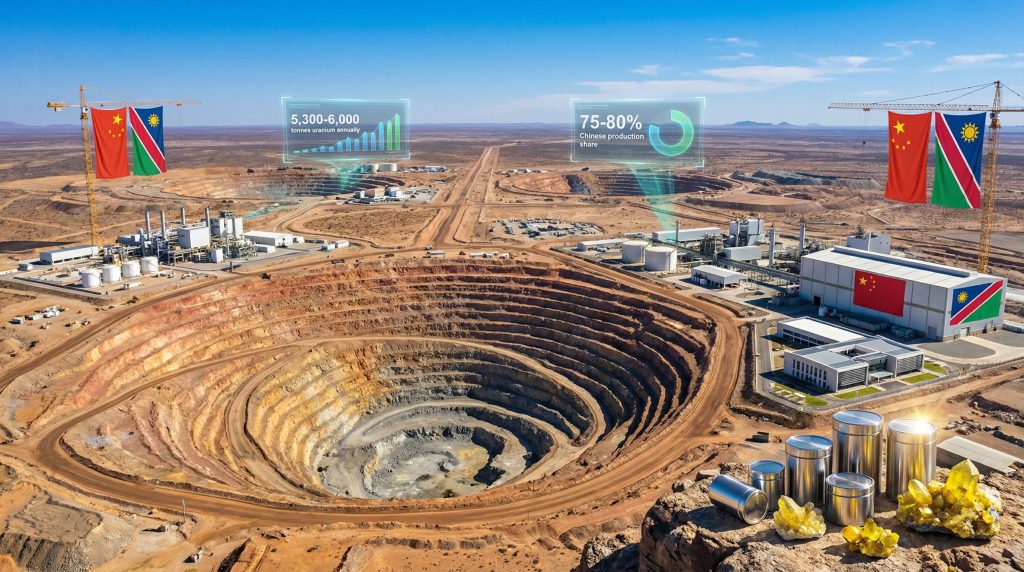
Production capacity at Husab reaches 5,300-6,000 tonnes of uranium annually, making it one of the world's largest single uranium operations. The mine's projected operational life extends beyond 20 years, providing predictable supply flows for Chinese nuclear reactor fuel requirements.
Ownership structure includes 90% Chinese control through CGN, with 10% held by Epangelo Mining, Namibia's state-owned mining company. This partnership model combines Chinese technical expertise and financing with Namibian local knowledge and regulatory compliance.
Rössing Mine Strategic Acquisition
The China National Nuclear Corporation's acquisition of majority control in the historic Rössing mine from Rio Tinto in 2018 secured access to one of the world's longest-operating uranium facilities. With over 45 years of operational history, Rössing provides technological expertise and established production systems.
Annual production from Rössing averages 1,200-1,500 tonnes of uranium, while Chinese ownership has facilitated $50+ million in technology upgrades since 2019. These investments focus on processing efficiency improvements and environmental management enhancements.
CNNC also maintains a 25% stake in the Langer Heinrich mine operated by Paladin Energy, demonstrating diversified participation across multiple Namibian uranium operations. Paladin Resources continues operating as one of the world's largest independent uranium producers, maintaining significant Namibian production capabilities.
Etango Project Partnership
The most recent development in China's investment in Namibia's uranium sector involves CNNC's partnership with Bannerman Energy for the Etango uranium project development. This joint venture structure provides CNNC with 42.75% project ownership in exchange for up to $321.5 million in development financing.
| Partnership Structure | Details |
|---|---|
| CNNC Stake | 42.75% |
| Bannerman Retention | 52.25% |
| Namibian Participation | 5% (One Economy Foundation) |
| Total Investment | $321.5 million |
| Offtake Agreement | 60% of lifetime production |
The Etango project partnership between Bannerman Energy and China's CNNC targets production of 52.6 million pounds of uranium over a mine life exceeding 15 years, equivalent to approximately 23,860 tonnes of uranium concentrate. This production scale would position Etango among Namibia's largest uranium operations upon reaching full production capacity.
CNNC's agreement includes provisions for purchasing 60% of Etango's uranium output throughout the mine's operational life, ensuring supply security for Chinese nuclear reactors while providing Bannerman with guaranteed revenue streams.
International Competition for African Uranium Resources
Investment Scale Comparisons
Chinese uranium investments in Namibia significantly exceed competing international commitments. Total Chinese investments across four major Namibian projects approach $3.5 billion, creating substantial Chinese influence over the country's uranium production capacity.
Comparative International Presence:
• Australian investments focus on 2 active projects with approximately $800 million total commitment
• European participation remains limited to $200 million in exploration and development activities
• United States involvement consists primarily of exploration agreements with minimal production investments
This investment disparity creates market concentration risks, as Chinese entities control an estimated 75-80% of Namibian uranium production through direct ownership and offtake agreements. Consequently, understanding uranium investment insights becomes crucial for international investors seeking alternative opportunities.
Strategic Approach Differences
Chinese uranium acquisition strategies differ fundamentally from Western approaches to mineral resource procurement:
Chinese Strategic Framework:
• Long-term equity partnerships providing operational control
• Integrated supply chain management from mine to reactor
• Technology transfer and operational expertise sharing
• Comprehensive offtake agreements securing production flows
Western Procurement Methods:
• Market-based purchasing through spot and term contracts
• Limited long-term equity commitments in overseas operations
• Emphasis on supply chain flexibility and multiple supplier relationships
• Focus on financial returns rather than supply security objectives
These contrasting approaches reflect different nuclear power expansion timelines and supply security priorities between Chinese and Western nuclear programs.
Geopolitical Implications of Uranium Market Concentration
Supply Chain Security Concerns
Chinese control over 75-80% of Namibian uranium production creates potential supply disruption scenarios for other nuclear-powered nations. As one of only three countries producing over 10% of global uranium, Namibia's production flows significantly influence global market dynamics.
Critical Dependencies:
• Limited alternative suppliers for high-grade uranium concentrate
• Transportation bottlenecks through single port facilities
• Potential supply restrictions during geopolitical tensions
• Price influence through concentrated market control
These dependency risks become more significant as nuclear power capacity expands globally, with 70+ reactors under construction requiring reliable uranium fuel supplies throughout their operational lifetimes. In addition, recent developments like the US Senate uranium ban have highlighted the importance of diversified supply chains.
Western Response Strategies
Recognition of uranium supply concentration risks has prompted alternative investment initiatives:
United States Initiatives:
NANO Nuclear Energy signed a memorandum of understanding with Namibia in June 2025, representing initial steps toward securing future uranium supplies for American nuclear power expansion.
Russian Competition:
Rosatom concluded agreements with Niger in July 2025 covering civil nuclear energy and uranium development, creating alternative supply relationships in West Africa.
European Diversification:
European investments in Namibian lithium projects provide mineral sector expertise that could extend to uranium operations, though current commitments remain limited.
Regional Economic Impact
China's investment in Namibia's uranium sector generates substantial economic multiplier effects throughout Namibian communities:
Employment Creation:
• Direct mining employment: 3,000+ specialised positions
• Indirect service employment: 15,000+ supporting roles
• Skills development: Technical training programmes for local workers
• Community investment: Infrastructure and social programmes
Government revenues from uranium operations exceed $200+ million annually, supporting national development programmes and infrastructure investments. These economic benefits create strong incentives for continued Chinese partnership expansion.
The next major ASX story will hit our subscribers first
How Will Market Dynamics Evolve?
Scenario 1: Continued Chinese Market Expansion
Probability Assessment: High likelihood based on current investment trends and nuclear capacity targets.
Key Supporting Factors:
• China's nuclear expansion timeline remains aggressive through 2040
• Namibian government maintains investment-friendly regulatory frameworks
• Global uranium demand growth supports project economics
• Chinese financing capabilities exceed competing international alternatives
Expected Outcomes:
• Additional Chinese acquisitions targeting remaining independent operations
• Namibian annual production capacity doubles to 12,000+ tonnes by 2030
• Chinese market share increases to 85%+ of Namibian output
• Enhanced infrastructure development including port and transportation upgrades
Scenario 2: Western Strategic Counter-Investment
Probability Assessment: Moderate likelihood dependent on policy changes and financing mechanisms.
Driving Factors:
• U.S. and European energy security concerns escalate regarding supply concentration
• Government-backed financing emerges to compete with Chinese investment capabilities
• Namibian government seeks supply diversification to reduce dependency risks
• Geopolitical tensions increase focus on strategic mineral security
Potential Outcomes:
• Increased Western mining company investments supported by government financing
• Joint Western-Namibian development projects for remaining prospects
• Market share rebalancing toward 60-65% Chinese control
• Enhanced competitive dynamics for new project developments
The broader implications of China's investment in Namibia's uranium sector extend to global critical minerals strategy considerations, as nations recognise the interconnected nature of strategic resource security.
Scenario 3: Market Disruption Events
Probability Assessment: Lower likelihood but significant impact potential.
Risk Factors:
• Regulatory changes affecting foreign investment frameworks
• Global uranium price volatility disrupting project economics
• Environmental or social opposition affecting operations
• Alternative energy technology developments reducing uranium demand
Possible Outcomes:
• Project delays or cancellations affecting production expansion plans
• Renegotiated partnership terms reducing Chinese control levels
• Increased emphasis on Chinese domestic uranium production development
• Alternative supplier development in other African regions
Investment Opportunities Beyond Chinese Operations
Emerging Project Pipeline
Despite Chinese dominance, several development opportunities remain available for international investors:
Near-Term Development Projects (2026-2028):
• Deep Yellow's Tumas project: 2,500 tonnes annual capacity targeting 2027 production start
• Lotus Resources' Kayelekera restart (Malawi): 1,500 tonnes capacity following facility upgrades
• Aura Energy's Tiris project (Mauritania): 1,000 tonnes capacity through in-situ recovery methods
Long-Term Prospects (2029+):
• 50+ active exploration licences across Namibian uranium regions
• Technology partnerships for advanced extraction methods
• Processing facility investments for value-added uranium products
• Transportation infrastructure development supporting regional operations
Strategic Partnership Models
Alternative investment structures provide entry opportunities without direct Chinese competition:
Joint Venture Frameworks:
• Technology transfer agreements combining international expertise with local operations
• Shared financing arrangements reducing individual investor risk exposure
• Offtake partnership combinations securing supply and revenue streams
• Local content requirement compliance through community partnership programmes
What Are The Industry-Specific Investment Considerations?
Uranium Market Dynamics
Uranium pricing exhibits significant volatility compared to other industrial minerals, with historical price ranges from $20-140 per pound over the past decade. This volatility stems from:
• Reactor fuel cycle timing creating periodic demand surges
• Strategic stockpiling by nuclear utilities affecting market clearing
• Supply disruption events creating temporary price spikes
• Alternative energy competition influencing long-term demand projections
Understanding these market dynamics becomes critical for investment decision-making, particularly for projects requiring 5-7 year development timelines from initial investment to production.
Geological and Technical Factors
Namibian uranium deposits benefit from open-pit mining accessibility, reducing extraction costs compared to underground operations in other regions. Typical uranium grades range from 0.02-0.05% uranium oxide, comparable to major global producers.
Technical Advantages:
• Mechanised extraction suitable for large-scale operations
• Established processing technologies proven over decades of operations
• Transportation infrastructure connecting mines to export facilities
• Skilled technical workforce developed through industry experience
Regulatory Framework Analysis
Namibian mining regulations provide transparent licensing procedures and foreign investment protections that facilitate international partnerships. Key regulatory features include:
• Joint venture requirements ensuring local participation in major projects
• Environmental compliance standards aligned with international practices
• Taxation frameworks providing predictable cost structures for long-term planning
• Export licensing procedures facilitating international uranium trade
The scale and strategic nature of Chinese uranium investment approaching N$50 billion in Namibia demonstrates the long-term commitment to securing uranium supply chains. However, this concentration creates both opportunities and risks for other international investors seeking exposure to African uranium resources.
Investment Disclaimer: The analysis presented involves forecasting and speculation about future uranium market developments, geopolitical scenarios, and investment opportunities. Readers should conduct independent research and consult qualified professionals before making investment decisions. Historical performance and projected scenarios do not guarantee future results, and uranium investments carry inherent risks including regulatory changes, market volatility, and geopolitical factors.
Further Research Opportunities:
Readers seeking additional insights into African mining investments and strategic mineral supply chains can explore specialised publications covering mining industry developments, geopolitical resource analysis, and energy transition investment themes across emerging markets.
Looking to Capitalise on Critical Mineral Discoveries?
Discovery Alert's proprietary Discovery IQ model delivers real-time notifications on significant ASX mineral discoveries, instantly empowering subscribers to identify actionable opportunities ahead of the broader market. Understand why historic discoveries can generate substantial returns by exploring major mineral finds that have transformed investor portfolios, then begin your 14-day free trial to position yourself ahead of the competition.