May 14, 2026
Strategic Ocean Floor Operations Reshape Global Mineral Dependency Patterns
The convergence of technological capability and regulatory acceleration in deep-sea mining represents a fundamental shift in how nations approach critical mineral security. As extraction technologies mature beyond experimental phases, the strategic implications extend far beyond simple resource acquisition to encompass geopolitical positioning, supply chain resilience, and economic sovereignty. Trump to speed permits for deep-sea mining in international waters represents a pivotal moment where understanding these dynamics requires examining the intersection of regulatory frameworks, technological readiness, and international competition for previously inaccessible mineral deposits.
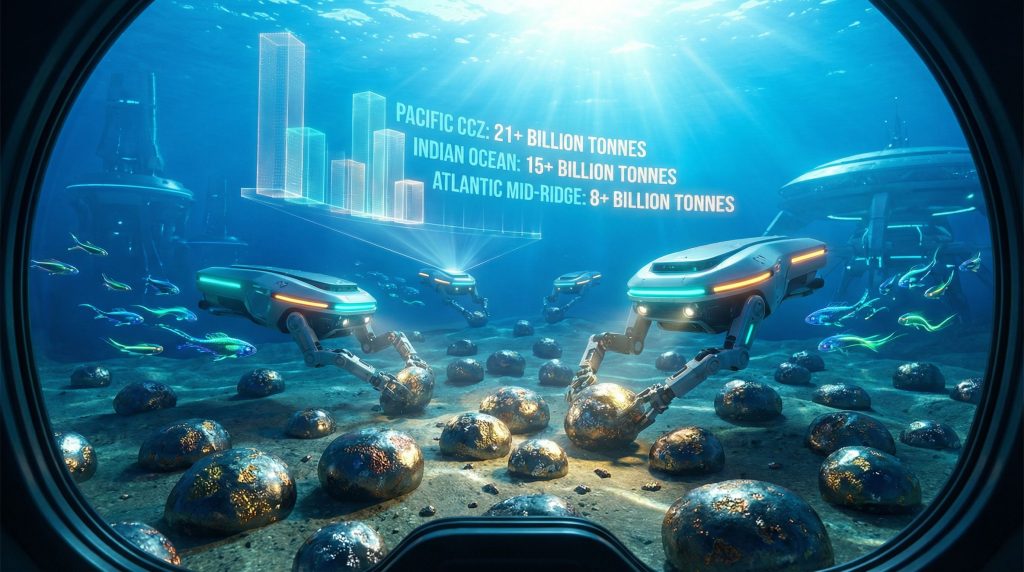
Deep-sea mining operations target polymetallic nodules containing concentrated deposits of nickel, copper, cobalt, and manganese scattered across ocean floors at depths exceeding 4,000 meters. These potato-shaped formations, accumulated over millions of years through natural precipitation processes, offer mineral concentrations often exceeding terrestrial ore grades by 200-300%. Furthermore, the strategic value becomes apparent when considering that traditional land-based mining operations face declining ore quality, increasing environmental restrictions, and growing community opposition.
When big ASX news breaks, our subscribers know first
Regulatory Framework Consolidation Accelerates Commercial Viability Timelines
The transformation of deep-sea mining from experimental concept to commercial reality hinges on regulatory certainty and streamlined approval processes. Current permitting structures involve multiple jurisdictions, overlapping authorities, and lengthy environmental review cycles that can extend project development timelines beyond investor tolerance thresholds.
Streamlined Licensing Architecture Under Federal Oversight
The National Oceanic and Atmospheric Administration now consolidates previously fragmented approval processes into unified review mechanisms. This structural change eliminates sequential licensing requirements that historically added 18-24 months to project development cycles. Companies previously navigated separate approvals for exploration licenses, environmental assessments, and operational permits through different federal agencies with varying standards and timelines.
Under the consolidated framework, permit applications undergo simultaneous technical, environmental, and regulatory review within single administrative pathways. This approach mirrors successful regulatory acceleration models used in critical infrastructure development. Moreover, this streamlined permitting process allows national security considerations to justify expedited review processes without compromising safety or environmental standards.
Critical Mineral Security Through Ocean Resource Diversification
The strategic imperative for mineral diversification becomes clear when examining current supply chain vulnerabilities. Over 60% of global cobalt production originates from the Democratic Republic of Congo, while 80% of rare earth processing occurs in China. These concentration risks create national security concerns that extend beyond economic considerations to encompass technological competitiveness and defense capabilities.
Deep-sea mining operations offer supply chain diversification that operates outside traditional geopolitical constraints. Ocean floor deposits exist in international waters beyond any single nation's direct control, though extraction rights depend on complex international frameworks and bilateral agreements. Consequently, the strategic advantage lies in accessing mineral resources without dependence on potentially unstable or adversarial nations.
Pacific Ocean Clarion-Clipperton Zone Emerges as Primary Strategic Target
The Clarion-Clipperton Zone spanning 4.5 million square kilometers between Hawaii and Mexico represents the most commercially viable deep-sea mining region currently identified. Geological surveys estimate the area contains 21 billion tonnes of polymetallic nodules with average grades of 1.3% nickel, 1.1% copper, and 0.25% cobalt.
Resource Density Analysis and Extraction Economics
Resource distribution within the Clarion-Clipperton Zone varies significantly based on geological formations, ocean current patterns, and sediment accumulation rates. The highest-grade deposits concentrate in areas where deep ocean currents intersect with seamount formations, creating ideal conditions for nodule formation over geological timescales.
Commercial viability requires minimum nodule densities of 10 kilograms per square meter to justify the capital expenditure for deep-sea extraction equipment. Premium zones within the Clarion-Clipperton area achieve densities exceeding 20 kilograms per square meter, making them priority targets for commercial development. The polymetallic nodules benefits become increasingly apparent when examining these concentration levels.
International Competition for Strategic Ocean Territories
Multiple nations have submitted exploration license applications for overlapping areas within the Clarion-Clipperton Zone, creating potential conflicts over extraction rights. Current license holders include companies affiliated with 15 different nations, each claiming rights to specific geographic areas based on International Seabed Authority guidelines.
The competitive landscape includes:
- Chinese entities controlling 5 exploration licenses covering 75,000 square kilometers
- European companies holding 7 licenses spanning 105,000 square kilometers
- Pacific island nations partnering with international miners for 4 additional licenses
- North American companies advancing 3 license applications through accelerated approval processes
International Jurisdictional Frameworks Create Complex Operational Environments
Deep-sea mining operations must navigate intricate legal frameworks that blend national sovereignty claims, international treaty obligations, and emerging regulatory precedents. The absence of comprehensive international standards creates opportunities for nations to establish favorable regulatory precedents through unilateral action.
United Nations Convention on Law of the Sea Compliance Challenges
The International Seabed Authority, established under the UN Convention on the Law of the Sea, maintains regulatory authority over mining activities in international waters beyond national jurisdiction. However, the United States has not ratified this convention, creating legal uncertainties about ISA authority over American companies and operations.
This non-ratification status provides strategic flexibility while creating potential diplomatic complications. In addition, American companies can potentially claim freedom of the high seas principles to justify mining operations without ISA approval, though such approaches risk international legal challenges and diplomatic tensions with treaty signatories. According to recent policy analysis, the Trump administration to speed up permitting for deep-sea mining operations reflects this strategic positioning.
Environmental Assessment Standards in Expedited Approval Processes
Accelerated permitting raises questions about environmental review thoroughness, particularly given limited scientific understanding of deep-sea ecosystem impacts. Current environmental assessment requirements focus on several key areas, and the deep‐sea mining controversy often centres around these very concerns.
Biodiversity Impact Modeling:
- Species population surveys in proposed mining areas
- Ecosystem disruption scenarios based on sediment dispersal patterns
- Long-term habitat recovery projections following extraction activities
- Endangered species protection compliance under existing environmental laws
Water Quality Protection Measures:
- Sediment plume containment strategies during nodule collection
- Chemical discharge monitoring from processing operations
- Deep ocean current disruption assessments
- Marine food chain impact evaluations
Economic Scenarios for Deep-Sea Mining Commercial Development
Financial modeling for deep-sea mining projects requires accounting for unprecedented capital requirements, technological risks, and volatile commodity markets. Initial investment estimates range from $2-5 billion per project, with operational costs significantly exceeding terrestrial mining equivalents due to complex deep-ocean logistics.
Capital Investment Requirements and Risk Premiums
| Cost Category | Deep-Sea Mining | Terrestrial Mining | Premium |
|---|---|---|---|
| Initial Development | $3.5 billion | $2.1 billion | 67% higher |
| Annual Operating Costs | $450 million | $275 million | 64% higher |
| Environmental Compliance | $125 million | $45 million | 178% higher |
| Technology Development | $200 million | $25 million | 700% higher |
These cost differentials reflect the technological complexity of operating at 4,000-6,000 meter depths where pressure exceeds 400 atmospheres and equipment must function in corrosive saltwater environments. Specialized vessels, remotely operated vehicles, and processing equipment require custom engineering solutions that significantly exceed standard mining equipment costs.
Market Price Volatility Considerations
Deep-sea mining project economics depend heavily on sustained high commodity prices to justify elevated capital and operating costs. Historical price analysis shows that nickel and cobalt markets experience 30-40% annual volatility, creating substantial financial risks for projects with 20-30 year payback periods.
Recent market trends favor deep-sea mining economics:
- Nickel prices increased 45% over the past two years due to electric vehicle demand
- Cobalt prices remain elevated despite supply diversification efforts
- Copper demand projections suggest 40% growth through 2030 driven by renewable energy infrastructure
- Strategic mineral premiums of 10-15% emerge for supply chain diversification
Technology Readiness and Operational Capabilities Assessment
Commercial deep-sea mining requires integration of multiple advanced technologies, from autonomous underwater vehicles to specialised processing equipment designed for marine environments. Current technology readiness varies significantly across different operational components, reflecting broader trends in mining industry evolution.
Autonomous Collection Systems and Processing Technologies
Leading deep-sea mining companies have developed collector vehicles capable of operating at 5,000-meter depths with autonomous navigation and selective nodule harvesting capabilities. These systems achieve collection rates of 200-300 tonnes per day while minimising seafloor sediment disturbance through precision targeting mechanisms.
Processing technology presents greater challenges due to the high water content and unique mineral compositions of deep-sea deposits. Current pilot operations achieve 85% mineral recovery rates compared to 92-95% recovery rates typical in terrestrial operations. Technology development focuses on improving separation efficiency while managing the corrosive marine environment.
Transportation and Logistics Infrastructure Requirements
Deep-sea mining operations require specialised vessels capable of continuous operation for 300+ days annually while maintaining precise positioning over extraction sites. Current fleet capacity limitations represent a significant bottleneck for industry scaling.
Existing mining support vessels number fewer than 50 globally, with only 12 capable of deep-sea mining support. Industry expansion requires construction of 25-30 additional vessels at costs exceeding $300 million each. Furthermore, shipyard capacity constraints suggest 5-7 year delivery timelines for new vessel orders, creating potential bottlenecks for rapid industry expansion.
The next major ASX story will hit our subscribers first
Environmental Opposition and Legal Challenge Scenarios
Environmental organisations maintain strong opposition to deep-sea mining based on ecosystem protection concerns and scientific uncertainty about long-term impacts. Legal challenges represent significant risks to project timelines and commercial viability, particularly given limited precedent for deep-sea mining litigation.
Conservation Organisation Legal Strategies
Environmental groups focus legal challenges on environmental impact assessment adequacy rather than opposing mining activities directly. This approach leverages existing environmental protection laws to require comprehensive ecosystem studies that could delay projects for multiple years.
Potential legal challenges include:
- National Environmental Policy Act compliance for federal permit approvals
- Endangered Species Act violations for operations in critical habitats
- Marine Mammal Protection Act enforcement regarding noise and disruption
- Clean Water Act applications to deep-sea discharge activities
Deep-Sea Ecosystem Impact Scientific Uncertainties
Limited scientific understanding of deep-sea ecosystems creates challenges for both environmental assessment and legal defence strategies. Recent research suggests deep-ocean biodiversity may exceed previous estimates, with new species discoveries occurring at rates of 100+ annually in deep-sea environments.
Key scientific uncertainties include:
- Species population recovery rates following mining disturbance
- Sediment plume dispersal patterns and ecosystem impacts
- Food chain disruption cascading effects through marine ecosystems
- Long-term habitat modification from large-scale extraction activities
Geopolitical Implications of Unilateral Deep-Sea Mining Expansion
American acceleration of deep-sea mining permits creates potential tensions with international partners while establishing precedents that other nations may follow. The strategic implications extend beyond resource access to encompass broader questions of international law compliance and multilateral cooperation.
Alliance Coordination and Technology Sharing Frameworks
NATO allies with advanced maritime capabilities represent natural partners for deep-sea mining technology development and operational cooperation. Norway, the United Kingdom, and Canada possess complementary expertise in offshore operations, marine engineering, and mineral processing that could enhance American deep-sea mining capabilities.
Technology sharing agreements could accelerate industry development while distributing costs and risks across multiple nations. Joint research initiatives focusing on environmental protection technologies and operational best practices could address international concerns about environmental compliance while maintaining commercial competitiveness. This collaboration aligns with broader critical minerals strategy initiatives across allied nations.
Competitive Response from Resource-Dependent Nations
China's comprehensive deep-sea mining programme includes state-sponsored research initiatives, equipment manufacturing capabilities, and international partnership agreements that position Chinese companies as significant competitors in global deep-sea mining development. Accelerated American permitting may prompt corresponding acceleration of Chinese deep-sea mining activities.
Russian Arctic seabed exploration presents additional competitive considerations, particularly given Russia's extensive Arctic continental shelf claims and developing ice-capable mining technologies. European Union regulatory harmonisation efforts aim to create unified standards for member nation deep-sea mining activities, potentially creating alternative regulatory frameworks to American approaches.
Investment Return Analysis and Risk Assessment Models
Deep-sea mining investment returns depend on successful integration of multiple high-risk factors, from technology performance to commodity price stability. Financial modelling requires scenario-based approaches that account for various operational and market outcomes.
Risk-Adjusted Return Projections Under Multiple Scenarios
| Scenario | NPV (20-year) | IRR | Risk Premium |
|---|---|---|---|
| Optimistic | $2.8 billion | 18.5% | 4.5% |
| Base Case | $1.2 billion | 12.3% | 7.2% |
| Conservative | -$450 million | 6.8% | 12.1% |
These projections assume nickel prices averaging $28,000-35,000 per tonne with cobalt prices remaining above $45,000 per tonne throughout the operational period. Sensitivity analysis shows project economics remain viable provided two of three primary commodities maintain elevated pricing above historical averages.
Technology Development Risk Premiums and Mitigation Strategies
Investors demand risk premiums of 8-12% above conventional mining projects to compensate for technology development uncertainties and operational complexity. These premiums reflect the limited operational track record for commercial-scale deep-sea mining and the potential for unforeseen technical challenges.
Risk mitigation strategies include:
- Phased development approaches with incremental capacity expansion
- Technology partnership agreements with established marine engineering companies
- Insurance coverage for specialised equipment and operational delays
- Commodity price hedging through long-term supply contracts
Commercial Timeline Scenarios and Development Pathways
Deep-sea mining commercial development timelines vary significantly based on regulatory approval speeds, technology readiness, and market conditions. Multiple scenarios require consideration due to the complex interdependencies between technical, regulatory, and market factors.
Optimistic Development Timeline (2026-2029)
Accelerated regulatory approval combined with successful technology deployment could enable commercial operations by 2028-2029 for advanced projects. This scenario requires several critical factors to align simultaneously.
Under the assumption that Trump to speed permits for deep-sea mining in international waters becomes effective policy, the following conditions must be met:
- Permit approvals within 18 months of application submission
- Successful pilot operations demonstrating commercial viability by 2027
- Favourable commodity markets supporting project financing throughout development
- Resolution of international legal challenges without significant operational delays
Under optimistic conditions, 3-5 commercial deep-sea mining operations could achieve production by 2029, generating combined annual output of 50,000-75,000 tonnes of nickel equivalent. This production level would represent approximately 3-4% of global nickel supply, creating measurable impact on mineral markets.
Conservative Implementation Timeline (2026-2035)
More realistic development scenarios account for probable delays from legal challenges, technology refinement requirements, and international diplomatic complications. Conservative timelines suggest commercial production beginning 2031-2033 with limited initial capacity.
Factors supporting conservative timelines include:
- Environmental legal challenges extending approval processes by 24-36 months
- Technology development requiring additional pilot testing and refinement
- International diplomatic pressure for compliance with ISA frameworks
- Market volatility affecting project financing and investor confidence
Recent analysis from the U.S. finalisation of deep-sea mining rules provides additional clarity on regulatory pathways that support these timeline projections.
Strategic Positioning for the Deep-Sea Mining Era
The emergence of commercial deep-sea mining represents a fundamental shift in global mineral supply dynamics that extends beyond simple resource extraction to encompass broader questions of technological leadership, environmental stewardship, and international cooperation.
Policy Coordination Requirements for Successful Implementation
Effective deep-sea mining development requires unprecedented coordination between federal agencies, international partners, and private sector stakeholders. Current regulatory frameworks lack integration mechanisms necessary for managing the complex technical, environmental, and diplomatic challenges inherent in deep-sea mining operations.
Successful implementation depends on:
- Inter-agency coordination between NOAA, State Department, and Defence Department for integrated policy development
- Congressional oversight ensuring adequate funding for regulatory infrastructure and enforcement capabilities
- International diplomatic engagement to address jurisdictional conflicts and environmental concerns
- Industry-government partnerships for technology development and operational best practices
Long-term Competitive Advantage Sustainability
Maintaining American leadership in deep-sea mining requires sustained investment in marine technology development, environmental protection capabilities, and international cooperation frameworks. The strategic advantage lies not merely in accessing deep-sea resources but in establishing technological and regulatory standards that other nations adopt.
Environmental stewardship credibility becomes crucial for long-term industry sustainability. Companies and nations that demonstrate superior environmental protection capabilities while maintaining commercial viability will likely capture larger market shares and favourable international partnerships as the industry matures.
However, the initiative to expedite permits for deep-sea mining operations reflects a broader strategic calculation about Trump to speed permits for deep-sea mining in international waters as a means of securing critical mineral supplies while potentially bypassing traditional multilateral frameworks.
Strategic Consideration: The nation that successfully balances rapid commercial development with robust environmental protection will likely dominate the emerging deep-sea mining industry for decades, as other countries adopt similar regulatory and technological frameworks proven effective in early commercial operations.
Disclaimer: This analysis contains forward-looking projections and scenarios based on current regulatory proposals and industry developments. Actual outcomes may vary significantly due to technological, regulatory, environmental, or market factors not fully predictable at present. Investment decisions should incorporate comprehensive due diligence and professional financial advice specific to individual circumstances.
Ready to Capitalise on Deep-Sea Mining Investment Opportunities?
As deep-sea mining accelerates with streamlined permitting and massive capital investments flowing into this emerging sector, identifying the right ASX-listed companies positioned to benefit becomes crucial. Discovery Alert's proprietary Discovery IQ model delivers real-time alerts on significant mineral discoveries, including those related to critical metals like nickel, cobalt, and copper that drive deep-sea mining economics, ensuring you're positioned ahead of market movements that could reshape global mineral supply chains.