
August 7, 2026
Strategic Petroleum Dynamics Facing Unprecedented Disruption
The global energy landscape stands at a critical juncture as geopolitical forces reshape fundamental assumptions about oil supply security and international investment stability. Recent developments in Latin America have triggered a comprehensive reassessment of energy strategies across major consuming nations, forcing market participants to confront scenarios that were previously considered theoretical possibilities. US intervention in Venezuelan oil represents a paradigm shift that extends far beyond traditional supply and demand fundamentals, creating vulnerability points throughout the intricate web of state-owned enterprises, international partnerships, and cross-border financing arrangements.
This transformation reveals deeper structural questions about energy independence, technological sovereignty, and the evolving balance of power in global commodity markets. As traditional alliances face stress testing through real-world disruptions, investment strategies must adapt to accommodate higher levels of uncertainty whilst maintaining exposure to critical energy assets that underpin economic stability.
When big ASX news breaks, our subscribers know first
Current Production Infrastructure Under Severe Stress
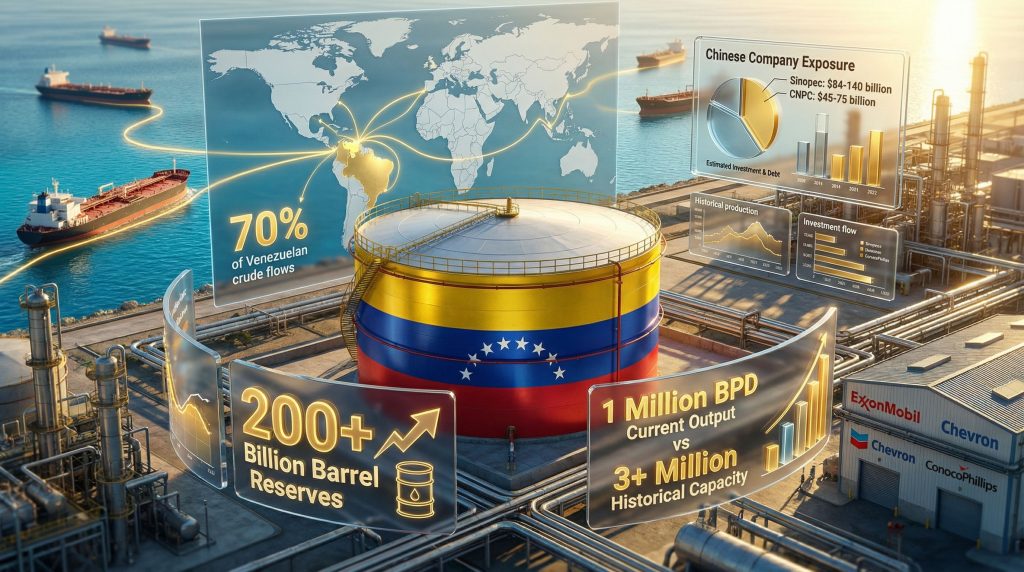
Venezuela's energy sector exemplifies the challenges facing resource-rich nations when political instability intersects with technical complexity. The country's current output of approximately one million barrels per day represents a dramatic decline from historical production levels exceeding three million barrels daily during peak periods. This reduction reflects decades of underinvestment in critical infrastructure, including refining capacity, pipeline networks, and enhanced recovery technologies that modern oil operations require.
The technical rehabilitation required extends beyond simple maintenance schedules. Comprehensive modernisation programmes demand sophisticated expertise in heavy crude processing, given Venezuela's oil characteristics that require specialised handling and refining capabilities. Industry estimates suggest that $200 billion or more would be necessary to restore full production capacity, encompassing everything from wellhead equipment to downstream processing facilities.
Furthermore, the US oil production decline analysis highlights how domestic challenges compound global supply concerns. Understanding tensions between Venezuela and the US over petroleum resources reveals the historical context underlying current developments.
Infrastructure Vulnerabilities and Recovery Timelines
The petroleum sector's recovery trajectory depends heavily on resolving fundamental operational challenges that have accumulated over extended periods. Key infrastructure elements requiring immediate attention include:
- Wellhead maintenance and rehabilitation across thousands of production sites
- Pipeline integrity programmes addressing corrosion and capacity constraints
- Refining capacity restoration for heavy crude processing requirements
- Port facilities modernisation to accommodate international shipping standards
- Power grid stabilisation supporting energy-intensive extraction operations
Conservative engineering assessments indicate that meaningful production increases require 5-7 years minimum under optimal political and economic conditions. More aggressive scenarios envision accelerated timelines of 3-5 years, contingent upon massive capital injection and unrestricted access to advanced drilling technologies.
International Investment Exposure Analysis
The scale of foreign investment at risk represents one of the largest potential asset redistributions in modern energy history. Chinese state enterprises hold the most substantial exposure, with Sinopec controlling approximately 2.8 billion barrels in entitlements and China National Petroleum Corp maintaining rights to roughly 1.5 billion barrels. These figures, derived from Wood Mackenzie analysis referenced in recent market assessments, illustrate the magnitude of potential wealth transfer.
Russian energy sector involvement, whilst smaller in absolute terms than Chinese holdings, carries significant strategic implications. Roszarubezhneft's acquisition of former Rosneft assets in 2020 positioned Russian interests as major stakeholders in Venezuelan energy development. Industry observers estimate that $30-50 billion in Russian energy investments face uncertainty under changing political arrangements.
Smaller Players with Strategic Positions
Beyond the major state enterprises, several smaller firms maintain meaningful Venezuelan exposure through production-sharing agreements. According to Oxford Institute for Energy Studies research, companies including Anhui Guangda Mining Investment Co., Anhui Erhuan Petroleum Group, and China Concord Resources Corp. have established operational partnerships with Petroleos de Venezuela SA.
Indian energy companies, notably ONGC Videsh Ltd. and Indian Oil Corp., maintain more modest but strategically important Venezuelan entitlements. These positions reflect India's broader energy security strategy of diversifying supply sources whilst maintaining flexibility in international partnerships.
Market Response Patterns and Price Discovery Mechanisms
Energy markets demonstrate remarkable sensitivity to supply disruption scenarios, particularly when involving reserves of Venezuela's magnitude. The country's 200+ billion barrel reserve base represents approximately 17% of global proven reserves, creating systemic implications that extend beyond regional considerations.
Crude oil pricing mechanisms reflect multiple uncertainty factors simultaneously. However, comprehensive analysis of WTI/Brent futures trends reveals how benchmarks incorporate not only immediate supply disruptions but also longer-term scenarios involving capacity restoration under different political frameworks.
What Drives Current Volatility Patterns and Trading Strategies?
Professional energy traders employ several strategies to navigate Venezuelan-related uncertainty:
- Geographic arbitrage opportunities emerging from Caribbean shipping disruptions
- Temporal spread trading capturing short-term volatility whilst positioning for longer-term reconstruction scenarios
- Quality differential plays leveraging heavy crude processing constraints
- Political risk hedging through specialised insurance products and derivative instruments
The insurance market has responded particularly dramatically, with coverage for Venezuelan oil tankers experiencing 300-400% premium increases according to industry sources. These cost escalations reflect both immediate operational risks and longer-term uncertainty about legal frameworks governing international shipping.
Reconstruction Scenarios and Capital Requirements
Post-intervention reconstruction presents multiple potential pathways, each with distinct implications for international investment flows and technological development. American energy companies, including ExxonMobil, Chevron, and ConocoPhillips, possess both the technical capabilities and financial resources necessary for large-scale infrastructure projects.
Conservative reconstruction scenarios envision gradual capacity building focused on rehabilitating existing fields rather than pursuing aggressive exploration programmes. This approach prioritises stability and proven reserves whilst minimising political risks associated with rapid expansion. In addition, Trump's US oil companies investment plans demonstrate the scale of potential American involvement in Venezuelan reconstruction efforts.
Aggressive development scenarios incorporate advanced recovery technologies and accelerated exploration programmes targeting Venezuela's substantial unconventional resources. These approaches require $50-100 billion in private investment but could potentially achieve 2.5+ million barrels per day production within 3-5 years.
International Consortium Development Models
Multilateral development frameworks offer potential advantages in managing political risks whilst maximising technical expertise. Consortium approaches typically involve:
- Risk distribution across multiple national interests
- Technology sharing agreements combining complementary capabilities
- Financing diversification through development banks and private markets
- Governance frameworks providing transparency and accountability mechanisms
The World Bank and Inter-American Development Bank maintain extensive experience in energy sector reconstruction programmes, offering both financial resources and institutional expertise for complex multinational projects.
Regional Geopolitical Realignment and Energy Security
Venezuela's energy sector disruption accelerates broader trends in Latin American energy integration and security cooperation. Colombia and Brazil emerge as potential alternative suppliers, leveraging existing infrastructure and established international partnerships to capture market share previously held by Venezuelan exports.
Guyana's offshore discoveries add competitive pressure through high-quality crude production that contrasts favourably with Venezuela's heavy oil characteristics. These developments reshape regional energy flows and investment priorities across the Caribbean Basin.
Strategic Petroleum Reserve Implications
Major consuming nations reassess strategic stockpile policies in light of Venezuelan supply uncertainties. The United States Strategic Petroleum Reserve faces decisions about release timing and volume to offset potential market disruptions. Similarly, China's strategic reserves programme must balance Venezuelan supply losses against broader energy security objectives.
European energy planners incorporate Venezuelan scenarios into comprehensive security assessments, particularly given the region's complex relationship with Russian energy supplies and ongoing diversification efforts. Consequently, analysis of trade war oil movements becomes increasingly relevant as geopolitical tensions reshape global energy flows.
The next major ASX story will hit our subscribers first
Technology and Innovation Acceleration Factors
Venezuelan oil characteristics demand sophisticated processing technologies that could drive innovation across the broader petroleum sector. Heavy crude enhancement techniques, including upgrading and blending strategies, become economically attractive as light crude availability faces potential constraints.
Enhanced recovery technologies gain prominence as operators seek to maximise output from existing Venezuelan fields whilst minimising new drilling requirements. These approaches include:
- Thermal recovery methods optimised for heavy crude properties
- Chemical flooding techniques improving reservoir sweep efficiency
- Digital oilfield technologies reducing operational complexity and political risks
- Modular processing units providing operational flexibility under uncertain conditions
Innovation acceleration extends beyond petroleum-specific technologies. Renewable energy investments benefit from oil market instability as governments and private investors seek alternatives that reduce exposure to geopolitical risks.
Investment Strategy Evolution and Risk Management
Energy sector investors adapt portfolio strategies to accommodate heightened political risks whilst maintaining exposure to critical commodity markets. Geographic diversification becomes essential as single-country exposures face unprecedented uncertainty levels.
Political risk insurance products experience growing demand as investors seek protection against asset nationalisation, contract modification, and operational disruptions. Specialised insurance markets develop new products addressing energy sector vulnerabilities.
Commodity Trading Adaptations
Physical oil trading operations restructure supply chains to minimise Venezuelan dependencies whilst maintaining operational flexibility. Key adaptations include:
- Alternative sourcing arrangements with Middle Eastern and African suppliers
- Transportation route diversification reducing Caribbean shipping dependencies
- Storage capacity expansion providing buffer inventory during transition periods
- Contract modification protocols incorporating enhanced force majeure provisions
Financial markets develop sophisticated instruments for hedging Venezuelan-specific risks, including customised derivatives and structured products addressing supply disruption scenarios. For instance, detailed oil price rally analysis demonstrates how markets respond to evolving geopolitical conditions.
Long-Term Energy Security Architecture
The Venezuelan situation catalyses fundamental reassessment of energy security frameworks across major consuming regions. Traditional assumptions about supply reliability and geopolitical stability face scrutiny as market participants recognise the interconnected nature of global energy systems.
Supply chain resilience becomes a critical planning factor as governments and corporations evaluate dependencies on politically unstable regions. This analysis extends beyond immediate supply considerations to encompass refining capacity, transportation infrastructure, and financial arrangements supporting international energy trade.
Climate transition policies intersect with energy security concerns in complex ways. Venezuela's massive reserves create potential conflicts between carbon reduction objectives and energy independence goals, particularly as alternative suppliers may not possess equivalent resource bases.
Market Psychology and Behavioural Factors
Energy market psychology demonstrates remarkable sensitivity to narrative changes surrounding Venezuelan developments. Investor sentiment reflects not only immediate supply concerns but also broader questions about the reliability of international investment frameworks and contract enforcement mechanisms.
Behavioural finance principles suggest that US intervention in Venezuelan oil could create persistent uncertainty even after political resolution, as market participants incorporate higher risk premiums into long-term planning assumptions. This psychological factor may delay investment recovery and extend the timeline for production normalisation.
The experience provides valuable lessons for emerging energy producers about the importance of maintaining stable investment climates and diversified partnership arrangements. Countries with significant petroleum resources observe Venezuelan developments closely, recognising potential parallels to their own situations.
Furthermore, comprehensive assessment of oil price crash impact reveals how sudden supply changes can trigger broader market disruptions affecting global economic stability.
This analysis incorporates data from Wood Mackenzie, Oxford Institute for Energy Studies, and Morgan Stanley research as reported in industry publications. Investment decisions should consider multiple scenarios and seek professional guidance given the complex and rapidly evolving nature of the situation described.
Ready to Capitalise on Energy Market Disruptions?
As global energy markets face unprecedented volatility and geopolitical reshuffling creates new investment opportunities, timing becomes critical for capturing emerging trends. Discovery Alert's proprietary Discovery IQ model delivers real-time insights on significant ASX mineral and energy discoveries, ensuring subscribers stay ahead of market-moving developments through actionable investment alerts.