
August 5, 2026
Understanding Strategic Petroleum Reserve Dynamics
Market volatility in global energy systems has prompted sophisticated nations to develop comprehensive stockpiling frameworks that serve as critical infrastructure for economic stability. China's crude stockpiling represents one of the most significant developments in strategic petroleum management, demonstrating how large-scale reserve accumulation can influence global commodity markets. Furthermore, these strategic approaches to petroleum accumulation illustrate how major economies position themselves for energy security while simultaneously affecting worldwide price dynamics.
The fundamental architecture of strategic petroleum reserves operates through complex interactions between storage capacity expansion, opportunistic purchasing strategies, and geopolitical risk management protocols. Understanding these dynamics provides insight into how major economies navigate energy security challenges during periods of market instability.
Strategic Reserve Development Fundamentals
| Component | Function | Market Impact |
|---|---|---|
| Storage Infrastructure | Physical capacity expansion | Market absorption capability |
| Price Trigger Mechanisms | Opportunistic accumulation | Price floor stabilisation |
| Geopolitical Hedging | Supply chain diversification | Diplomatic flexibility |
| Economic Optimisation | Cost-benefit calculations | Resource allocation efficiency |
When big ASX news breaks, our subscribers know first
China's Crude Stockpiling Strategy Transformation
China's petroleum reserve acceleration represents a fundamental evolution in strategic energy security planning, with implications extending throughout global commodity markets. The systematic approach to crude oil accumulation demonstrates sophisticated risk management capabilities designed to address multiple vulnerability scenarios simultaneously.
The scale of China's stockpiling operations reached unprecedented levels during 2025, with crude oil imports achieving an all-time high of 11.55 million barrels per day, representing a 4.4% increase compared to 2024 levels. December 2025 specifically recorded an average of 13.18 million bpd, establishing the highest monthly import volume in Chinese history.
Record Stockpiling Acceleration Metrics
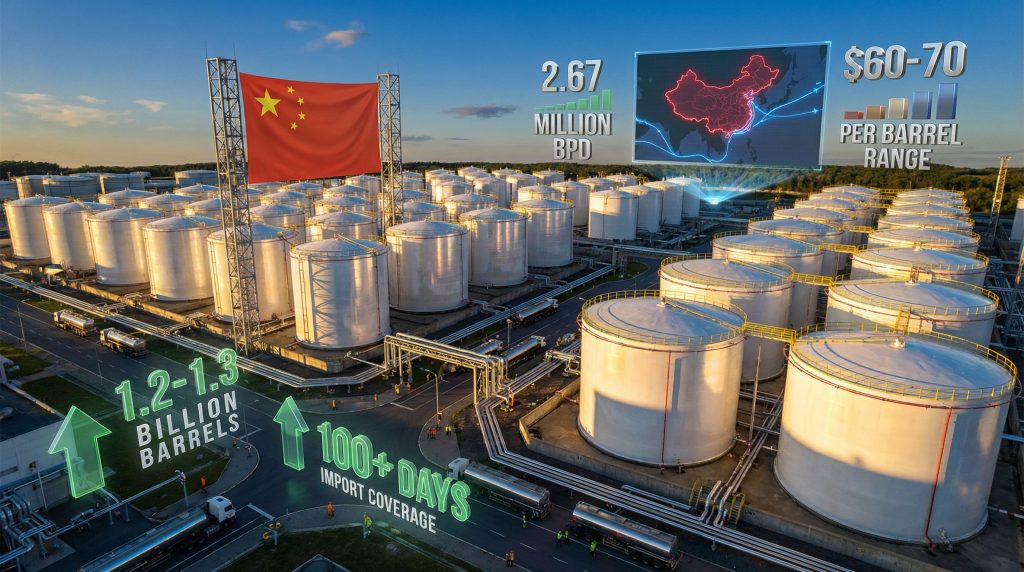
• December 2025 Stockpiling Rate: 2.67 million bpd – fastest accumulation since June 2020 pandemic period
• November 2025 Comparison: 1.88 million bpd – demonstrating significant monthly acceleration
• Strategic Timeline: Accelerated stockpiling commenced March-April 2025 during $60/barrel price stability
• Annual Import Growth: 4.4% increase to record 11.55 million bpd total
The Energy Information Administration identified this stockpiling activity as functioning as demand absorption by removing barrels from global markets. Between January and August 2025, crude oil inventories in China increased by approximately 900,000 bpd, effectively creating artificial demand during periods of supply abundance.
Technical Stockpiling Assessment Methodology
Since China does not publicly report inventory figures like the United States, analysts employ indirect calculation methods consisting of:
- Total Supply calculation (domestic production + imports)
- Refinery Processing volume subtraction
- Estimated Crude Storage differential analysis
- Strategic versus commercial reserve allocation modelling
This methodology provides insight into the proportion of imported crude being diverted to strategic reserves versus immediate processing into refined products, revealing the true scope of strategic accumulation activities.
How Storage Infrastructure Expansion Enables Market Influence
The physical infrastructure supporting China's stockpiling programme represents a massive logistical undertaking with significant implications for future market dynamics and global energy trade patterns. Consequently, this infrastructure expansion creates the foundation for more sophisticated market timing strategies.
2025-2026 Storage Capacity Development Timeline
• 2025 Additions: 32 million barrels of new operational capacity
• 2026 Planned Expansion: 94 million barrels additional onshore storage
• Maximum Utilisation Scenario: Up to 170 million barrels potential accumulation at 60% capacity utilisation
• Average Daily Impact: Nearly 500,000 bpd absorption capacity over full year
Infrastructure expansion represents a strategic enabler for timing optimisation, providing China with increased flexibility to execute purchases during optimal market windows rather than being constrained by existing capacity limitations.
The relationship between available storage capacity and stockpiling rates operates as a constraint variable, where infrastructure projects that expand storage capacity directly enable increased purchasing flexibility and volume expansion capabilities. Moreover, this enhanced capacity allows for strategic timing of major accumulation activities during favourable market conditions.
Capacity Utilisation Strategic Implications
The December 2025 record stockpiling rate of 2.67 million bpd was facilitated by the 32 million barrels of new capacity that came online during 2025. This infrastructure-enabled approach allows for strategic timing of major accumulation activities, creating the ability to capitalise on oil price movements while maintaining operational flexibility across different price environments.
Economic Drivers Behind Strategic Reserve Decisions
China's strategic stockpiling demonstrates sophisticated cost-benefit analysis incorporating multiple economic dimensions including immediate commodity costs, future price appreciation potential, and geopolitical risk mitigation value. However, the recent easing oil prices have created particularly attractive purchasing opportunities for strategic reserve managers.
Price-Sensitive Purchasing Framework
Historical analysis reveals China maintains specific price thresholds that function as purchasing decision triggers:
• Aggressive Accumulation Range: Below $70 per barrel
• Optimal Buying Window: $60-$65 per barrel range
• Reduced Activity Threshold: Above $75-$80 per barrel
• Strategic Timing: Opportunistic deployment during market weakness
International crude benchmarks stabilised at approximately $60 per barrel during 2025, a price level China apparently designated as economically attractive for strategic accumulation activities. In addition, analysts studying the oil price rally patterns have noted China's consistent buying behaviour during price dips.
Economic Decoupling from Immediate Demand
The separation between crude import volumes and refinery processing rates demonstrates that strategic stockpiling decisions operate according to geopolitical and commodity price parameters. Furthermore, China increased crude oil imports to record levels during 2025 despite weak transportation fuel demand and economic challenges.
Strategic Cost Optimisation Analysis
| Price Range | Stockpiling Activity | Strategic Rationale |
|---|---|---|
| Below $60 | Maximum accumulation | Extreme value opportunity |
| $60-$70 | Aggressive building | Favourable economics |
| $70-$80 | Moderate activity | Balanced approach |
| Above $80 | Minimal stockpiling | Cost prohibitive |
Market Stabilisation Mechanisms and Global Impact
China's role functions not as traditional demand growth, but rather as what analysts characterise as the oil market's shock absorber. China's crude oil hoarding has proven particularly effective at moderating price volatility and supporting crude prices during periods of supply uncertainty.
Global Supply Absorption Capacity
Projections indicate a global crude oil surplus of 1.8 million bpd for 2026, with Chinese stockpiling at anticipated rates positioned to absorb a significant portion of this excess supply. Since April 2025, China's crude stockpiling maintained international oil prices within the $60-$70 per barrel range, despite significant pressures from trade uncertainties and economic concerns.
Price Floor Support Mechanisms
The purchasing behaviour during periods of price weakness creates a supportive mechanism that prevents sharp price declines despite oversupply conditions. This stabilisation effect operates through several channels:
- Direct Market Absorption: Physical removal of excess supply
- Psychological Price Support: Market confidence in sustained demand
- Volatility Dampening: Reduced price swing amplitude
- Supply Chain Stability: Predictable demand patterns for producers
Regional Price Differential Impacts
China's strategic purchases create localised demand variations that influence regional crude pricing structures. Consequently, these purchases particularly affect Middle Eastern and Russian crude grades, creating premium opportunities for suppliers during accumulation periods.
Supply Chain Diversification and Geopolitical Strategy
China maintains crude oil imports from multiple sources including OPEC+ members, as well as sanctioned suppliers including Russia, Iran, and Venezuela. These sanctioned sources represent approximately 15% of total crude imports from these suppliers combined during supply disruption scenarios.
Strategic Supplier Portfolio Management
The reserve programme enables China to maintain relationships with sanctioned suppliers while reducing immediate dependency risks. However, the OPEC production impact remains a significant consideration in strategic planning decisions.
• Diversified Source Base: Multiple supplier relationships maintained
• Sanction Resilience: Reduced vulnerability to supply disruptions
• Diplomatic Flexibility: Enhanced negotiation positioning
• Economic Leverage: Market influence through purchasing power
Uncertainties around sanctioned barrels, especially in the latter half of 2025, formed part of China's increased crude accumulation strategy. In addition to other factors including new storage capacity launch, opportunistic buying at favourable prices, and government mandates to refill strategic reserves.
The next major ASX story will hit our subscribers first
Future Market Dynamics and 2026 Projections
China's stockbuilding will continue functioning as a critical pillar of global oil demand dynamics throughout 2026. Furthermore, energy market analysis firms expect it to remain a key market stabiliser, particularly as analysts continue monitoring potential oil price crash analysis scenarios.
2026 Stockpiling Projections and Market Impact
• Conservative Scenario: 500,000 bpd average accumulation rate
• Base Case Projection: 750,000 bpd sustained building activity
• Maximum Potential: 1.0+ million bpd during optimal price windows
• Infrastructure Support: Additional 94 million barrels storage coming online
If storage capacity utilisation reaches approximately 60% efficiency, China could theoretically add up to 170 million barrels of crude oil stocks during 2026. This would be equivalent to nearly 500,000 bpd averaged over the full year period.
Market Stabilisation Continuation Framework
This stockpiling capacity would help absorb a large portion of the projected 1.8 million bpd surplus forecast for 2026. Moreover, Reuters analysis suggests this could provide continued price floor support and market stability during potentially volatile conditions.
China may not be driving demand growth in the traditional sense, but in 2026, it could once again act as the oil market's shock absorber, providing stability during uncertain market conditions.
Amid uncertainties around heavy sour crude supply from Venezuela and other geopolitical developments, strategic stockpiling becomes increasingly important for market stability.
Strategic Reserve Infrastructure Development
The expansion of storage infrastructure represents more than simple capacity increases; it establishes strategic capabilities for enhanced market timing and operational flexibility. Furthermore, this infrastructure development provides the foundation for long-term energy security planning.
Underground Storage Development Potential
Beyond the documented onshore expansion, underground storage facility development offers additional long-term capacity expansion possibilities. These developments could potentially add another 200 million barrels of strategic storage capability over extended development timelines.
Geographic Distribution Strategic Considerations
Storage facility geographic distribution across China enhances supply chain resilience and reduces vulnerability to regional disruptions. In addition, this optimises logistics for different crude oil sources and transportation networks.
Investment and Economic Implications
The capital allocation toward strategic petroleum infrastructure represents significant economic commitment to energy security. However, this demonstrates sophisticated understanding of long-term risk management value versus immediate costs.
Infrastructure Investment Returns Analysis
Strategic storage infrastructure provides multiple return mechanisms:
- Risk Mitigation Value: Protection against supply disruption costs
- Market Timing Benefits: Ability to capitalise on favourable pricing
- Geopolitical Flexibility: Enhanced diplomatic positioning
- Economic Stability: Reduced energy price volatility impacts
The investment in storage capacity enables strategic petroleum stockpiling that functions as both defensive economic insurance and opportunistic capital deployment during market weakness periods.
Global Energy Security Paradigm Implications
China's comprehensive stockpiling strategy establishes new benchmarks for energy security planning. Consequently, this may influence policy development across other major energy-importing nations and regions.
Competitive Strategic Reserve Response Considerations
Other major economies may need to reassess their own strategic reserve policies in response to China's expanded capacity. This could potentially lead to increased competition for crude oil supplies during favourable market conditions.
Supply Chain Resilience Model Development
The Chinese approach demonstrates how large-scale strategic reserves can provide both economic and diplomatic leverage. Furthermore, this may influence global energy trade patterns and international alliance structures in energy security planning.
China's crude stockpiling programme represents sophisticated energy security planning that simultaneously serves economic, strategic, and diplomatic objectives through systematic market participation. The programme's continued evolution will likely influence global energy trade patterns, supply chain strategies, and strategic reserve policies worldwide, establishing new standards for energy security planning in an increasingly complex geopolitical environment.
Want to Identify Strategic Commodity Investment Opportunities?
Discovery Alert's proprietary Discovery IQ model delivers real-time alerts on significant ASX mineral discoveries, helping investors identify actionable opportunities in strategic commodities before the broader market reacts. Just as China strategically accumulates crude oil during favourable price windows, savvy investors can position themselves ahead of major mineral discoveries by beginning their 14-day free trial today and securing their market-leading advantage.