
July 21, 2026
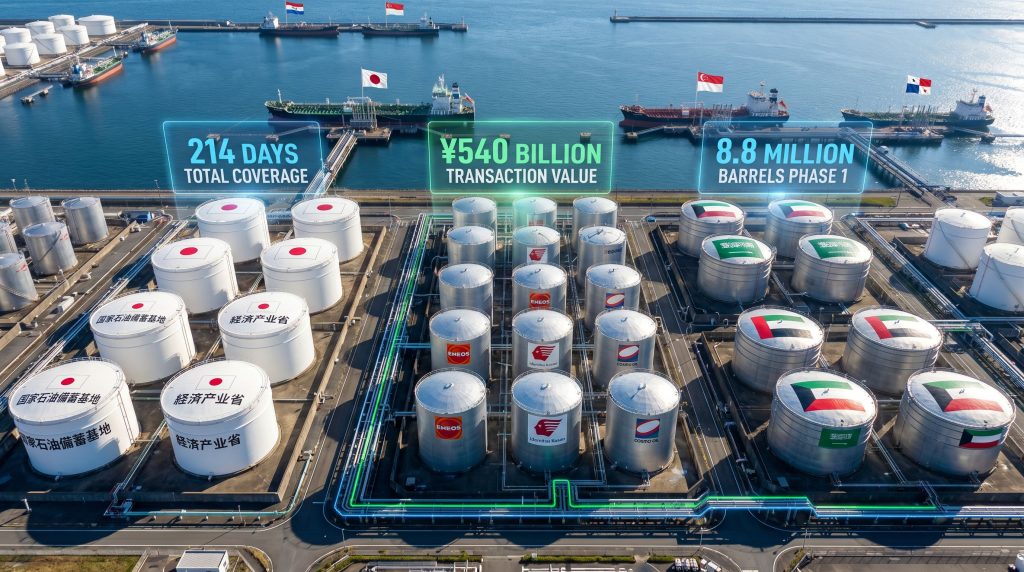
Strategic Petroleum Reserve Architecture and Energy Security Fundamentals
Strategic petroleum reserves represent a cornerstone of national energy security policy, designed to provide buffer capacity during supply disruptions and price volatility periods. These systems operate through carefully structured frameworks that balance emergency preparedness with operational efficiency, particularly as nations navigate the complex landscape of energy security transition.
Japan's strategic reserve system exemplifies sophisticated multi-tier architecture, comprising 214 days of total oil coverage as documented in April 2026 data. This comprehensive stockpile structure includes:
• 131 days of national government reserves held directly by state agencies
• 81 days of private sector mandatory stockpiles maintained by refiners and distributors
• 3 days of bilateral joint reserves through producer nation partnerships
The three-tier approach provides administrative flexibility unavailable in single-tier systems used by other nations. Private sector reserves offer immediate deployment capability through regulatory mandate adjustments, while national stockpiles provide sustained release capacity during extended disruptions.
Storage Infrastructure Distribution
Japan's reserve infrastructure spans more than 10 major storage facilities strategically distributed across the archipelago. The Shibushi National Petroleum Stockpiling Base in southern Japan serves as the primary release facility, supported by nine additional storage centers that enable geographic redundancy and logistics distribution.
This distributed approach prevents single-point bottlenecks during emergency drawdowns while providing regional supply security. The facility network underwent operational testing during the 2026 Middle East crisis, demonstrating the effectiveness of staggered release protocols.
Regulatory Framework Fundamentals
Strategic reserve deployment operates through defined regulatory triggers that distinguish between automatic and discretionary release mechanisms. Automatic triggers typically activate when supply disruptions exceed specific percentage thresholds of total imports, while discretionary releases address price volatility and geopolitical risk considerations.
The regulatory structure establishes clear protocols for reserve access, pricing methodologies, and allocation procedures that maintain market stability during deployment periods.
When big ASX news breaks, our subscribers know first
Crisis Response Coordination and International Emergency Protocols
International crisis response mechanisms rely on coordinated frameworks developed through organisations like the International Energy Agency (IEA) to address large-scale supply disruptions. The 2026 Middle East crisis demonstrated how geopolitical events trigger multilateral reserve deployment protocols.
Timeline of 2026 Crisis Response
The escalation from initial conflict to coordinated international response followed a rapid timeline:
• March 2026: IEA collective emergency action agreement initiated
• March 16, 2026: Japan's private sector reserve mandate reduced by 15 days
• March 26, 2026: National reserve drawdowns commenced
• April 23, 2026: Lebanon ceasefire extended by three weeks
• May 1, 2026: Second phase national reserve releases initiated
Geopolitical Risk Assessment Indicators
The Strait of Hormuz closure represented a critical supply chokepoint disruption affecting global oil transit. Maritime interdiction operations by US forces, including the boarding of vessels carrying Iranian oil, created uncertainty that triggered multiple national reserve releases simultaneously.
Iranian counter-responses, including the seizure of two MSC-owned container ships in the Strait of Hormuz, demonstrated the escalatory dynamics that influence reserve deployment decisions. The approximately 300-mile US naval blockade between the Pakistan-Iran border and Oman effectively redirected global shipping patterns.
Energy Market Price Response
Brent crude prices reached all-time highs in late March and early April 2026 following the effective closure of the Strait of Hormuz. However, the subsequent price easing in late April suggested that coordinated reserve releases from multiple nations provided measurable market stabilisation effects, contributing to a broader oil price rally.
The disruption to approximately 20% of global liquefied natural gas supply from Middle East Gulf sources created additional energy security concerns that influenced broader policy responses across multiple fuel categories.
Japan's Phased Oil Reserve Release Implementation Strategy
Japan to release oil reserves involved a carefully orchestrated multi-phase release strategy designed to provide sustained market supply while preserving longer-term reserve capacity. This approach demonstrated sophisticated crisis management protocols.
| Release Phase | Volume (Million Barrels) | Duration | Start Date | Source Category | Status |
|---|---|---|---|---|---|
| Phase 1 | 8.8 | 15 days | March 16, 2026 | Private sector mandate | Completed |
| Phase 2 | 53 | 30 days | March 26, 2026 | National stockpiles | Ongoing |
| Phase 3 | 36 | 20 days | May 1, 2026 | Additional national reserves | Scheduled |
| Bilateral Access | 8.8 | 5 days | March 2026 | Joint reserves | Deployed |
Pricing and Market Integration Mechanisms
Phase 3 operations involved ¥540 billion ($3.4 billion) in total transaction value, with pricing determined through a sophisticated methodology that referenced February 2026 official selling prices adjusted for Brent crude price movements between February and March.
This formula-based approach insulated transaction pricing from real-time volatility while incorporating recent market movement signals. Furthermore, it provided predictability for both government treasury management and refiner procurement planning.
Refiner Allocation and Distribution
Four major domestic refiners received Phase 3 allocations:
• Eneos (Japan's largest refining operation)
• Idemitsu Kosan (integrated energy company)
• Cosmo Oil (operates 214,000 barrels/day Chiba refinery)
• Taiyo Oil (regional refining capacity)
The allocation methodology distributed supply across Japan's refining network to prevent regional shortages whilst maintaining operational efficiency across different facility capacities.
Geographic Release Sequence
The staggered facility release protocol began with Shibushi National Petroleum Stockpiling Base on May 1, 2026, followed by sequential releases from nine additional storage facilities. This approach distributed logistics burden across infrastructure networks while preventing single-point distribution bottlenecks.
Bilateral Energy Partnerships and Diplomatic Reserve Arrangements
Bilateral reserve agreements enhance energy security through diplomatic frameworks that provide Japanese companies priority access to stored oil during emergencies whilst serving commercial purposes during stable periods.
Confirmed Bilateral Partnership Structure
Japan maintains strategic reserve cooperation agreements with three key Middle East producers:
• Saudi Arabia: Strategic reserve cooperation framework
• United Arab Emirates: Bilateral energy partnership agreements
• Kuwait: Joint storage arrangement protocols
These partnerships contributed 3 days' worth of oil reserves (approximately 8.8 million barrels) that were deployed during the March 2026 crisis response. Consequently, this demonstrated operational bilateral access protocols.
Dual-Use Protocol Framework
The bilateral arrangements operate through two distinct access categories:
- Emergency Access Protocols: Prioritised Japanese company access during supply disruptions
- Commercial Operations: Normal-period supply arrangements during market stability
This dual-use structure enables reserves to serve both strategic security functions and commercial revenue generation for producer nations, potentially enhancing long-term agreement sustainability.
Supply Diversification Implementation
Japanese energy policy explicitly targets reduction in Strait of Hormuz transit dependency through alternative sourcing strategies. The first delivery of US West Texas Intermediate crude procured after the US-Iran conflict commenced arrived at Keiyo Sea Berth, Chiba Prefecture on April 26, 2026.
This 910,000 barrel WTI shipment to Cosmo Oil's 214,000 barrels/day Chiba refinery represented a strategic pivot toward North American crude supplies. For instance, this shift occurred as Middle East Gulf access remained constrained due to ongoing regional tensions.
Economic Impact Assessment of Large-Scale Reserve Deployments
Strategic reserve releases generate complex economic effects that extend beyond immediate supply stabilisation to influence refining margins, government revenues, and broader energy market dynamics.
Market Stabilisation Effects
The coordinated international reserve releases during the 2026 crisis contributed to measurable crude price easing from all-time highs reached in late March and early April. European refining margins, which had turned negative during peak price periods, rebounded into positive territory as crude supply availability improved.
The incoming supply from US Strategic Petroleum Reserve releases to European markets, offered at approximately $5/barrel premiums to North Sea Dated on a delivered basis, pressured prices for local crude grades. In addition, this improved refinery profitability prospects.
Fiscal Policy Considerations
Government revenue from reserve sales provides fiscal benefits that partially offset emergency response costs. Japan's Phase 3 release generated ¥540 billion in sales proceeds, contributing to treasury resources whilst providing refiner cost relief during elevated market pricing.
The pricing methodology using February reference prices with Brent adjustment factors created predictable government revenue streams. However, it maintained market-responsive pricing for refiners.
Supply Chain Impact Mitigation
Reserve releases addressed multiple supply chain vulnerabilities beyond crude oil availability. The disruption to approximately 20% of global LNG supply from Middle East Gulf sources created cascading effects across energy markets that strategic petroleum reserves helped stabilise.
Regional energy security partnerships and alternative procurement strategies reduced dependency concentration risks. Furthermore, these measures maintained industrial fuel supply continuity amidst global trade tensions.
International Reserve Release Comparison and Coordination Frameworks
Global strategic reserve deployment during the 2026 crisis involved multiple nations implementing coordinated release strategies through established international frameworks.
US Strategic Petroleum Reserve Operations
The United States released approximately 26 million barrels of crude from strategic reserves, with trading companies including Vitol, Trafigura, Shell, and Mercuria receiving allocations. The US supplies included both sour Bryan Mound crude and less sulfurous West Hackberry Sweet grades.
US crude reached European markets at competitive pricing that influenced regional crude grade valuations. Norwegian medium sour Johan Sverdrup offers declined from previous levels, while Mediterranean grades including Libyan Es Sider and Algerian Saharan Blend experienced significant price pressure.
Policy Effectiveness Metrics
The coordination between multiple nations' reserve releases demonstrated enhanced effectiveness compared to unilateral deployments. Key performance indicators included:
• Price volatility reduction: Measurable stabilisation following coordinated releases
• Supply security enhancement: Maintained refinery operations during transit disruptions
• International cooperation success: Synchronised deployment across multiple nations
• Market confidence restoration: Reduced speculation and panic purchasing
Emergency Response Protocol Evolution
The 2026 crisis response revealed opportunities for enhanced coordination mechanisms, particularly regarding:
- Release timing synchronisation across different national frameworks
- Volume coordination to optimise market impact without oversupply
- Communication protocols for market transparency and speculation reduction
- Replenishment planning coordination to prevent secondary market disruptions
The next major ASX story will hit our subscribers first
Long-Term Energy Security Policy Framework Development
Strategic reserve management faces evolving challenges as energy transition policies, geopolitical risk patterns, and technology capabilities reshape traditional energy security frameworks.
Reserve Adequacy Assessment Evolution
Traditional reserve sizing methodologies based on import replacement duration require updating to address:
• Alternative energy integration with petroleum-based reserve systems
• Critical mineral stockpiling for renewable energy infrastructure
• Grid storage technology coordination with traditional reserves
• Climate resilience planning for storage facility vulnerability
Infrastructure Modernisation Requirements
Current storage infrastructure faces ageing challenges that require systematic modernisation planning. Storage facility age, corrosion management protocols, and redundancy systems need evaluation against extended service life requirements.
The technical integration of rapid deployment systems with modern automated inventory management represents an opportunity to enhance response capability. Consequently, this could reduce operational costs.
Energy Transition Security Integration
As nations advance renewable energy deployment, strategic reserve frameworks must adapt to support hybrid energy systems that combine traditional petroleum reserves with renewable energy storage and critical mineral stockpiles.
The coordination between fossil fuel reserves and renewable energy infrastructure creates new policy complexities that require integrated planning approaches. Moreover, the US oil production decline adds further complexity to global energy security considerations.
Investment and Policy Interpretation Framework for Market Participants
Strategic reserve deployments create investment opportunities and risks that require systematic analysis for energy market participants and policymakers.
Energy Infrastructure Investment Implications
Reserve release operations highlight several investment themes:
• Storage infrastructure modernisation opportunities in both traditional and alternative energy systems
• Refining sector capacity utilisation optimisation during supply disruption periods
• Alternative energy acceleration drivers from supply security concerns
• Transportation infrastructure adaptability for multiple fuel types and supply routes
Market Psychology and Risk Assessment
The 2026 crisis demonstrated how geopolitical risk pricing in energy markets can create both threats and opportunities for market participants. Understanding reserve deployment protocols helps investors assess:
- Crisis duration estimation through reserve capacity analysis
- Government intervention likelihood based on established trigger mechanisms
- Market stabilisation timeline using historical deployment effectiveness data
- Recovery trajectory planning through replenishment strategy evaluation
Policy Framework Integration Strategies
Effective energy security policy requires balancing multiple objectives:
• Economic efficiency versus emergency preparedness capacity
• International cooperation benefits against national autonomy concerns
• Climate transition objectives with traditional energy security requirements
• Private sector coordination whilst maintaining government strategic control
Long-term Strategic Planning Considerations
Energy security policy development must address evolving threat landscapes whilst maintaining operational effectiveness. Key planning elements include:
- Technology integration for enhanced deployment capability
- International coordination framework enhancement
- Climate adaptation for storage infrastructure resilience
- Economic transition support during energy system transformation
Furthermore, understanding the OPEC production impact remains crucial for long-term strategic planning.
Strategic Reserve Management: Key Operational Questions
How long can Japan to release oil reserves sustain complete supply disruption?
Japan to release oil reserves represents a capacity that significantly exceeds International Energy Agency minimum requirements, providing substantial buffer capacity during extended disruptions. The multi-tier structure enables flexible deployment across different crisis scenarios.
What determines automatic versus discretionary reserve releases?
Automatic triggers typically activate when supply disruptions exceed specific percentage thresholds. However, discretionary releases address price volatility and geopolitical risk assessments that require policy judgment rather than mechanical responses.
How do bilateral reserves with producer nations function operationally?
Bilateral agreements provide Japanese companies priority access to stored oil during emergencies whilst serving commercial purposes during normal operations. Consequently, this creates mutual benefit structures that enhance agreement sustainability.
What replenishment strategies follow reserve depletion?
Replenishment typically involves market purchases during price stability periods, spread over 12-18 months to avoid market disruption. Furthermore, this approach rebuilds strategic capacity for future emergencies through systematic market engagement.
According to Japan's Energy Agency, the coordinated release strategy demonstrates enhanced international cooperation in energy security management.
Disclaimer: This analysis is based on publicly available information and should not be considered as investment advice. Energy markets involve significant risks, and reserve policy effectiveness can vary based on crisis duration and international coordination factors. Readers should consult qualified professionals for specific investment and policy decisions.
Looking for Your Next Energy Investment Opportunity?
Discovery Alert's proprietary Discovery IQ model delivers real-time alerts on significant ASX mineral discoveries, instantly empowering subscribers to identify actionable opportunities ahead of the broader market. Begin your 14-day free trial today and secure your market-leading advantage.