
August 5, 2026
The Shrinking Safety Net: Understanding America's Oil Reserve Crisis at a Four-Decade Low
Energy security frameworks are only as strong as the physical buffers underpinning them. For decades, the United States built its strategic energy posture around a simple premise: maintain enough crude oil in reserve to absorb a major supply disruption without triggering economic crisis. That buffer is now at its most threadbare point since the early 1980s, raising urgent questions about resilience, replenishment, and the real cost of deploying emergency stockpiles as an active policy instrument rather than a last resort.
The US Strategic Petroleum Reserve lowest level since 1983 is not just a headline statistic. It is a structural signal about how American energy security has been reshaped by consecutive crises, political decisions, and the growing tension between short-term market intervention and long-term strategic preparedness. Furthermore, understanding this development requires context around crude oil market dynamics that have been shifting significantly in recent years.
When big ASX news breaks, our subscribers know first
What the Strategic Petroleum Reserve Actually Is and How It Works
The SPR was born from crisis. Following the 1973 Arab oil embargo, which exposed the United States as dangerously dependent on imported crude with no meaningful buffer against supply interruptions, Congress passed the Energy Policy and Conservation Act in 1975, authorising the creation of the world's largest emergency petroleum stockpile.
The physical infrastructure is unusual: crude oil is stored not in above-ground tanks, but inside naturally occurring and artificially enlarged salt caverns along the Gulf Coast of Texas and Louisiana. The four primary sites — Bryan Mound, Big Hill, West Hackberry, and Bayou Choctaw — collectively hold an authorised capacity of 713.5 million barrels. Salt cavern storage is ideal for crude oil because salt is essentially impermeable, does not react with hydrocarbons, and allows vast quantities of oil to be stored at low maintenance cost relative to surface facilities.
Drawdown operations work by injecting fresh water into a cavern to displace the oil upward into pipelines. Injection works in reverse: crude is pumped in as the brine is discharged. This cycle means the SPR is not a passive warehouse but an active component of U.S. energy infrastructure, capable of releasing up to 4.4 million barrels per day at maximum drawdown rate under emergency conditions.
By the Numbers: The Depth of the Current Depletion
The data paints a stark picture of how significantly the reserve has been drawn down over recent years.
| Metric | Value |
|---|---|
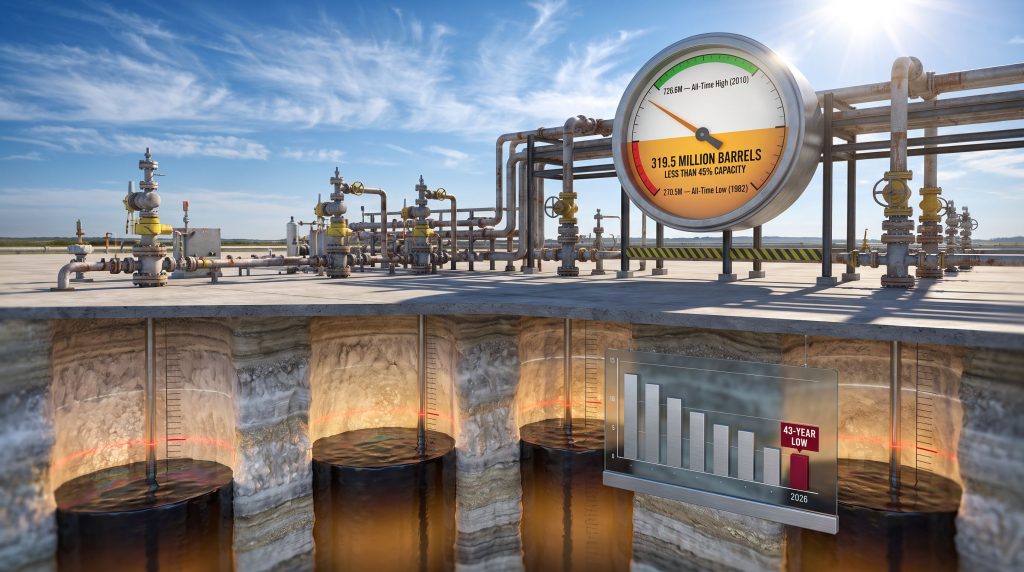
| SPR Level (Week Ending July 3, 2026) | 319.5 million barrels |
| SPR Level (Week Ending July 10, 2026) | 316.5 million barrels |
| All-Time High (2010) | 726.6 million barrels |
| Decline From Peak | Approximately 56% below all-time high |
| Previous Biden-Era Low (July 2023) | 346.8 million barrels |
| Total SPR Drawdown Since February 2026 | 98.9 million barrels (as of July 10, 2026) |
| Combined U.S. Crude Inventories (SPR + Commercial, as of July 3) | 730.8 million barrels, lowest since 1984 |
| Authorised SPR Capacity | 713.5 million barrels |
| Current Fill Rate vs. Authorised Capacity | Less than 45% |
| All-Time SPR Low (August 1982) | 270.5 million barrels |
As of July 10, 2026, according to Department of Energy data reported by Reuters, SPR inventories have fallen to 316.5 million barrels, a decline of approximately 3 million barrels in a single week. This marks the lowest inventory level since April 1983. Combined commercial and SPR crude stocks sat at 730.8 million barrels as of July 3, the weakest combined reading since 1984.
How the 2026 Drawdown Ranks Historically
To understand the significance of the current depletion, it helps to compare it against the three major SPR release events on record:
| Release Event | Barrels Released | Primary Driver | SPR Level Post-Event |
|---|---|---|---|
| 2011 Libya Crisis | ~30 million barrels | IEA coordinated release | Remained above 695M barrels |
| 2022 Ukraine War | ~180 million barrels | Global energy price crisis | Fell to 346.8M barrels (July 2023) |
| 2026 Iran Conflict | 172M barrels authorised | Strait of Hormuz closure | 316.5M barrels (July 10, 2026) |
The 2026 drawdown is the second largest in SPR history by authorised volume and is on track to become the most consequential in terms of the reserve's remaining buffer capacity.
The Geopolitical Trigger: How the U.S.-Iran Conflict Forced Emergency Reserves Into Action
The immediate driver of the current depletion is the military conflict between the United States and Iran, which began at the end of February 2026. The closure of the Strait of Hormuz, through which approximately 20% of the world's tradeable oil normally passes, created an immediate and severe supply shock that could not be absorbed by market mechanisms alone.
The Trump administration responded by authorising the release of 172 million barrels from the SPR to compensate for the lost import flow and stabilise domestic fuel prices. Since the conflict began, SPR inventories have fallen by 98.9 million barrels as of July 10, 2026, with commercial crude stocks falling simultaneously to produce a combined drawdown of 123.9 million barrels since late February.
The simultaneity of both SPR and commercial stock declines is particularly significant. Typically, commercial inventories and strategic reserves move in different directions during supply shocks, as market participants draw down commercial stocks while the government supplements supply from the SPR. When both fall together, it indicates that total crude availability within the domestic system is under genuine stress, not merely a reallocation between storage categories.
This situation is further complicated by OPEC's market influence, which has added additional layers of complexity to an already strained global supply environment. In addition, the broader oil price shock experienced across North America has underscored how interconnected these pressures truly are.
A Historical Perspective: What April 1983 Can Teach Us About 2026
The last time SPR inventories sat at comparable levels, the reserve was still in its infancy, actively being filled toward its operational capacity following the second oil crisis of 1979. Today's figure reflects the opposite trajectory: a reserve that was nearly full being drawn down at wartime pace.
This distinction matters enormously for interpreting the risk. In 1982 and 1983, a low SPR reading was a transitional condition on the path toward energy security. In 2026, the same numerical range represents a depletion from a position of relative strength, with no immediate prospect of rapid replenishment.
The 1973 embargo that created the SPR cost the U.S. economy an estimated $600 billion in 2023 dollars in output losses over its duration. The SPR was designed specifically so that no future administration would face that choice unarmed. The degree to which that buffer has been consumed raises legitimate questions about whether the reserve's original mandate has been compromised.
The Replenishment Problem: Energy Secretary Wright's 200-Million-Barrel Target
Energy Secretary Chris Wright has publicly stated a target of replenishing 200 million barrels into the SPR. The practical challenge is substantial.
Step-by-Step: How SPR Replenishment Actually Works
-
Congressional Budget Authorisation — Funding must be approved to purchase crude on the open market, a politically contested process even in non-crisis conditions.
-
DOE Competitive Tender Process — The Department of Energy issues formal solicitations to domestic and international producers; this process typically takes weeks to months.
-
Pipeline and Marine Delivery — Crude must be physically transported to Gulf Coast terminal infrastructure, which has finite throughput capacity.
-
Salt Cavern Injection — Oil is pumped into storage caverns as brine is displaced; injection rates are bounded by cavern engineering and pipeline capacity.
-
EIA Inventory Verification — The Energy Information Administration confirms barrel counts via weekly petroleum status reports, providing public transparency.
-
Market Timing Constraints — Large government purchases in a tight supply environment risk pushing crude prices higher, creating a feedback loop where buying to replenish the reserve directly inflates the cost of doing so.
Under realistic purchasing conditions, refilling 200 million barrels would likely take between two and four years. If crude prices remain elevated due to ongoing supply disruptions, the fiscal cost of replenishment would substantially exceed the revenues generated by the original drawdown sales, representing a net loss to the U.S. Treasury on the transaction.
This is not a theoretical concern. The Biden administration sold SPR crude in 2022 at prices ranging from approximately $85 to $95 per barrel. Any repurchase at current geopolitically elevated prices could cost materially more per barrel, compounding the strategic cost of the drawdown with a fiscal one.
The next major ASX story will hit our subscribers first
Global Reserve Comparisons: How the U.S. Stacks Up
The SPR depletion also has implications for America's standing within the international emergency reserves framework managed by the International Energy Agency (IEA).
| Country / Bloc | Estimated Strategic Reserve | Coverage Standard |
|---|---|---|
| United States | ~316.5 million barrels (July 2026) | ~25 days of net imports |
| China | ~220 to 280 million barrels (estimated) | Undisclosed |
| European Union (IEA Members) | Combined ~1.2 billion barrels | 90-day net import standard |
| Japan | ~300 million barrels | 90-day IEA obligation |
| South Korea | ~97 million barrels | 90-day IEA obligation |
IEA member countries are obligated to maintain reserves equivalent to 90 days of net oil imports. At current levels, the United States holds roughly 25 days of net import coverage from the SPR alone, well below the IEA standard. This gap is partially offset by commercial inventories and domestic production capacity, but it represents a meaningful reduction in the strategic cushion the U.S. can offer both domestically and to allied nations in a coordinated IEA release scenario.
Market Implications and Three Scenarios for the SPR Through End of 2026
For crude oil markets, a structurally depleted SPR changes the risk calculus in ways that go beyond current prices. When the reserve is full, oil markets can price in the implicit government put: the knowledge that a major supply shock will be met with reserve releases that cap the upside in crude prices. With the SPR below 45% of authorised capacity, that put has diminished purchasing power.
WTI crude price volatility historically increases during periods when SPR inventories fall below 350 million barrels, as the market begins to factor in the reduced intervention capacity of the U.S. government. Upstream producers, oilfield services companies, and energy infrastructure operators tend to benefit from this dynamic, as tighter physical supply buffers support higher realised prices and stronger drilling economics. Consequently, trade war oil prices have added yet another variable into an already volatile pricing environment.
Three plausible trajectories exist for the SPR through the remainder of 2026:
Scenario A: Conflict Resolution and Controlled Replenishment
The Strait of Hormuz reopens, authorised releases are halted, and the DOE begins a systematic buyback programme. SPR stabilises near 300 million barrels by the fourth quarter of 2026, with a multi-year replenishment programme following.
Scenario B: Prolonged Conflict and Continued Drawdown
Releases continue through the third quarter, pushing the SPR toward the 270 to 280 million barrel range and approaching the August 1982 all-time low of 270.5 million barrels. This scenario would represent an unprecedented wartime depletion of a strategic reserve originally built to prevent exactly this kind of vulnerability.
Scenario C: Multilateral IEA Coordinated Action
Allied nations jointly release reserves to supplement U.S. drawdowns, reducing pressure on the SPR but accelerating depletion across the global emergency reserve system simultaneously, potentially creating a synchronised vulnerability across multiple major economies.
The Structural Dilemma at the Heart of U.S. Energy Policy
The SPR's diminished state in 2026 reflects a broader and unresolved tension in American energy policy: whether strategic reserves should be preserved exclusively for genuine supply emergencies, or whether they represent a legitimate tool for price management and geopolitical signalling in less acute situations.
The 2022 Ukraine War release, at 180 million barrels, was the largest single coordinated release in SPR history and was at least partially motivated by domestic fuel price concerns rather than a physical supply emergency. That decision left the reserve at its lowest modern level before the 2026 conflict began, meaning the U.S. entered the Iran crisis with a diminished buffer from the outset.
With the SPR now holding less than half its authorised capacity, and combined domestic crude inventories at their lowest point since 1984, the United States faces a structurally reduced ability to use reserve releases as either a diplomatic instrument or a market stabilisation mechanism going forward. Understanding oil's role in the global economy makes it clear why rebuilding that capacity will require sustained political will, favourable market conditions, and several years of patient accumulation. The cost of the current drawdown, measured not just in barrels but in strategic optionality, will be felt long after the immediate conflict subsides.
Disclaimer: This article is intended for informational purposes only and does not constitute financial, investment, or commodity trading advice. Forward-looking scenarios involve inherent uncertainty and should not be relied upon as predictions of future market conditions. Readers are encouraged to consult the U.S. Energy Information Administration's weekly petroleum status reports, available through the Department of Energy's public data portal, for the most current SPR inventory figures. Additional reporting is available via Reuters at Reuters.com.
Want to Stay Ahead of the Next Major Resource Discovery Driven by Energy Market Shifts?
As geopolitical tensions reshape global commodity markets and energy security concerns intensify, Discovery Alert's proprietary Discovery IQ model scans ASX announcements in real time, delivering instant alerts on significant mineral discoveries across over 30 commodities — turning complex market signals into actionable investment opportunities. Explore Discovery Alert's dedicated discoveries page to understand how historic mineral discoveries have generated substantial returns, and begin your 14-day free trial today to position yourself ahead of the broader market.