August 9, 2026
America's Emergency Oil Buffer Is Running Dry
The United States built the Strategic Petroleum Reserve as an institutional insurance policy against the kind of supply shocks that crippled the American economy in the 1970s. For decades, that insurance policy sat largely intact, its salt dome caverns along the Gulf Coast holding hundreds of millions of barrels as a quiet guarantee of energy continuity. Today, however, that guarantee looks considerably less certain.
After a sequence of large-scale drawdowns spanning two administrations, the SPR is tracking toward its lowest inventory level since 1982, a generational erosion of strategic capacity that has taken place against a backdrop of geopolitical instability, Congressional budget constraints, and a global fuel market under acute stress. With U.S. retail gasoline prices surpassing $4.50 per gallon for the first time since July 2022, the Trump administration is now exploring an unconventional solution: drilling under military bases to refill the Strategic Petroleum Reserve using crude oil produced directly from federally controlled subsurface resources.
When big ASX news breaks, our subscribers know first
How the SPR Reached a 40-Year Low
The Strategic Petroleum Reserve was established through the Energy Policy and Conservation Act of 1975, a legislative response to the 1973 Arab oil embargo that exposed the structural vulnerability of U.S. energy markets to geopolitical supply disruptions. The reserve was engineered with a total storage capacity of 714 million barrels, distributed across four Gulf Coast salt dome storage facilities: Bryan Mound and Big Hill in Texas, and West Hackberry and Bayou Choctaw in Louisiana.
Salt dome caverns were chosen for a specific geological reason. These naturally occurring formations, created when ancient seabed salt deposits were forced upward through overlying rock by pressure differentials, provide chemically stable, structurally robust storage chambers that can hold crude oil under pressure for extended periods with minimal risk of contamination or loss. The Gulf Coast's concentration of salt dome geology made it uniquely suited to this role.
The reserve's depletion was not caused by a single decision but by a compounding sequence of emergency interventions across multiple administrations. Furthermore, the crude oil price trends in global markets have added additional pressure to these decisions:
-
The Biden administration authorised a historically large release to counteract fuel price surges triggered by Russia's 2022 invasion of Ukraine, representing the largest peacetime drawdown in the reserve's operating history.
-
The Trump administration subsequently ordered a 172-million-barrel release structured as an exchange agreement to address soaring energy prices amplified by the conflict with Iran and the near-closure of the Strait of Hormuz.
-
The Biden administration's refilling effort, initiated after the initial drawdown, was halted when available Congressional funding was exhausted before meaningful replenishment could be achieved.
-
The SPR is now approaching inventory levels not recorded since 1982, meaning the buffer designed to provide approximately 90 days of import cover during supply disruptions has been materially compromised.
The near-closure of the Strait of Hormuz has intensified the urgency. This critical maritime chokepoint carries approximately 20% of global oil supply, and any significant disruption to its throughput creates precisely the kind of supply shock the SPR was architected to absorb. A reserve operating near 40-year lows has substantially reduced capacity to perform that function. In addition, the trade war impact on oil prices has further complicated the government's ability to manage these pressures effectively.
The SPR's current vulnerability reflects not a single policy failure but a compounding series of emergency responses, incomplete replenishment cycles, and Congressional budget constraints that collectively degraded a strategic asset built to last generations. (World Oil, May 2026)
What Drilling Under Military Bases Actually Means
The phrase drilling under military bases to refill the Strategic Petroleum Reserve can create a misleading mental image. The concept does not involve drilling rigs positioned inside secure base perimeters or operational disruption to military functions. It refers instead to accessing subsurface geological formations that happen to exist beneath federally controlled defence land, using drilling technology that can locate wellheads and surface infrastructure at locations entirely outside sensitive operational areas.
The Technology That Makes This Possible
Modern directional and horizontal drilling techniques have fundamentally transformed the relationship between surface location and subsurface access. A wellbore initiated at a surface point outside a base perimeter can be steered gradually through the subsurface to reach target formations positioned laterally beneath defence installations, sometimes extending one to three miles from the vertical projection of the surface wellhead.
Horizontal drilling extends this capability further, transitioning the wellbore from a vertical to near-horizontal trajectory within the target formation and maximising the contact length between the wellbore and the oil-bearing rock. A single surface location can therefore access subsurface resources across a substantial subsurface footprint, minimising surface disruption whilst maximising subsurface recovery.
The Scale of What Lies Beneath Federal Land
A 2025 analysis by the U.S. Geological Survey quantified the potential resource base beneath collectively managed federal land, producing figures that reframe the scale of the opportunity:
| Resource Type | Estimated Volume | Comparative Context |
|---|---|---|
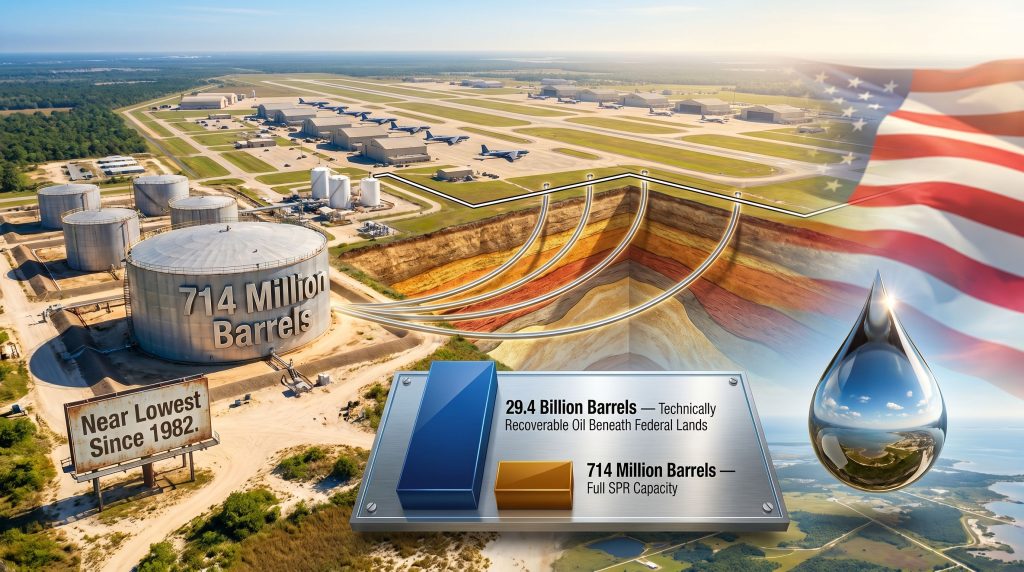
| Technically Recoverable Oil | 29.4 billion barrels (Bbbl) | Approx. 41x the SPR's total storage capacity |
| Natural Gas | 391 trillion cubic feet (Tcf) | Among the largest identified federal resource bases |
| SPR Full Capacity | 714 million barrels | Current level approaching 1982 low |
The 29.4 Bbbl estimate encompasses property controlled by the Department of Defense, the Interior Department, and other federal agencies collectively. Not all of this resource sits beneath military installations specifically, but the scale establishes that federal subsurface resources represent a potentially transformative strategic asset if even a fraction were actively developed.
To put the proportionality in perspective: the entire SPR at maximum capacity holds 714 million barrels. The technically recoverable oil beneath federal lands is estimated at approximately 41 times that figure. A development programme targeting even a small percentage of accessible defence-land resources could fundamentally alter the government's long-term reserve replenishment arithmetic.
Barksdale Air Force Base: The Precedent That Changes the Conversation
For those inclined to treat the idea of drilling under military installations as radical or untested, the history of Barksdale Air Force Base in Louisiana provides a corrective. Oil and gas leasing arrangements at Barksdale have operated for several decades, establishing that subsurface resource extraction and active military operations are not mutually exclusive.
In September 2025, the Trump administration formalised this precedent by auctioning subsurface drilling rights covering nearly 2,000 acres of Barksdale property. The significance of this transaction extends beyond its acreage. Barksdale is one of only two U.S. Air Force installations that host B-52 Stratofortress strategic bombers, aircraft central to the American nuclear deterrent posture. The auction of drilling rights beneath a facility of this strategic sensitivity demonstrates that the operational compatibility between military function and subsurface resource development is both legally established and functionally validated.
Barksdale Air Force Base has hosted oil and gas leasing for decades whilst simultaneously operating as a frontline strategic bomber installation, providing the clearest available evidence that subsurface resource extraction and sensitive military operations can coexist under appropriate institutional frameworks. (World Oil, May 2026)
What Makes This Different From Previous Barksdale Leasing
The critical distinction between historical Barksdale leasing and the current initiative lies in the intended destination of produced crude. Prior lease arrangements directed production to private market participants and generated revenue for the federal government as a land management outcome. The initiative under examination would, however, redirect produced crude directly into SPR storage, allowing the government to accumulate reserves without market purchases, bypassing the Congressional appropriations process that has repeatedly stalled replenishment efforts.
The Strategic Logic: Bypassing the Budget Constraint
Understanding why the Trump administration is exploring drilling under military bases to refill the Strategic Petroleum Reserve requires understanding the structural flaw in the existing replenishment model. Consequently, OPEC's influence on oil markets and the US oil production decline have made domestic strategic alternatives increasingly attractive to policymakers.
The conventional pathway to SPR refilling involves open-market crude purchases: the federal government allocates Congressional appropriations, purchases crude from private producers at prevailing market prices, and injects that crude into reserve storage. This model has two fundamental vulnerabilities:
-
Congressional willingness to appropriate funds: The billions of dollars required for meaningful replenishment require legislative authorisation, and Congress has demonstrated reluctance to commit that capital.
-
Market price exposure: Purchases made at elevated prices, as would be the case during or following supply disruptions, maximise the fiscal cost of replenishment at precisely the moment budget pressure is highest.
Producing crude from federally controlled subsurface resources addresses both vulnerabilities simultaneously. If the government owns the subsurface resource and conducts extraction operations, it can accumulate reserve crude at production cost rather than market price, and may be able to structure the programme in ways that reduce dependence on standard Congressional appropriations processes.
The Exchange Agreement Mechanism
The most recent 172-million-barrel release was structured as an exchange agreement rather than a conventional drawdown. Under exchange mechanics, the government transfers crude to market participants who are contractually obligated to return a greater volume at a specified future date, effectively functioning as a collateralised loan of strategic crude.
The terms of the current exchange are expected to yield approximately 200 million barrels in return, representing a 20% premium on the original 172-million-barrel release. This means the government will receive roughly 28 million additional barrels above the volume it released, within approximately one year. However, even with this built-in premium, the exchange mechanism addresses only a fraction of total replenishment needs:
| Replenishment Pathway | Volume | Timeline | Congressional Approval |
|---|---|---|---|
| Exchange agreement returns | ~200 million bbl | Within ~1 year | Not required |
| Open-market crude purchases | Variable | Immediate to short-term | Required (appropriations) |
| Drilling on federal/defence land | Multi-year programme | 3-7+ years | Potentially limited |
| Private sector lease revenue | Indirect | Medium-term | Partial |
National Security as a Budgetary Reframing
The Trump administration's decision to publicly categorise SPR replenishment as a national security imperative rather than an energy market management exercise carries meaningful institutional implications. Energy Secretary Chris Wright communicated at a Wall Street Journal forum that the administration intended to pursue pragmatic approaches to energy resources under federal control and that creative mechanisms were needed to restore reserve levels.
Wright specifically referenced military bases and federal facilities positioned within oil-producing geological regions where subsurface resources remain undeveloped despite their proximity and identifiability. Framing reserve replenishment as a defence matter potentially positions the initiative within budgetary and regulatory frameworks that are distinct from conventional energy procurement processes, though no formal determination on specific mechanisms has been publicly confirmed.
Operational Realities: What the Timeline Actually Looks Like
Any assessment of drilling under military bases to refill the Strategic Petroleum Reserve must account for the gap between strategic intent and operational delivery. Drilling programmes of this nature are not short-duration interventions. Furthermore, an oil price rally in the near term would not accelerate these timelines in any meaningful way.
The sequential requirements for any development programme on federal defence land include:
-
Site selection and geological assessment of candidate formations beneath qualifying installations
-
Environmental baseline studies and regulatory review under applicable federal environmental statutes
-
Permitting and authorisation from the Department of Defense, Department of Energy, and potentially other agencies
-
Wellbore design, procurement, and spud of directional wells targeting subsurface formations
-
Drilling, completion, and well testing to confirm commercial productivity
-
Surface facility construction and pipeline tie-in to connect production to SPR storage infrastructure
-
Ramp-up to meaningful production volumes as additional wells are drilled and brought online
This sequence, even under favourable regulatory and logistical conditions, typically spans multiple years before production volumes become strategically meaningful. As a result, this initiative should be understood as a long-duration strategic asset development programme, not a mechanism for addressing the current price environment or near-term supply tightness. The administration's own commentary acknowledged this, noting the initiative is unlikely to have any immediate impact on energy prices.
The next major ASX story will hit our subscribers first
Unknowns, Gaps, and What Has Not Been Decided
As of the time of reporting, the administration has not publicly identified any Department of Defense installations beyond Barksdale as candidates for subsurface development under this programme. No formal feasibility assessments, geological targeting criteria, or priority site lists have been publicly released. The Energy Department did not respond to requests for comment on the initiative's scope or status.
What has been confirmed publicly:
-
The initiative is under active study and consideration within the administration
-
No final decision has been made to proceed with a formal drilling programme
-
The Barksdale September 2025 auction established the most recent operational precedent
-
Energy Secretary Wright's comments at the Wall Street Journal forum represented the highest-profile public acknowledgement of the concept
The programme therefore remains in an exploratory assessment phase, with its ultimate scope, site selection, and implementation architecture yet to be determined. Consequently, analysts tracking crude oil price trends are watching closely to understand how this policy direction might eventually reshape domestic supply dynamics.
The Bigger Picture: Federal Subsurface Resources as Strategic Assets
The most consequential implication of this initiative may not be its direct impact on SPR inventory levels, but the conceptual shift it represents in how the U.S. government thinks about federally controlled subsurface resources.
For decades, oil and gas resources beneath federal lands have been managed primarily as revenue-generating assets, with leasing proceeds flowing to Treasury. The proposed reorientation treats these resources not as fiscal instruments but as sovereign strategic reserves, comparable in function to the SPR itself but geologically distributed across the federal land base rather than concentrated in four Gulf Coast storage facilities.
If the 29.4 Bbbl of technically recoverable oil beneath federal lands were reconceptualised in these terms, the United States would possess one of the largest government-controlled petroleum endowments of any country, without requiring a single barrel to be purchased on the open market. Even partial mobilisation of a fraction of accessible defence-land resources across a multi-decade development horizon could fundamentally alter the government's energy security calculus.
That reconceptualisation, more than any specific drilling programme, may represent the lasting significance of the Trump administration's exploration of military base subsurface drilling.
Frequently Asked Questions
What is the Strategic Petroleum Reserve and why does it need refilling?
The SPR is the world's largest government-controlled emergency oil stockpile, stored in salt dome caverns along the U.S. Gulf Coast with a total capacity of 714 million barrels. A combination of large-scale emergency releases under two administrations and incomplete replenishment cycles has reduced inventory to levels approaching a 40-year low, degrading the buffer capacity the reserve was designed to provide.
Is it legal to drill for oil beneath U.S. military bases?
Yes. Subsurface oil and gas leasing on defence-controlled land has legal precedent, most notably at Barksdale Air Force Base in Louisiana where such arrangements have existed for several decades. The legal and regulatory framework for subsurface leasing beneath federal defence property is established; the current question is one of policy prioritisation rather than legal authorisation.
Will this lower gasoline prices in the near term?
No. Development programmes of this nature require multi-year timelines before production reaches meaningful volumes. The initiative is a long-duration strategic reserve restoration mechanism, not a short-term consumer price relief tool. Other policy instruments would be required to address near-term price pressures.
How much oil exists beneath federal lands?
A 2025 U.S. Geological Survey analysis estimated approximately 29.4 billion barrels of technically recoverable oil beneath federal lands collectively, alongside 391 trillion cubic feet of natural gas. This estimate covers land controlled by multiple federal agencies, including but not limited to the Department of Defense.
How does the exchange agreement work?
Under an exchange agreement, the government releases crude oil from the SPR to private market participants who are contractually obligated to return a larger volume at a specified future date. The most recent 172-million-barrel release is structured to return approximately 200 million barrels, a built-in premium of roughly 20% over the original release volume, within approximately one year. For further context on how filling the Strategic Petroleum Reserve works, the U.S. Department of Energy provides detailed guidance on the mechanisms involved.
Has a decision been made to proceed with military-base drilling?
No. As of the reporting date, no formal decision has been announced. The initiative remains in an exploratory study phase, with no confirmed list of target installations beyond Barksdale and no public release of feasibility assessments or implementation timelines.
Key Takeaways
-
The SPR is approaching its lowest inventory level since 1982, driven by compounding emergency drawdowns and failed replenishment efforts across multiple administrations.
-
The proposal to pursue drilling under military bases to refill the Strategic Petroleum Reserve is under active administration study, though no final decision has been made.
-
Barksdale Air Force Base, which has hosted oil and gas leasing for several decades, provides an established legal and operational template for subsurface development beneath active defence installations.
-
A 2025 USGS analysis identified 29.4 Bbbl of technically recoverable oil beneath federal lands, approximately 41 times the SPR's total storage capacity.
-
The exchange agreement covering the most recent 172-million-barrel release is expected to return approximately 200 million barrels within one year, a 20% premium, but falls well short of full reserve restoration.
-
This initiative is best understood as a multi-year strategic reserve restoration programme, not a near-term energy price intervention.
-
The deeper significance may be conceptual: a shift toward treating federal subsurface resources as sovereign strategic assets rather than purely revenue-generating land management instruments.
Disclaimer: This article is intended for informational purposes only and does not constitute financial, investment, or energy policy advice. Figures related to subsurface resource volumes represent technically recoverable estimates and are subject to revision based on geological assessment, market conditions, and regulatory determinations. The initiative described remains in an exploratory phase with no confirmed implementation timeline or final decision. Readers should consult primary government sources and qualified energy professionals for decisions based on the information presented.
Want to Stay Ahead of the Next Major Resource Discovery?
While governments grapple with strategic petroleum reserves and long-term energy security, Discovery Alert's proprietary Discovery IQ model scans ASX announcements in real time, instantly identifying significant mineral discoveries across more than 30 commodities before the broader market reacts. Explore how major resource discoveries have historically generated substantial returns on Discovery Alert's dedicated discoveries page, and begin your 14-day free trial today to position yourself ahead of the next transformative find.