
August 14, 2026
Strategic Portfolio Transitions in Modern Mining
The contemporary mining sector faces unprecedented pressure to realign strategic priorities amid evolving energy landscapes and capital allocation demands. Furthermore, the mining industry evolution increasingly confronts complex decisions about which assets drive long-term value creation versus those requiring divestment to optimise operational focus. These strategic inflection points often reveal the intricate relationship between operational performance, market timing, and transaction execution in ways that traditional financial models struggle to capture.
When big ASX news breaks, our subscribers know first
Understanding Transaction Complexity in Major Mining Deals
The collapse of major mining transactions frequently stems from operational disruptions that activate sophisticated risk allocation mechanisms built into acquisition agreements. Material Adverse Change provisions serve as critical circuit breakers, protecting acquiring parties when unexpected events fundamentally alter asset performance or continuity assumptions underlying transaction valuations.
In the case of the Anglo American coal sale Australia, the Moranbah North incident exemplifies how safety protocols can trigger contractual protections even when no permanent damage occurs to underlying ore bodies. Carbon monoxide detection systems that necessitate mine suspension represent exactly the type of operational volatility that sophisticated Material Adverse Change clauses are designed to address.
Key MAC Triggers in Mining Transactions:
• Production capacity disruptions affecting output projections
• Regulatory compliance issues impacting operational permits
• Environmental incidents requiring significant remediation
• Safety events necessitating extended operational suspension
• Market condition changes fundamentally altering economics
This legal framework reflects the inherent unpredictability of extractive operations, where geological conditions, equipment failures, and regulatory requirements can rapidly shift transaction fundamentals. Moreover, effective investment risk management becomes crucial when navigating these complex deal structures.
Queensland Coal Asset Strategic Positioning
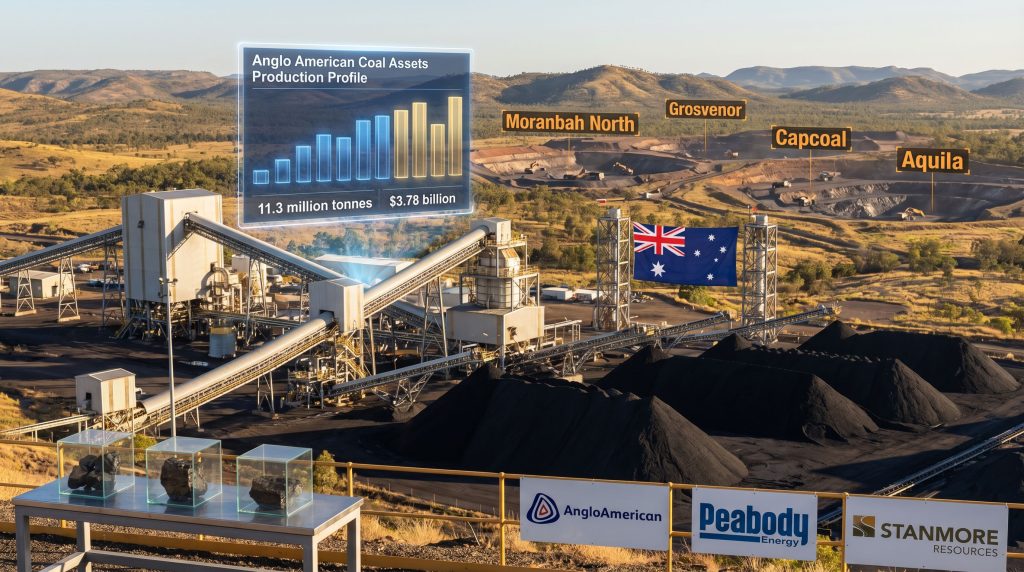
Anglo American's Australian metallurgical coal operations represent premium assets within the global coking coal supply chain, positioned strategically to serve Asian steel production centres. The portfolio encompasses four high-grade operations in Queensland's Bowen Basin, collectively targeting 11.3 million tonnes of annual production by 2026.
Anglo American Queensland Coal Operations Profile:
| Mine | 2026 Production Target | Coal Grade | Primary Markets |
|---|---|---|---|
| Moranbah North | 5.3 million tonnes | Premium Hard Coking | Japan, South Korea |
| Grosvenor | 3.2 million tonnes | Hard Coking | China, India |
| Capcoal | 1.8 million tonnes | Semi-Hard Coking | Southeast Asia |
| Aquila | 1.0 million tonnes | PCI/Thermal | Regional Markets |
The strategic value of these assets extends beyond production capacity to encompass established infrastructure connectivity. This includes dedicated rail access to coastal shipping terminals and long-term customer relationships with major Asian steel producers. This infrastructure integration creates significant barriers to entry for competitors whilst ensuring reliable market access.
Premium hard coking coal from operations like Moranbah North commands price premiums due to superior metallurgical properties essential for high-quality steel production. These characteristics include optimal carbon content, low ash percentages, and superior coking behaviour that Asian steel mills specifically require for blast furnace operations.
Capital Allocation Strategy and Energy Transition Priorities
Anglo American's divestment approach reflects broader industry recalibration toward minerals essential for energy infrastructure transformation. Consequently, the company's strategic reallocation emphasises copper expansion for electrification networks, platinum group metals for hydrogen economy development, and iron ore optimisation for steel sector decarbonisation.
This transition represents more than environmental positioning – it constitutes fundamental portfolio optimisation based on long-term demand projections and capital efficiency requirements. The critical minerals energy transition drives copper demand forecasts suggesting sustained growth from electric vehicle adoption and renewable energy infrastructure, whilst platinum group metals face increasing demand from fuel cell technologies and industrial catalysis applications.
Strategic Reallocation Framework:
• Copper Operations: Expanded production capacity targeting electrification infrastructure demand
• Platinum Group Metals: Enhanced focus on hydrogen economy applications
• Iron Ore: Optimisation for steel industry decarbonisation requirements
• Coal Assets: Strategic divestment aligned with portfolio transformation
The failed Peabody transaction complicates this strategic timeline but doesn't alter fundamental restructuring logic. Alternative execution pathways may emerge, including staged asset sales, joint venture partnerships, or alternative buyer structures that accommodate operational risk concerns. The critical minerals strategy continues to drive corporate decision-making despite transaction setbacks.
Potential Acquirer Analysis and Market Dynamics
Several strategic buyers have expressed interest in the Anglo American coal sale Australia portfolio, each bringing distinct competitive advantages and acquisition rationale. Stanmore Resources represents domestic Australian expansion potential but faces market capitalisation constraints relative to transaction scale requirements.
Mitsubishi Corporation offers established Asian steel industry relationships and superior financial capacity for major acquisitions. Their vertical integration strategy would secure strategic coking coal supplies for Japanese steel production whilst expanding global market presence.
BUMA Internasional brings Indonesian mining expertise and regional Asian market access, positioning potential acquisition within broader Southeast Asian resource development strategies. Their operational experience in similar geological conditions could facilitate integration efficiencies.
Competitive Metallurgical Coal Landscape:
| Producer | Annual Capacity | Geographic Focus | Strategic Position |
|---|---|---|---|
| BHP Mitsubishi Alliance | 45 million tonnes | Asia-Pacific | Dominant Market Leader |
| Glencore | 35 million tonnes | Global Distribution | Integrated Trading Platform |
| Teck Resources | 25 million tonnes | Asia/Europe | Premium Quality Focus |
| Anglo American | 11.3 million tonnes | Asian Markets | Divestment Candidate |
Market concentration within metallurgical coal production creates strategic imperatives for both existing producers seeking scale expansion and steel industry participants pursuing supply chain security. In addition, the broader mining industry consolidation trend influences buyer behaviour and valuation expectations.
Operational Risk Assessment and Valuation Implications
How do safety incidents impact mining transaction valuations?
The Moranbah North incident introduces complex valuation considerations that extend beyond immediate production disruption. Safety-related mine suspensions create uncertainty regarding restart timelines, additional compliance requirements, and potential regulatory scrutiny affecting future operational parameters.
Insurance coverage for operational disruptions varies significantly across mining operations. This includes specific exclusions for certain incident types and coverage limits that may not fully compensate for extended production delays. Sophisticated buyers typically conduct extensive due diligence on insurance structures and operational risk management protocols.
Risk Premium Factors:
• Production Continuity: Uncertainty during operational restart phases
• Insurance Coverage: Adequacy for future operational disruption scenarios
• Regulatory Environment: Enhanced scrutiny following safety incidents
• Market Timing: Commodity price volatility affecting transaction economics
Alternative transaction structures may emerge to address these complexities. These include staged acquisition milestones tied to operational performance, joint venture arrangements distributing risk exposure, or contingent consideration mechanisms linking payments to production resumption success.
The next major ASX story will hit our subscribers first
Asian Steel Industry Supply Chain Implications
The delayed divestment affects strategic planning for major Asian steel producers who rely heavily on Australian premium coking coal supplies. Japanese steel companies, including Nippon Steel and JFE Holdings, maintain long-term supply agreements that provide stability but require backup sourcing strategies when operational disruptions occur.
South Korean steel giants like POSCO face similar supply security considerations. This is particularly relevant given their expanding production capacity and quality requirements for premium steel grades serving automotive and shipbuilding industries.
Regional Supply Security Assessment:
• Japan: Diversification requirements for strategic resource security
• South Korea: Enhanced focus on long-term contract stability mechanisms
• China: Opportunity for domestic coking coal producer capacity expansion
• India: Growing import dependency amid domestic production constraints
Chinese steel production, whilst increasingly focused on domestic coal sources, still requires premium Australian coking coal for specific steel grades. This creates ongoing demand despite geopolitical complexities affecting trade relationships. The situation has led to increased interest from alternative buyers seeking to secure strategic coal assets.
Mining Sector M&A Evolution and Risk Management
The Anglo American coal sale Australia transaction collapse establishes important precedents for operational risk allocation in major mining acquisitions. Sophisticated Material Adverse Change clauses now incorporate mining-specific triggers that reflect industry operational realities more precisely than generic commercial contract provisions.
Emerging Best Practices:
• Enhanced Due Diligence: Comprehensive operational continuity assessment
• Sophisticated MAC Clauses: Mining-specific risk triggers and definitions
• Insurance-Backed Warranties: Operational performance guarantees
• Staged Completion Mechanisms: Phased risk exposure management
Future mining transactions will likely incorporate lessons learned from this experience. This potentially establishes new industry standards for managing operational uncertainty in major asset acquisitions. However, the fundamental drivers supporting mining sector consolidation remain intact, suggesting continued M&A activity with evolved risk management approaches.
Transaction Risk Innovation Areas:
• Performance Escrows: Funds held pending operational milestone achievement
• Insurance Market Development: Specialised mining operational disruption coverage
• Regulatory Pre-Clearance: Advanced approval processes reducing compliance uncertainty
• Technology Integration: Advanced monitoring systems providing real-time operational data
Market Fundamentals and Pricing Dynamics
What drives metallurgical coal market stability?
Metallurgical coal markets demonstrate sustained demand fundamentals despite broader energy transition pressures. This reflects the absence of viable alternatives for steel production using conventional blast furnace technology. Current benchmark pricing around $180-185 per tonne reflects balanced supply-demand conditions with limited new mine development globally.
Asian demand patterns support continued coking coal requirements, driven by infrastructure development, automotive production growth, and shipbuilding capacity expansion across the region. Steel production forecasts suggest stable to growing demand through 2030, providing sustained market support for premium coking coal operations.
Supply constraints emerge from limited new mine development, extended permitting timelines, and increasing environmental compliance requirements affecting brownfield expansion projects. These factors support pricing stability for existing high-quality operations whilst creating barriers to entry for new capacity.
Strategic Lessons and Industry Implications
The Anglo American coal sale Australia experience illustrates how operational realities can override strategic imperatives in complex mining transactions. Furthermore, whilst portfolio transformation logic remains sound, execution timing and risk allocation mechanisms prove critical for successful implementation.
The eventual resale process will likely incorporate enhanced operational due diligence, sophisticated risk allocation structures, and possibly alternative transaction models that better accommodate mining sector operational volatility.
Key Strategic Insights:
• Operational Excellence: Fundamental requirement for successful asset divestment
• Risk Allocation Innovation: Evolution of contractual protection mechanisms
• Market Timing: Importance of executing transactions during operational stability
• Buyer Sophistication: Enhanced due diligence capabilities in mining M&A
These lessons extend beyond individual transactions to influence broader mining industry approaches to strategic portfolio management. They also affect operational risk assessment and transaction structuring methodologies that better reflect the inherent complexities of extractive operations in global commodity markets.
Ready to Capitalise on Strategic Mining Market Shifts?
Discovery Alert's proprietary Discovery IQ model delivers real-time alerts on significant ASX mineral discoveries, instantly empowering subscribers to identify actionable opportunities ahead of market movements like the Anglo American coal asset developments. Begin your 14-day free trial today at Discovery Alert and position yourself to capture opportunities in this rapidly evolving mining landscape.