May 12, 2026
Strategic Positioning in Critical Mineral Markets
Global supply chain security has become the defining challenge for advanced manufacturing economies, with rare earth element access emerging as a critical vulnerability point. Nations dependent on concentrated supplier relationships face mounting pressure to diversify procurement strategies while maintaining competitive manufacturing capabilities. This dynamic has accelerated strategic partnerships between allied nations seeking to establish alternative supply networks outside traditional dominant producers.
Japan's Sojitz expand Australian rare earth imports represents more than simple procurement diversification. The nation has developed a comprehensive framework combining bilateral partnerships, technology transfers, and long-term financing mechanisms to secure alternative supply sources. With over 85% of global rare earth production concentrated in Chinese operations, Japan's systematic approach addresses both immediate supply vulnerabilities and long-term strategic autonomy in critical materials.
When big ASX news breaks, our subscribers know first
Understanding Japan's Critical Mineral Independence Framework
Japan's rare earth procurement strategy operates through multiple coordinated mechanisms designed to reduce single-source dependency while maintaining cost competitiveness. The framework emphasizes partnerships with politically stable suppliers offering geological advantages and processing capabilities that can compete with established supply chains.
Key Strategic Components:
- Bilateral partnership development with alternative producers
- Long-term financing mechanisms for overseas mining operations
- Technology transfer agreements securing preferential access
- Strategic stockpiling initiatives for supply chain resilience
- Trading house intermediation providing market access and logistics
Furthermore, the success of this approach depends on identifying suppliers with both technical capabilities and scalable production potential. Australia has emerged as Japan's primary alternative source due to its combination of high-grade deposits, established processing infrastructure, and regulatory stability.
Australia's Competitive Advantages in Rare Earth Production
Australia's rare earth sector offers unique characteristics that distinguish it from other potential alternative suppliers. The combination of geological endowments, processing capabilities, and strategic location creates compelling value propositions for Japanese procurement strategies.
Production Infrastructure and Technical Capabilities
Lynas Rare Earths operates the only significant separated rare earth production facility outside Chinese control, providing Japan with access to processed materials rather than raw concentrates. The company's Mt. Weld deposit contains some of the world's highest-grade rare earth ore bodies, offering economic advantages in extraction and processing costs.
The Malaysian processing facility represents critical infrastructure for rare earth separation and refinement, with established quality control systems and environmental compliance frameworks. This processing capability eliminates Japan's dependence on Chinese separation facilities, which have historically controlled the transformation of raw materials into usable industrial inputs.
Technical Advantages:
- Separation expertise for heavy rare earth elements
- Quality control systems meeting Japanese manufacturing standards
- Environmental compliance with international standards
- Scalable production capacity for expanding output volumes
Geographic and Logistical Benefits
Australia's proximity to Japan provides significant advantages in transportation costs and delivery reliability compared to African or South American alternatives. Shorter shipping routes reduce both transportation expenses and supply chain vulnerability to disruption, while established trade relationships facilitate customs and regulatory compliance.
The regulatory environment in Australia offers predictable mining codes and environmental frameworks that support long-term investment planning. This stability contrasts with jurisdictions experiencing political volatility or changing resource nationalism policies that could threaten supply security.
Japan's Rare Earth Import Evolution and Strategic Targets
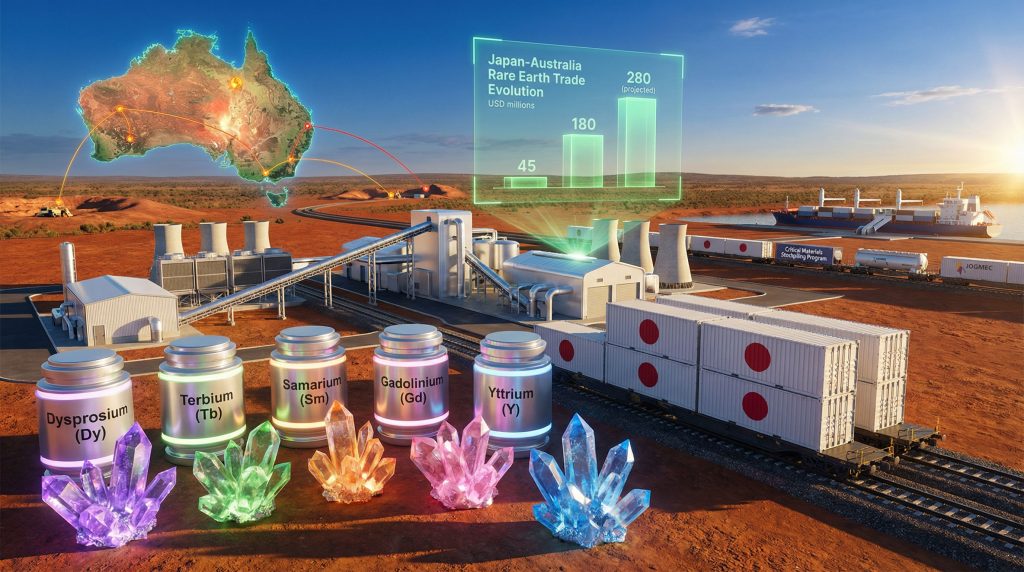
Sojitz Corporation's partnership with Lynas Rare Earths demonstrates how Japan's trading house system facilitates strategic mineral procurement. The collaboration, which began in 2011, has evolved from light rare earth imports to encompass heavy rare earth elements critical for advanced manufacturing applications.
The expansion began with dysprosium and terbium imports starting in October 2025, representing Japan's first significant heavy rare earth procurement from non-Chinese sources. These elements command premium pricing due to their critical applications in permanent magnets for wind turbines, electric vehicle motors, and industrial robotics systems.
Planned Import Expansion Timeline:
- April 2026: Addition of samarium for permanent magnet applications
- Mid-2027: Target of six medium and heavy rare earth elements
- Future additions: Gadolinium and yttrium for specialized applications
Critical Applications Driving Import Demand
Japan's procurement priorities reflect its advanced manufacturing requirements across multiple high-technology sectors. The focus on heavy rare earth elements aligns with applications where substitution possibilities are limited and supply security is paramount.
Dysprosium and Terbium Applications:
- Permanent magnets for renewable energy systems
- Electric vehicle motor components requiring high-temperature performance
- Industrial robotics and automation equipment
- Defense electronics requiring performance reliability
Samarium Market Integration:
- Specialized permanent magnet production for aerospace applications
- High-temperature industrial processes requiring thermal stability
- Medical device manufacturing with precise magnetic properties
- Nuclear reactor control systems demanding radiation resistance
Future Procurement Elements:
- Gadolinium: Medical imaging equipment and nuclear reactor control
- Yttrium: Superconducting materials and advanced ceramics
- Additional medium rare earths: Expanding manufacturing applications
Trading House Partnerships and Supply Chain Integration
Japanese trading houses serve as critical intermediaries in international commodity procurement, providing financing, logistics, and market access services that enable mining companies to develop projects while guaranteeing off-take agreements for Japanese manufacturers.
Sojitz's approach to rare earth procurement combines direct investment with long-term contract arrangements that provide mining partners with development capital while securing preferential access to production output. This model reduces financial risk for mining companies while ensuring supply security for Japanese manufacturers.
Financial and Operational Support Mechanisms
Trading house partnerships provide mining companies with patient capital and guaranteed revenue streams that traditional project financing cannot match. These arrangements typically include technology transfer components, equipment supply agreements, and marketing support for reaching Japanese industrial consumers.
Partnership Benefits:
- Long-term contracts providing price stability and volume security
- Joint venture investments sharing operational and financial risks
- Technology partnerships supplying processing equipment and expertise
- Market development creating downstream demand channels
Consequently, the trading house model enables smaller mining companies to access Japanese markets without developing independent marketing and distribution capabilities, while providing Japanese manufacturers with direct supply chain visibility and quality control oversight.
Geopolitical Drivers Accelerating Supply Chain Restructuring
Recent export control measures have transformed rare earth procurement from a gradual diversification strategy into an urgent strategic priority. China's implementation of gallium and germanium export restrictions in 2023 demonstrated the potential for broader controls affecting rare earth supplies.
These developments have accelerated Japan's diversification timeline, with government support for alternative supply chain development increasing significantly. The urgency reflects recognition that continued dependence on concentrated supply sources creates strategic vulnerabilities that could affect Japan's manufacturing competitiveness.
Export Control Impact on Market Dynamics
Export control measures create price volatility and supply uncertainty that affect procurement planning across multiple industries. The precedent of controls on gallium and germanium suggests potential for similar measures affecting rare earth elements, particularly during periods of geopolitical tension.
Control Mechanism Effects:
- Processing bottlenecks limiting refining capacity outside China
- Technology transfer restrictions reducing access to processing expertise
- Price volatility increasing procurement costs and planning uncertainty
- Supply allocation potentially favouring domestic Chinese consumption
Allied Coordination and Security Frameworks
The U.S.-Japan-Australia trilateral framework creates coordinated approaches to critical mineral security through shared stockpiling arrangements and joint infrastructure development. This coordination enables smaller alternative suppliers to compete with established supply chains by providing guaranteed demand and financing support.
Furthermore, an executive order on critical minerals announced in February 2026 regarding preferential trade bloc plans represents formal recognition of supply chain security as a national security priority. The proposed coordinated price floors could provide alternative suppliers with revenue stability needed to justify capacity expansion investments.
The next major ASX story will hit our subscribers first
Manufacturing Competitiveness and Industrial Applications
Diversified rare earth supplies enable Japan to maintain technological leadership in multiple industrial sectors while reducing supply chain vulnerabilities that could affect production continuity. The availability of heavy rare earth elements particularly supports Japan's competitive advantages in precision manufacturing and advanced materials.
Electric Vehicle and Renewable Energy Integration
Japan's electric vehicle manufacturing relies heavily on permanent magnet motors requiring dysprosium and terbium for high-efficiency operation. Secured access to these elements supports Japan's competitive position in both domestic and export markets for electric vehicles and automotive components.
Automotive Applications:
- Permanent magnet motors for electric vehicle propulsion systems
- Battery management systems using lanthanide elements for advanced chemistries
- Charging infrastructure requiring rare earths for power electronics and magnetic components
Moreover, the renewable energy sector represents another critical application area where rare earth security affects Japan's industrial competitiveness. Wind turbine generators require significant quantities of dysprosium and terbium for efficient operation, while critical minerals energy security considerations drive solar panel production utilising europium and terbium in photovoltaic cells.
Advanced Manufacturing and Technology Applications
Japan's precision manufacturing capabilities depend on access to high-purity rare earth elements for specialised applications where substitution is technically challenging or economically prohibitive. These applications often command premium pricing and represent high-value segments of global manufacturing supply chains.
High-Value Manufacturing Applications:
- Medical imaging equipment using gadolinium for MRI contrast enhancement
- Superconducting materials incorporating yttrium for quantum computing applications
- Defence electronics requiring rare earth elements for performance reliability
- Industrial robotics utilising permanent magnets for precision positioning systems
Investment Implications and Market Opportunities
Japan's rare earth diversification strategy creates multiple investment themes across the value chain, from mining development through processing infrastructure and recycling technologies. The restructuring of supply chains generates opportunities for companies positioned to benefit from changing procurement patterns.
Mining Sector Investment Opportunities
Australian rare earth developers with advanced projects represent primary beneficiaries of Japan's diversification strategy. Companies demonstrating technical capabilities in heavy rare earth separation and processing command premium valuations due to limited alternative suppliers and growing demand from strategic partnerships.
Investment Categories and Risk Profiles:
| Investment Category | Risk Level | Return Potential | Key Factors |
|---|---|---|---|
| Established producers | Medium | Moderate-High | Production track record, processing capabilities |
| Development projects | High | Very High | Resource quality, financing capacity, offtake agreements |
| Processing infrastructure | Medium-High | High | Technical expertise, environmental compliance, location |
| Recycling technologies | Very High | Extreme | Technology validation, scale economics, regulatory support |
Technology and Infrastructure Investment Themes
The transition to diversified supply chains requires significant investment in processing infrastructure, transportation systems, and quality control technologies. These capital-intensive projects offer long-term investment opportunities supported by government policy and strategic partnerships.
Infrastructure Investment Priorities:
- Separation and refining facilities for rare earth processing
- Transportation and logistics specialised for rare earth materials
- Quality control systems meeting Japanese manufacturing standards
- Environmental compliance infrastructure for sustainable operations
In addition, recycling technologies represent longer-term investment opportunities with potentially transformative returns. Urban mining solutions for rare earth recovery from electronic waste could reduce primary demand while creating new supply sources in consumer markets.
Policy Frameworks Supporting Supply Chain Diversification
Government policies in Japan and Australia create favourable conditions for expanded rare earth trade through targeted incentives, regulatory alignment, and strategic financing mechanisms. These policy frameworks reduce investment risks while accelerating supply chain development timelines.
Japanese Government Support Mechanisms
Japan's critical minerals strategy includes comprehensive policy support for alternative supply chain development. The government provides both financial incentives and regulatory facilitation for rare earth imports from allied nations, particularly Australia.
Policy Support Elements:
- Critical Materials Stockpiling Program providing government-funded strategic reserves
- JOGMEC financing for overseas resource development investments
- Tax incentives for critical mineral imports from allied nations
- Research and development grants supporting rare earth processing technologies
The Japan Organisation for Metals and Energy Security (JOGMEC) plays a central role in financing overseas mining investments that support Japan's resource security objectives. This government entity provides patient capital and technical expertise that complements private sector investment in critical mineral projects.
Australian Export Facilitation and Development Support
Australia's Critical Minerals Strategy provides comprehensive government support for rare earth sector development, including export finance assistance and regulatory streamlining for projects serving strategic partnerships with allied nations.
Australian Government Initiatives:
- Export finance assistance for mining companies serving Japanese markets
- Regulatory streamlining with expedited approvals for critical mineral projects
- Infrastructure investment supporting rare earth transportation and processing
- Research collaboration with Japanese institutions on processing technologies
The coordination between Japanese and Australian government policies creates synergies that support private sector investment while advancing strategic objectives for both nations. However, this alignment reduces regulatory risks and provides policy stability for long-term project development.
Future Scenarios and Strategic Implications
Strategic scenario modelling reveals multiple potential futures for Japan-Australia rare earth cooperation, each with distinct implications for investors, policymakers, and industrial consumers. Understanding these scenarios enables better preparation for different possible outcomes and their associated opportunities and risks.
Scenario 1: Accelerated Strategic Decoupling
This high-probability scenario envisions rapid expansion of non-Chinese supply chains driven by escalating geopolitical tensions and export control measures. The timeline for complete supply chain diversification accelerates significantly, creating premium valuations for alternative suppliers.
Scenario Characteristics:
- Timeline: 2026-2030 for major supply chain restructuring
- Investment implications: Premium valuations for established alternative suppliers
- Risk factors: Higher transition costs and potential supply shortages
- Policy responses: Increased government support for alternative supply development
Scenario 2: Technological Breakthrough in Recycling
This medium-probability scenario involves significant advances in rare earth recycling technologies that reduce primary mining demand while creating new supply sources from electronic waste and industrial byproducts.
Scenario Implications:
- Timeline: 2028-2035 for commercial scale deployment
- Market impact: Shift toward circular economy models reducing mining demand
- Investment focus: Urban mining and recycling technology development
- Risk considerations: Potential stranded assets in traditional mining projects
Scenario 3: Geopolitical Stabilisation and Diversified Sourcing
This lower-probability scenario assumes reduced trade tensions enable more balanced global supply chains without complete decoupling from Chinese sources, creating opportunities for multiple supplier relationships.
Strategic Outcomes:
- Timeline: 2027-2032 for stabilised multi-source supply chains
- Supply chain structure: Diversified sourcing with reduced single-source dependency
- Investment patterns: More balanced allocation across multiple suppliers and regions
- Risk mitigation: Reduced vulnerability while maintaining cost competitiveness
Market Psychology and Investment Considerations
The rare earth market exhibits unique psychological dynamics influenced by geopolitical perceptions, supply security concerns, and technological disruption possibilities. Understanding these psychological factors helps explain market behaviour and identify potential investment opportunities and risks.
Supply security premium represents a significant component of rare earth valuations, particularly for heavy rare earth elements with limited alternative suppliers. This premium reflects market recognition that supply disruption risks justify higher costs for diversified sourcing strategies.
Investor Psychology Factors:
- Security premium for geopolitically stable suppliers
- Technology disruption concerns affecting long-term demand projections
- Scale economics requirements for viable alternative suppliers
- Policy support reliability influencing project development confidence
For instance, market sentiment toward rare earth investments fluctuates significantly based on geopolitical developments and policy announcements. The partnership between Japanese trading house Sojitz and Australian producer Lynas demonstrates how strategic cooperation creates value through secured supply chains. Additionally, Japan's expansion into heavy rare earths represents a significant shift in global supply chain dynamics.
Japan's Sojitz expand Australian rare earth imports represents a critical evolution in global supply chain restructuring. This strategic partnership demonstrates how allied nations can collaborate to reduce dependency on concentrated supply sources while building resilient alternatives that support manufacturing competitiveness.
The implications extend beyond bilateral trade relationships to encompass broader themes including mining industry evolution and Australia's defence materials strategy. These developments create investment opportunities across multiple sectors while advancing strategic objectives for both nations.
Understanding these psychological dynamics enables better timing of investment decisions and more accurate assessment of market-driven valuation premiums versus fundamental value creation opportunities in the rare earth sector.
This analysis presents strategic scenarios and market assessments based on current information and industry trends. Investment decisions should consider individual risk tolerance and conduct independent due diligence. Market conditions, geopolitical developments, and technological advances may significantly affect actual outcomes.
Ready to Discover the Next Critical Minerals Breakthrough?
Whilst geopolitical shifts reshape global supply chains, Discovery Alert's proprietary Discovery IQ model identifies emerging opportunities in critical minerals and rare earth discoveries across the ASX in real-time. Explore how historic discoveries have delivered exceptional returns and begin your 14-day free trial today to position yourself ahead of strategic market developments.