May 16, 2026
Strategic Positioning in the Global Permanent Magnet Supply Chain
The permanent magnet manufacturing landscape is undergoing a fundamental transformation as Western nations accelerate efforts to establish processing capabilities independent of Chinese dominance. This strategic shift reflects broader concerns about supply chain sovereignty in materials critical to defense systems, renewable energy infrastructure, and electric vehicle production. The emergence of specialized partnerships between Australian materials suppliers and American manufacturers represents a new model for securing access to rare earth-based products through allied nation cooperation frameworks.
The significance of these developments extends beyond individual transactions, signalling a systematic approach to rebuilding Western manufacturing capacity in sectors where China has maintained overwhelming market control for decades. As global demand for high-performance permanent magnets accelerates across multiple industries, the establishment of reliable, transparent supply relationships becomes increasingly valuable for both suppliers and manufacturers.
When big ASX news breaks, our subscribers know first
What Does ASM's Noveon Partnership Signal for Australian Critical Metals Strategy?
Positioning Australia as a Non-Chinese Rare Earth Processing Hub
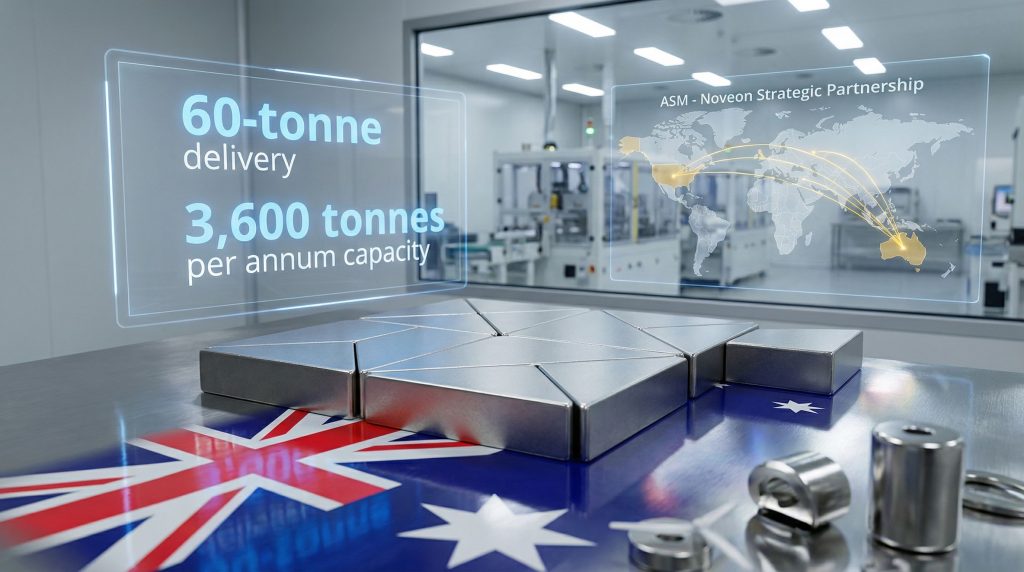
Australian Strategic Materials has established its Korean metals plant as a cornerstone of the company's mine-to-metals strategy, targeting annual production capacity of 3,600 tonnes of NdFeB alloy. This facility represents one of the few non-Chinese sources of processed rare earth materials capable of meeting the stringent specifications required for advanced permanent magnet manufacturing.
The strategic value of Australia's position in the global supply chain extends beyond raw material extraction to encompass downstream processing capabilities. Furthermore, this positioning aligns with the broader critical minerals strategy being implemented across allied nations. ASM's approach involves developing specialised metallurgical expertise to produce high-purity neodymium-iron-boron alloys that meet the exact composition requirements of permanent magnet manufacturers.
Key advantages of the Australian processing model include:
• Established regulatory frameworks supporting foreign investment in processing facilities
• Geographic proximity to major Asian manufacturing centres while maintaining Western political alignment
• Proven metallurgical capabilities in complex mineral processing operations
• Strong bilateral relationships with key allies, particularly the United States
Strategic Volume Commitments and Market Testing
The ASM deepens Noveon link demonstrates a progressive delivery approach designed to validate supply chain reliability before committing to larger volumes. The initial 100-tonne supply contract framework, with 60 tonnes already delivered, allows both parties to assess product quality, delivery consistency, and commercial viability.
This phased approach serves multiple strategic purposes. For Noveon, it provides an opportunity to validate ASM's manufacturing capabilities and product specifications without committing to multi-year volume agreements. For ASM, the arrangement demonstrates market demand for its products while maintaining manageable production commitments during the ramp-up phase of its Korean facility.
According to ASM Managing Director Rowena Smith, the transaction represents a strong endorsement of the company's capability to deliver high-quality, specification-driven products to global customers. This reflects growing momentum in the market and increasing demand for reliable, transparent supply chains for critical materials, she noted.
How Do Bilateral Supply Agreements Reshape Critical Metals Markets?
Long-term Contract Negotiations in Volatile Commodity Markets
The evolution from discrete transactions to long-term supply agreements represents a fundamental shift in how critical metals markets operate. Both ASM and Noveon are actively discussing potential long-term agreements for continued NdFeB alloy supply, indicating confidence in sustained demand and supply reliability.
Long-term contracts in critical metals markets typically address several key risk factors:
• Price volatility management through structured pricing mechanisms
• Supply security guarantees with defined delivery schedules and quality specifications
• Force majeure provisions addressing geopolitical and operational disruptions
• Quality compliance frameworks with penalty structures for specification deviations
Vertical Integration vs. Strategic Partnerships Analysis
The ASM deepens Noveon link illustrates the strategic choice between vertical integration and specialised supplier relationships in critical metals processing. Rather than investing in upstream rare earth processing capabilities, Noveon has opted to secure reliable supplier relationships with established processors.
| Approach | Capital Requirements | Technical Risk | Supply Chain Control | Time to Market |
|---|---|---|---|---|
| Vertical Integration | High | High | Complete | Extended |
| Strategic Partnerships | Moderate | Moderate | Shared | Accelerated |
| Spot Market Sourcing | Low | Low | Limited | Immediate |
This partnership model enables Noveon to focus capital and expertise on magnet manufacturing while leveraging ASM's specialised metallurgical capabilities. The approach reduces capital requirements for downstream processors while providing upstream suppliers with committed demand for their production capacity.
What Are the Geopolitical Implications of US Rare Earth Manufacturing?
Noveon's Role in American Supply Chain Sovereignty
Noveon's position as the first operational manufacturer of sintered NdFeB rare earth magnets in the United States represents a strategic milestone in American efforts to establish domestic permanent magnet production capabilities. This development aligns with the recent US mineral production order and addresses long-standing concerns about Chinese dominance in rare earth processing and permanent magnet manufacturing.
The company has secured supply agreements with major American manufacturers including:
• Nidec Motor Corporation – global leader in precision motor technology
• General Motors – automotive manufacturer with significant electric vehicle commitments
• ABB – industrial automation and power technology systems
These partnerships create a complete domestic supply chain from processed rare earth materials through finished permanent magnet products to end-use applications in defense, automotive, and energy sectors.
Allied Nations Critical Minerals Cooperation Framework
The ASM deepens Noveon link exemplifies emerging cooperation patterns between allied nations in critical minerals supply chains. Australia's role as a reliable supplier of processed rare earth materials to US manufacturers supports broader strategic objectives of reducing dependence on Chinese sources.
Smith emphasised ASM's pride in supporting Noveon's mission to produce magnets in the US and contribute to building resilient supply chains for defense, energy technologies, and electric vehicle applications. This alignment reflects shared strategic interests in establishing secure supply chains for materials critical to national security and economic competitiveness.
How Does Production Scaling Impact Market Dynamics?
Korean Metals Plant Expansion Economics
ASM's Korean processing facility represents a significant investment in rare earth downstream processing capabilities outside China. The company is fully funded to expand the plant to 3,600 tonnes per annum of NdFeB alloy production, removing capital constraints as a potential barrier to scaling operations.
Current facility status includes:
• Production ramping up toward full operational capacity
• Funding completed for expansion to target capacity levels
• Technical validation through successful delivery of specification-grade products
• Market demand confirmation through secured supply agreements
The Korean plant serves as a cornerstone of ASM's mine-to-metals strategy, providing solutions for critical materials from resource extraction through refined product delivery. This integrated approach enables the company to capture value across multiple stages of the rare earth processing value chain.
US Manufacturing Facility Feasibility Assessment
Smith indicated that ASM is considering replication of its Korean plant's manufacturing capabilities in the United States, with feasibility and planning work already underway. This expansion would further strengthen ASM's position as one of the few non-Chinese suppliers of critical metals and alloys.
A US-based facility would offer several strategic advantages:
• Reduced logistics costs for American customers
• Enhanced supply security through domestic processing capacity
• Regulatory compliance with potential domestic content requirements
• Operational redundancy across multiple processing locations
What Market Forces Drive Critical Metals Processing Partnerships?
Demand Growth Projections Across Key Sectors
The increasing commercial sales volume, such as the recent 60-tonne delivery to Noveon, provides a strong foundation for development of expanded processing facilities. Multiple end-use sectors are driving sustained demand growth for high-performance permanent magnets:
Electric Vehicle Applications:
Electric vehicle motors require significant quantities of NdFeB permanent magnets to achieve the power density and efficiency characteristics demanded by automotive manufacturers. Each electric vehicle typically contains several kilograms of permanent magnet materials distributed across traction motors, auxiliary systems, and charging infrastructure.
Renewable Energy Systems:
Direct-drive wind turbine generators utilise permanent magnet generators containing substantial quantities of NdFeB magnets. The global expansion of wind energy capacity creates sustained demand for high-performance magnetic materials capable of operating in challenging environmental conditions.
Defense and Industrial Applications:
Military systems, industrial automation, and precision manufacturing equipment require permanent magnets with consistent performance characteristics and verified supply chain provenance. These applications often justify premium pricing for materials sourced from trusted suppliers with transparent traceability systems.
Supply Chain Transparency and ESG Considerations
Smith emphasised the growing demand for reliable, transparent supply chains for critical materials, reflecting broader industry evolution trends toward supply chain traceability and environmental, social, and governance compliance. Modern procurement practices increasingly prioritise suppliers who can demonstrate responsible sourcing practices and provide detailed documentation of material origins.
Transparency requirements in critical metals sourcing include:
• Material traceability from mine through processed product
• Environmental impact documentation for processing operations
• Social responsibility verification in supply chain management
• Governance compliance with international standards and regulations
The next major ASX story will hit our subscribers first
How Do Pricing Mechanisms Work in Specialised Alloy Markets?
NdFeB Alloy Valuation Methodologies
Pricing mechanisms in specialised alloy markets like NdFeB reflect the complex interplay between raw material costs, processing complexity, and quality specifications. Unlike commodity metals with established spot markets, NdFeB alloy pricing typically involves bilateral negotiations based on composition specifications and delivery requirements.
Key pricing factors include:
• Rare earth element content – particularly neodymium concentration and purity levels
• Alloy composition tolerances – engineering specifications for magnetic properties
• Processing complexity – metallurgical requirements for specific applications
• Quality assurance – testing and certification requirements
• Delivery logistics – transportation and handling considerations
Risk Management in Critical Metals Trading
The thin trading environment for specialised alloys like NdFeB creates unique challenges for price discovery and risk management. Limited transaction volumes mean that pricing information is often proprietary and bilateral negotiations may diverge significantly from theoretical market rates.
Important Disclaimer: The specific pricing terms of the ASM-Noveon supply agreement have not been disclosed. Market pricing for NdFeB alloys varies significantly based on composition specifications, delivery terms, and contractual arrangements. Investors should not rely on this analysis for financial decision-making without conducting independent research on market conditions and pricing trends.
Risk management considerations include:
• Currency exposure for international transactions
• Quality specification compliance and associated penalty structures
• Delivery timing risks and force majeure provisions
• Long-term price stability through structured contract arrangements
What Does This Partnership Model Mean for Industry Competition?
Competitive Positioning Analysis
ASM's differentiation as a non-Chinese critical metals supplier positions the company uniquely in a market dominated by Chinese processors. This positioning becomes increasingly valuable as Western governments and companies prioritise supply chain diversification away from single-country dependence.
Noveon's first-mover advantage as the initial operational sintered NdFeB manufacturer in the United States provides significant competitive benefits:
• Market access to customers requiring domestic production sources
• Regulatory compliance with potential domestic content requirements
• Technical expertise development ahead of potential competitors
• Customer relationship establishment with major American manufacturers
Strategic Alliance Network Effects
The ASM deepens Noveon link creates network effects that extend beyond the immediate supplier-customer relationship. Noveon's established supply agreements with Nidec, General Motors, and ABB provide indirect validation of ASM's product quality and delivery capabilities.
These network relationships generate several competitive advantages:
• Reference credibility for future customer acquisition
• Technical feedback for product development and improvement
• Market intelligence regarding future demand requirements
• Joint development opportunities for specialised applications
How Do Mine-to-Metals Strategies Create Value?
Vertical Integration Benefits Assessment
ASM's mine-to-metals strategy enables the company to capture value across multiple stages of the rare earth processing value chain. This integrated approach provides several competitive advantages compared to companies operating at single stages of the value chain.
Smith described the Korean metals plant as a cornerstone of ASM's comprehensive approach to providing solutions for critical materials, from resource extraction to refined product delivery. This integration enables quality control and specification compliance throughout the processing chain.
Value capture opportunities include:
• Raw material margins from mining operations
• Processing premiums for specialised metallurgical capabilities
• Quality assurance through integrated supply chain control
• Customer relationships developed through direct engagement
Capital Allocation Efficiency in Processing Expansion
The completion of funding for ASM's Korean plant expansion to 3,600 tonnes per annum represents a significant capital commitment to downstream processing capabilities. This investment reflects confidence in sustained market demand and the company's ability to compete effectively in processed rare earth markets.
Capital allocation considerations include:
• Return on investment analysis for processing capacity expansion
• Market timing optimisation for capacity deployment
• Technology selection for competitive processing capabilities
• Geographic positioning for customer access and regulatory compliance
What Are the Long-term Strategic Implications?
Global Critical Metals Supply Chain Reconfiguration
The ASM deepens Noveon link represents one example of broader shifts occurring in global critical metals supply chains. Western governments and companies are systematically developing alternatives to Chinese-dominated processing capacity through strategic partnerships and domestic capability development.
This reconfiguration involves several key trends alongside initiatives such as the European CRM facility and the Australia critical minerals reserve:
• Distributed processing networks replacing centralised Chinese capacity
• Allied nation partnerships for secure supply chain development
• Technology transfer initiatives to accelerate capability building
• Government support for strategic mineral processing investments
Investment Opportunities and Risk Assessment
The critical metals processing sector presents significant growth opportunities as global demand accelerates and supply chains diversify. However, investors must carefully evaluate the substantial risks associated with capital-intensive processing operations in competitive markets.
Potential opportunities include:
• Growing market demand across multiple end-use sectors
• Supply chain premiums for non-Chinese processing capacity
• Government support for strategic mineral processing development
• Technology advancement enabling more efficient processing methods
Key risk factors include:
• Capital intensity of processing facility development
• Technical complexity of rare earth metallurgical operations
• Market concentration among end-use customers
• Regulatory uncertainty regarding trade policies and domestic content requirements
Investment Disclaimer: This analysis is provided for informational purposes only and should not be construed as investment advice. Critical metals processing involves significant technical, market, and regulatory risks. Potential investors should conduct comprehensive due diligence and consult qualified financial advisors before making investment decisions.
Furthermore, the ASM announcement regarding their strategic partnership demonstrates the company's commitment to building long-term relationships in the US market. The ASM deepens Noveon link represents more than a single supply agreement; it exemplifies the systematic reconstruction of Western critical metals processing capabilities through strategic partnerships between allied nations. As this trend accelerates, companies positioned at key points in these emerging supply chains may capture significant value from the fundamental restructuring of global materials flows.
Seeking Your Next Investment Opportunity in Critical Metals?
Discovery Alert's proprietary Discovery IQ model provides instant notifications when significant ASX mineral discoveries are announced, helping you identify emerging opportunities in critical metals and rare earth exploration before the broader market reacts. Explore how historic discoveries have generated substantial returns by visiting Discovery Alert's discoveries page and begin your 30-day free trial today to gain a competitive advantage in identifying the next breakthrough in Australia's critical metals sector.