June 15, 2026
Strategic Production Decisions Drive Global Oil Market Turbulence
Global energy security fundamentals have shifted dramatically as regional powers increasingly weaponise crude oil production decisions to advance geopolitical objectives. The intersection of military conflict and energy supply management reveals how traditional market mechanisms give way to strategic resource deployment during periods of heightened international tension. Understanding these dynamics becomes critical as the Saudi Arabia and Iran conflict oil production situation drives unprecedented supply disruptions across the Middle East.
The Persian Gulf's role as a critical energy chokepoint has transformed from an economic consideration into a strategic vulnerability, with approximately 20% of global oil flows dependent on uninterrupted maritime transit through contested waters. This dependency creates cascading effects throughout global supply chains when geopolitical tensions escalate into active conflict.
Recent production patterns demonstrate how anticipatory resource management precedes military operations, suggesting coordination between energy policy and strategic planning at the highest levels of government. These developments fundamentally alter traditional oil price rally analysis frameworks and require new approaches to understanding supply-demand dynamics during periods of regional instability.
When big ASX news breaks, our subscribers know first
How Regional Tensions Reshape OPEC Production Strategies
Pre-Conflict Production Surge Analysis
Saudi Arabia's production decisions during early 2026 provide crucial insights into how regional powers coordinate energy policy with geopolitical developments. According to Bloomberg's comprehensive survey published March 13, 2026, Saudi Arabia increased crude oil production by 340,000 barrels per day to reach 10.34 million barrels per day in February 2026, despite formal OPEC+ agreements to freeze production during the first quarter.
The magnitude of this production increase becomes more significant when considering the discrepancy between independently tracked output and official notifications. The OPEC secretariat reported that Saudi Arabia notified the organisation of an even larger production boost of approximately 782,000 barrels per day, indicating potential strategic ambiguity in production signalling.
Key Production Metrics – February 2026:
| Producer | Production Change (bpd) | Total Output (MMbpd) | Strategic Significance |
|---|---|---|---|
| Saudi Arabia | +340,000 to +782,000 | 10.34 | Swing producer leadership |
| OPEC Total | +640,000 | 29.52 | Largest increase since June 2025 |
| Gulf Region | Variable | 8.0+ affected | Pre-conflict positioning |
This production surge mirrors a similar increase that Saudi Arabia executed before the United States attacked Iran's nuclear facilities in June 2025, establishing a demonstrable pattern of anticipatory production management preceding military escalation. The consistency of this timing suggests deliberate coordination between energy policy and intelligence assessments of impending conflicts.
OPEC+ Coordination Versus Unilateral Action
The February 2026 production increase occurred despite formal OPEC+ commitments to maintain production freezes during the first quarter, highlighting how geopolitical risk assessment supersedes cartel agreements when regional tensions escalate. Saudi Arabia's role as the organisation's de facto leader enables unilateral production decisions that effectively override collective quota systems.
The production surge encompassed approximately half of OPEC's total 640,000 barrel per day increase during February 2026, demonstrating Saudi Arabia's disproportionate influence on global supply levels. This swing producer capability provides significant diplomatic leverage during periods of regional uncertainty.
The discrepancy between Bloomberg's independently tracked production figures and OPEC secretariat notifications suggests multiple layers of strategic communication. The 340,000 barrel per day increase tracked through tanker monitoring represents actual export flows, while the 782,000 barrel per day notification may reflect production destined for strategic reserves, delayed reporting mechanisms, or deliberate signalling to both allies and adversaries about available surge capacity.
Critical Infrastructure Vulnerabilities and Supply Chain Disruption
Strait of Hormuz Bottleneck Economics
The March 2026 geopolitical escalation exposed fundamental vulnerabilities in global oil supply architecture. The joint U.S.-Israeli military action against Iran effectively halted tanker flows through the Strait of Hormuz, creating immediate supply destruction rather than mere export delays.
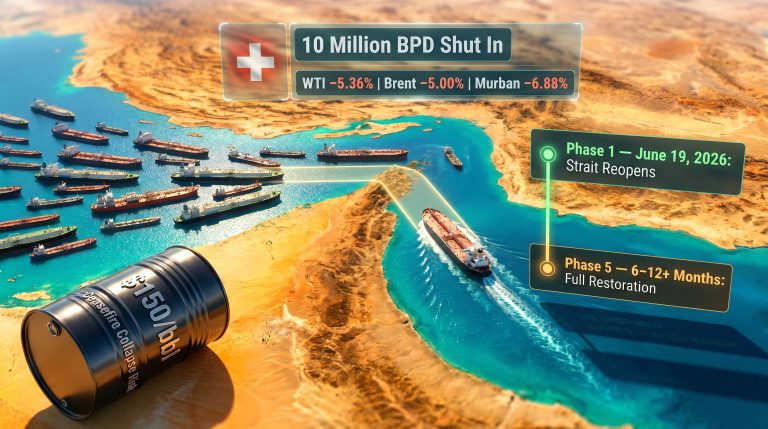
Countries dependent on Hormuz transit—specifically Saudi Arabia, the United Arab Emirates, and Iraq—collectively halted 8 million barrels per day of crude production plus an additional 2 million barrels per day of condensate and natural gas liquids. This 10 million barrel per day supply loss represents the largest conflict-driven production shutdown in modern energy markets.
Hormuz Dependency Impact Analysis:
- Total Supply Loss: 10 MMbpd (crude + condensate)
- Affected Producers: Saudi Arabia, UAE, Iraq
- Global Market Share: Approximately 10% of world oil production
- Duration: Ongoing as of March 2026
The production shutdown pattern reveals critical infrastructure dependencies that extend beyond transportation logistics. Gulf producers face operational constraints related to storage capacity, field pressure maintenance, and safety protocols that require immediate production cessation when export corridors close, rather than inventory drawdown strategies.
Emergency Response Infrastructure Limitations
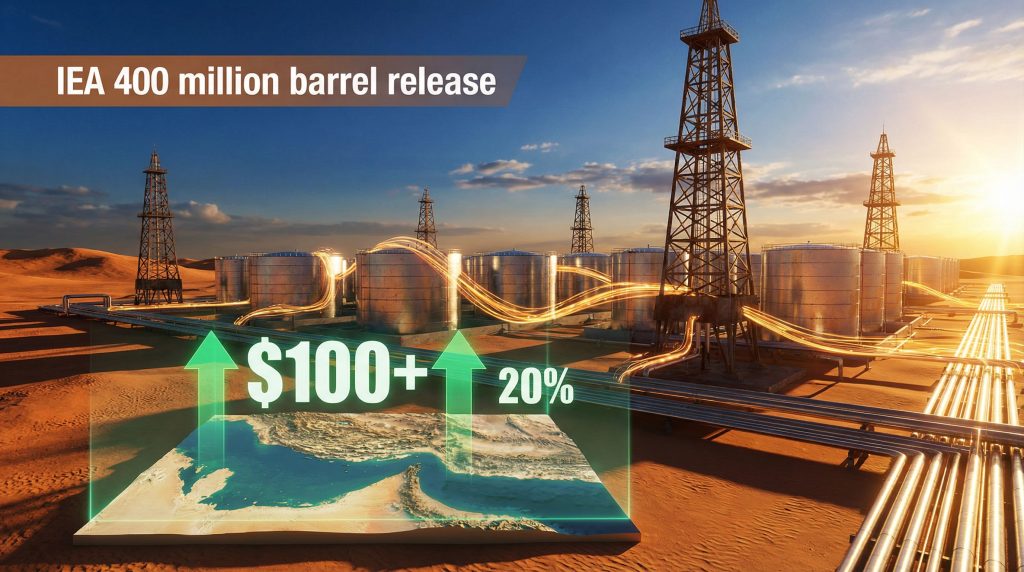
The International Energy Agency coordinated an unprecedented emergency response, with member nations agreeing to release 400 million barrels from strategic petroleum reserves. This represents the largest coordinated reserve deployment in IEA history, yet market prices continued surging toward $100 per barrel levels.
The scale of the reserve release highlights both the severity of the supply disruption and the limitations of strategic stockpiles in offsetting major infrastructure disruptions. The 400 million barrel release provides temporary buffer capacity but cannot substitute for sustained production losses exceeding 10 million barrels per day.
Alternative export infrastructure proves insufficient to absorb full regional production volumes when primary maritime routes close. Pipeline alternatives and secondary shipping corridors lack the capacity to maintain normal export flows, creating bottleneck constraints that force production shutdowns rather than route diversification.
Market Psychology and Price Formation During Crisis Periods
Fear Premium Quantification and Price Dynamics
Oil prices surged to trade near $100 per barrel in London following the military escalation and subsequent infrastructure disruption. This price level reflects the intersection of immediate supply destruction, continued closure of critical transit corridors, and uncertainty regarding conflict duration and potential for further escalation.
The price formation mechanism during the March 2026 crisis demonstrates how geopolitical events translate into physical market constraints. Unlike speculative trading-driven price spikes, the near-$100 pricing reflects actual supply destruction rather than anticipated disruptions.
Crisis Price Formation Factors:
- Immediate Supply Loss: 10 MMbpd production shutdown
- Infrastructure Closure: Strait of Hormuz transit suspension
- Duration Uncertainty: Unclear conflict resolution timeline
- Escalation Risk: Potential for expanded regional involvement
The sequential pattern of events—anticipatory production increases, military operations, infrastructure disruption, and price response—suggests that market participants accurately assessed and priced geopolitical risk before the crisis fully materialised. However, furthermore, the magnitude of the actual supply loss exceeded most risk assessments.
Supply-Demand Rebalancing Challenges
The combination of 10 million barrel per day supply loss and coordinated 400 million barrel strategic reserve release creates complex rebalancing dynamics. The reserve deployment provides short-term price stabilisation but cannot address sustained production losses without demand destruction or alternative supply sources.
Demand destruction thresholds become critical at $100+ price levels, as elevated energy costs impact economic activity and transportation patterns. However, the inelastic nature of short-term oil demand means that price-driven consumption reductions occur gradually rather than immediately offsetting supply disruptions.
Non-OPEC production response capabilities remain limited by existing capacity utilisation and development timelines. Moreover, US oil production decline factors and other regional constraints mean that shale oil producers cannot rapidly scale production to offset Middle Eastern supply losses, creating sustained market tightness until infrastructure disruptions resolve or demand adjusts downward.
Energy Production as Geopolitical Weapon Systems
Saudi Arabia's Strategic Production Calculus
Saudi Arabia's production decisions during the February-March 2026 period demonstrate sophisticated integration of energy policy with geopolitical strategy. The kingdom's capacity to increase production by 340,000 to 782,000 barrels per day within a single month implies sustainable spare capacity that can be deployed rapidly for strategic purposes.
The timing coordination with anticipated military operations suggests access to intelligence assessments and diplomatic coordination that extends beyond traditional market-driven production planning. The pre-conflict production surge appears designed to build inventory buffers and signal market stabilisation intentions before anticipated supply disruptions.
Saudi Arabia's swing producer role within OPEC provides diplomatic leverage that extends beyond energy markets. Consequently, the ability to unilaterally override formal quota agreements during crisis periods demonstrates de facto control over global supply conditions, creating significant geopolitical influence.
Production Flexibility as Strategic Asset
The technical capacity to rapidly adjust production levels represents a strategic asset distinct from traditional military or economic power. Saudi Arabia's demonstrated ability to increase output by nearly 800,000 barrels per day provides buffer capacity against supply disruptions while signalling resolve to both allies and adversaries.
The discrepancy between tracked production increases and official notifications may reflect deliberate strategic ambiguity. Maintaining uncertainty about actual production capacity and deployment timelines creates information advantages during diplomatic negotiations and conflict scenarios.
"The integration of energy production decisions with military and diplomatic planning represents a fundamental shift in how regional powers exercise international influence."
For instance, these oil price movements reflect deeper strategic calculations beyond traditional market fundamentals.
Long-Term Structural Implications for Middle East Energy Architecture
Infrastructure Vulnerability Assessment and Investment Priorities
The March 2026 supply disruption exposes critical vulnerabilities in regional energy infrastructure that will likely trigger substantial investment in resilience measures. The forced shutdown of 10 million barrels per day of production capacity demonstrates the fragility of export-dependent production systems.
Gulf producer nations face strategic choices between investing in alternative export infrastructure, diversifying production geography, or accepting continued vulnerability to transit corridor disruptions. Each option involves significant capital requirements and extended implementation timelines.
Infrastructure Resilience Investment Categories:
- Alternative Export Routes: Pipeline development and secondary port infrastructure
- Storage Capacity Expansion: Strategic inventory management during disruptions
- Production Flexibility: Rapid shutdown and restart capabilities
- Security Hardening: Physical protection of critical facilities
Capital Flow Redirections and Investment Strategy Evolution
The demonstration of supply vulnerability during the March 2026 crisis will likely influence long-term capital allocation patterns across the energy sector. Investors face increased risk assessments for assets dependent on single-point-of-failure infrastructure systems.
Sovereign wealth funds from Gulf producer nations may accelerate diversification strategies to reduce dependence on hydrocarbon revenues subject to geopolitical disruption. Furthermore, the volatility associated with conflict-prone production assets creates incentives for geographic and sectoral diversification.
Energy security considerations may drive increased investment in alternative energy infrastructure as consuming nations seek to reduce dependence on geopolitically volatile supply sources. The $100+ oil prices during supply disruptions accelerate the economic viability of renewable energy alternatives.
The next major ASX story will hit our subscribers first
Global Response Mechanisms and Strategic Reserve Management
Coordinated Strategic Reserve Deployment
The International Energy Agency's coordination of a 400 million barrel strategic petroleum reserve release represents the largest emergency deployment in the organisation's history. This unprecedented scale reflects both the magnitude of the supply disruption and the evolution of coordinated energy security mechanisms.
The reserve release includes contributions from the United States, Japan, Germany, and other IEA member nations, demonstrating multilateral cooperation in addressing regional supply disruptions. However, the continued price pressure toward $100 per barrel levels indicates the limitations of strategic stockpiles in offsetting sustained production losses.
Strategic Reserve Deployment Analysis:
- Total Release: 400 million barrels
- Participating Nations: United States, Japan, Germany, others
- Duration: Coordinated deployment schedule
- Market Impact: Partial price stabilisation, insufficient for full offset
Emergency Sharing Agreement Evolution
The March 2026 crisis demonstrates the need for enhanced international coordination mechanisms beyond traditional strategic reserve deployments. The scale of the supply disruption exceeds existing emergency sharing frameworks and requires new approaches to multilateral energy security cooperation.
Future emergency response protocols may need to incorporate production guarantee agreements, coordinated diplomatic intervention, and enhanced intelligence sharing to prevent supply disruptions rather than merely responding to them after they occur.
Investment Strategy Implications During Energy Conflict Cycles
Portfolio Rebalancing and Risk Management
The March 2026 oil price surge to near-$100 levels creates significant implications for energy sector investment strategies. The combination of supply destruction, infrastructure vulnerability, and geopolitical escalation generates volatility patterns that require sophisticated risk management approaches.
Energy sector rotation opportunities emerge during conflict periods as markets reassess geographic risk exposure, infrastructure vulnerability, and production sustainability. In addition, investors must balance exposure to high-return conflict-zone assets against supply security and operational continuity risks.
The ongoing oil price stagnation impact demonstrates how broader geopolitical tensions influence market dynamics beyond immediate supply concerns.
Investment Strategy Considerations:
- Geographic Diversification: Reduced concentration in single-region production assets
- Infrastructure Resilience: Preference for assets with multiple export options
- Volatility Management: Enhanced hedging strategies for conflict-prone regions
- Alternative Energy Acceleration: Increased investment in supply-secure energy sources
Commodity Market Trading Strategies
The sequential pattern of anticipatory production increases, military escalation, and supply disruption creates identifiable trading opportunities for sophisticated market participants. However, the magnitude and duration of actual supply losses often exceed initial risk assessments.
Volatility trading strategies must account for the potential for sustained rather than temporary supply disruptions when infrastructure damage or geopolitical tensions persist beyond initial conflict periods. The March 2026 crisis demonstrates how physical supply destruction creates different market dynamics than speculative risk premiums.
Strategic Scenario Planning for Future Energy Conflicts
Probability-Weighted Disruption Models
The March 2026 experience provides critical data for developing probability-weighted models of future supply disruption scenarios. The pattern of anticipatory production increases, coordinated military action, and infrastructure targeting offers insights into potential future conflict sequences.
Regional energy interdependencies create cascading disruption potential where limited initial conflicts expand into broader supply disruptions through infrastructure vulnerabilities and alliance obligations. Saudi Arabia and Iran conflict oil production decisions demonstrate how bilateral tensions can generate global supply impacts.
Scenario Planning Variables:
- Conflict Duration: Short-term military action versus sustained confrontation
- Infrastructure Impact: Transit corridor closure versus production facility damage
- Alliance Involvement: Bilateral versus multilateral conflict expansion
- Response Coordination: Strategic reserve effectiveness and diplomatic intervention
Early Warning System Development
The consistent pattern of production increases preceding military escalation suggests potential for developing early warning indicators based on energy production decisions, tanker movements, and strategic reserve activities. These indicators could provide advance notice of impending conflicts.
Intelligence integration across energy markets, diplomatic communications, and military preparations may enable more effective conflict prevention or supply disruption mitigation. The Saudi Arabia and Iran conflict oil production patterns offer baseline data for future warning system development.
The broader trade war oil impact considerations show how multiple geopolitical tensions can compound market volatility.
Policy Framework Adaptations for Energy Security
International Energy Security Treaty Requirements
The limitations of existing emergency response mechanisms during the March 2026 crisis highlight the need for enhanced international energy security frameworks. Current strategic reserve sharing agreements prove insufficient for offsetting sustained supply disruptions exceeding 10 million barrels per day.
Future treaty frameworks may require production guarantee obligations, coordinated investment in alternative infrastructure, and enhanced diplomatic intervention mechanisms to prevent rather than merely respond to supply disruptions.
The Guardian reports that this crisis represents the largest supply disruption in oil market history, emphasising the need for enhanced international cooperation frameworks.
Emergency Coordination Protocol Standardisation
The complexity of coordinating the 400 million barrel strategic reserve release across multiple nations demonstrates the need for standardised emergency response protocols. Streamlined decision-making processes and pre-authorised deployment mechanisms could improve response effectiveness.
Regional energy security cooperation may require formal agreements regarding production sharing, alternative export routing, and conflict prevention measures. The Middle East's role as a critical global energy supplier necessitates enhanced stability mechanisms beyond traditional military and diplomatic approaches.
Saudi Arabia and Iran conflict oil production decisions will continue to shape global energy security frameworks, requiring adaptive policy responses from consuming nations and international organisations.
This analysis is based on publicly available information and market observations. Energy market investments involve significant risks, including geopolitical disruption, price volatility, and supply chain interruptions. Readers should conduct independent research and consult qualified professionals before making investment decisions. Past performance and historical patterns do not guarantee future results, and the complex interactions between geopolitical events and energy markets can produce unexpected outcomes.
Looking to Capitalise on Energy Market Volatility?
Discovery Alert's proprietary Discovery IQ model delivers real-time alerts on significant ASX mineral discoveries, helping investors identify actionable opportunities during periods of market turbulence like the current energy crisis. With oil prices surging towards $100 per barrel and global supply chains under pressure, understanding how major mineral discoveries have historically generated substantial returns becomes crucial for portfolio diversification and risk management during uncertain times.