
June 9, 2026
Strategic Reserve Positioning in Caribbean Gas Markets
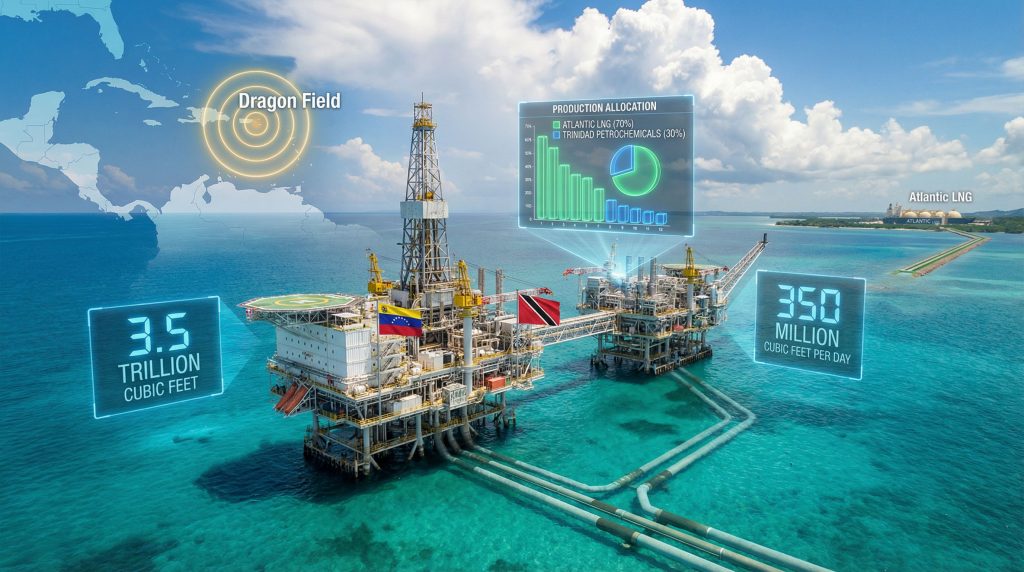
The offshore energy landscape of the Caribbean presents unprecedented opportunities for regional transformation, particularly as trinidad eyes late 2027 start for venezuelan gas field development. The Dragon field's 3.5 trillion cubic feet of estimated reserves positions this development as a cornerstone for regional energy transformation. This massive resource base, located in Venezuelan waters near the Trinidad maritime boundary, represents approximately ten years of Trinidad's current annual gas consumption at historical demand levels.
Reserve estimates of this magnitude create strategic implications beyond simple supply additions. The field's proximity to existing Trinidad processing infrastructure eliminates many of the technical and economic barriers that typically challenge cross-border energy developments. Furthermore, the current oil price rally analysis suggests favourable market conditions for major energy infrastructure investments.
Unlike deepwater projects requiring entirely new infrastructure, Dragon field gas can integrate directly into Trinidad's established Atlantic LNG processing complex through relatively straightforward pipeline connections. This integration capability becomes particularly relevant when considering broader oil price movements and their impact on regional energy planning.
Comparative Analysis with Regional Developments
Regional context reveals the Dragon field's exceptional positioning within Caribbean offshore development patterns. The convergence of declining production, evolving sanctions frameworks, and cross-border partnership opportunities creates scenarios that could fundamentally reshape the region's approach to trinidad eyes late 2027 start for venezuelan gas field initiatives.
- Guyana's Liza field complex: Produces approximately 800,000 barrels per day of oil but requires floating production infrastructure
- Trinidad's historical offshore fields: Declining production from mature reservoirs averaging 15-20 years of operation
- Venezuela's existing gas infrastructure: Underutilised processing capacity due to sanctions and maintenance challenges
- Regional LNG demand growth: Caribbean nations increasingly dependent on imported energy supplies
The Dragon field's 350 million cubic feet per day initial production target represents roughly 15% of Trinidad's peak historical gas production capacity. This volume provides sufficient feedstock to maintain Atlantic LNG facility operations whilst supporting domestic petrochemical requirements and potential regional distribution networks.
Cross-Border Infrastructure Integration Requirements
Maritime pipeline development between Venezuelan waters and Trinidad processing facilities presents technical challenges requiring specialised engineering solutions. Water depths ranging from 150 to 400 feet along the proposed route demand subsea pipeline specifications capable of handling high-pressure gas transmission across approximately 25 nautical miles of open water.
Pipeline engineering requirements include:
- Corrosion-resistant steel specifications for marine environment operations
- Pressure management systems maintaining 1,000+ PSI transmission capacity
- Environmental protection measures meeting both Venezuelan and Trinidad regulatory standards
- Emergency shutdown capabilities for cross-border safety coordination
- Maintenance access protocols addressing dual-jurisdiction operational requirements
Integration with Trinidad's existing Atlantic LNG infrastructure requires minimal facility modifications, as current processing units maintain excess capacity following domestic production declines. The facility's four-train configuration can accommodate Venezuelan gas supplies without major capital expenditure, providing immediate monetisation opportunities upon pipeline completion.
When big ASX news breaks, our subscribers know first
OFAC Licensing Framework Evolution and Investment Implications
The October 2025 OFAC authorisation marks a critical evolution in US sanctions policy, creating a two-phase licensing structure that separates negotiation permissions from production authorisations. This framework reflects Washington's recognition that energy security considerations sometimes require nuanced approaches to sanctions implementation.
Trinidad Energy Minister Roodal Moonilal confirmed that current licensing permits transactions and negotiations but explicitly excludes production and development activities. However, the tariffs impact analysis indicates that broader geopolitical considerations continue to influence regional energy investment decisions.
Secondary Licensing Timeline and Requirements
The transition from negotiation licenses to production authorisation involves several critical factors. In addition to regulatory considerations, the energy security transition demonstrates how Caribbean nations must navigate complex policy environments whilst maintaining energy independence objectives.
- Technical readiness demonstration: Proof that infrastructure and operational capabilities meet safety and environmental standards
- Financial transparency requirements: Documentation of funding sources and revenue distribution mechanisms
- Regional stability assessments: US government evaluation of project contributions to Caribbean energy security
- Sanctions compliance frameworks: Detailed protocols ensuring Venezuelan government revenue limitations
- Timeline coordination: Alignment with broader US-Venezuela diplomatic engagement schedules
Industry specialists estimate the secondary licensing application process requires 6-12 months for comprehensive review, assuming no major policy reversals or geopolitical complications. This timeline creates planning challenges for Shell and BP, as major capital commitments cannot proceed without production authorisation certainty.
Geopolitical Risk Assessment for Energy Investors
Washington policy volatility represents the primary uncertainty factor affecting project execution timelines. US presidential election cycles, Congressional sanctions legislation, and Venezuela's domestic political developments all influence licensing sustainability and project completion probability.
Risk mitigation strategies focus on several key areas:
| Risk Category | Mitigation Approach | Timeline Impact |
|---|---|---|
| Policy Reversal | Phased capital deployment, exit options | 6-18 month delays |
| License Modification | Flexible infrastructure design | 3-9 month adjustments |
| Regional Instability | Multi-sourcing agreements | 12-24 month alternatives |
| Technical Delays | Conservative scheduling margins | 6-12 month buffers |
Shell and BP partnership dynamics under sanctions regimes require careful coordination between corporate risk management and government relations strategies. Both companies maintain extensive sanctions compliance programmes, but cross-border energy projects involving Venezuelan resources demand enhanced monitoring and reporting protocols.
Production Timeline Scenarios and Market Integration
The final quarter 2027 production startup target reflects optimistic assumptions about regulatory approval timelines and infrastructure completion schedules. Moreover, successful implementation of trinidad eyes late 2027 start for venezuelan gas field plans requires careful coordination with broader regional energy initiatives, including Saudi exploration licenses that may influence global gas market dynamics.
However, this timeline faces several potential adjustment factors requiring scenario planning across multiple development pathways. Industry sources suggest that maritime infrastructure projects in the Caribbean typically encounter 15-25% timeline extensions due to weather, regulatory, and technical factors.
Baseline Production Projections
Initial production volumes of 350 million cubic feet per day represent conservative estimates based on reservoir engineering assessments and processing capacity limitations. Phased development approaches could scale production to 500-600 million cubic feet per day within 24 months of initial startup, depending on market conditions and infrastructure optimisation.
Production ramp-up scenarios consider several variables:
- Reservoir pressure maintenance: Natural decline curves and artificial lift requirements
- Pipeline capacity optimisation: Throughput increases through pressure and flow management
- Processing facility utilisation: Atlantic LNG train availability and maintenance scheduling
- Market demand fluctuations: LNG export pricing and regional consumption patterns
- Regulatory compliance requirements: Environmental monitoring and reporting obligations
Technical assessments suggest the Dragon field can maintain plateau production for 8-12 years before requiring enhanced recovery techniques or additional well drilling programmes. This production profile provides sufficient timeline for developing additional Venezuelan fields and optimising regional supply chain integration.
Market Distribution Strategy and Revenue Optimisation
Gas allocation between export markets and domestic utilisation creates strategic choices affecting long-term revenue generation and regional energy security objectives. Current planning assumes the following distribution framework:
| End Use | Allocation Percentage | Volume (MMcf/d) | Strategic Purpose |
|---|---|---|---|
| Atlantic LNG Export | 70% | 245 | European/Asian market revenue |
| Trinidad Petrochemicals | 20% | 70 | Industrial feedstock security |
| Regional Distribution | 10% | 35 | Caribbean energy diplomacy |
This allocation strategy balances revenue maximisation through LNG exports with domestic energy security and regional relationship management. European markets currently offer premium pricing relative to Caribbean spot markets, whilst petrochemical feedstock applications provide stable long-term demand less subject to global price volatility.
LNG export revenue projections depend heavily on global market conditions and Atlantic basin pricing dynamics. Consequently, European energy security concerns following geopolitical developments create potential price premiums of $2-4 per million BTU above Asian market rates, making European destinations particularly attractive for Caribbean LNG suppliers.
Expanding Venezuelan Field Development Through Proven Models
The Dragon field development establishes operational and regulatory precedents that could facilitate additional Venezuelan offshore projects, creating a systematic approach to cross-border energy cooperation. Trinidad seeks OFAC licensing for the Loran and Manakin-Cocuina fields, indicating strategic planning beyond single-project development.
For instance, recent developments in regional energy cooperation demonstrate how cross-border partnerships can enhance energy security whilst maintaining compliance with international regulatory frameworks.
Loran Field Development Prospects
The Loran field presents similar technical characteristics to Dragon, with estimated reserves supporting additional gas supplies for Trinidad's processing infrastructure. Located in comparable water depths and geological formations, Loran development could follow established engineering and regulatory pathways with reduced uncertainty and development timelines.
Key advantages of sequential field development include:
- Shared infrastructure utilisation: Pipeline and processing capacity optimisation across multiple fields
- Operational experience transfer: Technical lessons and best practices from Dragon field application
- Regulatory precedent establishment: Proven OFAC licensing pathways reducing approval uncertainties
- Economies of scale realisation: Combined development reducing per-unit infrastructure costs
- Supply diversification benefits: Multiple production sources enhancing supply security
Loran field development could commence 12-18 months after Dragon field production startup, assuming successful operational performance and continued regulatory support. This timeline allows infrastructure optimisation and market development whilst maintaining development momentum.
Manakin-Cocuina Strategic Positioning
The Manakin-Cocuina field complex offers longer-term development potential with larger reserve estimates requiring more extensive infrastructure investment. Technical assessments suggest this field could support dedicated processing facilities or enhanced pipeline capacity to accommodate higher production volumes.
Strategic considerations for Manakin-Cocuina development include:
- Reserve size optimisation: Larger field development requiring enhanced infrastructure investment
- Market timing coordination: Development scheduling aligned with global LNG demand growth
- Technology advancement integration: Application of improved offshore production techniques
- Regional supply chain expansion: Broader Caribbean energy network development opportunities
- Investment scaling requirements: Capital commitment levels requiring international financing participation
This field represents Phase 3 development in a systematic Venezuelan offshore gas monetisation strategy, potentially commencing 2029-2030 timeframe depending on Dragon and Loran field performance and market conditions.
Caribbean Energy Economics Transformation
Trinidad's positioning as a regional gas processing hub reflects strategic planning to address domestic production declines whilst capitalising on Venezuelan resource proximity. This transformation requires significant infrastructure investment and operational coordination, but offers substantial economic and energy security benefits.
The successful implementation of trinidad eyes late 2027 start for venezuelan gas field initiatives could serve as a model for other Caribbean energy cooperation frameworks. Furthermore, understanding how global energy markets respond to regional developments becomes crucial for long-term planning.
Trinidad's Energy Security Evolution
Domestic gas production declines of approximately 15% annually over the past five years create urgent supply gap challenges affecting both export revenue and domestic energy security. Venezuelan gas supplies provide immediate relief from production constraints whilst enabling long-term strategic planning around regional resource optimisation.
Energy security improvements include:
- Supply diversity enhancement: Reduced dependence on aging domestic reservoirs
- Infrastructure utilisation optimisation: Existing Atlantic LNG capacity maximisation
- Petrochemical industry revitalisation: Reliable feedstock supplies supporting industrial growth
- Regional energy leadership: Trinidad positioning as Caribbean gas distribution centre
- Economic diversification opportunities: Energy services and processing revenue streams
The partnership enables Trinidad to maintain its historical role as a regional energy hub whilst transitioning from purely domestic resource dependence to strategic resource processing and distribution functions.
Regional Supply Chain Integration Benefits
Venezuela gains access to modern processing infrastructure and established export markets without requiring massive capital investment in domestic facility development. This arrangement provides immediate revenue generation opportunities whilst leveraging Trinidad's technical expertise and market relationships.
Regional integration advantages include:
- Technology transfer opportunities: Advanced offshore production techniques and processing optimisation
- Market access expansion: Established LNG export routes and customer relationships
- Operational cost reduction: Shared infrastructure utilisation reducing per-unit production costs
- Risk mitigation through diversification: Multiple revenue streams and market destinations
- Investment attraction enhancement: Proven operational models reducing development uncertainty
Caribbean energy independence improves through reduced external dependency on distant suppliers and enhanced regional cooperation frameworks. This model could extend to other Caribbean nations seeking energy security improvements through regional resource sharing and infrastructure optimisation.
The next major ASX story will hit our subscribers first
Investment Risk Management and Strategic Mitigation
Cross-border energy projects involving sanctions regimes require comprehensive risk assessment and adaptive management strategies addressing regulatory, technical, and market uncertainties. Stakeholders must balance development opportunities against policy volatility and operational complexity.
Regulatory Uncertainty and Timeline Management
US policy continuity risks represent the most significant uncertainty affecting project execution and long-term viability. Presidential administration changes, Congressional policy initiatives, and Venezuelan government stability all influence licensing sustainability and operational authorisation.
Risk management strategies include:
- Phased capital deployment: Investment staging aligned with licensing milestone achievement
- Contingency planning development: Alternative development scenarios and exit strategies
- Stakeholder engagement programmes: Proactive communication with regulatory authorities and policy makers
- Compliance framework enhancement: Robust monitoring and reporting systems exceeding minimum requirements
- Political risk insurance utilisation: Coverage for policy-related project interruption scenarios
Timeline management requires conservative scheduling with substantial contingency margins accounting for regulatory review delays and potential policy modifications. Project managers typically allocate 25-40% additional timeline for sanctions-related uncertainties.
Technical and Financial Risk Mitigation
Offshore development projects face cost escalation pressures from equipment availability, marine construction complexity, and specialised technology requirements. Currency fluctuation between US dollars and regional currencies creates additional financial planning challenges.
Financial risk mitigation approaches include:
| Risk Factor | Mitigation Strategy | Cost Impact |
|---|---|---|
| Equipment Cost Inflation | Fixed-price contracts, early procurement | 5-15% premium |
| Marine Construction Delays | Weather window optimisation, backup contractors | 10-20% schedule buffer |
| Currency Fluctuation | Multi-currency hedging, local content maximisation | 3-8% cost variance |
| Technology Obsolescence | Modular design, upgrade capability | 5-12% future investment |
Infrastructure maintenance across maritime borders requires specialised protocols addressing dual-jurisdiction regulatory requirements and emergency response coordination. Insurance frameworks must account for cross-border liability and environmental protection obligations.
Investment-grade risk assessment suggests the Dragon field project achieves acceptable risk-return profiles under baseline scenarios, but requires enhanced monitoring and adaptive management capabilities throughout the development and operational phases.
Disclaimer: This analysis contains forward-looking projections and speculative assessments based on available information as of early 2026. Actual development timelines, production volumes, and regulatory outcomes may vary significantly from projections due to political, technical, and market factors beyond current predictability. Investors should conduct independent due diligence and consult qualified advisors before making investment decisions related to Caribbean energy projects.
Ready to Invest in the Next Major Energy Discovery?
Discovery Alert instantly alerts investors to significant ASX mineral discoveries using its proprietary Discovery IQ model, turning complex mineral data into actionable insights. Understand why historic discoveries can generate substantial returns by exploring Discovery Alert's discoveries page and begin your 30-day free trial today to position yourself ahead of the market.