August 5, 2026
Strategic Resource Dependencies Reshape Global Mining Frontiers
Resource-dependent nations face mounting pressure to diversify their critical material supply chains as geopolitical tensions intensify around traditional mining corridors. Advanced economies increasingly recognize that reliance on single-source suppliers for essential minerals creates strategic vulnerabilities that extend far beyond commercial considerations into national security domains. Japan's deep sea mining plan represents a significant response to these challenges.
This dynamic has accelerated innovative extraction methodologies, with several nations exploring unconventional resource deposits to establish supply chain independence. The convergence of technological advancement and strategic necessity has opened new frontiers in resource exploration, particularly in marine environments where vast mineral deposits remain largely untapped.
When big ASX news breaks, our subscribers know first
How Geopolitical Mineral Dependencies Drive Strategic Innovation
Critical Material Bottlenecks Create National Security Concerns
China's dominance in rare earth processing represents one of the most significant supply chain vulnerabilities in the global economy. The nation controls approximately 90% of global rare earth refining capacity, positioning it as the gatekeeper for materials essential to modern technological infrastructure. This concentration creates strategic leverage that extends beyond commercial relationships into geopolitical influence, particularly as US–China trade tensions continue to escalate.
Recent export restriction policies have amplified concerns among technology-dependent economies. These restrictions affect multiple industrial sectors simultaneously, from consumer electronics to renewable energy infrastructure. The automotive industry faces particular exposure, as electric vehicle production requires substantial quantities of neodymium, dysprosium, and other heavy rare earth elements for motor magnets and battery systems.
Defense applications compound these vulnerabilities. Modern military hardware relies extensively on rare earth elements for guidance systems, communications equipment, and advanced weaponry. A single F-35 fighter jet contains approximately 920 pounds of rare earth materials, while advanced radar systems and missile guidance technology depend on specialised magnetic properties available only through rare earth compounds.
Industrial Applications Across Multiple Sectors
The scope of rare earth dependencies extends across virtually every advanced technology sector. Furthermore, critical minerals for energy transition become increasingly vital as nations pursue renewable energy targets:
- Wind Energy Infrastructure: Permanent magnet generators require substantial neodymium and dysprosium quantities
- Electric Vehicle Manufacturing: Motor magnets and battery chemistry demand specific rare earth combinations
- Electronics Production: Smartphone displays, computer hard drives, and semiconductor manufacturing
- Medical Equipment: MRI machines and specialised diagnostic equipment utilise rare earth-based magnets
- Renewable Energy Storage: Battery technologies increasingly incorporate rare earth elements
Advanced Deep-Sea Extraction Technologies
Minamitori Island Operations Framework
Japan's deep sea mining plan centres on the waters surrounding Minamitori Island, located approximately 1,850 kilometres southeast of Tokyo. The operation targets sediment deposits at depths reaching 6,000 metres, requiring specialised equipment capable of functioning under extreme pressure conditions.
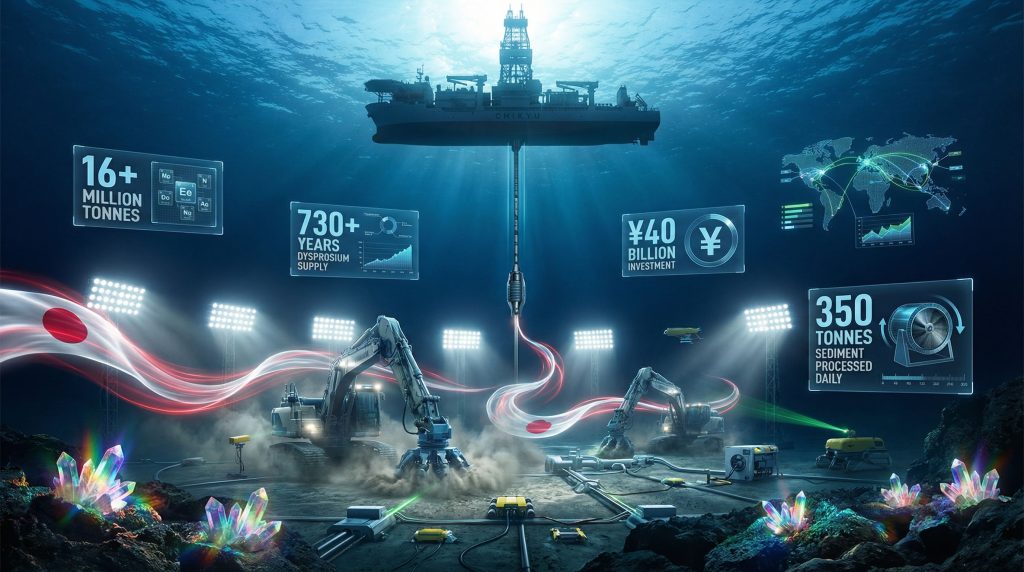
The research vessel Chikyu serves as the primary platform for extraction operations. This deep-sea drilling ship features advanced positioning systems and specialised extraction equipment designed for abyssal depths. Daily processing targets aim for 350 tonnes of sediment, representing a significant scale-up from experimental operations conducted over the past decade.
Industrial Processing and Refinement Systems
The extraction process employs industrial-scale centrifugal systems to separate rare earth-bearing sediments from seawater. These specialised spin-dryer technologies remove excess water before transportation to mainland processing facilities. The separation process requires precise control of sediment particle size and density to maximise rare earth concentration.
Transportation logistics present unique challenges given the remote location and deep-water operations. Specialised vessels must maintain sediment integrity during transit whilst managing environmental exposure risks. Additionally, data-driven mining operations enable real-time monitoring and optimisation of extraction processes.
Economic Projections and Resource Assessments
Estimated Resource Volumes and Market Implications
| Element Category | Estimated Volume | Supply Duration | Strategic Priority |
|---|---|---|---|
| Total Rare Earths | 16+ million tonnes | Multi-century supply | Critical |
| Heavy Rare Earths | Substantial deposits | 730+ years (dysprosium) | Defence-essential |
| Yttrium Compounds | Large quantities | Extended domestic supply | Technology-critical |
| Neodymium Resources | Significant reserves | Industrial-scale supply | Manufacturing-vital |
These volume estimates suggest Japan could achieve complete self-sufficiency in rare earth supply whilst potentially becoming a significant global exporter. The 730-year supply estimate for dysprosium represents particular strategic value, as this element remains among the most geopolitically sensitive rare earth materials.
Investment Timeline and Financial Commitments
The Japanese government has allocated ¥40 billion (approximately $256 million) for deep-sea mining development since 2018. This investment encompasses research vessel operations, extraction technology development, and processing facility modifications.
The Japan deep sea mining plan targets February 2027 for full-scale demonstration mining operations. Commercial viability assessments depend on extraction costs relative to traditional land-based mining operations. Initial projections suggest break-even scenarios become achievable with sustained operations above 300 tonnes daily processing capacity.
Financial models indicate that deep-sea operations could achieve cost parity with traditional mining if environmental compliance costs continue rising for land-based extraction.
Environmental Challenges and Regulatory Frameworks
Marine Ecosystem Impact Assessments
Deep-sea mining operations raise significant deep‐sea mining concerns within the scientific community. The Deep Sea Conservation Coalition has highlighted potential biodiversity losses in abyssal environments that remain poorly understood by researchers. These ecosystems operate on geological timescales, with recovery periods potentially extending across centuries.
Carbon storage disruption represents an additional concern. Deep ocean sediments serve as significant carbon sinks, and large-scale sediment extraction could release stored carbon into ocean systems. Environmental impact assessments must quantify these potential effects against the climate benefits of renewable energy infrastructure enabled by rare earth materials.
International Oversight and Compliance Requirements
The International Seabed Authority maintains jurisdiction over deep-sea mining activities in international waters. Whilst Japan's operations occur within territorial waters, international precedents established through these activities could influence global mining regulations.
Scientific community pressure for mining moratoriums has intensified as deep-sea biodiversity research reveals ecosystem complexity. However, regulatory frameworks must balance strategic resource needs against environmental preservation requirements, creating ongoing tension between economic and ecological priorities.
Global Competitive Landscape Analysis
International Deep-Sea Mining Initiatives
Japan's initiative occurs within a broader context of global deep-sea mining development. In addition, Japan's mission represents the world's first commercial-scale deep-sea rare earth extraction attempt:
- Norway's Arctic Programs: Seabed exploration targeting copper, zinc, and rare earth deposits
- Pacific Island Partnerships: Small island nations licensing mining rights to international consortiums
- European Union Strategy: Critical materials initiatives emphasising supply chain diversification
- Canadian Arctic Operations: Underwater mineral exploration in territorial waters
Technology Transfer and Innovation Opportunities
Japanese maritime engineering expertise positions the nation as a potential technology exporter to allied countries developing similar capabilities. Deep-sea extraction technologies could find applications in other resource-dependent economies facing similar supply chain vulnerabilities.
Research collaboration frameworks with international partners could accelerate technology development whilst spreading associated costs. Furthermore, mining innovation trends suggest that joint ventures with European and North American partners might enhance project viability while building strategic resource alliances.
The next major ASX story will hit our subscribers first
Strategic Scenario Modeling for Project Outcomes
Success Pathway: Commercial Viability Achievement
Successful implementation could fundamentally alter global rare earth market dynamics. Supply chain independence from Chinese exports would enhance Japan's strategic autonomy whilst potentially offering alternative supply sources to allied nations. Technology licensing opportunities could generate additional revenue streams beyond direct mining operations.
Regional economic development around Minamitori Island could create new employment opportunities and research infrastructure. Consequently, the demonstration of viable deep-sea mining might encourage similar initiatives among other resource-dependent nations.
Challenge Scenario: Environmental Opposition Intensification
Mounting international pressure could force operational modifications or complete project suspension. Environmental groups might leverage international forums to restrict deep-sea mining activities, particularly if early operations reveal significant ecosystem impacts.
Alternative supply chain strategies would require increased investment in recycling technologies and rare earth substitution research. Material conservation initiatives and circular economy approaches might partially offset supply constraints.
Hybrid Outcome: Limited-Scale Strategic Operations
A balanced approach might involve demonstration-phase continuation without full commercial expansion. Strategic reserve development could provide national security benefits whilst minimising environmental impacts. This scenario might incorporate enhanced environmental safeguards and international monitoring systems.
The most likely outcome involves scaled operations that balance strategic resource needs with environmental considerations, creating a model for sustainable deep-sea mining practices.
Long-Term Resource Security Implications
Geopolitical Supply Chain Restructuring
Successful deep-sea mining operations could reduce global dependence on single-source rare earth suppliers, fundamentally altering international trade relationships. Enhanced negotiating positions in bilateral trade agreements would strengthen Japan's economic diplomacy capabilities.
Alliance-building opportunities with other resource-dependent nations could create collaborative frameworks for supply chain diversification. Shared technology development and joint procurement arrangements might emerge as strategic partnerships evolve.
Technological Innovation Acceleration
Advanced extraction methodologies developed through this initiative could find applications beyond rare earth mining. Environmental monitoring technologies and deep-sea robotics might create new industrial sectors with global export potential.
Integration with renewable energy transition strategies could accelerate clean technology adoption whilst ensuring material supply security. The convergence of resource security and environmental sustainability might drive innovation across multiple industrial sectors.
Disclaimer: This analysis involves projections and assumptions about future technological, economic, and geopolitical developments. Resource estimates, environmental impacts, and commercial viability assessments remain subject to significant uncertainty as deep-sea mining technologies continue evolving.
Could Japan's Deep-Sea Mining Success Reshape Your Investment Strategy?
Japan's groundbreaking deep-sea rare earth mining initiative exemplifies how geopolitical supply chain vulnerabilities create extraordinary investment opportunities in resource sectors. Discovery Alert's proprietary Discovery IQ model delivers instant notifications when ASX-listed companies announce significant mineral discoveries across critical materials sectors, helping subscribers identify actionable opportunities before broader market recognition. Begin your 30-day free trial with Discovery Alert today to position yourself ahead of evolving resource market dynamics.