August 14, 2026
Strategic Resource Governance in African Mining Sectors
African mineral-rich nations increasingly recognise that traditional extraction-based economic models fail to capture optimal value from natural resource endowments. This strategic realisation drives sophisticated policy interventions designed to redirect global commodity flows through domestic processing infrastructure, fundamentally altering established trade patterns and investment frameworks.
Contemporary resource governance extends beyond simple export taxation or royalty adjustments. Modern approaches implement comprehensive value-capture mechanisms that mandate domestic beneficiation as a prerequisite for international market access, creating new paradigms for state-industry relationships in extractive sectors.
When big ASX news breaks, our subscribers know first
Regulatory Architecture of Export Control Systems
Zimbabwe's comprehensive prohibition on unprocessed mineral exports demonstrates how emerging economies can leverage regulatory frameworks to restructure global supply chains. The Zimbabwe export ban on raw materials, announced February 25, 2026, through Zimbabwe's Mines Ministry statement to Reuters and Zimbabwe's Chamber of Mines, encompasses all raw minerals and lithium concentrates without sectoral exceptions.
This regulatory intervention accelerated previously planned restrictions by approximately 10 months. Zimbabwe's government had announced in 2025 intentions to implement lithium concentrate export prohibitions effective January 2027, but systemic compliance concerns prompted immediate implementation across all mineral sectors. Furthermore, the mining industry evolution demonstrates similar policy shifts across other jurisdictions.
Revenue Protection Mechanisms
Government oversight agencies identified systematic inefficiencies requiring immediate intervention. The Mines Ministry characterised these as addressing continued malpractices during mineral exportation and implementing enhanced compliance frameworks to curb revenue leakages within existing systems.
During 2025, Zimbabwe exported 1.128 million metric tons of lithium-bearing spodumene concentrate, representing substantial value flows through traditional export channels. In the first half of 2025 alone, Zimbabwe reported 586,197 metric tons of lithium spodumene concentrate sales, reflecting a 30 percent increase compared to the corresponding 2024 period when 451,824 metric tons were sold.
Compliance Framework Implementation
The regulatory structure operates through indefinite prohibition requiring mining companies to demonstrate compliance with new beneficiation requirements and establish approved domestic processing capacity before export authorisation resumes. Unlike quota-based systems, this framework creates binary compliance requirements: either materials achieve domestic processing standards or export remains prohibited entirely.
Companies must establish domestic beneficiation facilities that add significant value through chemical processing, refining, or manufacturing stages. This requirement necessitates substantial infrastructure development rather than operational modifications to existing extraction processes. Additionally, comprehensive mining permitting insights become crucial for navigating these new regulatory frameworks.
Economic Drivers Behind State Intervention
Macroeconomic Stability Context
Zimbabwe's export restrictions occurred alongside notable macroeconomic improvements. In January 2026, Zimbabwe recorded its lowest inflation rate in over 20 years, with ZiG (Zimbabwe dollar) inflation falling to 4.1 percent in January, declining from 15 percent in December 2025 and 19 percent in November 2025.
The ZiG, partially backed by gold reserves, maintained stability in official markets while trading at a parallel-market premium of approximately 20 percent. These developments preceded and may have contributed to government confidence in implementing comprehensive export restrictions.
Revenue Optimisation Strategy
Zimbabwe's strategic positioning as Africa's leading lithium producer, achieved in 2024, provides context for policy intervention. Despite global lithium prices declining dramatically from peaks exceeding $80,000 per metric ton in 2022 to $8,450 per metric ton by June 2025 (a 90 percent price reduction), Zimbabwe sustained substantial export volumes and operational efficiency.
Gold production momentum reinforces broader resource management strategy. Moreover, the gold market performance was anticipated to exceed the 2024 record of 38.4 tons, driven by persistently high gold prices. Caledonia Mining Corporation disclosed plans to invest approximately $132 million during 2026 to initiate development of what is projected to become Zimbabwe's largest gold mine.
Comparative Analysis of Global Resource Control Models
Processing Requirement Differentiation
Unlike China's quota-based rare earth export approach, which implements graduated restrictions allowing market forces to allocate limited supplies, the Zimbabwe export ban on raw materials policy mechanism operates through absolute prohibition requiring complete domestic processing before any export authorisation.
| Policy Element | China (Rare Earths) | Zimbabwe (All Minerals) | Implementation |
|---|---|---|---|
| Control Mechanism | Export quotas | Complete prohibition | Binary compliance |
| Processing Requirements | Variable standards | Mandatory beneficiation | Infrastructure dependent |
| Market Access | Quantity-limited | Quality-conditional | Value-add threshold |
| Compliance Timeline | Annual adjustments | Indefinite suspension | Immediate effect |
Infrastructure Development Requirements
Zimbabwe requires immediate construction of comprehensive processing infrastructure:
- Lithium hydroxide processing facilities with minimum 50,000 tonnes annual capacity
- Spodumene concentration upgrading plants
- Quality control laboratories meeting international battery-grade specifications
- Export certification systems for processed materials
Investment projections for infrastructure development:
| Infrastructure Type | Required Investment | Construction Timeline | Operational Capacity |
|---|---|---|---|
| Lithium processing plants | $400-600 million | 18-24 months | 80,000 tonnes LCE |
| Beneficiation facilities | $150-250 million | 12-18 months | 200,000 tonnes concentrate |
| Quality assurance labs | $25-50 million | 6-12 months | Full export compliance |
Market Disruption and Supply Chain Reconfiguration
Immediate Supply Impact
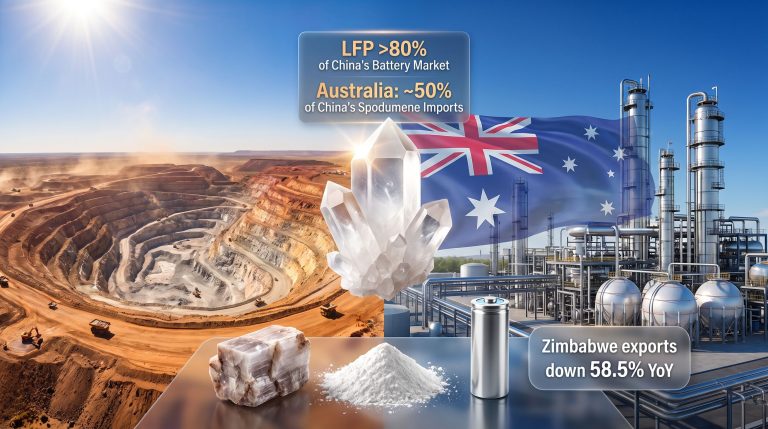
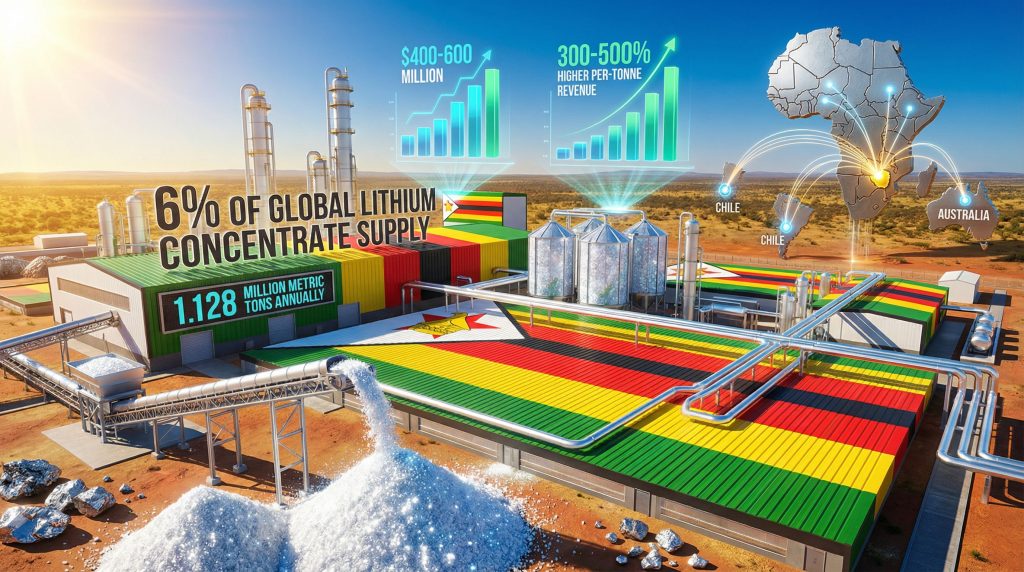
Zimbabwe previously contributed approximately 6 percent of global lithium concentrate supply. The export suspension removes 1.128 million metric tons of annual production from international markets, forcing global battery manufacturers and processing facilities to rapidly diversify sourcing strategies.
Market analysts project 15-25 percent price increases for lithium concentrates in Q2 2026 as buyers compete for alternative supply sources while Zimbabwe's substantial production exits international markets. However, lithium refinery advancements in other regions may help mitigate some supply constraints.
Alternative Sourcing Requirements
Global battery manufacturers must immediately diversify supply chains with increased focus on:
- Australian hard rock lithium operations (Pilbara region)
- Chilean brine operations (Atacama Desert)
- Argentine lithium triangle developments
- North American lithium projects (Quebec, Nevada)
Processing Capacity Redistribution
Chinese mining enterprises face immediate pressure to accelerate domestic processing investments or risk asset stranding. This creates precedent for forced localisation of mining value chains, fundamentally altering international mining investment models.
Companies seeking continued access to Zimbabwean lithium must pivot toward joint venture arrangements that include domestic processing commitments, technology transfer agreements, and local capacity building initiatives. Meanwhile, executive mining orders in other jurisdictions may influence global supply chain strategies.
Regional Economic Integration Implications
Continental Trade Framework Challenges
The Zimbabwe export ban on raw materials challenges Southern African Development Community trade liberalisation objectives, potentially triggering dispute resolution mechanisms under regional economic partnership agreements.
The policy tests African Continental Free Trade Agreement provisions regarding export restrictions, as other African nations monitor Zimbabwe's approach for potential replication across strategic mineral sectors. This development was reported by Mining Zimbabwe as having immediate regional implications.
Policy Replication Risk Assessment
African governments controlling strategic minerals may adopt similar frameworks:
- Democratic Republic of Congo (cobalt processing requirements)
- Ghana (bauxite beneficiation mandates)
- Tanzania (gold value addition policies)
- Zambia (copper processing initiatives)
The next major ASX story will hit our subscribers first
Domestic Value Addition Infrastructure Development
Strategic Processing Initiatives
In February 2026, Zimbabwe announced plans to inaugurate Africa's first lithium sulphate plant through partnership with Chinese firms, involving a groundbreaking $270 million lithium project. This initiative demonstrates Zimbabwe's commitment to downstream processing infrastructure development.
Production Scaling Projections
By 2030, Zimbabwe's production is projected to reach 160,000 tonnes of lithium carbonate equivalent, a volume significantly surpassing other regional producers. This represents a 400 percent increase from current processing capacity.
Employment and Skills Development
Domestic processing requirements create opportunities for 15,000-25,000 direct manufacturing jobs while demanding significant technical training programmes to develop specialised mining and chemical processing expertise.
Investment Strategy Implications
Foreign Direct Investment Restructuring
International mining companies must now incorporate regulatory capture risk into African investment models, as the Zimbabwe export ban on raw materials approach may inspire similar policies across mineral-rich African nations.
Risk assessment frameworks must evaluate:
- Government policy stability and resource nationalism trends
- Domestic processing infrastructure requirements and timelines
- Technology transfer obligations and local partnership mandates
- Long-term operational cost implications of forced beneficiation
Partnership Model Evolution
Traditional extraction-focused mining operations must evolve toward integrated value-chain partnerships. Successful engagement requires:
- Joint venture arrangements with domestic processing commitments
- Technology transfer agreements supporting local capacity development
- Infrastructure investment coordination with government development priorities
- Long-term supply agreements incorporating graduated local content requirements
Economic Transformation Projections
Revenue Generation Potential
Processed lithium exports generate 300-500 percent higher per-tonne revenue compared to raw concentrate sales. This transformation could potentially increase Zimbabwe's mineral export earnings from $2.1 billion to $6-8 billion annually by 2028.
Industrial Development Strategy
Zimbabwe aims to transition from primary commodity exporter to regional processing hub. This strategic shift requires coordinated development of power generation, transportation networks, and technical education systems to support expanded processing operations.
"Strategic Insight: Zimbabwe's comprehensive export ban establishes the most aggressive resource nationalism policy implemented by an African government in recent decades, creating a new benchmark for state control over mineral value chains and potentially inspiring similar approaches across strategic mineral sectors continent-wide."
Market Adaptation and Strategic Responses
Supply Chain Resilience Requirements
Global lithium consumers must immediately implement supply chain diversification strategies to mitigate concentration risk from African producers adopting similar policies. This includes developing strategic inventory reserves, securing long-term contracts with multiple suppliers across different jurisdictions, and investing in alternative processing technologies.
Price Volatility Management
Market participants face increased price volatility as supply sources become increasingly concentrated among fewer jurisdictions with stable export policies. Hedging strategies and forward contracting mechanisms become essential risk management tools for battery manufacturers and automotive companies dependent on consistent lithium supply.
Long-term Sector Evolution
Technology Transfer Acceleration
Forced localisation requirements accelerate technology transfer from developed to developing economies, potentially creating new centres of mining and processing expertise across Africa. This redistribution of technical capabilities may fundamentally alter global competitiveness patterns in extractive industries.
Regulatory Precedent Establishment
Zimbabwe's policy establishes regulatory precedent that other resource-rich African nations may reference when implementing similar value-capture strategies. This creates systemic risk for international mining investors operating across multiple African jurisdictions.
The Zimbabwe export ban on raw materials represents a fundamental shift in African resource governance, establishing new paradigms for state control over mineral value chains while forcing rapid adaptation across global supply networks dependent on African mineral production.
Ready to Capitalise on Global Mining Policy Shifts?
Discovery Alert's proprietary Discovery IQ model delivers real-time notifications on significant ASX mineral discoveries, instantly empowering subscribers to identify actionable opportunities as global supply chains restructure and new market dynamics emerge. Begin your 14-day free trial today and position yourself ahead of these transformative market shifts.