May 13, 2026
Strategic Resource Independence Drives Australia's Economic Future
Global supply chain vulnerabilities exposed by recent geopolitical tensions have accelerated nations toward resource sovereignty strategies across critical mineral sectors. Australia's position at the intersection of vast geological endowments and sophisticated mining expertise creates unique opportunities to reshape international commodity flows. The nation's australia critical minerals strategy encompasses both immediate stockpiling initiatives and long-term processing capacity development, fundamentally altering its role from raw material supplier to integrated critical minerals partner.
Resource security calculations now extend beyond traditional economic metrics to encompass defence preparedness, technological independence, and allied partnership obligations. These multidimensional considerations drive policy frameworks that prioritise strategic value over short-term market optimisation, establishing new paradigms for government intervention in commodity markets.
When big ASX news breaks, our subscribers know first
Economic Security Through Mineral Independence
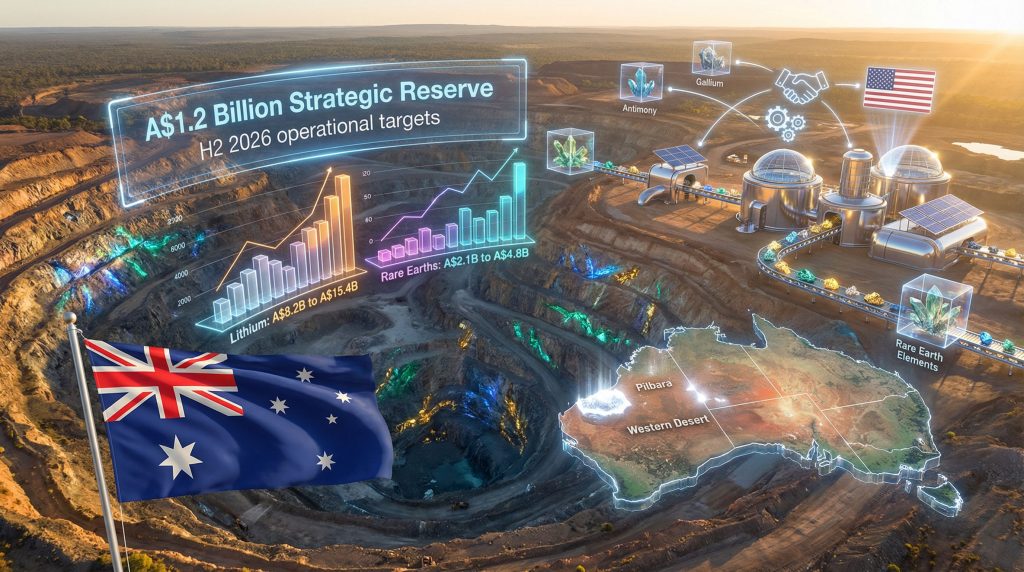
Australia's A$1.2 billion strategic reserve initiative represents a fundamental shift from market-driven resource allocation toward state-directed supply chain security. The program targets antimony, gallium, and rare earth elements identified through vulnerability assessments as critical bottlenecks in defence and automotive supply chains.
Defence sector applications create particularly acute supply security requirements due to their specialised performance specifications and limited supplier bases. Antimony's role in semiconductor applications and gallium's importance in integrated circuits demonstrate how seemingly niche materials become strategically critical when incorporated into advanced military systems.
The reserve architecture prioritises minerals where supply disruption risk intersects with national security applications, rather than pursuing comprehensive stockpiling across all critical materials. This targeted approach concentrates resources on vulnerabilities where alternative suppliers remain limited and substitution proves technically challenging.
Clean energy transition demands compound these strategic considerations, as renewable energy infrastructure requires substantial rare earth element inputs for permanent magnet applications. Australia's positioning as an alternative to dominant global suppliers becomes increasingly valuable as allied nations seek supply chain diversification options.
Competitive Positioning in Global Supply Networks
Australia's emergence as a critical minerals alternative to dominant global producers leverages both geological advantages and geopolitical alignment with major consuming nations. The country's rare earth production outside traditional supply chains provides strategic value that extends beyond pure cost competitiveness.
Lynas Rare Earths Ltd, operating as the world's largest rare earth producer outside China, exemplifies Australia's competitive positioning. Recent market volatility affecting the company, including share price declines exceeding 4% following policy uncertainty, demonstrates the sector's sensitivity to government support mechanisms.
Geographic advantages in lithium, rare earth elements, and battery metals create natural competitive positions, but processing capacity constraints limit value capture potential. Current industry structure concentrates downstream processing in jurisdictions outside Australia, reducing the country's share of total value-added production.
| Mineral Category | Australian Position | Key Advantage | Processing Gap |
|---|---|---|---|
| Lithium | Major producer | High-grade deposits | Limited refining capacity |
| Rare Earth Elements | Alternative to China | Geopolitical alignment | Minimal separation facilities |
| Battery Metals | Emerging player | Diverse resource base | Limited cathode production |
Technology transfer requirements and capability building initiatives become essential for transitioning from raw material extraction toward integrated supply chain participation. Investment in downstream processing infrastructure represents the critical pathway for maximising competitive positioning.
Reserve Implementation and Operational Framework
The A$1.2 billion reserve program targeting operational readiness by second half 2026 establishes specific benchmarks for stockpile accumulation and distribution capabilities. Department of Industry coordination with Export Finance Australia suggests integrated governance structures linking reserve operations with broader supply chain financing initiatives.
Stockpiling methodology focuses on minerals vulnerable to supply disruption rather than comprehensive coverage of all critical materials. This approach concentrates resources on specific vulnerability points where alternative suppliers remain limited and technical substitution proves challenging.
Australian Resources Minister Madeleine King emphasised the program's fiscal discipline, stating that Australia remains determined to ensure value for taxpayer money in both the reserve and any price floor mechanisms. This commitment indicates government focus on cost-effective procurement strategies and long-term sustainability.
Second half 2026 operational targets require rapid development of storage infrastructure, procurement protocols, and distribution systems. The timeline suggests phased implementation with initial stockpile accumulation beginning immediately to meet readiness benchmarks.
Reserve architecture incorporates multiple procurement mechanisms beyond direct government purchasing, including offtake agreements and price floor arrangements designed to support domestic project development while building strategic stockpiles.
Market Stabilisation Through Price Support Mechanisms
Australia's approach to price floor implementation through offtake agreements reflects lessons learned from international precedents, particularly US experiences with targeted project support. King characterised the strategic antimony loan precedent as a game-changer, despite its limited deployment across single projects.
Offtake agreement structures serve dual functions as both market stabilisation tools and strategic procurement mechanisms. These arrangements provide price certainty for domestic producers while ensuring government access to priority materials at predetermined terms.
The Australian framework emphasises multiple mechanisms rather than relying solely on price floors, indicating flexibility in response to varying market conditions across different mineral categories. This approach addresses the complexity of establishing effective market-based pricing mechanisms highlighted in US implementation challenges.
Congressional funding limitations and pricing complexity cited as factors in US retreat from broader price floor commitments demonstrate the political and technical challenges inherent in sustained government intervention in commodity markets.
Risk mitigation strategies focus on protecting taxpayer value through strategic procurement timing and avoiding reserve depletion through unfavourable price dynamics. Government emphasis on fiscal responsibility suggests careful evaluation of market conditions before reserve activation.
| Price Support Model | Implementation Method | Advantages | Constraints |
|---|---|---|---|
| Direct Price Floor | Guaranteed minimum pricing | Immediate producer certainty | High fiscal exposure |
| Offtake Agreements | Long-term purchase contracts | Market flexibility | Volume limitations |
| Strategic Procurement | Opportunistic buying | Cost optimisation | Timing uncertainty |
International Partnership and Bilateral Coordination
The October 2025 US-Australia framework establishes $1 billion minimum financing commitments per country and $13 billion project pipeline development targets, creating structured bilateral coordination mechanisms for critical minerals development.
Supply Security Response Group governance provides joint decision-making capabilities for rapid response to supply disruptions or market volatility. This institutional framework enables coordinated policy responses beyond individual national initiatives.
Regulatory streamlining and permitting acceleration components address bottlenecks that historically constrain project development timelines. Fast-track processes for mining and processing projects suggest prioritisation of supply chain security over traditional regulatory sequencing.
Standards-based trading system implementation indicates regulatory harmonisation efforts designed to facilitate seamless bilateral trade flows. Asset protection protocols against adversarial acquisition address national security considerations in foreign investment review processes.
Australia's commitment to pursue the australia critical minerals strategy despite US policy shifts demonstrates framework resilience beyond single policy mechanisms. King confirmed that Australia's strategic reserve program would continue regardless of US price floor developments, indicating independent policy determination within bilateral coordination structures.
The $13 billion project pipeline encompasses multiple development phases and investor categories, suggesting multi-year implementation timelines extending well beyond immediate reserve establishment. Project financing coordination between government and export finance agencies creates integrated support structures for industry development.
The next major ASX story will hit our subscribers first
Strategic Response to Supply Chain Vulnerabilities
China's position as the world's biggest producer of critical minerals creates concentration risks that drive alternative supply chain development requirements. Furthermore, the critical minerals energy transition explicitly addresses dependency concerns through domestic processing capacity expansion and alternative partnership frameworks according to the Australian government's critical minerals strategy.
Downstream processing concentration in single jurisdictions creates vulnerability points that extend beyond raw material supply security. Technology transfer and capability building initiatives become essential for reducing processing bottlenecks and capturing greater value-added production.
Market disruption scenarios require contingency planning across multiple supply chain levels, from raw material extraction through refined product delivery. Alternative partnership development with Japan, South Korea, and European Union members provides diversification options for both supply and demand relationships.
Supply shock response protocols integrated within the October 2025 bilateral framework enable rapid coordination during disruption events. Joint vulnerability assessments provide shared intelligence on emerging risks and coordinated response capabilities.
Diplomatic asset protection measures address concerns about adversarial acquisition of critical infrastructure or strategic projects. These protocols extend beyond traditional foreign investment screening toward active protection of strategic assets.
Sector-Specific Demand Dynamics and Growth Projections
Defence and aerospace applications drive specialised requirements for high-purity materials with stringent quality specifications. Sovereign capability development in defence supply chains creates sustained demand for domestically-sourced materials regardless of cost competitiveness considerations.
Advanced manufacturing requirements for military systems include specialised alloys, electronic components, and precision materials where security of supply takes precedence over price optimisation. Strategic stockpiling for national security applications ensures availability during potential supply disruptions.
Clean energy infrastructure expansion creates substantial demand growth across multiple mineral categories, particularly in securing lithium supply for battery applications:
- Battery manufacturing supply chain integration requires lithium, cobalt, nickel, and graphite in specific chemical forms
- Solar panel and wind turbine components utilise rare earth elements, silver, and specialised metals
- Grid storage and electric vehicle ecosystem support demands large-scale battery metal production
Advanced manufacturing and technology sectors generate demand for ultra-pure materials in semiconductor, 5G infrastructure, and quantum computing applications. These emerging technology applications often require higher specifications than traditional industrial uses, creating premium market segments.
| End-Use Sector | Key Minerals | Quality Requirements | Growth Trajectory |
|---|---|---|---|
| Defence/Aerospace | Antimony, gallium, REE | Ultra-high purity | Sustained government demand |
| Electric Vehicles | Lithium, cobalt, nickel | Battery-grade specifications | Exponential growth phase |
| Renewable Energy | REE, silver, copper | Industrial specifications | Infrastructure-driven expansion |
| Electronics/Tech | Gallium, indium, germanium | Semiconductor-grade | Innovation-driven growth |
Economic Transformation and Value Creation Opportunities
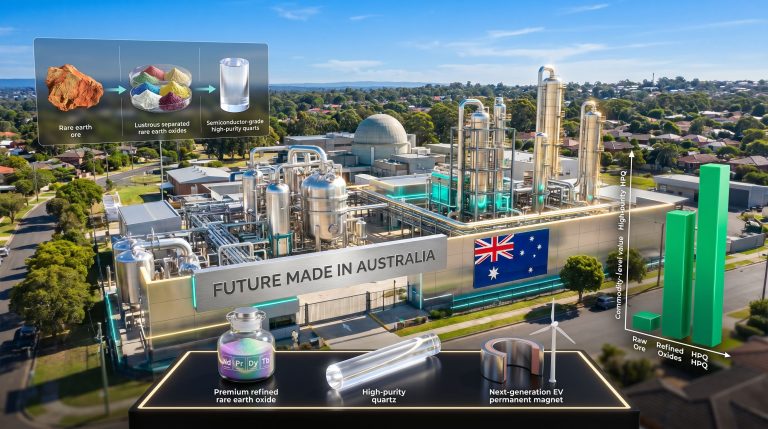
Value-add processing development represents the primary pathway for capturing greater economic returns from Australia's geological endowments. Onshore refining and processing investment creates employment opportunities in regional mining communities while reducing dependence on overseas processing facilities.
Investment climate improvements through strategic government support enhance Australia's attractiveness for foreign direct investment in processing infrastructure. Sovereign wealth fund participation models and private sector partnership frameworks provide capital mobilisation options for large-scale development projects.
Revenue projections indicate substantial growth potential across priority mineral categories:
| Mineral Category | 2026 Production Value | 2030 Projection | Employment Impact |
|---|---|---|---|
| Lithium | A$8.2 billion | A$15.4 billion | 12,000+ jobs |
| Rare Earth Elements | A$2.1 billion | A$4.8 billion | 3,500+ jobs |
| Critical Battery Metals | A$3.7 billion | A$8.9 billion | 8,200+ jobs |
Export diversification beyond raw commodity sales requires substantial investment in processing technologies and skilled workforce development. Regional economic development impacts extend beyond direct mining employment toward supporting service industries and infrastructure improvements.
Economic multiplier effects from processing operations typically exceed those from raw material extraction, creating additional justification for government support mechanisms. Value-added exports generate higher per-ton revenues while creating more sustainable employment patterns.
Implementation Challenges and Risk Factors
Market volatility and price risk management present ongoing challenges for sustaining government support mechanisms during commodity cycle downturns. Long-term contract structures and price hedging arrangements help mitigate exposure while maintaining program viability.
Infrastructure and logistics constraints could limit implementation timelines regardless of policy support. Port capacity expansion requirements, rail and road transport adequacy, and processing facility development schedules represent potential bottlenecks requiring coordinated planning.
Environmental impact assessment acceleration through fast-track processes must balance supply chain security priorities with environmental protection requirements. Streamlined approval processes require careful design to maintain environmental standards while reducing regulatory timelines.
Indigenous consultation and land rights integration add complexity to project development timelines but remain essential for sustainable operations. Sustainability standards for mining operations increasingly influence international market access and investment attractability.
Geopolitical risk factors include potential trade relationship instability, technology transfer restrictions, and regional security considerations. The Indo-Pacific security environment adds additional complexity to long-term planning assumptions.
Commodity cycle exposure remains a fundamental challenge for strategic reserve operations. Consequently, reserve deployment timing optimisation requires sophisticated market analysis to avoid value destruction through poor timing decisions.
Success Metrics and Future Outlook
Strategic objectives through 2030 focus on supply chain resilience metrics and vulnerability reduction rather than purely economic returns. Domestic value-add processing capacity targets and allied nation partnership depth serve as key performance indicators for program success.
Economic transformation milestones include transitioning from raw material exporter toward integrated supplier status. Advanced manufacturing ecosystem development and regional economic diversification create broader economic benefits beyond direct mineral sector impacts.
Global market position enhancement through increased market share in processed critical minerals establishes Australia as a technology leader in sustainable extraction methods. Strategic alliance leadership within allied supply chains provides ongoing geopolitical and economic advantages.
Technology leadership in sustainable extraction and processing methods creates competitive advantages that extend beyond resource endowments toward intellectual property and expertise exports. These capabilities become increasingly valuable as environmental standards tighten globally.
Market share growth projections in processed critical minerals depend critically on successful processing capacity development and technology adoption. In addition, evolving mining trends and mining investment strategies require continuous adaptation to maintain competitive positioning.
Investment in research and development capabilities supports long-term competitive positioning in high-value market segments. Moreover, Australia's approach aligns with the International Energy Agency's critical minerals framework, which emphasises supply chain resilience and clean energy transition requirements.
This analysis represents current policy frameworks and market conditions as of early 2026. Critical minerals markets remain subject to significant volatility, and government policy mechanisms may require adjustment based on changing market dynamics and geopolitical developments. Investors and industry participants should conduct independent due diligence and consider professional advice before making strategic decisions based on this information.
Want to Capitalise on Australia's Critical Minerals Boom?
Discovery Alert's proprietary Discovery IQ model delivers real-time alerts on significant ASX mineral discoveries, instantly empowering subscribers to identify actionable opportunities as Australia's A$1.2 billion strategic reserve initiative transforms the critical minerals sector. Begin your 14-day free trial today and secure your market-leading advantage in this rapidly evolving landscape.