
July 26, 2026
Understanding Strategic Resource Security in Modern Economies
Global supply chain vulnerabilities have reshaped how nations approach resource security, moving beyond traditional stockpiling models toward sophisticated strategic frameworks. These evolving approaches recognise that economic resilience requires proactive measures to secure access to materials essential for national security, technological advancement, and economic stability.
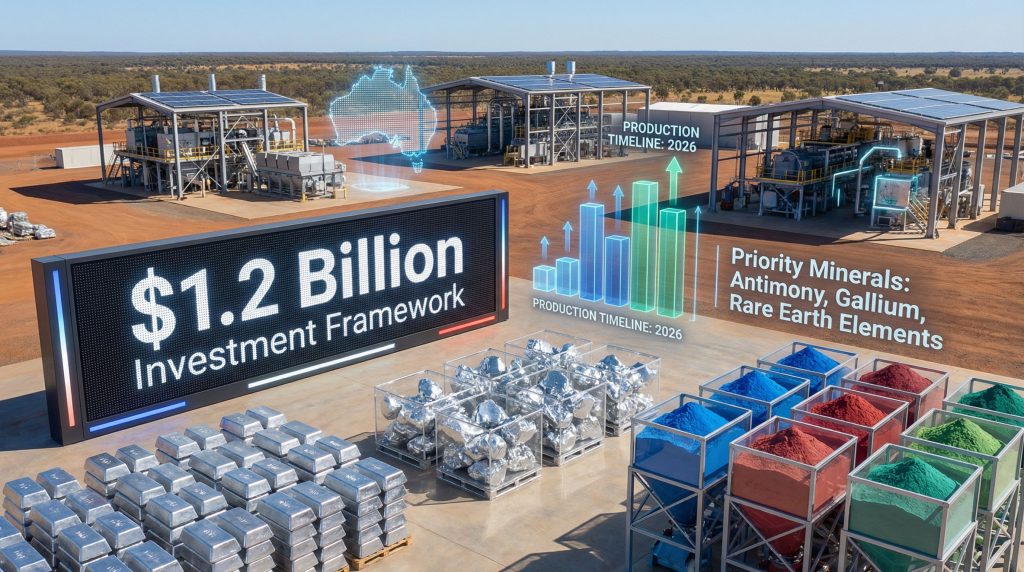
Australia's critical minerals strategic reserve represents a paradigm shift in resource management philosophy. Rather than simply accumulating physical inventory, this $1.2 billion AUD commitment establishes a rights-based acquisition framework designed to secure production capabilities whilst maintaining market flexibility. The initiative targets three priority minerals: antimony, gallium, and rare earth elements, each representing critical input materials for defence applications, semiconductor manufacturing, and clean energy infrastructure.
Furthermore, this strategic approach differs fundamentally from traditional commodity reserves. The framework secures rights to mineral production rather than physical stockpiles, allowing for responsive allocation based on real-time demand fluctuations whilst avoiding the storage costs and market distortions associated with conventional inventory models.
When big ASX news breaks, our subscribers know first
Financial Architecture and Implementation Framework
The critical minerals strategic reserve operates through a dual-funding mechanism designed to maximise operational flexibility whilst minimising fiscal risk. $1 billion AUD flows through the expanded Critical Minerals Facility, providing government-backed financing for eligible projects through loans and equity support. An additional $185 million AUD supports selective stockpiling operations and implementation costs where direct inventory accumulation proves strategically necessary.
Export Finance Australia receives enhanced legislative powers to facilitate reserve operations, representing a significant expansion of government intervention in mining. These enhanced authorities enable the organisation to execute complex rights-based transactions that secure future production whilst supporting private sector development.
The rights-based model functions by securing contractual access to mineral production from Australian operations, then reselling those rights to meet domestic and international demand. This approach provides several operational advantages:
• Market flexibility: Rights can be allocated based on real-time demand patterns
• Cost efficiency: Eliminates storage and inventory management expenses
• Price stability: Reduces direct market intervention whilst maintaining supply security
• Investment attraction: Provides demand certainty that supports project financing
Integration with the broader $5 billion AUD Critical Minerals Facility creates a comprehensive support ecosystem for strategic mineral development. Government-backed financing reduces project risk profiles, making previously marginal operations economically viable whilst accelerating development timelines for priority minerals.
Priority Mineral Selection and Strategic Rationale
Antimony: Defence Technology Dependencies
Antimony's inclusion reflects its critical role in defence applications and semiconductor manufacturing. This metalloid serves as a hardening agent for lead-based alloys used in ammunition and battery systems, whilst also functioning as a flame retardant in military equipment and electronic components.
However, global antimony production demonstrates concerning concentration patterns, with limited alternative supply sources creating vulnerability to supply disruptions. The mineral's strategic importance extends beyond military applications to include specialised electronics manufacturing and emerging battery technologies requiring specific performance characteristics.
In addition, efforts towards antimony domestic production demonstrate Australia's potential while highlighting technical complexities. This gold-antimony operation demonstrates Australia's domestic production potential whilst highlighting the technical complexities associated with antimony extraction and processing.
Gallium: Semiconductor Manufacturing Critical Path
Gallium represents a unique challenge in strategic mineral security due to its production method as a byproduct of aluminium and zinc smelting operations. This dependency relationship means gallium availability correlates directly with primary metal production levels, creating supply vulnerabilities independent of gallium-specific demand patterns.
The mineral's applications span integrated circuit manufacturing, light-emitting diodes, and photovoltaic cells. Modern semiconductor fabrication relies heavily on gallium arsenide compounds for high-frequency applications and specialised electronic devices essential to defence and telecommunications infrastructure.
Australia's aluminium industry provides a foundation for domestic gallium production, though specialised extraction and purification facilities require significant technical investment. The strategic reserve framework could support development of processing capabilities that currently limit Australia's participation in gallium value chains.
Rare Earth Elements: Clean Energy Infrastructure Foundation
Rare earth elements encompass seventeen chemically similar elements essential to permanent magnet production, catalysts, and phosphor materials. These materials enable wind turbine generators, electric vehicle motors, and advanced battery systems critical to clean energy transition objectives.
The complexity of rare earth processing represents a significant technical barrier to supply chain diversification. Mining operations must be coupled with sophisticated separation facilities capable of isolating individual rare earth elements to required purity levels. This processing gap currently limits Australia's participation in rare earth value chains despite substantial mineral endowments.
Lynas Rare Earths operates Australia's primary commercial rare earth facility, demonstrating both the technical feasibility and economic challenges of domestic processing. The critical minerals strategic reserve framework could support expansion of processing capabilities whilst securing access to specific rare earth elements for strategic applications.
International Alliance Integration and Supply Chain Resilience
Australia's critical minerals strategic reserve explicitly targets collaboration with democratic allies seeking supply chain diversification. Six key partner nations have been identified for coordination: the United States, Japan, South Korea, European Union member states, Canada, and the United Kingdom.
This alliance framework addresses single-point-of-failure vulnerabilities that have emerged in global mineral supply chains. Traditional supply concentration in specific geographic regions creates systemic risks for technology manufacturers and defence contractors across allied nations.
Furthermore, these developments have significant global market impacts as nations seek to reduce dependencies. The strategic reserve supports global supply chains of partner nations whilst positioning Australia as a reliable alternative supplier for critical materials essential to technological advancement and national security.
Diplomatic engagement includes high-level briefings with trading partners to coordinate supply commitments and technical standards. This coordination ensures Australian production meets quality specifications required by international manufacturers whilst establishing long-term supply relationships that support project financing.
The alliance approach creates redundant supply pathways that enhance collective resilience against supply disruptions. By developing alternative sources for critical minerals, allied nations reduce dependencies on potentially unstable supply relationships whilst supporting technological sovereignty objectives.
Comparative Analysis: International Strategic Reserve Models
| Nation | Reserve Type | Funding Scale | Primary Focus | Operational Model |
|---|---|---|---|---|
| Australia | Rights-based | $1.2B AUD | Antimony, gallium, rare earths | Production rights acquisition |
| United States | Physical stockpile | Variable | Defence-critical materials | Government inventory |
| European Union | Strategic partnerships | €43B EUR | Diversified supply chains | Private-public collaboration |
| Japan | Hybrid model | $2.8B USD | Technology metals | Stockpiling plus partnerships |
| South Korea | Strategic stockpiling | $1.1B USD | Battery materials | Government reserves |
Australia's rights-based approach represents an innovative departure from traditional stockpiling methodologies. Unlike physical inventory systems that require substantial storage infrastructure and periodic inventory rotation, the rights-based model maintains operational flexibility whilst supporting domestic production development.
The European Union's approach emphasises strategic partnerships and supply chain diversification through extensive funding for alternative supply relationships. This model focuses on reducing supply concentration through market-based incentives rather than direct government ownership of strategic materials.
Japan's hybrid approach combines selective physical stockpiling with strategic partnerships, reflecting the nation's experience with supply chain vulnerabilities during previous commodity market disruptions. This model provides immediate supply security through inventory whilst developing alternative supply relationships for long-term resilience.
Implementation Challenges and Risk Assessment
Technical and Processing Capacity Limitations
Australia's mineral processing capabilities represent a critical constraint on strategic reserve effectiveness. Whilst the nation possesses substantial mineral endowments, limited domestic processing facilities create dependencies on international separation and refining operations.
Rare earth processing exemplifies this challenge. Mining operations can extract rare earth-bearing ores, but conversion to individual rare earth oxides requires specialised chemical processing facilities with significant environmental management requirements. Current processing gaps limit Australia's ability to supply finished rare earth products without international processing partnerships.
Antimony and gallium processing present distinct technical challenges. Antimony extraction from complex ores requires specialised metallurgical techniques, whilst gallium recovery from aluminium production demands sophisticated chemical separation processes. Both minerals require substantial technical investment to establish domestic processing capabilities.
Market Volatility and Economic Considerations
Critical mineral markets demonstrate significant price volatility that complicates reserve economics. Rights-based acquisitions must account for potential price fluctuations that could affect the economic viability of securing production commitments during market downturns.
The strategic reserve must balance support for domestic production with competitive pricing for international customers. Excessive pricing premiums could reduce international demand, whilst insufficient pricing support might fail to incentivise domestic production expansion.
Long-term demand forecasting presents substantial uncertainty given rapidly evolving technology requirements and potential substitution developments. Reserve commitments must maintain flexibility to adjust allocation priorities based on changing strategic requirements and technological developments.
Regulatory and Environmental Approval Processes
Mining project development timelines depend heavily on regulatory approval processes that can extend development schedules significantly. The Association of Mining and Exploration Companies has emphasised the importance of streamlined permitting processes to achieve strategic reserve objectives within projected timelines.
Environmental assessment requirements for critical mineral projects often involve complex technical studies and public consultation processes. These requirements, whilst necessary for responsible development, can create substantial delays that affect reserve implementation schedules.
State and federal coordination presents additional complexity given overlapping regulatory jurisdictions for mining operations. Effective reserve implementation requires coordinated approaches across multiple government levels to ensure consistent regulatory treatment for priority projects.
The next major ASX story will hit our subscribers first
Industry Response and Investment Implications
Mining industry associations have generally welcomed the critical minerals strategy announcement whilst emphasising the need for detailed operational frameworks. The Association of Mining and Exploration Companies has proposed specific implementation mechanisms through its Strategic Reserve scheme, focusing on taxpayer risk minimisation whilst supporting project development.
Investment community response reflects recognition of the risk reduction benefits provided by government demand commitments. Strategic reserve support can improve project financing conditions by providing partial demand certainty that reduces market risk for private investors.
The framework's impact on critical minerals project valuations remains under assessment as specific operational details emerge. Projects targeting priority minerals may experience valuation improvements based on enhanced demand security, whilst broader market effects depend on reserve scale relative to total market demand.
International mining companies have expressed interest in Australian operations that could benefit from strategic reserve support. Government backing may attract foreign investment in domestic processing capabilities that previously faced uncertain market conditions.
Performance Measurement and Success Metrics
Strategic reserve success requires comprehensive performance metrics that address both immediate objectives and long-term strategic outcomes. Key performance indicators include:
Supply Security Metrics:
• Percentage of domestic critical mineral requirements secured through reserve commitments
• Reduction in supply chain vulnerability scores for priority minerals
• Number of alternative suppliers developed for each priority mineral
• Response time for supply allocation during market disruptions
Economic Impact Assessment:
• Private investment attracted to critical minerals projects
• Job creation in mining and processing sectors
• Export revenue generation from strategic mineral sales
• Return on government investment through rights transactions
Strategic Partnership Development:
• Number of long-term supply agreements established with allied nations
• Integration level with partner nation strategic reserve programs
• Technology transfer agreements supporting domestic processing development
• Coordination effectiveness during supply chain disruption events
Market Stability Indicators:
• Price volatility reduction for priority minerals
• Market confidence measures in Australian critical minerals supply
• Supply disruption recovery times with reserve support
• Competition impact on global mineral markets
Future Scenarios and Strategic Implications
Optimal Development Pathway
Successful implementation could position Australia as the primary democratic supplier of critical minerals to allied nations. This scenario involves full development of domestic processing capabilities, creation of integrated supply chains from extraction to finished products, and establishment of long-term export revenue streams.
Enhanced national security emerges through reduced dependence on potentially unstable supply relationships whilst providing strategic leverage in international negotiations. Regional development benefits extend to resource-rich areas through job creation and infrastructure investment supported by strategic reserve commitments.
Moreover, energy transition security becomes enhanced through integration with clean energy deployment objectives. Domestic rare earth processing capabilities support local renewable energy manufacturing whilst reducing international supply dependencies.
Moderate Success Framework
Partial achievement of strategic objectives presents a more realistic scenario involving mixed success across priority minerals. Some processing capabilities develop whilst others remain dependent on international partnerships, creating selective self-sufficiency rather than comprehensive supply independence.
International partnerships achieve varying levels of success based on partner nation priorities and market conditions. Trade relationships with some allies strengthen whilst others maintain existing supply arrangements, resulting in partial diversification of global supply chains.
Economic returns meet basic expectations without achieving transformational impacts on the Australian economy. Strategic reserve operations generate positive returns whilst supporting modest expansion of the critical minerals sector without dramatic market positioning changes.
Challenge Management Scenario
Implementation difficulties could limit critical minerals strategic reserve effectiveness through technical, regulatory, or market challenges. Permitting delays slow project development, creating gaps between reserve commitments and actual production capabilities.
International competition for the same mineral resources intensifies as other nations implement similar strategic initiatives. Market distortions emerge from multiple government interventions, creating pricing instability that complicates private sector planning.
Processing capability development faces greater technical and financial hurdles than anticipated, maintaining dependence on international facilities for finished product supply. Limited success in building domestic value-added capabilities restricts economic benefits whilst maintaining supply vulnerabilities.
Long-term Strategic Evolution
The critical minerals strategic reserve represents an initial framework likely to evolve based on operational experience and changing strategic requirements. Future expansions may include additional priority minerals as technological developments create new strategic dependencies.
Integration with broader industrial policy objectives could expand reserve functions beyond supply security to include technology development support and manufacturing capability enhancement. This evolution would transform the reserve from a supply tool into a comprehensive industrial development mechanism.
Additionally, the Australian Government has established official frameworks for implementation, whilst international coordination may deepen through multilateral reserve management frameworks that coordinate allied nation strategic reserves for maximum collective effectiveness. Such coordination could create distributed supply security systems that enhance resilience whilst reducing individual nation investment requirements.
Disclaimer: This analysis is based on publicly available information and government statements regarding Australia's Critical Minerals Strategic Reserve. Implementation details remain under development, and operational outcomes may vary significantly from current projections. Investment decisions should not be based solely on this analysis without additional due diligence and professional consultation.
Ready to Capitalise on Strategic Mineral Opportunities?
Discovery Alert's proprietary Discovery IQ model delivers real-time alerts on significant ASX mineral discoveries across critical minerals and commodities, instantly empowering subscribers to identify actionable opportunities ahead of the broader market. Begin your 30-day free trial today and explore Discovery Alert's dedicated discoveries page to understand why major mineral discoveries can generate exceptional returns for informed investors.