August 22, 2026
Strategic Risk Assessment: Oil Prices Extending Gains on Middle East Tensions
Petroleum markets operate within complex frameworks where geopolitical stability directly influences price discovery mechanisms and investment strategies. Current market dynamics in February 2026 reflect heightened uncertainty as regional conflicts create cascading effects through global energy systems. The interconnected nature of modern petroleum trading means that localised military incidents can trigger immediate price volatility across international benchmarks.
Understanding these transmission mechanisms requires analysis of multiple variables including strategic reserve deployment, alternative routing capabilities, and diplomatic intervention protocols. Market participants must navigate an environment where traditional supply-demand fundamentals interact with risk premiums that can shift dramatically within trading sessions.
When big ASX news breaks, our subscribers know first
Current Market Risk Premium Analysis
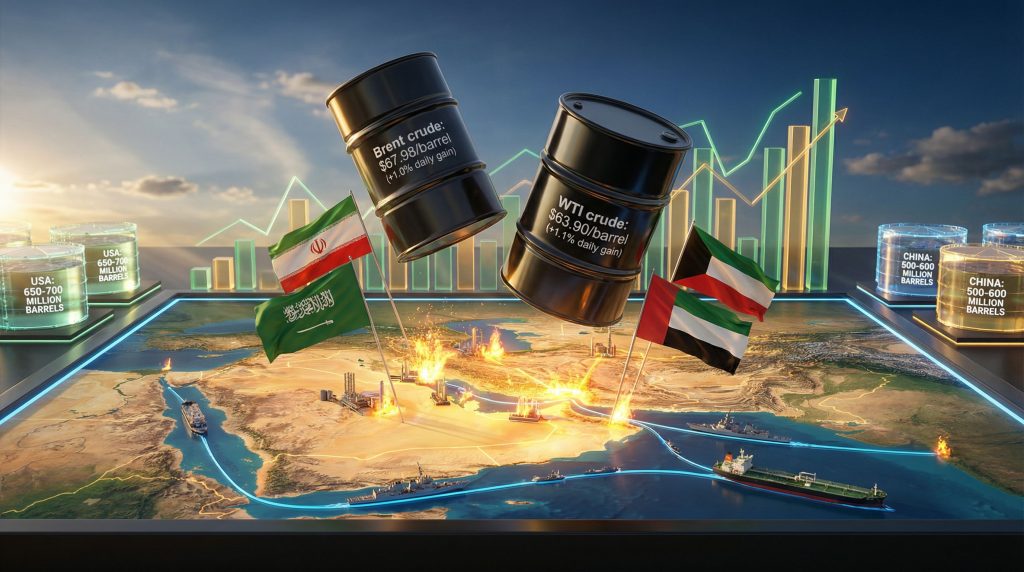
The petroleum markets demonstrate extraordinary sensitivity to regional security developments, with price movements reflecting both actual supply disruptions and perceived escalation risks. Brent crude reached $67.98 per barrel on February 4, 2026, representing a 1.0% daily gain, while West Texas Intermediate crude climbed to $63.90 per barrel with a 1.1% increase. These price movements followed documented military confrontations in critical shipping lanes, as evidenced by recent Middle East naval clashes.
The risk premium embedded in current pricing reflects market assessment of potential supply disruptions affecting approximately 20-25% of global petroleum liquids that transit through the Strait of Hormuz. This concentration creates extraordinary vulnerability where even minor incidents can trigger significant price reactions across global markets.
Furthermore, analysts have been tracking these developments closely, with comprehensive oil price rally analysis revealing underlying market pressures that extend beyond immediate geopolitical concerns.
Infrastructure Vulnerability Metrics
Critical petroleum infrastructure faces multiple threat vectors that market participants continuously monitor for early warning signals. The following facilities represent primary concern areas:
- Saudi Aramco processing facilities: Handle 12+ million barrels daily
- UAE export terminals: Process 3+ million barrels daily
- Kuwait production infrastructure: Manages 2.5+ million barrels daily
- Iraq pipeline networks: Transport 4+ million barrels daily
The cumulative exposure across these systems exceeds 22 million barrels daily, representing nearly 25% of global petroleum production. Any coordinated attacks or systematic disruptions affecting multiple facilities could create supply shortages exceeding strategic reserve replacement capabilities.
Military Incident Transmission Mechanisms
Recent confrontations illustrate how specific events translate into immediate market reactions through established price discovery mechanisms. The U.S. military engagement with Iranian forces on February 3-4, 2026, created immediate volatility as traders reassessed probability distributions for further escalation scenarios.
The documented incidents included Iranian drone operations approaching U.S. naval assets and gunboat confrontations with commercial vessels in the Strait of Hormuz. These events occurred in waters facilitating exports from Iran, Saudi Arabia, UAE, Kuwait, and Iraq, collectively representing the majority of OPEC production capacity.
However, recent oil price tariff impact studies suggest that broader geopolitical factors, including trade policy changes, continue to influence market sentiment alongside Middle Eastern tensions.
Inventory Impact Assessment
U.S. commercial crude inventories experienced an 11 million barrel decline during the week preceding February 4, 2026, according to American Petroleum Institute data. This inventory draw occurred despite analyst expectations for increases, signalling underlying supply tightness that amplifies geopolitical risk premiums.
The inventory decline pattern suggests that fundamental supply-demand conditions have shifted toward relative balance, contradicting pure oversupply characterisations. Current market structure indicates that prices above $65-67 per barrel may represent genuine equilibrium rather than artificially elevated geopolitical premiums.
In addition, the US oil production decline has contributed to tighter domestic supply conditions, further supporting the current price structure.
Price Scenario Framework Analysis
Containment Scenario: $55-70 Range Dynamics
The baseline containment scenario assumes current tensions remain localised without expanding to broader regional conflict affecting multiple petroleum-producing nations. This scenario relies on several supporting mechanisms:
Strategic Reserve Coordination: The United States maintains approximately 650-700 million barrels in strategic reserves, while China holds an estimated 500-600 million barrels. Combined with Japanese reserves of 150-200 million barrels and European Union holdings of 120-150 million barrels, coordinated releases could offset 3-5 million barrels daily for 30-60 days.
Alternative Supply Flexibility: U.S. shale production maintains breakeven costs around $35-45 per barrel, enabling rapid production increases when prices sustain above $55-60 per barrel levels. However, this flexibility operates with typical 12-18 month lags between investment decisions and actual production increases.
Diplomatic Intervention Protocols: Multiple mediation channels remain active, including bilateral discussions and OPEC+ coordination mechanisms. Economic incentives favour de-escalation, as Iran depends on oil exports for 60-70% of government revenue while Saudi Arabia maintains 40-50% fiscal dependence on petroleum.
Consequently, OPEC production strategies remain critical for maintaining market stability during periods of heightened uncertainty.
Infrastructure Targeting: $80-100 Spike Potential
Direct attacks on production facilities represent the most immediate escalation scenario capable of removing significant supply volumes from global markets. Historical precedent from the September 2019 Saudi Aramco attacks demonstrates this mechanism's potency, where precision strikes temporarily removed 5.7 million barrels daily, creating price spikes exceeding $15 per barrel within 24 hours.
The targeting scenario assumes coordinated attacks affecting multiple critical facilities simultaneously, overwhelming alternative supply arrangements and strategic reserve deployment capabilities. This scenario probability increases during periods of sustained diplomatic breakdown and military positioning escalation.
Maximum Disruption: Strait Closure Implications
Complete Strait of Hormuz disruption represents the extreme scenario with potential for $100-150 per barrel pricing. However, economic realities create natural limitations on sustained closure scenarios. Iran's own export dependence creates incentives for maintaining transit capabilities even during periods of heightened confrontation.
For instance, detailed analysis of OPEC tariff impacts reveals how broader trade considerations influence production and export decisions during geopolitical crises.
Strategic Reserve Deployment Analysis
Global Inventory Distribution
Strategic petroleum reserves serve as primary market stabilisation mechanisms during acute supply disruptions. Current inventory levels provide varying replacement capacity across major consuming regions:
| Country/Region | Strategic Reserves | Import Replacement Capacity |
|---|---|---|
| United States | 650-700 million barrels | 90-120 days |
| China | 500-600 million barrels | 60-90 days |
| Japan | 150-200 million barrels | 60-75 days |
| European Union | 120-150 million barrels | 45-60 days |
Coordinated Release Protocols
International Energy Agency frameworks enable coordinated reserve releases when crude benchmarks exceed predetermined thresholds. Current Brent pricing at $67.98 remains below typical $75-80 per barrel trigger levels, suggesting coordinated strategic reserve deployment remains unlikely unless prices spike dramatically.
The coordination mechanism requires minimum 90-day notification periods for member country releases, limiting rapid response capabilities during acute crisis scenarios. This timeline constraint emphasises the importance of alternative supply flexibility and diplomatic intervention during initial escalation phases.
Commercial Inventory Dynamics
Private sector storage responds rapidly to geopolitical developments through inventory building and floating storage deployment. Current inventory patterns signal market tightening despite fundamental oversupply conditions in preceding months.
Floating Storage Capacity
Floating storage in the Persian Gulf, Gulf of Oman, and broader Indian Ocean regions represents estimated 200-250 million barrels of deployable capacity. This storage availability effectively extends operational reserve timelines by 15-25 days for major consumers, providing secondary buffering beyond strategic petroleum reserves.
Traders utilise floating storage for multiple purposes including speculation on price improvements, supply chain flexibility during transit disruptions, and inventory management during periods of heightened uncertainty. Current deployment levels indicate market participants have elevated their risk assessments significantly compared to January 2026 baseline conditions.
The next major ASX story will hit our subscribers first
Diplomatic Complexity Assessment
Ongoing U.S.-Iran diplomatic discussions scheduled for February 2026 face significant procedural and substantive challenges that influence market psychology. Iran's demands to relocate talks from Turkey to Oman and narrow discussions to bilateral nuclear issues exclusively create uncertainty regarding negotiation viability.
These diplomatic complications contribute to risk premium calculations by introducing unpredictability regarding potential escalation pathways. Failed negotiations historically correlate with increased military confrontation probability, as diplomatic alternatives become exhausted and regional positioning becomes more aggressive.
Trade Agreement Implications
The February 2026 U.S.-India trade agreement included provisions regarding Indian purchases of Russian crude oil, creating additional supply chain pressures that support petroleum pricing. This agreement illustrates how geopolitical developments beyond direct Middle Eastern confrontation influence global petroleum market structure through sanctions regimes and political relationships.
Indian crude imports historically included substantial Russian volumes benefiting from sanctions-related price discounts. The policy shift toward reduced Russian purchases creates demand pressure supporting prices for competing supplies, including Middle Eastern crudes affected by current tensions.
Alternative Energy Acceleration Patterns
Sustained petroleum price volatility accelerates investment in renewable energy alternatives and domestic production capabilities, creating long-term structural changes in energy demand patterns. Current geopolitical tensions provide additional impetus for energy security planning that reduces petroleum dependence over strategic timeframes.
Investment Redirection Mechanisms
- Renewable energy project acceleration: Solar and wind installations receive increased funding priority
- Energy storage system deployment: Battery and alternative storage technologies gain investment focus
- Grid infrastructure modernisation: Smart grid capabilities reduce petroleum-based backup generation needs
- Domestic production technology development: Enhanced extraction and processing capabilities reduce import dependence
Regional Economic Impact Distribution
Gulf Cooperation Council Balancing Dynamics
GCC economies experience contradictory effects from elevated petroleum prices, benefiting from increased government revenues while facing tourism and trade disruption costs. The current environment accelerates diversification efforts as regional investment climates deteriorate during periods of uncertainty.
Higher petroleum prices provide fiscal benefits through increased export revenues, enabling continued infrastructure investment and economic development programs. However, regional instability creates offsetting costs through decreased foreign investment, tourism disruptions, and elevated security expenditures.
Global Consumer Transmission Effects
Sustained petroleum price increases translate directly into consumer inflation through multiple transmission mechanisms that may amplify economic impacts beyond immediate energy costs:
- Transportation cost inflation: Petrol and diesel price increases affect personal and commercial transport
- Industrial input cost pressures: Energy-intensive manufacturing faces margin compression
- Consumer discretionary spending reduction: Higher energy costs reduce available income for other purchases
- Central bank policy responses: Inflation concerns may trigger monetary policy tightening
Risk Management Framework Implementation
Professional energy traders employ sophisticated approaches during geopolitical tension periods, utilising options strategies and futures positioning to provide downside protection while maintaining upside participation. Current market conditions favour volatility-based strategies that capitalise on uncertainty rather than directional price movements.
Institutional Hedging Mechanisms
- Crude oil futures contracts: Provide direct price exposure management
- Volatility-based options strategies: Capitalise on uncertainty premiums
- Energy sector equity hedging: Manage broader energy investment exposure
- Currency exposure management: Address dollar-denominated commodity impacts
The 19-20 point increase in options volatility since January 2026 represents quantifiable evidence of market participants' elevated uncertainty assessments. This volatility expansion creates opportunities for protective strategies while increasing hedging costs for industrial consumers and portfolio managers.
Furthermore, comprehensive trading economic analysis provides valuable insights into these evolving market dynamics.
Forward-Looking Strategic Considerations
Market participants must evaluate multiple probability scenarios simultaneously, recognising that oil prices extending gains on Middle East tensions reflects complex interactions between immediate supply concerns, strategic reserve capabilities, and longer-term structural changes in global energy systems.
Current pricing at $67.98 for Brent crude incorporates significant uncertainty premiums that may dissipate rapidly if diplomatic solutions emerge or persist if confrontation patterns escalate. The key variables include Iran's position as the third-largest OPEC producer with capacity to influence approximately 3.3 million barrels daily of production, plus potential regional spillover effects affecting an additional 2-4 million barrels daily.
Strategic planning must account for timeline constraints in alternative supply development, with most infrastructure projects requiring 6-8 weeks minimum for implementation and full operational capacity often delayed until 2027 or later. These constraints emphasise the critical importance of diplomatic resolution and strategic reserve coordination during acute crisis periods.
Moreover, oil prices extending gains on Middle East tensions continues to shape both immediate trading strategies and longer-term energy security planning across major consuming nations.
Disclaimer: This analysis is for informational purposes only and should not be considered as financial advice. Oil market conditions can change rapidly, and investors should conduct their own research and consult with qualified financial professionals before making investment decisions. Geopolitical risk assessments involve significant uncertainty, and actual outcomes may differ materially from scenario projections discussed herein.
Looking to Capitalise on Energy Market Volatility?
Discovery Alert's proprietary Discovery IQ model delivers real-time alerts on significant ASX mineral discoveries, including energy-related opportunities that emerge during periods of market uncertainty. Stay ahead of major discoveries that can generate substantial returns by beginning your 14-day free trial today and position yourself to capture opportunities across all commodity sectors.