
May 16, 2026
Strategic Risk Frameworks Drive Container Shipping Recovery in Critical Trade Corridors
Global maritime logistics networks face unprecedented volatility as geopolitical tensions reshape traditional trade routes and force carriers to adopt sophisticated risk management protocols. The intersection of regional conflicts, diplomatic negotiations, and commercial imperatives creates complex decision matrices that determine when major shipping operators resume services in high-risk corridors. China's top shipper resumes Middle East trips amid Iran ceasefire talks, highlighting how commercial decisions increasingly reflect broader geopolitical developments.
Container shipping companies now deploy multi-scenario planning frameworks that integrate real-time intelligence feeds with quantitative risk assessments, fundamentally altering how the industry approaches route optimisation and capacity deployment during periods of instability.
When big ASX news breaks, our subscribers know first
Multi-Dimensional Risk Calculus for Gulf Region Operations
Advanced Route Selection Algorithms in High-Tension Environments
Major container lines utilise sophisticated modelling systems that evaluate dozens of variables when determining route viability during regional conflicts. These algorithms process insurance premium fluctuations, fuel cost variations, transit time extensions, and cargo damage probabilities to generate risk-adjusted profitability scores for each potential routing option.
Key Risk Assessment Variables:
• Security incident probability matrices based on historical data and current threat intelligence
• Port accessibility ratings that factor in local infrastructure and operational capacity
• Alternative routing costs including overland transportation and transshipment expenses
• Customer contract penalties for delayed or cancelled shipments
• Insurance coverage gaps and premium adjustments for specific geographic zones
The most sophisticated operators integrate these variables into dynamic pricing models that automatically adjust freight rates based on evolving security conditions, enabling rapid operational pivots when circumstances change.
Economic Incentive Analysis for High-Risk Market Re-entry
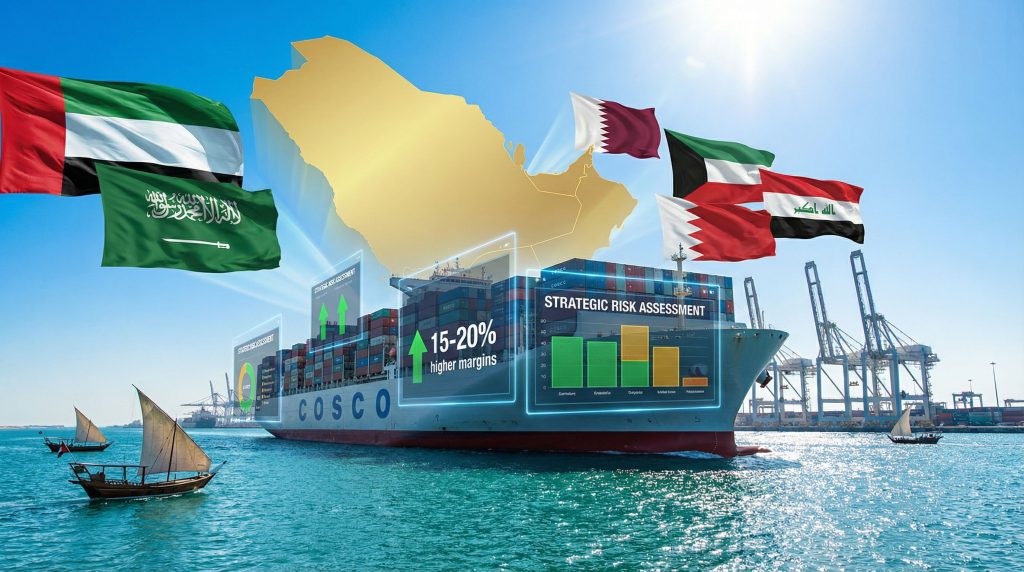
Container shipping margins in the Gulf region typically exceed standard Asian trade lane profitability by 15-20% due to limited competition and specialised cargo requirements. This premium pricing creates powerful financial incentives for early market re-entry, even when security risks remain elevated.
Regional Profitability Comparison Table:
| Trade Route | Average Margin | Risk Premium | Total Return |
|---|---|---|---|
| Asia-Europe | 8-12% | 2-3% | 10-15% |
| Asia-Gulf | 18-25% | 5-8% | 23-33% |
| Trans-Pacific | 12-18% | 1-2% | 13-20% |
| Intra-Asia | 6-10% | 1% | 7-11% |
These enhanced margins reflect both the specialised nature of Gulf cargo (petrochemicals, construction materials, high-value electronics) and the reduced competitive intensity that results when multiple carriers suspend operations simultaneously.
Intelligence Integration and Diplomatic Coordination
Commercial-Diplomatic Information Sharing Networks
Leading container operators maintain sophisticated intelligence networks that coordinate with diplomatic channels to anticipate conflict escalation or de-escalation scenarios. Furthermore, this coordination enables strategic positioning ahead of formal announcements or treaty negotiations.
The timing correlation between major carriers' operational decisions and diplomatic developments suggests systematic information sharing between commercial entities and government intelligence services. Consequently, this coordination provides carriers with advance notice of potential security improvements, enabling first-mover advantages in market re-entry.
Scenario-Based Operational Planning Frameworks
Modern container shipping operations incorporate multiple contingency scenarios into their route planning systems. In addition, these frameworks must account for broader economic implications, as the US‑China trade war demonstrates how geopolitical tensions cascade through global logistics networks.
Escalation Scenario Planning:
- Immediate Withdrawal Protocols: Pre-positioned assets enable rapid evacuation within 24-48 hours
- Partial Service Reduction: Selective port avoidance while maintaining core route structure
- Alternative Routing Activation: Pre-negotiated overland corridors and secondary port agreements
- Insurance Claim Procedures: Streamlined processes for cargo recovery and delay compensation
De-escalation Scenario Planning:
- Phased Market Re-entry: Gradual capacity restoration based on security assessment updates
- Premium Contract Negotiation: Leveraging scarcity to secure favourable long-term agreements
- Capacity Optimisation: Matching vessel deployment with recovering demand patterns
- Competitive Positioning: Strategic timing to maximise market share gains
Infrastructure Resilience and Alternative Corridor Development
Overland Transportation Network Expansion
Regional conflicts accelerate investment in alternative transportation infrastructure that bypasses traditional maritime chokepoints. Chinese logistics companies are evaluating permanent rail and road network investments connecting Central Asia to Middle Eastern markets, potentially reducing future dependence on vulnerable sea routes.
These overland corridors offer transit times comparable to maritime shipping for certain cargo types while providing greater route security and predictability during periods of naval tension. However, tariff impacts on markets may influence the viability of these alternative routing strategies.
Port Diversification and Redundancy Planning
Gulf region ports are implementing comprehensive redundancy strategies to maintain cargo flow during future disruptions. Moreover, these investments reflect changing global trade patterns as the multipolar global economy emerges.
Port Infrastructure Enhancements:
• Expanded storage capacity at eastern Gulf facilities to buffer supply chain disruptions
• Enhanced intermodal connections enabling rapid cargo rerouting between maritime and overland transport
• Automated handling systems that maintain operations with reduced workforce during security alerts
• Backup communication networks ensuring coordination during infrastructure attacks
These investments reflect a fundamental shift from efficiency-optimised logistics networks toward resilience-focused architectures that can maintain functionality under adverse conditions.
Supply Chain Restructuring and Inventory Strategy Evolution
Strategic Buffer Inventory Implementation
The recent shipping suspension prompted major importers to reassess just-in-time inventory models, with many shifting toward strategic buffer approaches for critical components sourced through Middle Eastern routes. This represents a fundamental change from lean supply chain optimisation toward resilience-focused inventory management.
According to China's COSCO shipping giant's recent operational updates, China's top shipper resumes Middle East trips amid Iran ceasefire talks as part of broader strategic repositioning efforts.
Inventory Strategy Transformation:
• Critical component buffers increased from 7-14 days to 45-90 days for essential materials
• Supplier diversification requirements mandating multiple geographic sources for key inputs
• Regional distribution centres strategically located to serve multiple markets during disruptions
• Emergency procurement protocols pre-negotiated with alternative suppliers across different regions
Dynamic Insurance and Risk Premium Models
Marine insurance markets are implementing sophisticated pricing models that adjust premiums based on real-time geopolitical assessments rather than static annual rates. This creates dynamic cost structures that shipping companies must incorporate into their operational planning frameworks.
Risk Premium Adjustment Factors:
| Risk Factor | Premium Impact | Adjustment Frequency |
|---|---|---|
| Diplomatic tensions | 15-30% increase | Weekly assessment |
| Military incidents | 50-100% increase | Daily adjustment |
| Port accessibility | 10-25% increase | Real-time updates |
| Alternative routes | 5-15% decrease | Monthly review |
These dynamic pricing mechanisms force carriers to maintain flexible operational strategies that can adapt to rapidly changing cost structures.
Strategic Maritime Policy and Economic Diplomacy
State-Owned Enterprise Coordination with Foreign Policy
The operational decisions of state-owned shipping companies increasingly reflect broader strategic interests in maintaining economic relationships while avoiding direct involvement in regional conflicts. This demonstrates how commercial maritime operations serve as instruments of economic diplomacy.
State-controlled carriers often resume operations ahead of privately-owned competitors, leveraging government intelligence resources and diplomatic protection to minimise commercial risks while advancing national economic objectives. For instance, the timing of when China's top shipper resumes Middle East trips amid Iran ceasefire talks reflects sophisticated coordination between commercial and diplomatic interests.
Belt and Road Initiative Route Diversification
Current regional tensions highlight vulnerabilities in maritime components of China's Belt and Road Initiative, accelerating development of alternative transportation corridors through Central Asia and the Caucasus region. These investments provide strategic alternatives to traditional shipping routes while reducing dependence on potentially volatile maritime passages.
"The development of multiple transportation corridors reflects a systematic approach to reducing single-point-of-failure risks in international trade networks, with implications extending far beyond current regional conflicts."
The next major ASX story will hit our subscribers first
Market Psychology and Competitive Dynamics
First-Mover Advantages in Post-Crisis Recovery
Container lines that resume operations early in crisis recovery cycles typically secure 20-30% higher freight rates than pre-crisis levels due to reduced competitive supply and pent-up demand from suspended services. This creates powerful incentives for risk-taking behaviour among major carriers.
Early market re-entry also enables carriers to lock in favourable long-term contracts with regional importers who faced supply chain disruptions, creating sustained competitive advantages that extend beyond immediate crisis recovery periods. Furthermore, oil price rallies during periods of regional tension can significantly impact shipping economics.
Qualification Processes and Customer Lock-in Effects
Defence and industrial customers utilise rigorous supplier qualification processes that can take 18-36 months to complete. Once qualified, suppliers tend to maintain relationships for years due to the complexity and cost of switching providers, creating competitive moats for companies that successfully navigate qualification requirements.
This dynamic is particularly relevant for specialised cargo requiring specific handling protocols or security clearances, where the barrier to entry for new competitors remains significantly elevated.
Regional Trade Architecture Transformation
Permanent Structural Changes in Logistics Networks
The current crisis is driving permanent changes in regional trade architecture that will persist beyond immediate conflict resolution. Additionally, the broader implications of the US economy & tariffs must be considered when evaluating long-term structural shifts.
Structural Network Modifications:
• Redundant routing capabilities built into long-term shipping contracts
• Flexible port allocation agreements enabling rapid capacity shifts between facilities
• Multi-modal transportation integration combining maritime, rail, and road transport seamlessly
• Regional cargo consolidation hubs positioned to serve multiple markets efficiently
Integration of Real-Time Intelligence in Commercial Operations
Modern container shipping increasingly integrates real-time geopolitical intelligence into operational decision-making frameworks. This represents a fundamental evolution from reactive crisis management toward predictive operational optimisation based on conflict probability modeling.
The sophistication of these intelligence integration systems suggests that commercial shipping strategies will increasingly resemble military logistics planning, with multiple contingency options maintained simultaneously and activation decisions based on continuously updated threat assessments. As reported by OilPrice.com's analysis of recent developments, China's top shipper resumes Middle East trips amid Iran ceasefire talks demonstrates this evolution toward intelligence-driven commercial operations.
Disclaimer: This analysis contains forward-looking assessments regarding shipping industry dynamics and geopolitical developments. Actual outcomes may vary significantly from projections due to the inherently unpredictable nature of regional conflicts and diplomatic negotiations. Readers should conduct independent research and consult with qualified advisors before making commercial or investment decisions based on this analysis.
Ready to Navigate Volatile Maritime Markets?
Discovery Alert's proprietary Discovery IQ model delivers real-time alerts on significant ASX mineral discoveries, instantly empowering subscribers to identify actionable opportunities in mining companies that supply critical materials for global trade infrastructure. Begin your 14-day free trial today and secure your market-leading advantage in commodity-driven sectors that benefit from evolving international trade patterns.