
August 21, 2026
The Strategic Risk Landscape of Mexico's Precious Metals Industry
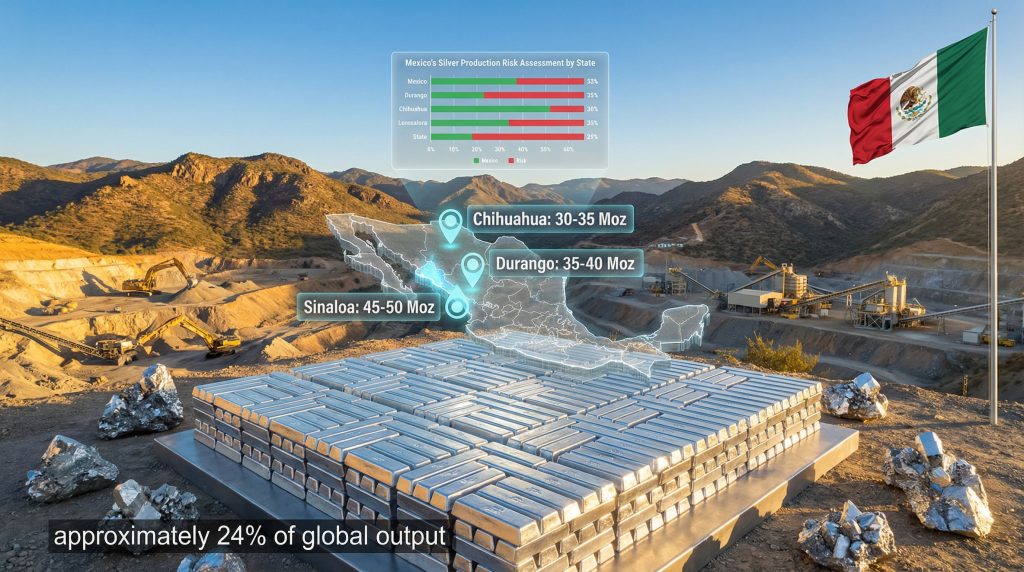
Mexico's silver mining operations face an unprecedented intersection of geological opportunity and security challenges that fundamentally reshape investment dynamics across the precious metals sector. The complex relationship between drug cartels and silver mining in Mexico has created a unique risk environment where criminal organisations systematically exploit mining operations through sophisticated extortion schemes. With the country producing approximately one-quarter of global silver output, mining companies must navigate complex risk matrices involving organised crime, regulatory frameworks, and community stakeholder relationships whilst pursuing some of the world's highest-grade silver deposits.
Understanding these dynamics requires moving beyond traditional mining investment analysis to incorporate geopolitical risk analysis, operational security protocols, and the evolving relationship between legitimate mining enterprises and criminal organisations that control significant portions of Mexico's mineral-rich territories. Furthermore, investors must recognise how these security challenges intersect with broader investment risk red flags that could signal operational vulnerabilities.
When big ASX news breaks, our subscribers know first
Criminal Organisation Revenue Models in Mining Regions
The systematic approach criminal organisations take toward mining operations reveals sophisticated business models that extend far beyond opportunistic crime. These groups have developed diversified revenue streams that exploit multiple vulnerabilities within mining value chains, creating what industry analysts describe as a parallel taxation system.
Primary Revenue Extraction Methods:
• Monthly protection payments ranging from 200,000 to 500,000 pesos
• Percentage-based taxation on mineral production output
• Mandatory equipment and vehicle rental arrangements
• Transportation corridor access fees
• Worker housing and logistics service charges
The February 2026 incident involving Vizsla Silver Corporation demonstrates the escalation potential within this framework. The company reportedly faced monthly extortion demands of 200,000 pesos (approximately $11,760 USD) before criminal elements kidnapped ten workers from their Panuco project in Sinaloa state, demanding 10 million pesos per worker in ransom payments.
This represents a fifty-fold escalation from routine monthly payments to crisis-level demands, illustrating how operational security can deteriorate rapidly in contested territories. The incident resulted in reported fatalities among the kidnapped workers, four arrests in connection with the crimes, and a 50% decline in Vizsla Silver's share price. However, the broader implications extend beyond individual companies to affect the entire mining industry evolution.
Geographic Risk Distribution Across Mining States
Mexico's silver production concentrates in states with varying levels of criminal organisation presence, creating distinct risk profiles for mining operations. Consequently, understanding regional security dynamics becomes crucial for operational planning.
| State | Security Environment | Operational Implications |
|---|---|---|
| Sinaloa | Heavy cartel presence | Extreme security protocols required |
| Durango | Established cartel territories | Moderate security arrangements |
| Chihuahua | Mixed criminal activity | Variable risk by specific location |
| Zacatecas | Contested cartel boundaries | High volatility in security conditions |
The Economics of Risk Tolerance in Precious Metals Mining
Despite documented security challenges, mining companies continue operations in high-risk Mexican territories due to compelling economic fundamentals that often justify elevated security costs and operational modifications. The intersection of drug cartels and silver mining in Mexico creates a complex cost-benefit analysis where companies must balance exceptional mineral wealth against substantial security expenses.
Cost Structure Advantages:
Labour expenses in Mexican mining operations run 60-70% below comparable North American facilities, creating substantial operational savings that can absorb security-related expenses whilst maintaining profitable margins. This cost differential, combined with reduced regulatory compliance burdens and access to established processing infrastructure, provides competitive advantages that many operators find difficult to replicate elsewhere.
Resource Quality Justifications:
Mexican silver deposits frequently contain ore grades exceeding global averages, translating directly into higher per-unit extraction revenues. In addition, the combination of high-grade deposits, established geological surveys, existing transportation networks, and favourable mining concession frameworks creates technical conditions that support continued operations despite security challenges.
Operational Security Adaptations and Risk Mitigation
Mining companies operating in contested territories have developed sophisticated security protocols that address criminal organisation activities whilst maintaining operational efficiency. These adaptations reflect lessons learned from incidents where drug cartels and silver mining in Mexico intersect with devastating consequences.
Concentrate Shipping Protocols
One of the most significant operational adaptations involves deliberate avoidance of on-site metal refining. Rather than processing silver ore into finished bars or ingots on-site, companies ship unrefined concentrates that visually resemble ordinary mining dirt or tailings.
This strategy, documented in operations at Avino Silver's Durango facilities, reflects explicit risk management rather than efficiency considerations. Mining industry sources note that shipping unprocessed concentrate eliminates the visual appeal that finished silver bars would present to criminal organisations whilst maintaining operational profitability through downstream processing arrangements.
Furthermore, this approach demonstrates how companies adapt traditional mining processes to address security concerns, reflecting the broader transformation occurring across the mining industry evolution. However, such adaptations also highlight the limitations that security concerns place on advanced mining technology implementation.
Community Stakeholder Protection Dynamics
A critical but often overlooked security factor involves alignment between mining operations and local community interests. Rural populations in mining regions frequently depend heavily on these operations for employment, creating informal protective networks where communities may actively resist criminal interference that threatens their economic lifeline.
This stakeholder dynamic creates natural deterrents to criminal organisation activities, as local workforces understand that mining operation disruption eliminates one of the few sources of stable employment in remote regions. The economic dependency relationship often results in community-based intelligence networks and social pressure against activities that might drive mining companies out of the region.
Corporate Structure Risk Management
Larger mining operators employ geographic diversification strategies that distribute operational risk across multiple jurisdictions whilst maintaining exposure to Mexico's profitable deposits. For instance, this approach helps companies navigate the complex relationship between drug cartels and silver mining in Mexico without abandoning lucrative projects entirely.
Pan American Silver Diversification Model:
Pan American Silver operates across six countries, including Mexico, Peru, Brazil, Bolivia, Chile, and Argentina. This geographic distribution allows the company to maintain Mexican operations whilst limiting single-country risk exposure that could threaten overall corporate viability.
As a company with approximately $25 billion in market capitalisation, Pan American Silver demonstrates how larger operators can fund enhanced security protocols, maintain government relations capabilities, and implement operational flexibility that smaller developers cannot match.
Investment Risk Assessment and Valuation Implications
The security challenges facing Mexican mining operations create distinct investment dynamics that influence company valuations, portfolio construction strategies, and investor risk tolerance. The ongoing issues surrounding drug cartels and silver mining in Mexico have fundamentally altered how investors assess precious metals companies operating in the region.
Risk Premium Analysis
Mexican mining operations typically trade at significant discounts to comparable operations in more stable jurisdictions, reflecting market recognition of operational uncertainties:
| Jurisdiction Category | Typical Valuation Multiple | Risk Premium |
|---|---|---|
| US/Canadian Operations | 15-18x earnings | Baseline |
| Mexican Operations | 12-14x earnings | 15-25% discount |
| Other Latin American | 13-15x earnings | 10-20% discount |
| African Operations | 10-12x earnings | 25-40% discount |
This valuation differential creates opportunities for investors willing to accept elevated security risks in exchange for potentially superior risk-adjusted returns, particularly when security conditions improve or companies demonstrate exceptional risk management capabilities. However, these opportunities come with substantial risks that extend beyond traditional investment risk red flags.
Company Size and Security Management Correlation
Investment analysis reveals strong correlations between company size and security risk management effectiveness:
Large Diversified Operators (>$10B market cap):
• Enhanced security budgets and professional personnel
• Government relations and diplomatic capabilities
• Comprehensive insurance and risk management resources
• Operational flexibility to suspend or relocate activities
• Risk premium: 10-15%
Mid-Cap Mexico-Focused Companies ($1-10B market cap):
• Limited security resources relative to operational scale
• Moderate government relations capabilities
• Standard insurance coverage with security exclusions
• Limited operational flexibility
• Risk premium: 25-35%
Single-Asset Developers (<$1B market cap):
• Minimal security infrastructure
• Limited or no government relations capabilities
• Basic insurance coverage
• No operational diversification
• Risk premium: 40-50%
Geopolitical Factors and Policy Response Scenarios
The classification of silver as a critical mineral by US authorities, combined with Mexico's strategic importance in North American supply chains, creates potential catalysts for policy interventions that could dramatically alter the security landscape for mining operations. These factors intersect with broader concerns about supply chain vulnerabilities and may drive policy responses similar to those observed in other geopolitical risk analysis scenarios.
Strategic Mineral Designation Implications
Silver's inclusion on the US critical minerals list provides potential justification for enhanced security cooperation or direct intervention to protect supply chain integrity. This designation, particularly relevant given ongoing tensions with traditional silver suppliers, could drive bilateral security initiatives specifically targeting criminal organisation interference in mining operations.
Policy Response Scenario Analysis:
Enhanced Bilateral Security Cooperation (65% probability):*
Timeline: 12-18 months for implementation
Impact: Moderate improvement in operational security through joint law enforcement initiatives, intelligence sharing, and coordinated anti-cartel operations in mining regions.
Direct US Security Intervention (25% probability):*
Timeline: 6-12 months for implementation
Impact: Significant short-term operational disruption followed by substantial long-term security improvements. Could involve joint military operations, enhanced border security, or direct protection of critical mining infrastructure.
Status Quo Deterioration (10% probability):*
Timeline: Ongoing degradation
Impact: Continued operational challenges with potential for increased criminal organisation sophistication and territorial control, leading to further investment uncertainty and operational cost escalation.
Regulatory Evolution Potential
Mexican mining regulations may evolve to address security challenges through multiple mechanisms. Nevertheless, implementation remains challenging given the entrenched nature of criminal organisations in mining regions.
• Enhanced federal and state security force coordination
• Specialised mining security protocols and certification programs
• International cooperation frameworks for cross-border security operations
• Investment incentives tied to security compliance standards
• Technology integration requirements for surveillance and monitoring systems
The next major ASX story will hit our subscribers first
Market Psychology and Investment Strategy Formation
The intersection of security risks and investment returns in Mexican mining creates complex psychological dynamics that influence both institutional and individual investor behaviour. The persistent threat posed by drug cartels and silver mining in Mexico has fundamentally altered how markets price precious metals companies with Mexican exposure.
Risk Perception vs. Risk Reality
Market pricing of Mexican mining securities often reflects worst-case security scenarios rather than statistical probabilities of adverse events. This creates potential opportunities for investors who can accurately assess actual risk levels versus market perceptions, though such assessments require careful consideration of emerging investment risk red flags.
The dramatic 50% decline in Vizsla Silver shares following the February 2026 incident demonstrates how security events can create immediate valuation adjustments that may exceed the fundamental impact on long-term operations. This reaction was particularly pronounced given the Panuco deposit's substantial resource base of 224+ million ounces of measured and inferred silver resources.
Portfolio Construction Strategies
Geographic Diversification Approach:
Investors seeking silver mining exposure whilst managing Mexico-specific risks typically construct portfolios spanning multiple jurisdictions. This strategy acknowledges that complete avoidance of Mexican operations eliminates access to some of the world's highest-grade silver deposits whilst geographic concentration creates unacceptable single-country risk.
Company Size-Based Risk Management:
Investment strategies often emphasise larger operators with demonstrated security management capabilities over smaller developers with limited risk mitigation resources. This approach accepts lower growth potential in exchange for superior operational continuity and security risk management.
Contrarian Value Opportunities:
Security incidents often create temporary valuation dislocations where market pricing reflects immediate security concerns rather than long-term asset values. Experienced investors may identify opportunities during these periods, particularly when companies maintain substantial resource bases and demonstrate operational resilience. However, such opportunities must be balanced against potential silver market squeeze dynamics that could affect global pricing.
Technological Solutions and Future Security Evolution
The mining industry's adoption of advanced mining technology offers potential pathways for reducing dependence on traditional law enforcement approaches whilst enhancing operational security in contested territories. These technological solutions may provide new approaches to managing the risks associated with drug cartels and silver mining in Mexico.
Surveillance and Monitoring Integration
Modern mining operations increasingly integrate comprehensive surveillance systems, unmanned aerial vehicle monitoring, real-time communication networks, and automated alert systems that can provide early warning of security threats whilst documenting criminal organisation activities for law enforcement cooperation.
These technological approaches offer several advantages over traditional security methods:
• Reduced human security personnel requirements in high-risk areas
• Real-time monitoring capabilities across large operational territories
• Evidence documentation for law enforcement collaboration
• Integration with emergency response and evacuation protocols
Community Integration Technology
Advanced communication systems that connect mining operations with local communities can strengthen the natural protective relationships that emerge around major employment centres. These systems can facilitate rapid information sharing about security threats whilst reinforcing community stakeholder alignment with mining operations.
Economic Impact and National Policy Considerations
Mexico's mining sector contributes approximately 2.5% to national GDP, with silver mining representing a substantial portion of this economic activity. This economic significance creates policy incentives for government intervention to protect mining operations whilst maintaining territorial sovereignty and addressing criminal organisation activities.
Employment and Regional Development
Rural communities in mining regions often lack economic alternatives to mining employment, creating political pressures for continued operations despite security challenges. These communities frequently serve as informal security networks for mining companies, as residents understand that operational disruptions eliminate critical sources of income and regional development funding.
International Trade and Supply Chain Security
Mexico's position as the world's largest silver producer creates international implications for security disruptions in mining regions. Supply chain security considerations, particularly relevant to North American manufacturing and defence applications, may drive policy responses that extend beyond traditional mining industry support. These concerns align with broader geopolitical risk analysis regarding critical mineral supply chains.
Future Outlook and Strategic Implications
The evolution of security challenges in Mexican mining operations will likely determine the long-term competitiveness of the country's precious metals sector whilst influencing global silver supply dynamics. The ongoing relationship between drug cartels and silver mining in Mexico represents a critical factor that will shape the industry's future trajectory.
Market Consolidation Trends
Security risk premiums associated with Mexican operations create natural advantages for companies with superior risk management capabilities whilst potentially forcing smaller operators to exit or avoid the region entirely. This dynamic may accelerate industry consolidation as larger players acquire assets from developers unable to manage security challenges effectively.
Technology and Security Integration
The successful integration of advanced mining technology with traditional mining operations may provide a pathway for maintaining Mexican operations whilst reducing dependence on uncertain law enforcement protection. Companies that successfully implement these approaches may gain competitive advantages through reduced security costs and enhanced operational reliability.
Geopolitical Risk Management
The classification of silver as a strategic mineral by major economies creates potential for government intervention that could dramatically alter the security landscape for mining operations. Companies with strong government relations capabilities and diversified operational portfolios may be better positioned to benefit from policy changes whilst managing transition risks.
Consequently, the future of Mexican silver mining will depend heavily on successful resolution of security challenges, technological innovation, and policy interventions that address the root causes of criminal organisation interference in legitimate mining activities.
Disclaimer: This analysis contains forward-looking statements and risk assessments based on current information. Mining operations in contested territories involve substantial risks including potential loss of life, asset seizure, operational disruption, and regulatory changes. Past performance and current conditions do not guarantee future results. Investors should conduct thorough due diligence and consider professional advice before making investment decisions in mining securities operating in high-risk jurisdictions.
Want to Find Opportunities in Mining Before Security Risks Impact Valuations?
Discovery Alert's proprietary Discovery IQ model delivers instant notifications on significant ASX mineral discoveries, helping investors identify opportunities before security concerns and market volatility affect pricing. Start your 14-day free trial today to access real-time alerts that transform complex geological data into actionable investment insights ahead of the broader market.