
May 15, 2026
Strategic Royalty Investment Psychology in Mining Sector Consolidation
When institutional capital flows into minority equity positions within the mining sector, it reveals complex psychological frameworks that drive investment decision-making in volatile commodity markets. The tendency for major mining corporations to acquire strategic stakes rather than pursue direct operational control reflects sophisticated risk management approaches that prioritise capital preservation while maintaining exposure to critical mineral price appreciation. This investment psychology becomes particularly evident when examining how established royalty companies construct portfolios that balance passive income generation with growth optionality, as demonstrated by the Altius Minerals investment in TNR Gold.
When big ASX news breaks, our subscribers know first
What Drives Major Mining Companies to Acquire Minority Stakes in Royalty Portfolios?
The strategic acquisition of precisely 9.9% equity positions represents a calculated approach to risk-adjusted commodity exposure that avoids the operational complexities inherent in direct mining investments. Furthermore, the Altius Minerals investment in TNR Gold demonstrates how major mining companies leverage minority positions to gain diversified access to critical minerals energy transition assets without assuming operational management responsibilities or capital expenditure obligations.
Risk Mitigation Through Diversified Exposure Models
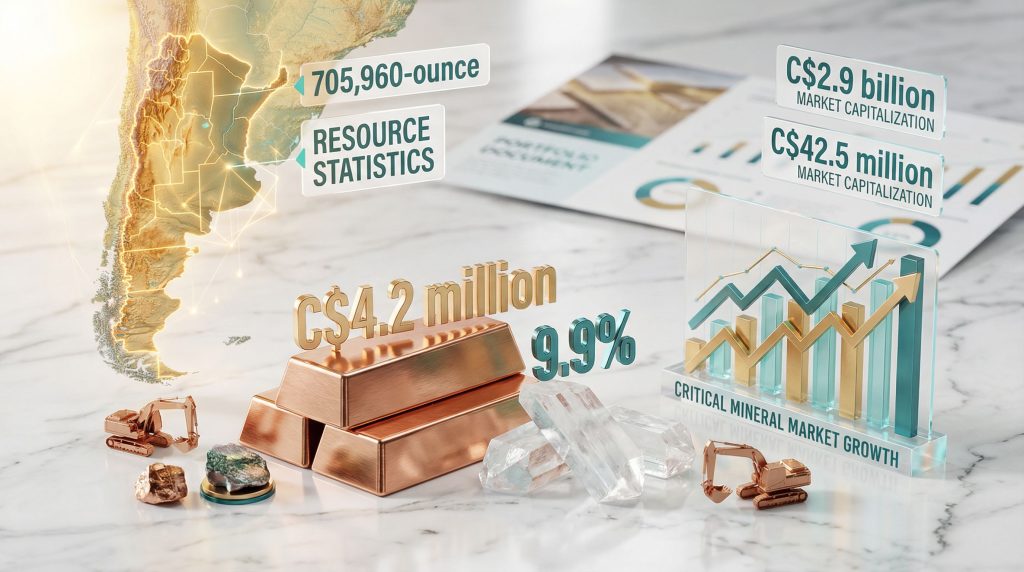
The 9.9% threshold serves multiple strategic purposes beyond simple regulatory considerations. This specific percentage typically falls below disclosure requirements that trigger enhanced reporting obligations while providing meaningful economic exposure to underlying asset performance. For instance, Altius Minerals' C$4.2 million commitment provides indirect access to Los Azules copper project (0.4% NSR royalty), Josemaría copper-molybdenum development (7% NPR royalty), Mariana lithium project (1.5% NSR royalty), and Shotgun gold property (90% equity interest).
Capital efficiency metrics strongly favour this approach over direct project investment alternatives. Replicating equivalent exposure through individual royalty purchases or direct project stakes would require substantially higher capital deployment across multiple transactions. However, the mining industry trends indicate increasing preference for such strategic minority investments.
Risk distribution characteristics favour minority equity positions in royalty-holding companies because they create natural diversification across commodity types, geographic regions, project development stages, and operator risk profiles. Consequently, the investment psychology supporting this approach recognises that operational mining carries execution risks, permitting delays, cost overruns, and technical challenges that royalty holders can largely avoid.
Strategic Positioning in Critical Mineral Supply Chains
Argentina's emergence as a critical jurisdiction for copper and lithium development creates compelling investment narratives that attract international mining capital. The country hosts significant undeveloped copper resources and operates within the lithium triangle that supplies global battery manufacturing supply chains. In addition, TNR Gold's portfolio concentration in Argentine projects provides strategic exposure to these supply chain dynamics through established royalty structures.
Portfolio theory application in mining sector diversification emphasises correlation benefits between different commodity exposures and geographic risk distribution. Moreover, copper and lithium often exhibit different price cycle timing, with copper responding to infrastructure development cycles while lithium tracks electric vehicle adoption rates and battery manufacturing capacity expansion. This temporal diversification creates potential for more stable cash flow generation across commodity cycles.
Market access considerations become particularly relevant for landlocked mining operations in Argentina, where infrastructure development and logistics coordination affect project economics. Consequently, royalty holders benefit from these infrastructure improvements without bearing direct investment costs, as operators handle transportation, processing, and marketing arrangements while royalty payments flow proportionally to production volumes.
Why Argentina's Mining Jurisdiction Attracts International Capital Flows
Argentina's mining regulatory framework demonstrates relative stability compared to other South American jurisdictions, particularly regarding foreign investment protection and mineral rights security. Furthermore, the country's established mining code provides legal frameworks that protect royalty interests and facilitate international capital deployment through structured investment vehicles. These factors contribute significantly to Argentina lithium insights and broader mining investment opportunities.
Regulatory Environment Assessment for Foreign Investors
Political risk evaluation frameworks employed by major mining companies typically assess Argentina as moderate risk within emerging market contexts. The country's membership in international investment protection agreements and established precedents for foreign mining investment create institutional confidence that supports capital deployment decisions.
Currency hedging considerations affect investment structuring, particularly regarding Argentine Peso exposure versus Canadian Dollar reporting currency. However, the transaction structure utilising TNR Gold as a Canadian-domiciled holding company creates natural currency hedging, as royalty payments denominated in US Dollars flow through CAD-reporting entities, reducing direct ARS exposure while maintaining underlying commodity price sensitivity.
Comparative analysis across South American mining jurisdictions suggests Argentina offers competitive advantages in permitting predictability, infrastructure access, and established mining service provider networks. These operational advantages reduce execution risks for project operators, which indirectly benefits royalty holders through improved project development probability and timeline predictability.
Resource Quality and Scale Factors in Investment Decision-Making
Geological assessment criteria emphasise the significant scale characteristics of Argentine copper and lithium deposits that support long-term production profiles. For instance, Los Azules represents one of Argentina's largest undeveloped copper resources, while the Mariana lithium project operates within established lithium production regions with proven processing technologies and export infrastructure.
Infrastructure development impact on project valuations becomes particularly pronounced in remote mining regions where operators must invest in power generation, water supply systems, and transportation networks. Furthermore, these infrastructure investments create lasting value that benefits subsequent production phases and can support expanded operations or additional project development within mining districts.
The following table illustrates the strategic asset portfolio that attracted the Altius Minerals investment in TNR Gold:
| Project | Operator | Commodity | Royalty Type | Stage |
|---|---|---|---|---|
| Los Azules | McEwen Mining | Copper | 0.4% NSR | Development |
| Josemaría | Lundin/BHP Joint Venture | Copper/Molybdenum | 7% NPR | Development |
| Mariana | Ganfeng Lithium | Lithium | 1.5% NSR | Development |
| Shotgun | TNR Gold | Gold | 90% Equity | Exploration |
How Royalty Streaming Models Transform Mining Investment Psychology
Cash flow predictability represents a fundamental attraction of royalty streaming models compared to direct mining operations that face volatile operating cost structures, technical challenges, and capital expenditure requirements. Moreover, royalty structures create revenue streams that correlate directly with commodity prices and production volumes while eliminating exposure to operational cost inflation, labour disputes, equipment failures, and regulatory compliance costs.
Cash Flow Predictability in Volatile Commodity Markets
Net Smelter Royalty (NSR) structures provide revenue calculation transparency that appeals to investors seeking predictable cash flow modelling. The 0.4% NSR on Los Azules and 1.5% NSR on Mariana create direct correlations between commodity price movements and royalty income without operational cost variables affecting payment calculations.
Net Profit Royalty (NPR) arrangements, such as the 7% NPR on Josemaría properties, defer revenue generation until projects achieve sustained profitability but offer potentially higher percentage returns on successful operations. However, this structure requires more complex cash flow modelling but provides significant upside participation in highly profitable mining operations.
Investor preference patterns increasingly favour passive income streams that require minimal management attention while providing commodity price exposure. Consequently, the psychological appeal of royalty investments stems from their similarity to dividend-paying stocks combined with commodity price sensitivity that offers inflation protection and economic cycle diversification.
Capital Allocation Efficiency in Mining Portfolio Construction
Comparative analysis demonstrates substantial capital efficiency advantages for royalty-linked equity investments versus direct mining project development. The C$4.2 million investment provides proportional exposure to multiple large-scale mining projects that would require hundreds of millions in direct development capital. This approach aligns with broader investment strategy components in modern portfolio construction.
Portfolio optimisation theory applications suggest that royalty investments offer superior risk-adjusted returns through reduced operational risk, enhanced liquidity (through public equity markets), and diversification across multiple projects and operators. These characteristics make royalty-linked equity particularly attractive for institutional investors managing large capital pools across multiple asset classes.
Liquidity considerations strongly favour publicly-traded royalty companies over direct project investments or private royalty purchases. In addition, TNR Gold's public listing provides daily liquidity options that allow position sizing adjustments based on market conditions or portfolio rebalancing requirements. This liquidity premium becomes particularly valuable during commodity cycle transitions when rapid position adjustments may be necessary.
What Market Signals Emerge from Premium Valuation Transactions?
The transaction pricing at C$0.1775 per share based on 30-day volume-weighted average pricing methodology demonstrates institutional-grade valuation discipline while providing TNR Gold with capital at current market rates. Furthermore, this pricing approach signals serious strategic intent rather than opportunistic investment, as it reflects sustained market trading patterns rather than short-term price movements.
Share Price Analysis and Market Sentiment Indicators
Market capitalisation disparities between Altius Minerals (C$2.9 billion) and TNR Gold (C$42.5 million) create interesting strategic dynamics. The 68x size differential suggests TNR Gold represents a minor allocation for Altius while providing significant capital infusion for the smaller company's development activities. This demonstrates how Altius has acquired a strategic position in the junior mining company.
Volume-weighted average pricing methodology indicates sophisticated institutional transaction structuring that considers market liquidity constraints and price impact minimisation. This approach demonstrates professional investment practices that avoid market manipulation concerns while ensuring fair value realisation for both parties.
The capital injection of C$4.2 million represents 9.88% of TNR Gold's total market capitalisation, providing substantial working capital for corporate development initiatives without creating excessive dilution for existing shareholders. TNR Gold has secured strategic investment that suggests strategic growth funding rather than distressed financing circumstances.
Corporate Development Strategy Implications
Working capital injection impact enables TNR Gold to pursue additional royalty acquisitions, expand existing project monitoring capabilities, or investigate new strategic partnerships without immediate financing pressures. According to company communications, these funds will support potential corporate development initiatives and general working capital requirements.
Strategic partnership formation creates potential for future collaboration between Altius and TNR Gold on additional royalty opportunities or project evaluation activities. The relationship establishes institutional knowledge sharing that could benefit both companies' strategic development activities.
Market validation effects from established royalty companies investing in smaller players typically increase institutional investor confidence and may attract additional strategic interest from other major mining companies seeking similar portfolio diversification opportunities. This trend reflects broader mining consolidation trends across the sector.
How Multi-Commodity Exposure Creates Investment Synergies
Critical mineral portfolio diversification across copper, lithium, and gold creates natural hedging characteristics that reduce overall portfolio volatility while maintaining exposure to multiple commodity super-cycles. Each metal responds to different economic drivers, creating potential for more consistent cash flow generation across varying market conditions.
Critical Mineral Portfolio Diversification Strategies
Copper-lithium correlation analysis reveals generally positive but imperfect correlation patterns that provide diversification benefits within the critical minerals category. Copper demand stems primarily from infrastructure development, industrial applications, and renewable energy installations, while lithium demand concentrates in battery manufacturing for electric vehicles and energy storage systems.
Geographic risk distribution across Argentina (three royalty positions) and Alaska (one equity position) provides currency diversification and political risk mitigation. This geographic spread reduces concentration risk while maintaining focus within established mining jurisdictions with favourable regulatory environments.
Commodity cycle timing considerations suggest that copper and lithium may experience different peak demand periods, with copper benefiting from infrastructure investment cycles while lithium tracks electric vehicle adoption curves and battery technology advancement. Consequently, this temporal diversification creates opportunities for more stable aggregate returns.
Resource Estimation Methodologies and Investment Confidence
The Shotgun project's 705,960-ounce gold resource (inferred category) demonstrates TNR Gold's capability in resource development beyond royalty management. Inferred resources carry higher uncertainty but provide significant upside potential if advanced to measured and indicated categories through additional exploration and development work.
Technical risk assessment varies significantly between royalty positions and direct equity interests. Royalty holders face limited technical risk as operators assume responsibility for resource development, production optimisation, and technical problem resolution. However, direct equity positions like Shotgun carry full technical risk but offer greater upside participation in successful development scenarios.
Investment confidence metrics typically weight royalty positions more heavily than early-stage exploration assets due to their lower execution risk profiles. The portfolio combination provides balanced exposure between established royalty income potential and exploration upside opportunity.
The next major ASX story will hit our subscribers first
What Long-Term Market Positioning Strategies Drive Consolidation Activity?
Industry consolidation trends indicate increasing concentration among major royalty companies as they acquire strategic positions in smaller royalty holders or development-stage companies with attractive asset portfolios. Furthermore, this consolidation activity reflects the limited availability of high-quality royalty opportunities and the competitive advantages that scale provides in deal flow access and capital deployment.
Industry Consolidation Trends in Royalty Streaming Sector
Market share concentration analysis shows major royalty companies increasingly dominating deal flow through established relationships with mining operators and superior capital deployment capabilities. Smaller companies like TNR Gold benefit from these relationships through strategic investments that provide growth capital and institutional credibility.
Competitive positioning through strategic minority investments allows major royalty companies to maintain deal flow relationships while providing growth capital to promising junior companies. This strategy creates potential acquisition pathways while supporting market development and new royalty creation.
Vertical integration considerations suggest that major royalty companies may eventually acquire successful junior royalty companies entirely, particularly those with proven management teams and attractive asset portfolios. The current minority investment creates optionality for future control transactions if TNR Gold's assets perform well.
Future Growth Catalyst Identification and Valuation
Project development timeline analysis suggests that TNR Gold's three Argentine royalty positions could begin generating cash flows within similar timeframes, creating potential for rapid revenue growth as multiple projects reach production simultaneously. This clustering effect could significantly enhance per-share cash flow generation.
Production ramp-up scenarios for Los Azules, Josemaría, and Mariana projects depend on operator capital deployment schedules and commodity price environments. Strong copper and lithium prices provide incentives for accelerated development, while weak prices may delay final investment decisions and extend development timelines.
Market expansion opportunities exist through additional royalty acquisitions in critical mineral projects, particularly as more operators seek royalty financing for project development. TNR Gold's established relationships and institutional backing position the company favourably for future deal flow participation.
How Investment Timing Reflects Market Cycle Psychology
Counter-cyclical investment strategies often produce superior long-term returns in mining sector investments, as asset prices typically decline during commodity price weakness while underlying asset quality remains unchanged. The current investment timing reflects confidence in long-term critical mineral demand growth despite near-term market volatility.
Commodity Price Cycle Positioning in Strategic Investments
Commodity price cycle analysis suggests current copper and lithium prices reflect moderate levels within historical ranges, providing reasonable entry points for long-term strategic investments. Neither commodity currently trades at extreme high or low levels that would indicate obvious timing advantages or disadvantages.
Market sentiment indicators show increasing institutional interest in critical mineral exposure as energy transition policies create structural demand growth expectations. This sentiment shift supports strategic investment timing as institutional capital allocation gradually increases toward critical mineral assets.
Macroeconomic factors including inflation expectations, infrastructure spending programmes, and energy transition policies create favourable long-term demand outlook for copper and lithium. These factors support strategic investment timing despite potential near-term volatility in commodity markets.
Capital Market Access and Funding Strategy Optimisation
Public market liquidity advantages favour investment in publicly-traded companies like TNR Gold over private royalty transactions or direct project investments. Public markets provide continuous valuation feedback and exit liquidity that enhances investment flexibility and portfolio management options.
Alternative financing mechanisms for mining project development increasingly include royalty financing as operators seek to reduce dilutive equity financing and expensive debt arrangements. This trend creates growing opportunities for royalty companies and supports long-term sector growth.
Strategic investor participation patterns show increasing involvement by major mining companies in junior company financing as they seek portfolio diversification without operational complexity. This trend validates the investment approach demonstrated by the Altius Minerals investment in TNR Gold.
Investment Performance Metrics and Comparative Analysis
| Investment Metric | Royalty-Linked Equity | Direct Mining Operation | Pure Royalty Stream |
|---|---|---|---|
| Capital Requirements | Low-Medium (C$4.2M) | Very High (>C$500M) | Medium (C$50-200M) |
| Operational Risk | Minimal | Maximum | Low |
| Revenue Predictability | Variable | Cyclical | Stable |
| Liquidity | High (Public Trading) | Low (Private Asset) | Medium (Fund Structures) |
| Diversification Benefit | High (Multi-Project) | Low (Single Asset) | Medium (Project-Specific) |
| Management Burden | None | Maximum | Minimal |
Performance comparison analysis demonstrates clear advantages for royalty-linked equity investments in terms of capital efficiency, risk management, and liquidity provision. These structural advantages explain institutional investor preference for this investment category over direct mining operations or private royalty purchases.
Market Outlook and Strategic Implications for Mining Investment Strategies
Critical mineral supply chain security considerations increasingly influence government policy development and institutional investment allocation decisions. The strategic importance of copper and lithium for energy transition initiatives creates supportive policy environments that benefit long-term investment prospects for well-positioned royalty companies.
Critical Mineral Supply Chain Security Considerations
Government policy frameworks increasingly recognise critical mineral supply chain vulnerabilities and implement policies that support domestic production capabilities. These policy developments create favourable operating environments for mining projects in stable jurisdictions like Argentina and Canada.
Strategic resource classification effects on international investment flows demonstrate increasing institutional focus on assets that support energy transition and infrastructure development objectives. This classification creates additional investment demand that supports premium valuations for well-positioned critical mineral assets.
Supply chain resilience factors drive institutional investment toward geographically diversified critical mineral portfolios that reduce concentration risk in any single jurisdiction or operator. TNR Gold's portfolio structure provides this diversification through multiple projects and operators across different regions.
Technology Transition Impact on Mining Asset Valuations
Electric vehicle adoption projections continue supporting long-term lithium demand growth expectations despite periodic market volatility caused by technology changes and supply expansion. Structural demand growth from battery manufacturing capacity expansion underpins positive long-term investment outlook.
Renewable energy infrastructure requirements create sustained copper demand growth expectations that support positive long-term price outlook for copper-exposed royalty positions. Grid modernisation, wind turbine installation, and solar panel manufacturing all require significant copper input.
Battery technology evolution considerations suggest that while specific battery chemistries may change over time, lithium's role in energy storage applications appears secure for the foreseeable future. This technology stability supports long-term investment confidence in lithium-exposed assets.
Please note that all investment decisions carry risk, and past performance does not guarantee future results. Commodity prices are subject to significant volatility, and mining investments involve operational, regulatory, and market risks that can affect returns. This analysis is for informational purposes only and should not be considered investment advice.
Ready to Capitalise on the Next Major Mineral Discovery?
Discovery Alert's proprietary Discovery IQ model delivers instant notifications on significant ASX mineral discoveries, transforming complex geological data into actionable investment opportunities for both short-term traders and long-term investors. Understand why major mineral discoveries can generate substantial returns by exploring historical examples, then begin your 14-day free trial to position yourself ahead of the market with real-time alerts powered by advanced AI technology.