May 12, 2026
Strategic Supply Chain Vulnerabilities Drive Industrial Nations Toward New Energy Architectures
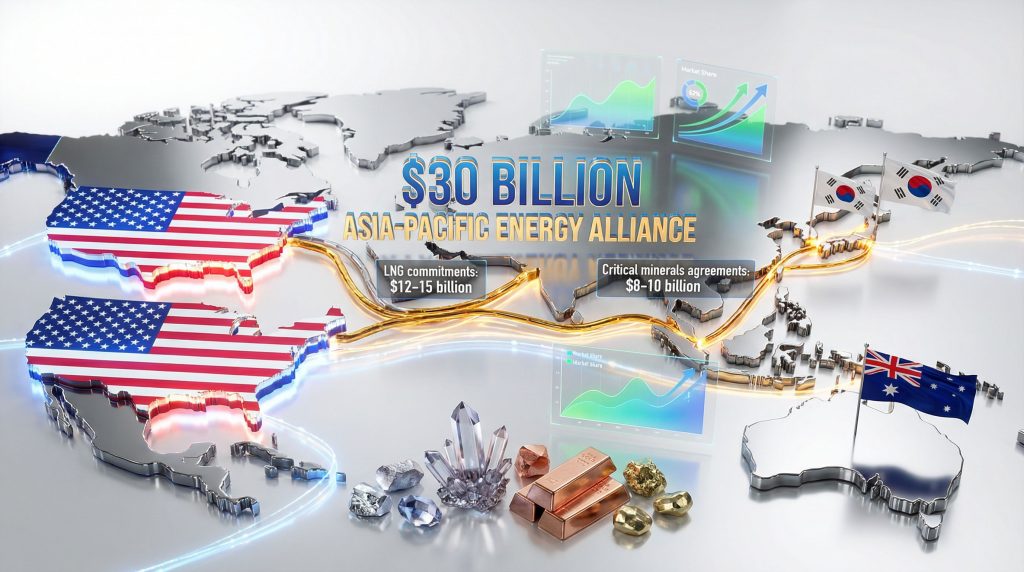
Industrial supply chains face unprecedented vulnerabilities as traditional energy dependencies expose critical weaknesses in manufacturing, technology, and defence sectors. Asia set to pledge $30 billion in energy and mineral deals with US represents a fundamental shift in regional resource procurement strategies. The Asia-Pacific region's accelerating shift toward diversified sourcing reflects deeper strategic calculations beyond simple market transactions. Regional powers are recalibrating their resource procurement strategies to address supply chain fragilities revealed through recent geopolitical disruptions and trade conflicts.
Contemporary commodity markets demonstrate the volatility inherent in concentrated supply arrangements. Copper prices at $5.78 per pound with daily fluctuations exceeding 0.80%, combined with natural gas trading at $3.153 per BTU amid 3.04% declines, illustrate the price instability that drives long-term strategic partnerships. Furthermore, the US natural gas forecast suggests continued volatility that makes these agreements particularly attractive. These market conditions create compelling economic incentives for multi-decade contractual frameworks that prioritise supply security over spot market optimisation.
The emergence of comprehensive energy and mineral partnerships represents a fundamental shift from traditional procurement models toward integrated strategic alliances. Industrial nations increasingly recognise that energy security and critical mineral access constitute essential components of national competitiveness in technology-intensive economies. In addition, the critical minerals transition extends beyond conventional energy transactions to encompass rare earth elements, battery materials, and advanced manufacturing inputs required for semiconductor production and renewable energy infrastructure.
When big ASX news breaks, our subscribers know first
Geopolitical Calculations Behind Resource Partnership Architecture
Regional Security Frameworks Drive Alliance Formation
The timing of major energy partnerships correlates directly with diplomatic initiatives across the Asia-Pacific region. Japanese Prime Minister Sanae Takaichi's March 19, 2026 Washington visit precedes planned bilateral discussions between the United States and China by approximately three weeks, indicating careful sequencing of strategic announcements to maximise diplomatic leverage.
Regional supply chain disruptions have accelerated partnership formation beyond normal commercial timelines. The suspension of liquefied natural gas exports from Qatar's state-owned energy company, historically considered the world's most reliable supplier, demonstrated the risks of concentrated sourcing arrangements. This disruption created immediate commercial opportunities for alternative suppliers while highlighting structural vulnerabilities in single-source dependency models.
Trade conflicts between major economies have further emphasised the strategic importance of diversified supply chains. The Trump administration's response to halted material flows from China during previous trade disputes included direct equity acquisitions in mineral companies, representing a shift from traditional procurement toward ownership-based supply assurance mechanisms. The tariff impact analysis shows how these trade tensions accelerate partnership formation.
Economic Drivers of Large-Scale Commitment Structures
Projected Partnership Breakdown by Sector:
| Sector | Estimated Value | Strategic Priority |
|---|---|---|
| LNG commitments | $12-15 billion | Regional energy security |
| Critical minerals | $8-10 billion | Technology supply chains |
| Traditional energy | $5-7 billion | Manufacturing inputs |
| Nuclear partnerships | $3-5 billion | Advanced technology transfer |
The scale of commitments reflects the magnitude of supply chain restructuring required to achieve meaningful diversification. South Korea's Hanwha Corporation subsidiary has committed to a 20-year agreement for 1.5 million tons of LNG annually from Venture Global Inc., exemplifying the long-term contractual frameworks emerging across the region.
Multi-decade agreements represent a departure from traditional spot market transactions toward strategic partnership models. These arrangements combine commercial transactions with technology transfer, infrastructure development, and diplomatic cooperation, creating integrated frameworks that extend beyond simple commodity purchases. Moreover, Asian nations are positioning themselves strategically to secure long-term supply arrangements.
Critical Mineral Dependencies and Supply Chain Transformation
Battery Technology and Energy Storage Requirements
Lithium processing capacity represents a critical bottleneck in electric vehicle and energy storage supply chains. Regional partnerships increasingly focus on refining and processing capabilities rather than raw material extraction alone, recognising that value-added processing determines supply chain control. The development of battery-grade lithium refinery facilities demonstrates this strategic focus.
Cobalt sourcing has become particularly strategic due to geographic concentration in politically unstable regions. Alternative supply arrangements with trusted partners provide risk mitigation for battery manufacturers facing volatile sourcing conditions in traditional supplier markets.
Rare earth element partnerships target reduced dependence on single-source suppliers. The complexity of rare earth processing, requiring specialised expertise and environmental management capabilities, creates opportunities for technology transfer agreements that combine commercial transactions with technical cooperation.
Advanced Manufacturing and Defence Applications
Strategic Materials in Focus:
Copper for electrical infrastructure expansion, titanium for aerospace manufacturing, and rare earth elements for advanced electronics represent the foundation of technological sovereignty initiatives across allied nations.
Semiconductor manufacturing requires increasingly specialised materials as chip architectures advance. Silicon and germanium supply chains face particular scrutiny as artificial intelligence and quantum computing applications drive demand for higher-purity materials. The copper uranium investment opportunities reflect this growing demand for strategic materials.
Defence applications create additional sourcing requirements for materials meeting stringent quality and security standards. These specialised markets often require dedicated supply chains separate from commercial applications, driving demand for trusted supplier relationships.
Historical Context and Precedent Analysis
Comparative Scale of Energy Partnership Agreements
Previous bilateral energy frameworks provide context for evaluating current commitments:
- 2019 US-Japan LNG Framework: $10 billion commitment over five years
- 2021 Australia-India Critical Minerals Partnership: $2.5 billion strategic arrangement
- 2025 Canada-US Strategic Minerals Initiative: $8 billion cooperation framework
The $30 billion Asia-Pacific commitment substantially exceeds historical precedents in both scale and scope. Unlike previous agreements focused on single commodities or bilateral relationships, current partnerships encompass multiple sectors across regional alliance networks. As reported by Business Times, Asia set to pledge $30 billion in energy and mineral deals with US represents the largest such arrangement to date.
Investment Structure Evolution and Financing Mechanisms
Contemporary agreements increasingly utilise government-backed financing mechanisms combining diplomatic, trade, and financial institutions. The involvement of cabinet-level departments, the National Energy Dominance Council, the US Trade and Development Agency, and the Export-Import Bank demonstrates institutional coordination beyond traditional commercial arrangements.
Risk-sharing models address commodity market volatility through long-term pricing mechanisms and supply guarantees. These structures provide greater certainty for both suppliers and purchasers while creating frameworks for infrastructure investment and capacity expansion.
Equity participation models represent an evolution from traditional purchase agreements. Direct ownership stakes in mineral companies provide supply assurance while creating shared interests in operational success and technological advancement.
Regional Power Dynamic Implications and Strategic Responses
China's Position in Evolving Supply Networks
Supply chain diversification initiatives create strategic challenges for China's position in regional energy and mineral markets. The emphasis on partnerships with "friends and allies" explicitly contrasts with dependency on "adversaries," though public statements limit direct references to specific nations.
China's response strategies may include enhanced offerings to Southeast Asian partners and Belt and Road Initiative modifications. However, as of March 2026, no official Chinese counter-initiatives have been announced in response to the Asia-Pacific partnership framework.
Alternative partnership development represents a potential Chinese strategy for maintaining regional influence. Historical patterns suggest competitive responses through enhanced financial offerings and accelerated infrastructure development in contested markets.
Australia's Enhanced Role as Regional Energy Hub
Australia's participation in the 18-nation Tokyo forum positions the country as a critical link between Asia-Pacific demand centres and diversified supply sources. Australia's dual role as both LNG exporter and critical minerals producer creates unique opportunities for integrated supply arrangements.
Strategic triangle formation between the United States, Japan, and Australia establishes a framework for coordinated regional sourcing strategies. This arrangement combines Australian resource capacity, Japanese demand, and US market access to create comprehensive supply security.
Enhanced processing capacity development in Australia could provide regional refining capabilities for critical minerals, reducing dependence on Chinese processing facilities while creating value-added opportunities for Australian industry.
Frequently Asked Questions: Regional Impact Analysis
Q: How will South Korea's participation affect regional energy pricing?
A: South Korea's commitment to long-term LNG contracts provides pricing stability while creating competition for traditional regional suppliers. The 20-year Hanwha agreement structure suggests movement toward fixed-price mechanisms that reduce spot market volatility.
Q: What implications exist for existing Japan-China energy relationships?
A: Diversification strategies complement rather than replace existing relationships, creating competitive pressure that may result in improved terms from all suppliers. Japan's approach emphasises supply security through multiple sourcing channels.
Q: How do these partnerships affect smaller regional economies?
A: The 18-nation participation framework includes Bangladesh and other developing economies, suggesting opportunities for technology transfer and infrastructure development beyond major industrial powers.
Industrial Sector Transformation and Market Impact
Steel and Manufacturing Supply Chain Restructuring
Coking coal supply arrangements represent critical inputs for steel production across the Asia-Pacific region. Long-term contracts provide price predictability while ensuring adequate supply for manufacturing operations requiring consistent raw material quality.
Iron ore trade patterns face modification as integrated supply agreements create new sourcing relationships. The combination of coking coal and iron ore agreements within comprehensive partnerships may alter traditional supplier relationships and pricing mechanisms.
Manufacturing cost structures benefit from supply predictability even if absolute prices remain elevated. The certainty provided by long-term agreements enables more accurate production planning and capital investment decisions.
Technology Sector Supply Chain Security Enhancement
Semiconductor manufacturing inputs achieve greater supply reliability through diversified sourcing arrangements. Critical materials for advanced chip production require consistent quality and availability that spot market purchases cannot guarantee.
Electric vehicle battery supply chains gain resilience through lithium, nickel, and cobalt sourcing agreements. The integration of mining, processing, and manufacturing within partnership frameworks creates more robust supply networks for growing EV markets.
Renewable energy component sourcing benefits from comprehensive mineral agreements covering solar panel, wind turbine, and energy storage system materials. These arrangements support clean energy transition goals while maintaining supply security.
Case Study: South Korea's Hanwha LNG Framework
- Annual Volume: 1.5 million tons from Venture Global Inc.
- Contract Duration: 20-year agreement structure
- Strategic Significance: Demonstrates long-term commitment model for regional supply security
- Price Mechanism: Long-term pricing provides stability against spot market volatility
- Infrastructure Impact: Requires expanded LNG terminal capacity and distribution networks
The next major ASX story will hit our subscribers first
Long-Term Economic Scenarios and Implementation Pathways
Scenario Analysis for Partnership Success Rates
Full Implementation Success (Estimated 70% probability):
- Regional energy prices stabilise 15-20% below current volatility ranges
- US energy export capacity increases by 25% within three years
- Asia-Pacific reduces Chinese energy dependence by approximately 30%
- Infrastructure development accelerates across participating nations
Partial Implementation with Structural Delays (Estimated 25% probability):
- Infrastructure bottlenecks limit execution to 60% of planned capacity
- Commodity price fluctuations affect long-term contract viability
- Political transitions in participating countries modify agreement terms
- Supply chain disruptions delay infrastructure completion timelines
Geopolitical Disruption Scenario (Estimated 5% probability):
- Major regional conflict derails partnership implementation
- Trade war escalation affects multilateral cooperation frameworks
- Alternative alliance structures emerge to address security concerns
- Energy security priorities override economic optimisation goals
Infrastructure Development Requirements and Investment Opportunities
Port facility expansions across the Asia-Pacific region require substantial capital investment to accommodate increased commodity flows. Existing terminals lack capacity for projected volume increases, creating opportunities for infrastructure development partnerships.
Pipeline and processing plant construction needs extend beyond traditional energy infrastructure to include critical mineral refining facilities. These projects require specialised technology and environmental management capabilities that favour experienced international partners.
Transportation network optimisation involves both maritime shipping and overland distribution systems. Integrated logistics planning becomes essential for maximising efficiency across extended supply chains spanning multiple continents.
Global Commodity Market Restructuring Effects
LNG Market Structural Evolution
Qatar's traditional market dominance in the Asia-Pacific region faces erosion as alternative suppliers gain long-term contract commitments. The suspension of Qatari LNG exports during Middle East conflicts demonstrated supply vulnerability and created commercial opportunities for competitors.
US export terminal capacity expansion becomes essential for meeting increased Asian demand. Existing facilities require upgrades while new terminals need development to handle projected volume increases from partnership agreements.
Shipping route optimisation and infrastructure investments modify global LNG transportation patterns. Traditional Middle East to Asia routes face competition from North American suppliers utilising different shipping lanes and terminal facilities.
Critical Minerals Market Share Redistribution
Projected Market Share Evolution by 2030:
| Market Segment | Current Share | Projected Change | Strategic Impact |
|---|---|---|---|
| US critical minerals exports to Asia | 15% | +150% increase | Reduced Chinese dominance |
| Chinese rare earth market control | 85% | -15% reduction | Increased competition |
| Regional processing capacity | 25% | +200% expansion | Enhanced value addition |
Chinese market dominance in rare earth elements faces systematic reduction through alternative supplier development. While China retains processing advantages, new partnerships create competitive pressure and supply alternatives.
Regional processing capacity expansion reduces dependence on Chinese refining facilities while creating value-added opportunities in partner countries. Technology transfer agreements enable development of specialised processing capabilities outside traditional supplier networks.
Coal Market Transition and Environmental Considerations
High-quality coking coal demand remains strong despite renewable energy transitions, driven by steel production requirements that lack immediate alternatives. Long-term agreements provide supply security for essential manufacturing processes.
Environmental compliance requirements increasingly influence trade flow patterns as carbon pricing mechanisms affect transportation costs and supplier selection. Cleaner production methods and shorter shipping distances may provide competitive advantages.
Carbon pricing integration into partnership structures creates incentives for efficiency improvements and technology development. These mechanisms may accelerate adoption of cleaner production technologies across supply chains.
Investment Risk Assessment and Strategic Positioning
Infrastructure Investment Risk Mitigation Strategies
Currency hedging becomes essential for multi-year agreements spanning different economic zones. Exchange rate fluctuations over 20-year contract periods require sophisticated financial risk management approaches.
Political risk insurance provides protection for cross-border energy investments facing potential policy changes or geopolitical disruptions. Specialised coverage addresses supply agreement enforcement and infrastructure asset protection.
Technology obsolescence protection requires flexible contract terms accommodating evolving energy technologies and efficiency improvements. Partnership agreements must balance long-term commitments with technological adaptation capabilities.
Strategic Investment Perspective:
The $30 billion commitment framework represents fundamental restructuring of global energy and mineral supply networks that extends beyond bilateral trade relationships. Secondary investment opportunities across infrastructure, technology, and logistics sectors may generate an additional $50-75 billion in related development projects.
Performance Measurement and Success Metrics
Supply chain diversification percentages provide quantifiable measures of strategic success. Target reductions in single-source dependencies enable objective assessment of partnership effectiveness.
Regional energy price volatility reduction offers measurable economic benefits from improved supply security. Price stability metrics demonstrate the value of long-term agreements over spot market dependence.
Strategic mineral reserve accumulation targets ensure adequate stockpiles for economic security during potential supply disruptions. Reserve levels provide buffers against market manipulation or geopolitical conflicts.
Implementation Timeline and Critical Milestones
Phase-Based Development Approach
Q2 2026: Initial infrastructure investment commitments and financing arrangements
- Project feasibility studies completion
- Environmental impact assessments initiation
- Regulatory approval processes commencement
- Technology transfer agreement finalisation
Q4 2026: First major shipment deliveries and operational capacity establishment
- Initial LNG delivery commencement
- Critical minerals processing facility startup
- Quality assurance protocol implementation
- Supply chain logistics optimisation
2027-2028: Full-scale operational capacity achievement and optimisation
- Maximum throughput capacity utilisation
- Cost efficiency target achievement
- Alternative supplier integration completion
- Strategic reserve accumulation goals attainment
The success of these comprehensive energy and mineral partnerships will ultimately depend on sustained political commitment, infrastructure development execution, and market adaptation to evolving supply chain architectures. Regional allies demonstrate recognition that energy security constitutes a fundamental component of economic competitiveness in an increasingly complex global environment.
Important Disclaimer: This analysis contains forward-looking assessments based on announced partnerships and historical precedents. Actual implementation results may vary significantly due to economic, political, and technological factors beyond current forecasting capabilities. Investment decisions should incorporate comprehensive due diligence and professional financial guidance appropriate to specific circumstances and risk tolerance levels.
Seeking Investment Opportunities in Strategic Commodity Markets?
Discovery Alert's proprietary Discovery IQ model provides instant notifications on significant ASX mineral discoveries, particularly in critical minerals sectors driving these historic energy partnerships. Understand why major mineral discoveries can lead to substantial market returns by exploring Discovery Alert's dedicated discoveries page, showcasing historic examples of exceptional outcomes, and begin your 14-day free trial today to position yourself ahead of the market.